Progressing Without a Barbell
Barbells are excellent tools and terrible gatekeepers. This page sets out six measurable levers — load, reps, range of motion, tempo, unilateral work, and density — that keep home training progressing without a single plate, and the logging discipline that makes the progress visible. It is the engine room of the home strength plan: the answer to "what do I add next week?"
What the evidence supports
- Low-load and high-load training produce broadly similar strength and size gains when sets are taken close to failure (Schoenfeld 2017).
- Slower, controlled tempos produce meaningful strength and hypertrophy responses in the review literature (Wilk 2021).
- Reps-in-reserve self-regulation tracks objective effort well enough to guide loading (Helms 2016).
What remains uncertain
- Whether the levers stack additively — tempo plus range plus density in one program — has no direct trial; the reviews isolate one variable at a time.
- How much unilateral work contributes beyond its load effect is inferred from neighboring studies, not measured head-to-head at home.
Evidence last reviewed: August 20, 2026. Conclusions may change as new research is published.
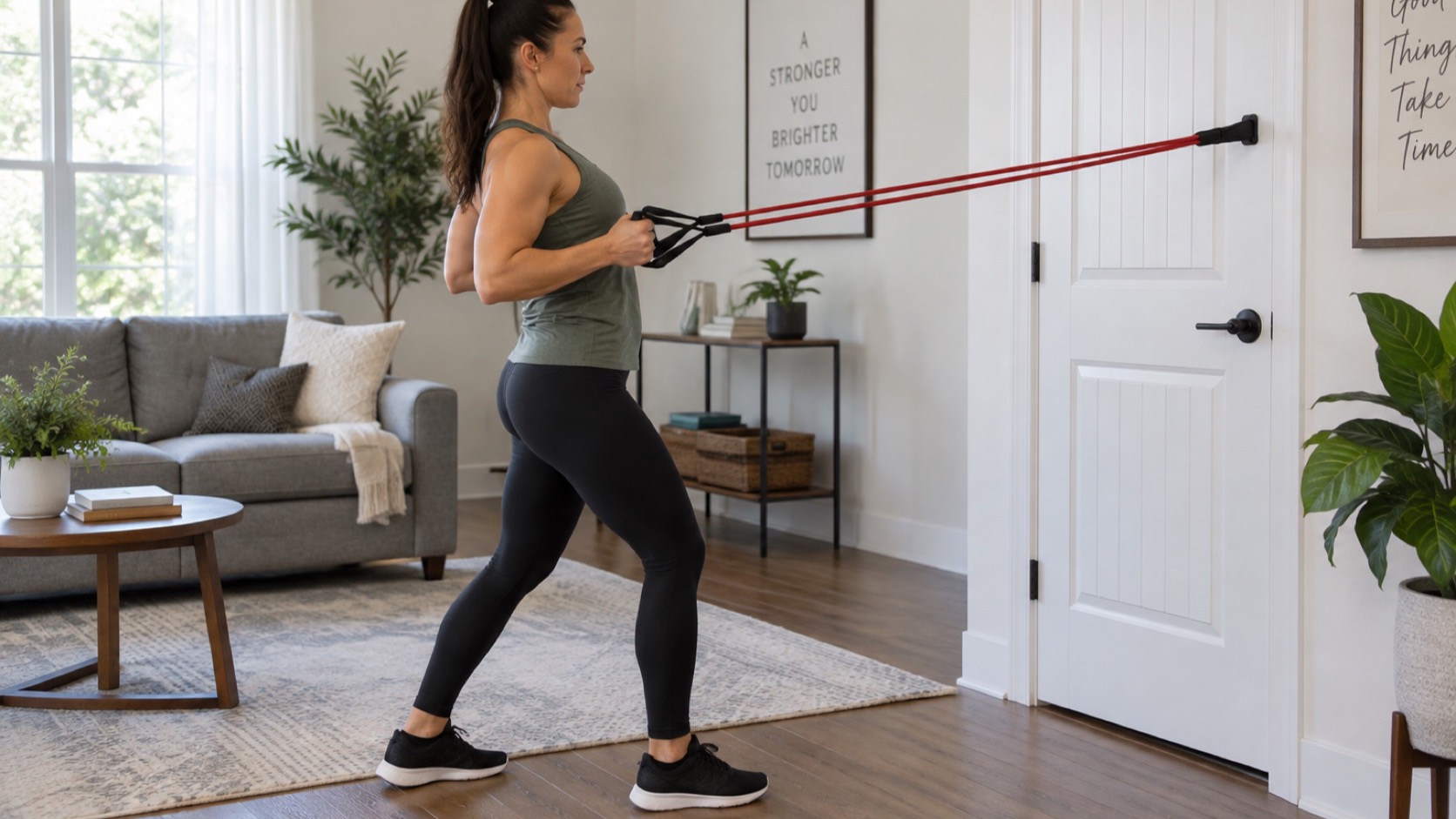
The Barbell Is a Convenience, Not a Requirement
The barbell's real advantage is granular loading — 2.5 kg steps, precisely repeatable, easy to log. But progression is a property of the program, not the implement. The overload principle page explains the mechanism; this page lists the levers a home lifter can pull without a bar in the room.
- 🏋️ The barbell compresses several levers into one — load and range arrive together — but each lever has a workable home-training equivalent.
- 📊 The strength literature does not require bars — low-load and high-load training produce similar gains when sets are taken near failure (Schoenfeld 2017).
- 🧠 The real gatekeeper is the log — if the log shows progress, the tool is working; the tracking the load page owns the bookkeeping.
- 🪜 Progress without plates is the norm, not the exception — the equipment ladder exists precisely because most lifters never touch a barbell.
Product picks are generic categories, not brands. We may earn a commission on Amazon or iHerb purchases at no cost to you — this never changes our evidence conclusions. Full disclosure
Adjustable dumbbells
Allows progressive loading at home across common strength movements.
⚠️ Poor technique or rapid load increases raise injury risk; not required to begin moving more.
Check price on Amazon →The Six Levers at a Glance
- 🏋️ Load — weight, band tension, or added bodyweight from a backpack or vest.
- 🔢 Reps — climbing the rep target within a range before touching the load.
- 📐 Range of motion — deeper or longer-lever versions of the same pattern.
- ⏱️ Tempo — slower lowering phases and pauses under tension.
- 🦵 Unilateral work — single-limb versions that raise the relative load on each side.
- ⏳ Density — more work in the same minutes via shorter rests.
Each lever is measurable in a notebook, which is the point: progress you cannot record is progress you cannot trust. The sections below walk the first three levers in detail and group the last three.
Lever One: Load
Load is the loudest lever. Bands add tension with stretch, dumbbells add discrete weight, and a backpack adds bodyweight — all of it loggable, none of it a barbell.
- 🎗️ Bands climb in stiffness steps — a stiffer band is a load increase, logged as band color or tension rating rather than kilograms.
- 🏋️ Dumbbells give the finest steps — the 2.5 Rule page explains why the smallest repeatable step keeps the engine running.
- 🎒 A loaded backpack is a free load cell — books, water jugs, sand; it scales the push, squat, and carry patterns without new gear.
- 🧮 Bands plus dumbbells mix cleanly — a banded push-up with a loaded backpack is a legible log entry, even if the numbers are homemade.
- 🔁 Double progression is the home engine — add reps first, then load, then repeat; the double progression page runs the loop in detail.
Lever Two: Reps and Proximity to Failure
When load cannot climb, reps can — and rep targets are ranges, not fixed numbers. The rep continuum page owns the range logic; the point here is how the lever works at home.
- 🔢 Climb the range before you climb the weight — eight clean reps become twelve, then the load steps up and the range resets.
- 🫁 Proximity is the variable that matters — sets taken close to failure drive most of the signal; the RPE page gives the honest way to gauge it.
- 📉 Leave one or two reps in reserve on most sets — the 40 Loading Rules page caps the hard sets per session for a reason.
- ✏️ Reps are the easiest lever to fake and the easiest to log — a count is a count; write it down and the lever works.
Lever Three: Range of Motion
Range is a lever because it changes the length a muscle works through and the leverage of the movement. Deeper versions are harder at the same external load — which makes depth a progression.
- 📐 Depth markers make range measurable — a chair height for squats, a towel roll under the chest for push-ups.
- 🪜 Lever-length progressions are the classic version — incline push-ups to floor push-ups; hands-elevated rows to feet-elevated rows.
- 🧘 Paused reps in the stretched position — a two-second pause at depth adds stimulus without adding weight, consistent with the tempo review below (Wilk 2021).
- ⚠️ Range is a joint-tolerance decision — pushing depth into pain is not progression; persistent pain is clinician territory, as the movement quality screens page reminds.
📈 Progress is a log entry, not a feeling
Feel is noisy: sleep, stress, and coffee change how a set feels more than they change what it does. The log is the load cell. Two numbers per set — reps completed and a one-word effort note — capture most of the signal across all six levers. When the log moves, you are progressing; when it does not, you have a diagnosis to work with, which is worth more than any gear purchase.
Guided journal or notebook
Can support reflection, planning, or brief stress-management practices.
⚠️ Journaling may be distressing for some people; it is not a substitute for mental-health treatment or crisis support.
Check price on Amazon →Levers Four to Six: Tempo, Unilateral Work, Density
The last three levers are the most underused at home because they cost nothing and feel like discipline. Each is a dial, not an all-or-nothing switch, and most weeks move two levers, not six.
- ⏱️ Tempo — slowing the lowering phase to three or four seconds adds time under tension; the tempo review literature found meaningful strength and size responses to controlled tempos (Wilk 2021).
- 🦵 Unilateral work — a split squat at bodyweight can load one leg harder than a two-legged squat at the same total mass, because the relative load is what climbs.
- ⏳ Density — shortening rests from three minutes to ninety seconds fits more sets in the same hour; the rest periods page documents the strength trade-off at each extreme.
- 🧊 The levers are order-independent — load this week, tempo next; the log decides which dial earned a repeat, and most weeks only two dials move.
- 🧮 One lever at a time, two weeks minimum — changing everything at once makes the log unreadable; the levers only work if you can tell which one moved the needle.
The Log Is the Load Cell
Every lever above is measurable — which is the entire point. The chart ranks the levers by how precisely a notebook captures them, so you know which dials give the cleanest read.
- ✏️ Two numbers per set capture most of the signal — reps plus a felt-difficulty note cover the loudest levers.
- 📏 Range and tempo need a marker or a timer — a stopwatch and a chair are the instruments; no app required.
- 🔍 When nothing moves for three weeks, the log is the first suspect — the when progress stalls page runs the diagnosis.
Two lines per session is the whole system: the five patterns, the picks, and one number per set. A five-minute review at the end of the week decides which lever moves next — and that review, not the gear, is the actual engine of this page. The levers are just the dials it reads.
When Progress Stalls Anyway
Every lever eventually stops moving — that is the system working, not breaking. The stall is a diagnostic moment with a fixed order of checks.
- 🔁 Check the levers in order — load, reps, range, tempo, unilateral, density; at least one of them moved in the past weeks, and the log says which.
- 🛌 Recovery comes before more work — the over-40 recovery math page explains why the recovery bill is usually the first unpaid debt.
- 🗓️ A deload week is a lever too — the deload weeks page prescribes the break before you change anything else.
- 📆 Give a lever four weeks before judging it — strength adaptations accumulate slowly, and honest evaluation windows run a month, not a weekend.
- 🏋️ If every lever is stuck, gear is the last resort, not the first — revisit the equipment tiers only after the log, the recovery, and the deload have had their turn.
The Bottom Line
- The barbell is one loading tool among several — progression is a property of the program (Schoenfeld 2017).
- Six measurable levers — load, reps, range, tempo, unilateral, density — replace the barbell's granularity at home.
- Double progression — reps first, then load — is the main home engine, and the log is its instrument panel.
- A three-week stall is a diagnostic moment — check the log, the recovery, and the deload before you check the catalog.
Related Topics
- Schoenfeld et al., "Strength and hypertrophy adaptations between low- vs. high-load resistance training: A systematic review and meta-analysis," Journal of Strength and Conditioning Research (2017)
- Wilk, Zajac & Tufano, "The influence of movement tempo during resistance training on muscular strength and hypertrophy responses: A review," Sports Medicine (2021)
- Helms et al., "Application of the repetitions in reserve-based rating of perceived exertion scale for resistance training," Sports Medicine (2016)
- Grgic et al., "The influence of rest period length on muscular strength: A systematic review and meta-analysis," Sports Medicine (2017)
- Kraemer & Ratamess, "Fundamentals of resistance training: progression and exercise prescription," Medicine & Science in Sports & Exercise (2004)