Movement Quality Screens
Before loading heavy, the protocol runs five quick self-checks — one per pattern — to decide which rung of the ladder you load today. This page defines the screens, how to run them in about ten minutes, and what they can and cannot tell you.
What the evidence supports
- Pre-participation readiness screening (the PAR-Q lineage) is an established, validated first gate before exercise (Thomas 1992; Jamnik 2011).
- Movement competence is a legitimate training target: balance and functional exercise reduce falls in older adults (Sherrington 2019), and resistance-training guidelines call for technique-first progression.
- Self-checks catch gross problems — pain, major asymmetry, uncontrolled patterns — before heavy loading, which is plain good risk hygiene.
What remains uncertain
- No movement screen has been validated to predict who gets injured under the barbell; screens are gates for loading, not crystal balls.
- The specific pass standards below are editorial syntheses of common coaching practice, not trial-derived cutoffs (the chair-rise reference is the closest thing to a researched threshold).
Evidence last reviewed: August 21, 2026. Conclusions may change as new research is published.
Why Screen Before Loading
The protocol's loading rule is form first: the load follows the movement, never the other way around. Everything on the Exercise Selection parent page — ladders, tiers, the balanced-program test — assumes the lifter is training patterns they can already perform with control. Screens are how you check that assumption in ten minutes instead of discovering it on a heavy set.
- 🧱 Loads amplify patterns — a squat with a collapsing knee at bodyweight becomes a squat with a collapsing knee under 60 kg; the screen sees the pattern at zero cost.
- 🩺 Screening is not diagnosing — these checks are gates for loading decisions, nothing more; they cannot name what is wrong, and persistent pain belongs to a clinician, not to a checklist.
- 🗓️ Screens are periodic, not once — re-run them after a layoff, an injury, a deload, or a big weight change; the deload page treats them as part of the reset.
- 🧭 The bigger gate comes first — for exercise readiness in general — heart, joints, chronic conditions — the PAR-Q questions and a health professional's clearance outrank every movement screen on this page.
Product picks are generic categories, not brands. We may earn a commission on Amazon or iHerb purchases at no cost to you — this never changes our evidence conclusions. Full disclosure
Resistance bands
A low-space way to begin or supplement resistance training.
⚠️ Bands can snap and unstable anchoring can cause injury; stop movements that provoke pain.
Check price on Amazon →What Pre-Participation Screening Actually Validates
It is worth being precise about what rests on evidence and what rests on practice, because the two get conflated in fitness media. The Physical Activity Readiness Questionnaire — revised in 1992 (Thomas 1992) and rebuilt as the evidence-based PAR-Q+ process (Jamnik 2011) — is a validated readiness gate: it flags the medical conditions that warrant professional clearance before exercise. That is the part with a validation study behind it.
- ✅ Validated: readiness screening — the PAR-Q family is the closest thing the field has to a researched standard, and the protocol borrows its logic.
- 🧪 Practice-based: movement screens — the five screens below are common coaching practice with sound reasoning, not trial-validated instruments; no published cutoff predicts injury reliably.
- 🎯 Their real job is modest — catch gross problems early, keep loading decisions honest, and give the log a movement baseline; that is enough to earn a place in the hour.
- 🤝 The older-adult anchor — where movement competence IS researched, it is consequential: targeted balance and functional training cut fall rates in older adults by roughly a quarter (Sherrington 2019), and the NSCA's older-adult position statement puts technique and screening before loading (Fragala 2019).
The Five Screens
| Screen | What it checks | Pass standard | If it fails |
|---|---|---|---|
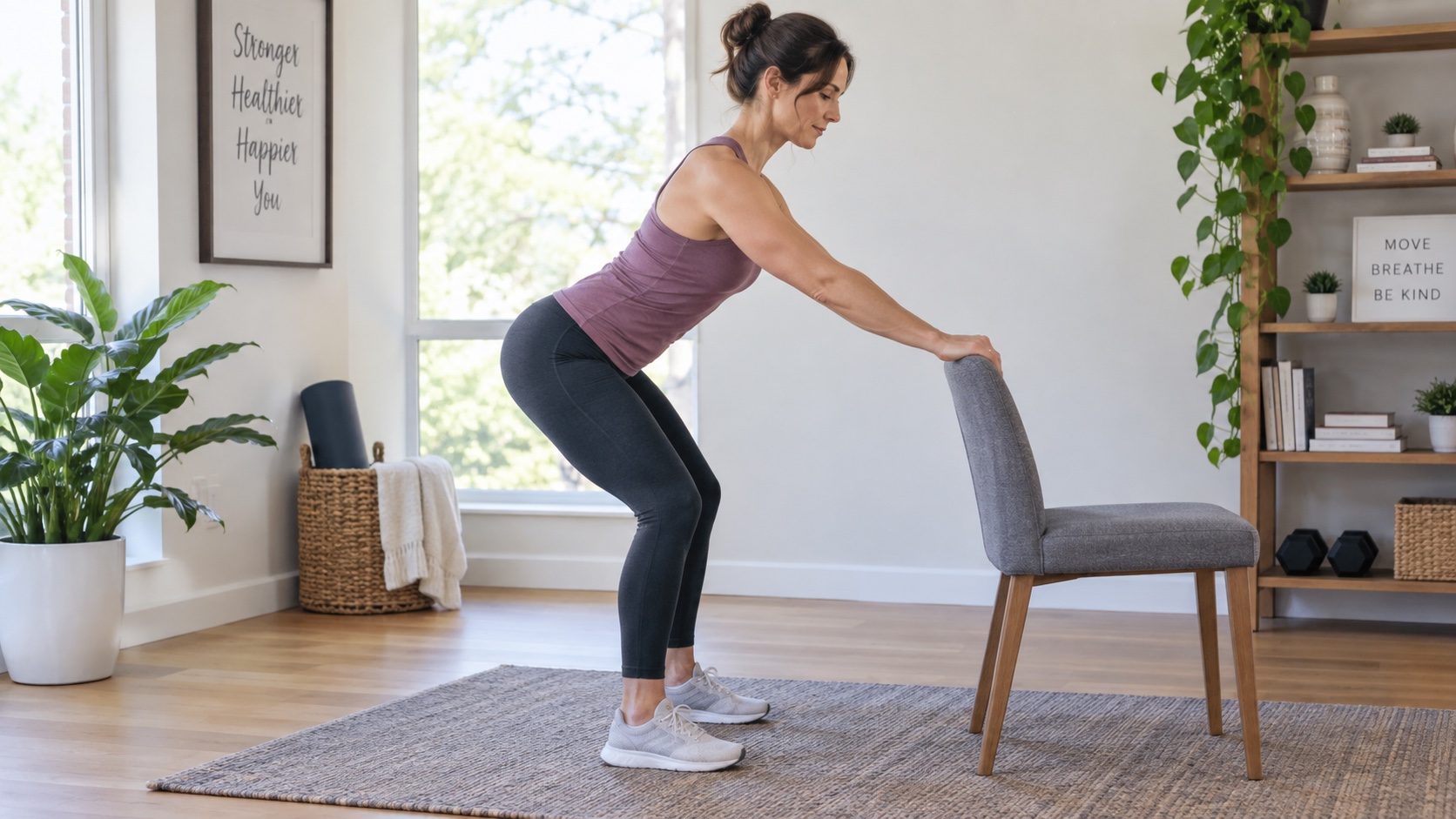
| 🪑 Chair stand | Squat pattern: control, knee tracking, heel contact | 10 slow reps, hands off thighs, heels down, torso upright | Box squat or wall sit; re-screen in 2 weeks |
| 🔗 Dowel hinge | Flat-back bending from the hips | A dowel stays against sacrum and upper back through the rep; hamstrings feel the stretch | Glute bridge and hip-hinge-to-wall; re-screen in 2 weeks |
| 🚪 Wall push-up | Brace, full range, no sag | Chest reaches the wall, body stays one plank, shoulders clear the ears | Incline push-up; re-screen in 2 weeks |
| 🪝 Band row | Neutral spine, no torso swing | 10 reps with ribcage still and shoulders quiet | Lighter band or higher anchor; re-screen in 2 weeks |
| 🎒 Loaded walk | Gait, grip, upright posture under load | 20–30 m with even steps, no lean, grip steady | Lighter load, shorter distance; re-screen in 2 weeks |
Each screen shadows its pattern's easiest rung, so a pass is not a medal — it is a license to load the next rung up. The pattern library page holds the rungs; this table decides which one is legal today.
How to Run a Screen Session
- ⏱️ Budget ten minutes, cold start — screens run at the top of a session or on a rest day, before fatigue turns every pattern into a failing screen.
- 🔥 Two minutes of easy movement first — walk, march, or arm circles; the goal is blood flow, not warm-up sets.
- 🔁 Three to five slow reps per screen — speed hides faults; the pass standards assume deliberate, slow reps.
- 📝 Log the verdict — one line per pattern in the same log as your lifts: pass, fail, or pass-with-note; next month's screen reads against it.
- 🩺 The pre-screen never expires for new things — new to lifting, or returning after a long layoff or an injury? The first investment is a form-check session and a clearance conversation, per the parent protocol's safety line.
- 📏 Re-screen on schedule — after every deload, after any injury, and whenever a lift starts feeling wrong at loads that used to be easy.
Reading the Results
A failed screen is information, not an identity. The response is almost always the same: drop one or two rungs on that pattern's ladder, rebuild the movement for two weeks, and re-screen. The Stability & Mobility topic owns the range-of-motion and control work that rebuilds a failing pattern; this page owns the decision rule.
- 🚩 Pain is never a screen outcome — screens grade control, not discomfort; sharp pain, joint pain that repeats, or pain that lingers after the session overrides every pass standard and sends you to a clinician.
- ↔️ Asymmetry is a yellow flag, not a verdict — a one-sided pattern usually means the easier rung and slower reps; if a side gap persists for weeks despite the rebuild, that is a conversation for a physical therapist.
- 📏 The one researched reference point — the EWGSOP2 consensus on sarcopenia uses a chair-rise time beyond 15 seconds as a low-function red flag in older adults (Cruz-Jentoft 2019); treat it as a performance reference for your screen, not a medical diagnosis.
- 🤝 Failing today costs nothing — two weeks on the easier rung is not lost progress; it is the same volume at a rung the pattern can actually use, and the Progressive Overload page explains why honest rungs beat heroic ones.
The Red Lines
- ⚠️ Sharp pain under load — stop the set, stop the pattern, and do not "work through it"; sharp pain is a stop sign, not a motivational challenge.
- ⚠️ The same joint, the same movement, every session — repeating pattern pain across two sessions means the exercise is wrong for you right now; swap within the pattern, and if it persists, get professional input.
- ⚠️ Dizziness, chest pain, or shortness of breath during exercise — stop and seek medical input; these are clinician territory, full stop.
- 🤲 Post-injury returns are not self-coached — coming back from any injury, especially a joint or back injury, earns a physical therapist's plan and clearance before the barbell; the screens above are training gates, not rehab prescriptions.
⚠️ A gate, not a diagnosis
Keep the screens humble and they will serve you for years. They decide which rung you load — nothing more. They do not diagnose injuries, predict who gets hurt, or replace professional input when something is actually wrong. Form first, load second, and when pain persists, the clinician's door beats any checklist on this or any other page.
Questions, Answered Briefly
- ❓ Do I screen every session? — No. Run the full set when starting, after layoffs, after injury, and after deloads; in between, the top set of each pattern is its own mini-screen.
- ❓ I passed everything — can I load heavy immediately? — The screens license the next rung, not the top of the ladder; progression still climbs by the loading rules on the Reps, Sets & Weights page.
- ❓ What if I fail the same screen for a month? — The rebuild belongs on the Stability & Mobility topic; a pattern that does not improve with two months of honest rung work is a reason to ask a professional why.
- ❓ Are these screens for older adults only? — No. They matter most for anyone loading heavy patterns, and the stakes rise with age; the NSCA position statement treats technique and screening as the foundation at every age (Fragala 2019).
- ❓ Can I film myself instead? — Please do; a phone camera at hip height catches what mirrors and mirrors' worth of good intentions miss, and the footage is the honest record for the log.
The Bottom Line
- Screens gate the loading decision: five checks, one per pattern, run in about ten minutes.
- Readiness screening is validated; movement screens are practice — useful and sensible, with no injury-prediction claim attached.
- A failed screen means a lower rung for two weeks, not an abandoned pattern and not an injury verdict.
- Pain overrides every pass standard — sharp pain, repeating joint pain, or any red-line symptom goes to a clinician, not to a substitution chart.
Related Topics
- Thomas, Reading & Shephard, "Revision of the Physical Activity Readiness Questionnaire (PAR-Q)," Canadian Journal of Sport Sciences (1992)
- Jamnik et al., "Enhancing the effectiveness of clearance for physical activity participation: background and overall process," Applied Physiology, Nutrition, and Metabolism (2011)
- Sherrington et al., "Exercise for preventing falls in older people living in the community," Cochrane Database of Systematic Reviews (2019)
- Cruz-Jentoft et al., "Sarcopenia: revised European consensus on definition and diagnosis," Age and Ageing (2019)
- Fragala et al., "Resistance training for older adults: position statement from the National Strength and Conditioning Association," Journal of Strength and Conditioning Research (2019)