The Minimum Equipment Ladder
Home strength training does not begin with a purchase order. This page frames the equipment question as a ladder — bodyweight first, bands second, adjustable dumbbells third, a bench optional — with the honest evidence for each rung and what each one actually unlocks. The home strength plan series assumes you start where you are; this page is the where-you-are map.
What the evidence supports
- Bodyweight exercises like the push-up produce similar hypertrophy and strength gains to comparable loaded presses in untrained lifters.
- Elastic band training produces broadly similar strength gains to conventional equipment in the meta-analyses that exist.
- The same five movement patterns can be trained at every equipment tier; exercise choice matters less than loading and consistency.
What remains uncertain
- Direct tier-versus-tier trials are mostly short, small, and run in young men; long-term differences across years of home training are untested.
- Exactly where bodyweight loading tops out for legs, relative to loaded options, has no clean head-to-head answer.
Evidence last reviewed: August 20, 2026. Conclusions may change as new research is published.
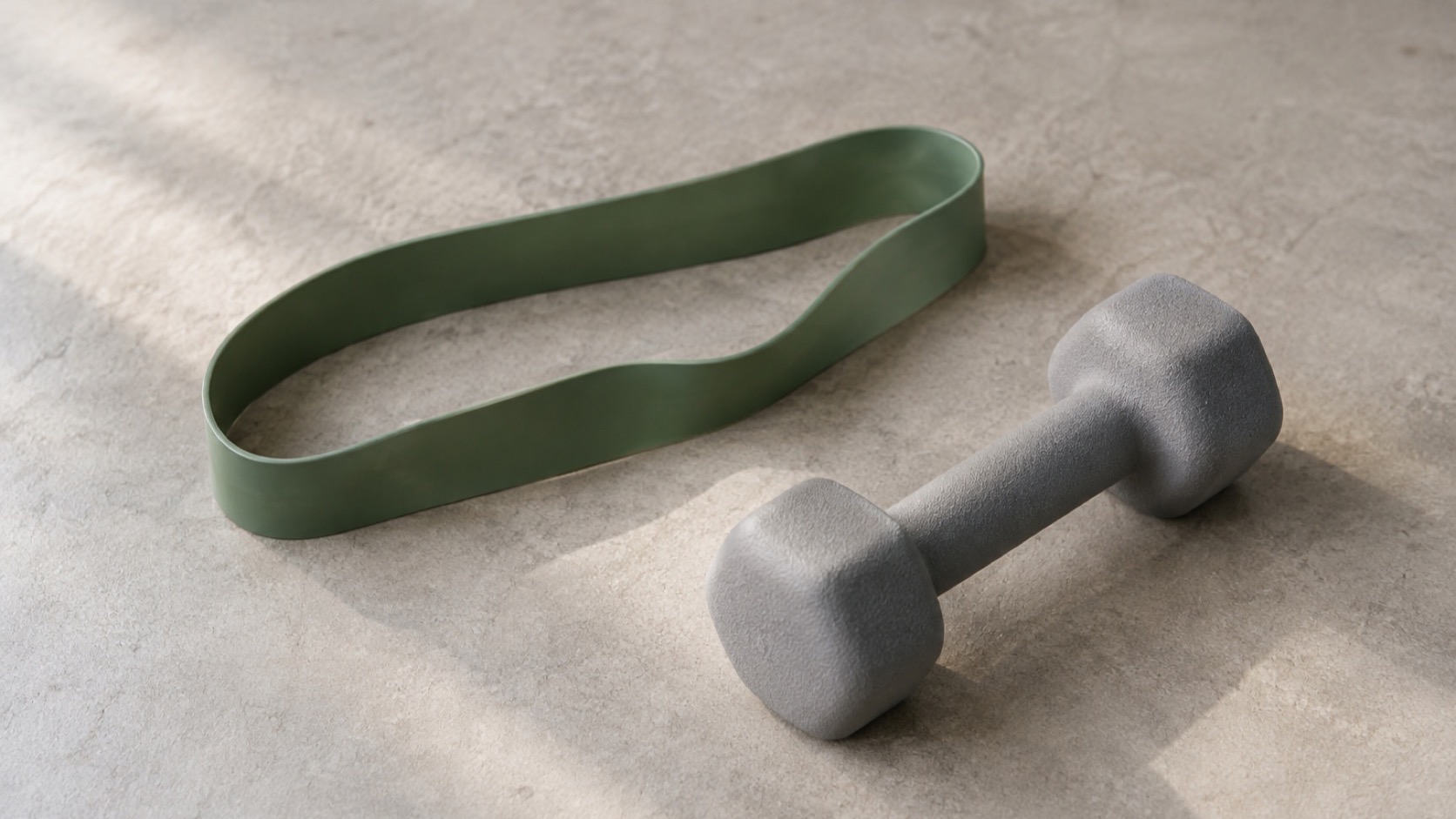
The Ladder, Not the List
The equipment question is usually asked as a shopping list: what do I have to buy? The evidence answers it as a ladder. Each rung is optional, each unlocks more of the same five patterns, and none is required for results — the Resistance Training protocol treats the habit, not the hardware, as the load-bearing element.
- 🪜 Rungs are additive, not mandatory — bodyweight, bands, adjustable dumbbells, and a bench each add loading range; none replaces the act of showing up twice a week.
- 🧠 The wrong purchase delays the start — the 2-Day Minimum page argues consistency outranks gear; a delayed start is the most expensive equipment.
- 📏 The five patterns stay constant — squat, hinge, push, pull, carry; only the loading tool changes as you climb, as the pattern library shows on every tier.
- 💰 No rung above bodyweight is a requirement — the strength training after 40 pillar treats a home setup as a first-class option, not a compromise.
Product picks are generic categories, not brands. We may earn a commission on Amazon or iHerb purchases at no cost to you — this never changes our evidence conclusions. Full disclosure
Adjustable dumbbells
Allows progressive loading at home across common strength movements.
⚠️ Poor technique or rapid load increases raise injury risk; not required to begin moving more.
Check price on Amazon →Rung One: Bodyweight Is a Real Rung
In untrained men, ten weeks of low-load bench press and push-ups produced similar hypertrophy and strength gains (Kikuchi & Nakazato 2017). The pattern did the work, not the price tag. Bodyweight covers four of the five patterns before a single purchase.
- 🚪 The push-up is a genuine press — wall, incline, floor, then weighted; the ladder inside this rung runs for years before it tops out.
- 🪑 The chair squat is a genuine squat — the chair is a depth checkpoint, and sitting down and standing up is the pattern's daily-life target anyway.
- 🔗 The glute bridge is a workable hinge — it under-loads compared with a deadlift, but it teaches hip extension and scales with holds and single-leg versions.
- 🎒 The carry pattern is free — a loaded backpack walk is not a workaround of the pattern; it is the original version, and it loads the spine, shoulders, and grip.
- 🪝 The one real gap is the pull — a towel row or doorframe row works, but a band makes the pattern dramatically easier to load; closing that gap is rung two's main job.
Rung Two: Bands Close the Pull Gap
Elastic bands are the highest-value first purchase in home training. A meta-analysis of elastic versus conventional resistance found broadly similar strength gains (Lopes et al. 2019), with the honest caveat that most of the included studies were small and short.
- 🪝 They make the pull pattern honest — anchored rows and pulldowns load the back without a bar, a machine, or a doorway that can take a chin-up.
- 📈 They add load to every pattern — banded push-ups, banded squats, and banded deadlifts all climb by stepping to a stiffer band or doubling it up.
- 🧳 Portability is the quiet advantage — a band set fits in a day bag, which means the hotel room and the office are training sites, not excuses.
- ⚠️ The honest limits — resistance grows with stretch, so the same band feels different at different joint angles, and exact load is harder to log than plates; the 40 Loading Rules page covers logging it anyway.
Rung Three: Adjustable Dumbbells Buy Precision
Where bands ask you to judge, dumbbells let you measure. An adjustable set replaces a whole rack in one corner, and its small load steps feed the double progression engine — add reps, then add weight — that progressive overload runs on.
- ⚖️ Small steps are the whole point — a 2.5 kg jump is legible in a log; the 2.5 Rule page explains why that granularity matters for progress.
- 🏗️ Every pattern gains a loaded version — goblet squats, single-arm rows, floor presses, and farmer's carries all take plates, which keeps the same five patterns intact.
- 🧮 Per-hand loading has a small tax — changing both sides takes a few seconds per set; a tray or stand keeps the pace honest.
- 💸 The real price is footprint, not money — a set plus a stand claims roughly a square metre of floor; that is the trade you make against rung four.
🪜 The best rung is the one you will stand on twice a week
Every purchase question on this ladder has the same answer: buy the rung that removes a reason to skip. If the floor is crowded, skip the bench. If the doorframe has no anchor, skip the bands. The ladder's purpose is to get you training this week with what exists — and to let your own log, not the marketing, tell you when the next rung earns its place.
Resistance bands
A low-space way to begin or supplement resistance training.
⚠️ Bands can snap and unstable anchoring can cause injury; stop movements that provoke pain.
Check price on Amazon →The Optional Fourth Rung: A Bench
A bench is the first rung that is genuinely optional. It adds pressing depth, seated rows, and step-ups, but nothing it unlocks is unreachable without it — the push pattern simply runs from the floor or an incline.
- 🛌 Floor presses cover the chest pattern — with a slightly shorter range and more stability demand, which is a feature for shoulder-sensitive lifters.
- 🪑 A sturdy chair covers the rest — step-ups, split squats, and incline push-ups all work from furniture you already own.
- 📏 Height adjustment is the real feature — an adjustable bench earns its footprint only if you actually use the incline positions; a flat bench is a chair with better branding.
- 🗓️ The test is six weeks of use — if the bench has not earned its corner in six weeks, it was a wish, not a need.
The Cost and Space Reality
The practical question is what each rung costs to enter — money now, floor space forever. The chart maps typical 2026 retail entry prices; the table sums what each rung unlocks and where it falls short.
- 💵 Retail ranges are wide — the used market changes the arithmetic completely; these numbers are entry points, not benchmarks.
- 📐 Space is the scarcer currency in most homes — the Space, Storage & Setup Friction sibling owns how to make room for whatever you choose.
- 🧮 Start where the gap is — if the pull pattern is your missing piece, bands beat dumbbells; if legs are the gap, dumbbells beat a bench.
| Rung | What it unlocks | Honest limits | Verdict |
|---|---|---|---|
| 🪜 Bodyweight | Squat, push, carry, and a workable hinge — four of five patterns, zero gear | The pull needs a band, towel, or doorframe row; leg loading tops out at your own mass | Start here |
| 🎗️ Bands | Full pull coverage and addable load on every pattern | Resistance grows with stretch; exact load is harder to log than plates | Good first buy |
| 🏋️ Adjustable dumbbells | Small, precise load steps on every pattern | Cost and floor footprint; per-hand loading takes a few seconds per set | When ready |
| 🪑 Bench | Pressing depth, seated rows, step-ups | Biggest footprint; nothing it unlocks is unreachable without it | Optional |
How to Start This Week
- ✅ Write one rung down — bodyweight for most readers; bands first if the pull gap is already annoying you.
- 🗓️ Schedule two sessions — the 2-Day Minimum case applies whether your rung cost $0 or $300.
- 📝 Log the first session — exercise, sets, reps, and a one-word note on how each set felt.
- 🔁 Re-evaluate at six weeks — the ladder is climbed on evidence from your own log, not on purchase anxiety.
Questions, Answered Briefly
- ❓ Do I need to buy anything to start? — No. Bodyweight covers four of five patterns with zero cost, and a towel row works for the pull while you decide whether a $30 band set is worth it to you.
- ❓ Are adjustable dumbbells worth the premium over fixed pairs? — For most homes, yes: one pair replaces a rack's worth of floor space, and the small load steps feed the double-progression engine; fixed pairs make sense only if you never change the weight.
- ❓ What if I already have a gym membership? — The ladder still applies. The gym is a tier with more loading range, not a different sport — the Resistance Training protocol runs identically there, and the rung logic tells you what to spend on first.
The Bottom Line
- Bodyweight covers four of five patterns with no purchase — the pull pattern is the gap.
- A band set is the highest-value first purchase — it closes the pull gap and adds load everywhere (Lopes 2019).
- Adjustable dumbbells buy precise, loggable load steps — the engine for double progression.
- A bench is optional — add it only when a named exercise needs it and the space exists.
Related Topics
- Kikuchi & Nakazato, "Low-load bench press and push-up induce similar muscle hypertrophy and strength gain," Journal of Exercise Science & Fitness (2017)
- Lopes et al., "Effects of training with elastic resistance versus conventional resistance on muscular strength: A systematic review and meta-analysis," SAGE Open Medicine (2019)
- Grgic et al., "Effect of resistance training frequency on gains in muscular strength: A systematic review and meta-analysis," Sports Medicine (2018)
- Kraemer & Ratamess, "Fundamentals of resistance training: progression and exercise prescription," Medicine & Science in Sports & Exercise (2004)