The 2–5 Rule: Small Jumps, Honest Loading
When double progression says "add weight," the 2–5 rule says how much: roughly 2.5–5% per step — for most lifts, that is the smallest plate increment available. This page explains why small jumps protect the slower-adapting tissues, computes the plate math for common bars, and covers what to do when the smallest step still feels like too much.
What the evidence supports
- Tendons and connective tissue adapt more slowly than muscle force, so the size of load steps matters for long-term joint health.
- Muscle and strength gains in trained individuals follow dose-response patterns where the smallest effective increments sustain progress longest (Rhea 2003).
What remains uncertain
- No trial has head-to-head tested 2.5% versus 10% jumps over years; the rule is the conservative end of documented progression guidance.
- Individual tolerance varies; the rule is a default, not a contract.
Evidence last reviewed: August 21, 2026. Conclusions may change as new research is published.
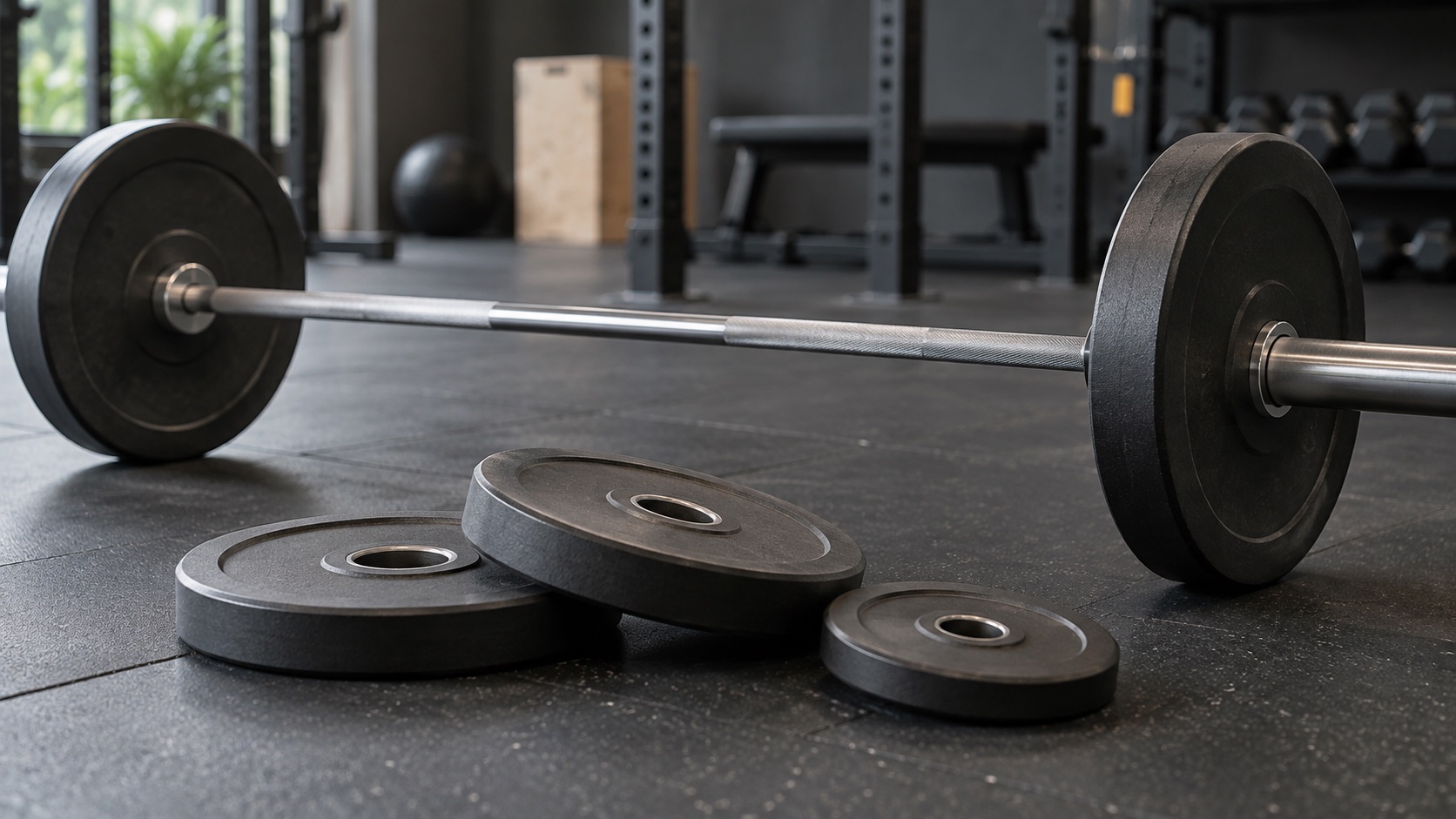
The Rule, Stated
Add weight in steps of roughly 2.5–5% of the working load, and never skip a step to chase a round number. For most barbell patterns, that rule collapses into one instruction: add the smallest plate pair available.
- 🧮 The math — 2.5% of 100 kg is 2.5 kg (a pair of 1.25 kg plates); 5% of 40 kg is 2 kg. Small bars and bodyweight patterns use smaller absolute steps — the percent, not the plate, is the rule.
- 📏 When to step — the step arrives when double progression says so: top of the rep range, all working sets, two sessions running. The scheme lives at Double Progression.
- ⚠️ The exception — in the first two weeks with a brand-new exercise, larger steps are acceptable while you find the honest working load; the rule protects progress, not pride.
Product picks are generic categories, not brands. We may earn a commission on Amazon or iHerb purchases at no cost to you — this never changes our evidence conclusions. Full disclosure
Adjustable dumbbells
Allows progressive loading at home across common strength movements.
⚠️ Poor technique or rapid load increases raise injury risk; not required to begin moving more.
Check price on Amazon →Why Small Jumps Win Over Years
Muscle force grows faster than the connective tissue that transmits it. Every load step is therefore absorbed by a system that trails behind — which is why the size of the step, not the speed of progression, is the joint-protection lever you actually control.
- 🦴 Tendons adapt on their own clock — collagen turnover is slow; aggressive jumps outpace it, and the joints become the tax on the muscle's growth.
- 🎯 Technique is part of the load — a small step preserves the movement pattern; a big step forces compensation, and compensation becomes chronic wear.
- 📊 The dose-response anchor — the strength dose-response literature rewards consistent graduated increases over sporadic large ones (Rhea 2003; Ratamess 2009).
Plate Math, Worked
| Bar set-up | Smallest step | Typical use |
|---|---|---|
| 🏋️ 20 kg bar + 1.25 kg plates | 2.5 kg (soon 5 kg if plates come in pairs) | Squats, deadlifts, presses in kg gyms |
| 🏋️ 45 lb bar + 1.25 lb plates | 2.5 lb (~1.25 kg) | The same lifts in lb gyms |
| 🔗 Dumbbells | 1–2 kg per pair (next size up) | Isolation and accessory patterns |
| 🪢 Bands | Next band or shorter band length | Bodyweight-tier loading |
When the smallest available step still overshoots — a light press, a long lever lift, a bodyweight pattern — micro-loading is the answer, covered below.
Micro-Loading Without Micro-Plates
Not everyone owns 0.5 kg fractional plates. Three workarounds keep the 2–5 rule alive on any budget:
- ⏱️ Tempo steps first — slow the eccentric (3 seconds down) instead of adding weight; the bar stays put, the demand rises, and $0 is spent.
- 🔁 Rep steps count as steps — an extra clean rep at the same weight is a legitimate demand increase; use it until the next plate step is honest.
- 🎒 Household weights — chains, ankle weights, or books in a backpack add fractional kilograms reasonably safely on dumbbell and band patterns; keep them far from collars and never improvise on a loaded barbell.
🧭 The step is a signal, not a score
If adding the smallest plate makes your form break on the first set, the step is too big for today — hold the load, add a rep, and retry the step next week. The 2–5 rule exists to keep the program running for years, not to make this week look impressive. A program that survives is a program that works; a bar that moves every week for a month and then stops moving for six is the alternative you are avoiding.
When the Rule Bends
- 🆕 New exercise, first week — larger early steps are fine while you locate the working load; the rule starts applying once the load is honest.
- 📉 Coming back from a break — return at 70–80% of your old working load and step up quickly; the joints re-acclimatize faster than the log remembers.
- 🛑 Stuck between steps — if three weeks pass without a clean step, that is a stall, not a plate problem; the diagnostic lives at When Progress Stalls.
- 🤕 Pain at the new load — sharp or joint pain after a step means the step outran the tissue; drop back a step and let the recovery page rebalance the week: Training vs Recovery.
Percentages, Not Plates: Why the Rule Is Relative
The rule is stated in percentages because a plate is not a percentage. The same 2.5 kg step is 3% of an 80 kg squat and 6% of a 40 kg press — two very different demands on the tissues. Thinking in relative terms keeps the joint-protection logic honest across exercises, equipment tiers, and bodyweights.
- ⚖️ A 40 kg press and an 80 kg squat are different projects — on the press, 2.5 kg is a 6% jump and may need micro-loading; on the squat it is 3% and is a routine step.
- 🪢 Bands and bodyweight have no plates — the relative rule still applies: next band resistance, a shorter band length, or a steeper angle is the analog of a 2.5–5% step; the Exercise Selection page maps the tiers.
- 🧮 Worked math — 5% of 60 kg is 3 kg; 5% of 100 kg is 5 kg. If the smallest plate pair overshoots 5%, you are in micro-loading territory and should say so in the log.
Case Study: The Light Press
Light upper-body lifts are where the 2–5 rule gets its reputation for being impossible. Here is the full worked path for a 40 kg overhead press with only 1.25 kg plates available (a 3.1% step).
| Week | Press | Rule in action |
|---|---|---|
| 📅 1 | 3 × 8 @ 40 kg | Bottom of range |
| 📅 2 | 3 × 10 @ 40 kg | Reps climb |
| 📅 3 | 3 × 12 @ 40 kg | Top reached twice → step due |
| 📅 4 | 3 × 8 @ 42.5 kg | Step lands; reps reset |
| 📅 5 | 3 × 9–10 @ 42.5 kg | Next chase |
| 📅 6 | 3 × 12 @ 42.5 kg | Step due again — 2.5 kg is 5.9%: use tempo or a rep first |
Notice week 6: the relative step is now 5.9%, outside the rule's zone, so the honest move is one rep at the same load or a slower eccentric before the next plate pair. The rule does not bend the math; it tells you when the math has changed.
If a planned double has to become a single, that is still a training week recorded; the rule protects the pattern, not the scoreboard.
How the Rule Interfaces With the Deload
- 📉 After a deload, steps accelerate temporarily — returning from a reduced week, relative steps can come faster for two to three weeks while the nervous system re-syncs; then the rule resumes its normal cadence.
- 🧭 The deload is not a step backwards — it is a re-arming; the weight that stalled usually lands two weeks after, which is why the stall page places the deload before the step, not after: When Progress Stalls.
Questions, Answered Briefly
- ❓ Do I need fractional plates? — Only for lifts where the smallest available step exceeds ~5% of working load; the press case above is the classic example.
- ❓ Can I add 5 kg on a deadlift when my squat steps 2.5 kg? — Yes — the rule is relative to the lift; large-pattern lifts carry larger absolute steps and stay inside the same percentage zone.
- ❓ What if the gym only has 2.5 kg pairs? — Use rep-first progression (the Double Progression scheme) and tempo steps to bridge until the load is heavy enough that 2.5 kg is within the zone.
- ❓ Does the rule apply to machine weights? — Yes, but machine weight stacks often step in 5 kg increments; treat those stacks as coarse and compensate with reps, tempo, and pauses between increments.
The Bottom Line
- Step 2.5–5% of working load, usually the smallest plate pair.
- Step only when double progression says so: top of range, all sets, twice.
- Tendons lag muscle, so step size is the joint-protection lever you control.
- No micro-plates? Use tempo, reps, or household weights — never skip the step into ego loading.
Related Topics
- Rhea et al., "A meta-analysis to determine the dose response for strength development," Medicine & Science in Sports & Exercise (2003)
- Ratamess et al., "ACSM position stand: progression models in resistance training for healthy adults," Medicine & Science in Sports & Exercise (2009)
- Folland & Williams, "The adaptations to strength training: morphological and neurological contributions to increased strength," Sports Medicine (2007)
- Bohm, Mersmann & Arampatzis, "Human tendon adaptation in response to mechanical loading: a systematic review and meta-analysis," Sports Medicine Open (2015)