When Home Training Needs Outside Help
Home training is a legitimate way to train, and it has blind spots. This page is about the honest limits: when a coached eye, a supervised environment, or a clinician is the right next step — and how to take the skill home afterward. Nothing here prescribes; home training is not a substitute for clinical care, and the home strength plan series is at its best when it knows when to ask for help.
What the evidence supports
- Progressive resistance training improves physical function in older adults in the Cochrane analyses (Liu & Latham 2009).
- Exercise programs that include balance work and supervision reduce falls in older adults (Sherrington 2019).
- Guidelines endorse individualized, professionally guided exercise for adults with chronic conditions (Garber 2011).
What remains uncertain
- Exactly how many coached sessions are needed to fix a form pattern has no controlled dose trial; one-session claims are practical experience, not data.
- Whether supervision prevents injury in healthy home lifters — versus clinical populations — is largely untested.
Evidence last reviewed: August 20, 2026. Conclusions may change as new research is published.
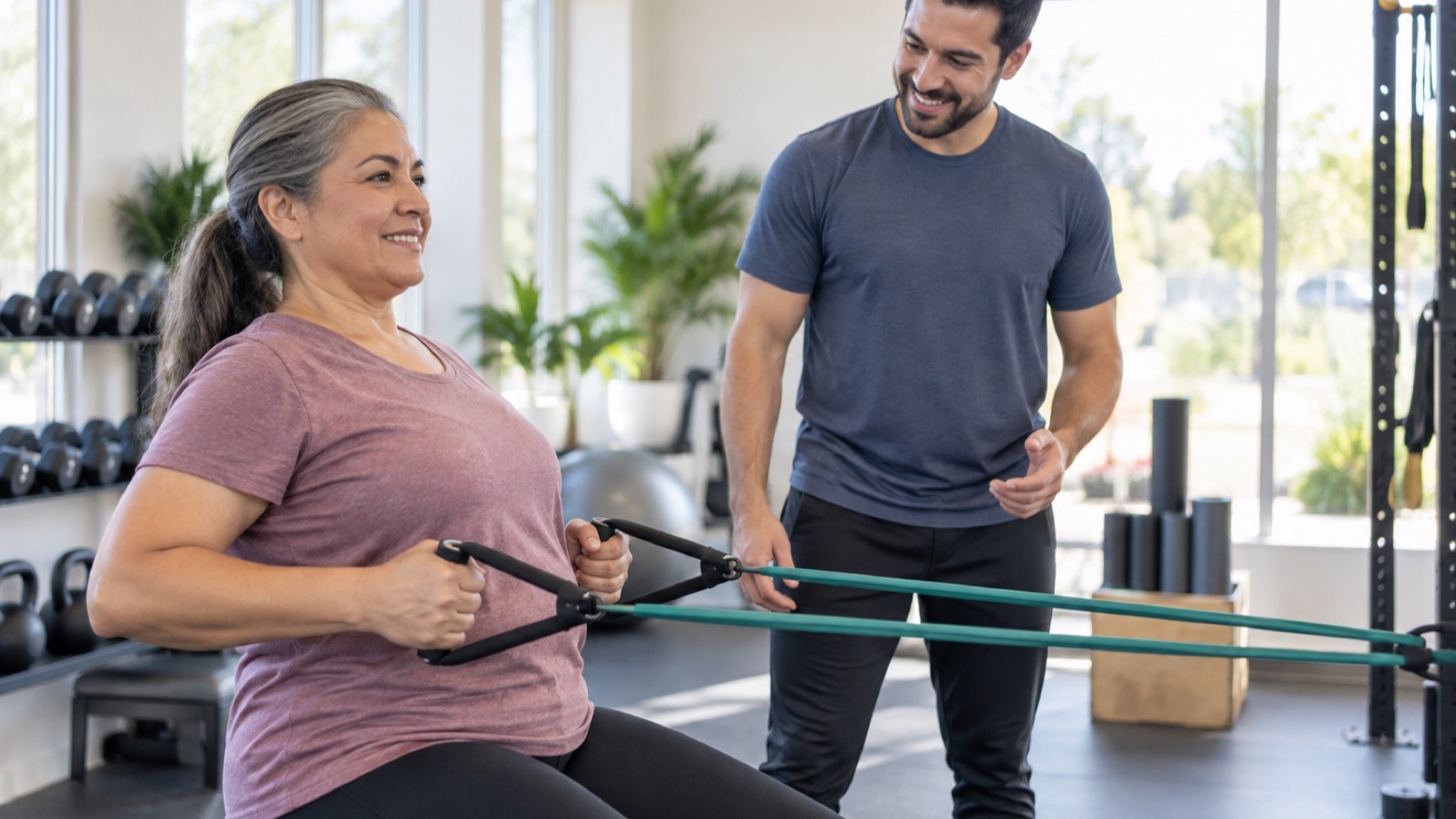
Home Training Has Blind Spots
Training alone in a room means no one sees your form, no one catches a heavy rep, and no one decides whether a symptom is adaptation or warning. Those are not failures of home training; they are its structural blind spots, and each has a standard remedy.
- 👁️ Form feedback is missing — the mirror lies, video helps, and a trained eye is decisive for some patterns.
- 🩺 Symptoms get self-diagnosed — the hardest part of home training is knowing which aches are adaptation and which are signals.
- 🧗 Some work wants supervision — balance, heavy carries, and return-to-training after a break are the usual candidates.
- 🧭 The remedy is a handoff, not an exit — coaching, supervision, and clinical care are steps in a loop that returns home; the strength training after 40 pillar keeps the long view of why the loop matters.
The Form Check That Decides
Before hiring help, run the self-check. The movement quality screens page has five self-tests; the decision rule below says when self-checking is enough and when it is not.
- 📹 Film the hinge and the squat from the side — a phone braced against a wall beats a mirror, which flatters the lifter.
- 🪞 Compare against the reference cues — depth, spine position, foot stability; the pattern library lists what each pattern is supposed to look like.
- 🤔 If the same flaw survives four weeks of deliberate practice — a coached eye is cheaper than a year of guessing, especially on the hinge and squat.
- 🩺 If a movement reliably hurts, the fix is not more form work — it is a clinical look; that distinction is the whole point of this page.
- 🎥 Review the video the next day, not between sets — a rested eye sees what a sweaty one misses, and the note goes straight into the log.
When a Coach or a Gym Earns Its Fee
The evidence for supervised exercise is strongest where balance and confidence are the issue: in the fall-prevention trials, exercise programs that included balance work and supervision reduced falls in older adults (Sherrington 2019). Supervision is not a luxury — it is a delivery mechanism for safety.
- 🧑🏫 One coached session can rewire a pattern — a single hour on the hinge and squat usually pays for itself in months of guessing.
- 🏋️ A gym membership is a supervision subscription — the equipment tiers page prices it as a tier, not as a failure of home training.
- 🪜 Confidence barriers are legitimate reasons — fear of falling, fear of loading, or plain uncertainty respond to supervised environments.
- 📊 Group classes trade intensity for safety — acceptable when the goal is consistency and skill rather than peak load.
🩺 Home training is not a substitute for clinical care
No page on this site prescribes, and this one is the most careful of all: when a symptom is new, persistent, or alarming, the next session waits for a professional opinion. A clinician's plan and a home template are compatible — the plan sets the boundaries, the template fills the time inside them. The handoff is not the end of home training; it is how home training stays safe.
Clinical Handoffs: When to Stop Self-Directing
Some situations are clinician territory, full stop. The rule is simple: when a symptom is new, persistent, or alarming, the next session waits for a professional opinion.
- 🫀 Chest pain, fainting, or unusual breathlessness — stop training and talk to a clinician before the next session; exercise is not the answer until the question is answered.
- 🦴 Joint pain that worsens across weeks — a physical therapist can separate movement error from tissue problem; the compound vs isolation page covers why prescribed accessories differ from gym decoration.
- 🩻 Known conditions change what safe means — heart, metabolic, or joint diagnoses come with their own rules; clearance and a plan come first, training second.
- 🧠 Mental health barriers are real — depression and anxiety are common reasons exercise stalls; they are treatable, and a clinician is the right doorway — not a tougher workout.
- 🚑 Emergency symptoms are not a training question — chest pain that spreads, fainting, or severe breathlessness at rest warrants urgent care; this page's triage covers planning, not emergencies.
Red Flags That Change the Plan
The table is a triage, not a diagnosis — it routes each barrier to the right first stop, and it does not judge anyone for needing one.
| Barrier | First stop | What happens there | Route |
|---|---|---|---|
| 🎯 Form plateau on hinge or squat | Coach or experienced friend | Eyes on your depth, spine position, and bar path — one session often fixes months of guessing | Coaching |
| 🫀 Chest pain, fainting, unusual breathlessness | Clinician, before the next session | Cardiovascular risk evaluation; clearance or a plan before training continues | Stop & call |
| 🦴 Joint pain that persists or worsens across weeks | Physical therapist | Movement-specific rehab plan and return-to-training steps you can run at home | Referral |
| 🪜 Fear of falling or low confidence on balance moves | Supervised environment | Group class or gym with rails, spotters, and instruction until confidence returns | Supervision |
- 🚩 The table routes; it does not diagnose — the label is a direction, not a verdict.
- ⏱️ "Persistent" means weeks, not days — one bad session is noise; three weeks of the same signal is data.
- 📞 The first call is usually the hardest — clinics expect these calls, and the 2-Day Minimum habit survives a week off.
How Much Supervision Different Situations Want
Supervision need is a spectrum, not a switch. The chart is an editorial synthesis of how much a supervised or clinical session typically adds in common situations — a planning aid, not a prescription.
- 🩻 Rehab-adjacent work is prescribed — a physical therapist's plan is the reference, and nothing on this site overrides it.
- 🏋️ Returners often get more from supervision than beginners — the skills are known but rusty, and the confidence gap is real.
- 📉 Maintenance wants the least — a check-in every few months keeps the loop honest without making the gym a lifestyle change.
The Return-On-Home Loop
Help is a loop, not a detour. The goal of every coached session, supervised block, or clinical plan is to return the skill to your home template — better than it left. The loop has a rhythm: short on the input, long on the output — a handful of coached hours per year feeding a template you run every week. That ratio keeps home training self-directed without being self-taught.
- 🎓 Get the skill in a coached or supervised setting — one session, one block, or one class.
- 🏠 Bring it home — the session's cues become the notes in your log and the template's instruction card.
- 🔁 Re-check when the pattern changes — new exercises, new loads, or new symptoms reopen the loop.
- 🗓️ A quarterly check-in is a reasonable rhythm — the recovery math and deload weeks pages cover the rest of the maintenance calendar.
How to Start This Week
- 🎥 Film one set of your hinge and squat — apply the movement quality screens before anything else.
- 📞 If any red flag from the table applies, call before you train — that call is the fastest form fix on this page.
- 🧑🏫 If form stalls, book a single session — one coached hour usually pays for itself.
- 📝 Decide the re-check date — six weeks out — and put it in the calendar — the loop only works when the next check is scheduled.
The Bottom Line
- Home training has three blind spots — form feedback, symptom triage, and supervision — each with a standard remedy.
- A single coached session can fix what months of self-video cannot, especially on the hinge and squat.
- Chest pain, fainting, and persistent joint pain are clinician territory — the session waits, and the template survives the pause.
- Help is a loop, not a detour — take the skill home, re-check quarterly, and return to the template.
Related Topics
- Liu & Latham, "Progressive resistance strength training for improving physical function in older adults," Cochrane Database of Systematic Reviews (2009)
- Sherrington et al., "Exercise for preventing falls in older people living in the community: An abridged Cochrane systematic review," British Journal of Sports Medicine (2019)
- Garber et al., "American College of Sports Medicine position stand. Quantity and quality of exercise for developing and maintaining cardiorespiratory, musculoskeletal, and neuromotor fitness in apparently healthy adults," Medicine & Science in Sports & Exercise (2011)
- Kraemer & Ratamess, "Fundamentals of resistance training: progression and exercise prescription," Medicine & Science in Sports & Exercise (2004)