The Home Strength Plan: Building a Durable Minimal Setup
The gym is not the program. This page is the home version of the resistance training protocol — the equipment ladder from floor to garage, the five patterns a minimal kit must cover, and the setup decisions that determine whether "train at home" survives its first ninety days.
What the evidence supports
- Home-based resistance training improves strength and functional capacity in older adults across trials — often comparable to supervised gym programs.
- Adherence is the mechanism that decides outcomes: the setting matters mostly through whether you show up.
- A minimal kit — bodyweight plus bands or adjustable dumbbells — can deliver progressive overload across all five movement patterns.
What remains uncertain
- Whether gyms add anything beyond equipment variety and built-in accountability is unsettled — trials rarely blind the setting.
- What to buy first is practice wisdom, not trial evidence; equipment lists in studies are dictated by the study, not by durability.
Evidence last reviewed: August 20, 2026. Conclusions may change as new research is published.
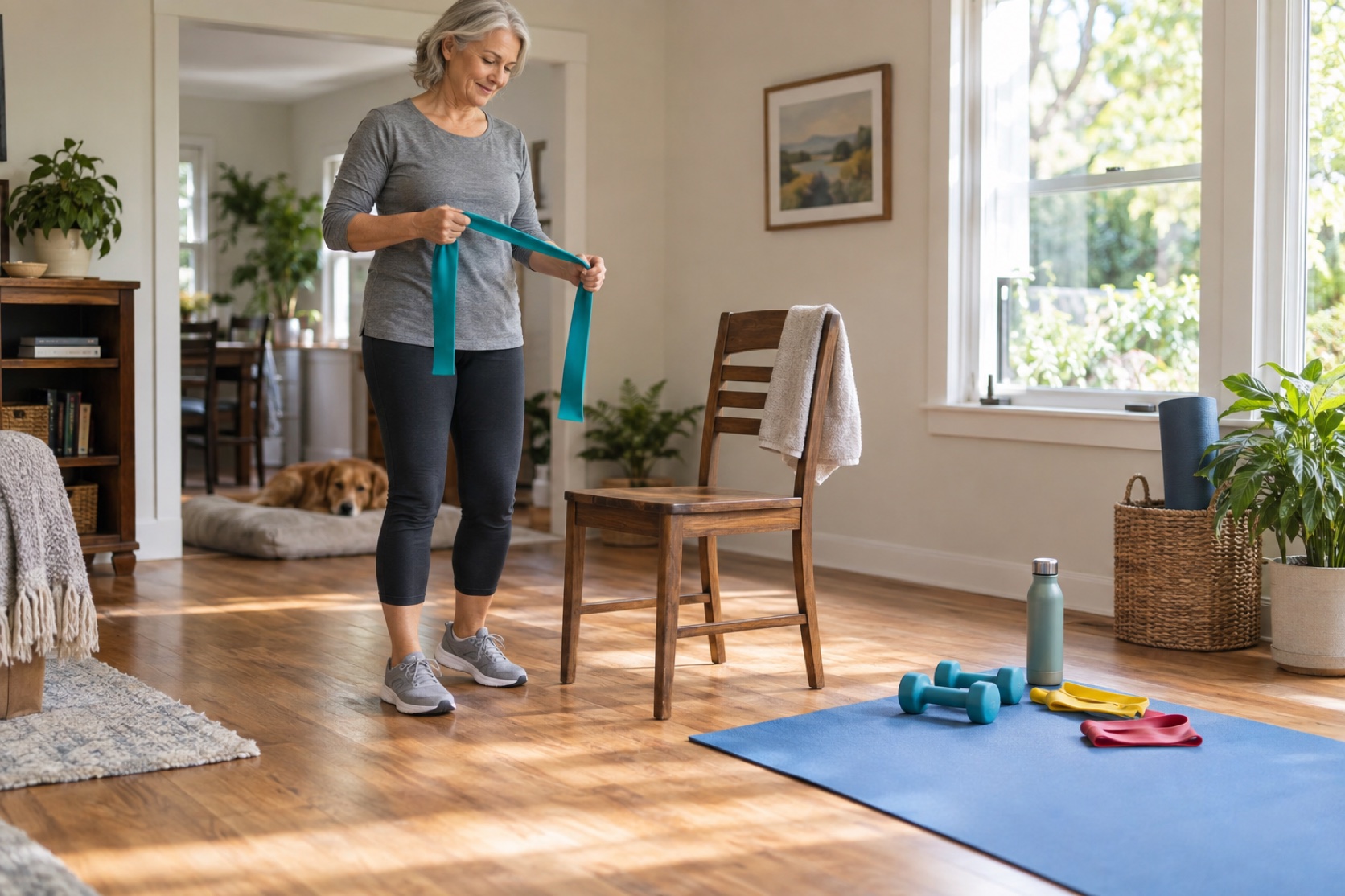
Why Home Training Works
The evidence for training at home is mostly the evidence for training, period — with one twist. A Cochrane review of home-versus-center exercise programs in older adults (Ashworth et al., 2005) found that home programs produce outcomes broadly comparable to supervised center programs. The difference that kept showing up was not muscle; it was attendance. People who trained at home often trained more often, and people who stopped, stopped for reasons the setting could not fix.
- 📍 The real variable is attendance — a gym membership that gets used three times a month builds less strength than a hallway you use twice a week. Home training wins by removing friction, and loses whenever it adds any.
- 📉 The honest trade — you trade equipment variety, social accountability, and coaching proximity for zero commute and total schedule freedom. That trade is worth taking only if the setup is genuinely low-friction.
- 📈 The durability question — a setup that survives six months beats a "perfect" setup that gets disassembled in week three. Every decision on this page is a decision for survival, not for Instagram.
- 🧭 Where the rest of the series fits — the overload rules from Progressive Overload, the movement choices from Exercise Selection, and the recovery half from Training vs Recovery all apply unchanged. Home changes the stage, not the play.
Product picks are generic categories, not brands. We may earn a commission on Amazon or iHerb purchases at no cost to you — this never changes our evidence conclusions. Full disclosure
Adjustable dumbbells
Allows progressive loading at home across common strength movements.
⚠️ Poor technique or rapid load increases raise injury risk; not required to begin moving more.
Check price on Amazon →The Setup Ladder, From Zero to Full
Nobody needs the bottom rung of a gym to start. The ladder runs from a patch of floor to a full rack, and each rung covers all five movement patterns — the question at each step is how much resistance you can load, not whether the workout exists.
| Tier | Gear | One-time cost | What it covers |
|---|---|---|---|
| 🧘 Floor | Bodyweight: push-ups, split squats, glute bridges, doorway rows, loaded backpack | $0–40 | All five patterns in regression — a full workout, not a placeholder |
| 🩹 Bands | 3–5 loop and long bands with a door anchor | $30–80 | Adds resistance to every pattern; the finest load steps on a budget |
| 🏋️ Corner | Adjustable dumbbells, flat bench, floor mat | $250–600 | Full strength range on all five patterns, for years |
| 🏠 Garage | Squat rack, barbell, plates | $1,500–4,000 | The gym at home — needs ceiling height and floor space |
The costs are 2026 retail ballparks, not requirements — the ladder is a sequence, not a shopping list. The Minimum Equipment Ladder page breaks each rung into what to buy first, what to skip, and where the used market changes the math.
The Five Patterns a Minimal Kit Must Cover
Every setup on the ladder has one job: give the five movement patterns a home version. If a purchase does not serve one of these, it is decoration.
- 🪑 Squat pattern — goblet squat, split squat, or a banded squat. The knee-bending pattern that carries stairs, chairs, and getting up off the floor.
- 🔗 Hinge pattern — glute bridge, hip hinge with a band, or dumbbell RDL. The hip-dominant pattern that protects the lower back.
- 🚪 Push pattern — push-up, band press, or dumbbell press. Chest and shoulders without needing a bench — the floor and the wall both work.
- 🪝 Pull pattern — doorway row, table row, band row. The pattern most home setups neglect, and the one that balances all that pushing.
- 🎒 Carry pattern — farmer's carry with dumbbells, a loaded backpack walk, or a suitcase carry. Grip, trunk, and posture in one move.
Two patterns from the full Exercise Selection menu — loaded carries and split-squat variants — are the ones that translate best to small spaces, which is why they appear in every template on this page. The Home Full-Body Template page assembles them into complete sessions.
What's Worth Buying
The buying question is not "what can I afford" but "what will I actually use for two years." Four rules cover most of it:
- ⚖️ Adjustable over fixed — one pair of adjustable dumbbells (2–24 kg / 5–52 lb) replaces six pairs and most of the floor space. The dial-in seconds are worth it.
- 🩹 Bands before plates — bands are cheap, quiet, and progressive. They cannot replace free weights for heavy loading, but they cover the first two tiers at a fraction of the cost.
- 🪑 A bench unlocks the corner — seated presses, rows, and split-squat support turn a dumbbell pair into a full gym. A flat bench under $150 does the job; skip the adjustable one.
- 🧱 Floor protection is not optional — a 10 mm exercise mat or 1 m² of rubber tile protects the floor, the dumbbells, and your willingness to keep training on carpet.
Doorway pull-up bar or suspension trainer
Can expand upper-body pulling options in a small home space.
⚠️ Incorrect installation or using an unsuitable door frame can cause falls; shoulder pain requires modification or assessment.
Check price on Amazon →Progressing Without a Barbell
The overload engine from Progressive Overload runs on any equipment — the levers just look different without plates. The honest limits: dumbbells jump in coarse steps, bands get harder as they stretch, and bodyweight eventually runs out of easy rungs. Each has a workaround.
- 🔁 Rep-range bridging — a 2.5 kg jump per hand is a 5 kg jump overall; fill the rep range (6 → 10) before taking it. The range is the bridge between dumbbell steps.
- ⏱️ Tempo and pauses — a 3-second lowering phase or a 2-second pause at the bottom adds demand with zero new equipment. Free, fine-grained, and honest overload.
- 🦵 Single-leg work — split squats and step-ups roughly double the load on one leg. They are the closest thing to a "heavier weight" a bodyweight-only lifter owns.
- 🩹 Band trickery — shorter bands, doubled bands, and anchoring lower all add tension without buying anything. The trade is that band resistance is not linear — the hard part is at the top of the rep.
The Progressing Without a Barbell page walks each lever with set-by-set examples, including when a deload looks different at home (it means lighter bands and shorter sets, not a skipped week).
Space, Storage & Setup Friction
Every minute between "I should train" and "first rep" is a minute the session can lose. The strongest predictor of a durable home setup is not the equipment — it is where the equipment lives.
- 🏠 The permanent corner rule — a two-square-meter corner that stays set up beats a beautiful kit that lives in a closet. If the mat stays down, the sessions happen.
- 🚪 Door-frame reality — pull-up bars need a sturdy frame and headroom; doorway rows need a door you are willing to stress. Check both before buying either.
- 📦 Storage is adherence — if the bands live in a drawer one reach away and the dumbbells live under the bed, you have two different setups with the same budget. Optimize for reach, not for tidiness.
- 🔉 The neighbor question — dropped dumbbells and jumping exercises carry through floors. Mats absorb some; choosing floor-based movements absorbs the rest.
The Space, Storage & Setup Friction page covers the apartment-sized versions of each decision, including what to do when there is no wall, no door, and no floor space to spare.
The Home Full-Body Template
Two sessions a week, five patterns each, no movement that needs a spotter. This is the template the whole series has been building toward — swap the home pick for whatever your rung of the ladder allows.
| Session | Movements (sets × reps) | Home pick |
|---|---|---|
| 📗 A | Goblet squat 3×6–10 · Push-up 3×6–12 · One-arm row 3×8–12 · Glute bridge 3×10–15 · Loaded carry 2×30–60 s | Dumbbells or bands; push-up regressed to knee or wall |
| 📘 B | Split squat 3×6–10 · Band or dumbbell press 3×8–12 · Doorway row 3×8–12 · Dumbbell RDL 3×8–12 · Suitcase carry 2×30–60 s per side | Floor tier: bodyweight versions of every movement |
Rest 2–3 minutes between work sets, leave 1–3 reps in reserve, and let the progression rules — reps first, then the smallest load jump — run the show. The Home Full-Body Template page has the warm-up, the rest schedule, and the 90-second version for genuinely impossible weeks.
When Home Training Needs Outside Help
Home training is a fine place to train and a poor place to learn certain things alone. This page does not prescribe training for any medical condition, and a home setup is not a substitute for clinical care. Three situations call for outside help, and calling for it is part of the plan, not a failure of it.
- 👨🏫 Form coaching — one or two sessions with a coach — in person or filmed-and-reviewed remotely — pays for itself on the squat and hinge patterns. Unsupervised practice is where small form errors become habits, and habits become pain.
- 🛡️ Supervised environments — if balance is a concern, or if getting up and down from the floor is itself risky, the floor tier is the wrong starting point. A supervised setting — a gym, a physio-led class — is the appropriate place to build that foundation first.
- 🩺 Clinical handoffs — new chest pain, joint pain that worsens with ordinary life, unexplained weakness, or any condition your clinician has not cleared for exercise all point one direction: a conversation with a qualified professional before the next session, not an online modification.
- 📋 The PAR-Q screen is a reasonable first gate — the Physical Activity Readiness Questionnaire (Thomas et al., 1992) flags the common reasons to check with a clinician before starting. Answering "yes" to any item is a prompt for that check, not a reason to quit.
⚠️ Confidence and safety barriers are legitimate reasons to train somewhere supervised, temporarily or permanently. The When Home Training Needs Outside Help page details the exact conversations to have — with a coach, a physiotherapist, or a doctor — and how to keep training while they happen.
Non-slip exercise or yoga mat
Provides a stable, comfortable surface for mobility or floor-based exercise.
⚠️ None expected; it does not treat pain or replace injury-specific care.
Check price on Amazon →The First 30 Days
The plan that survives contact with real life starts smaller than the plan that looks good on paper. The first month has one goal: make the corner a place you go twice a week without thinking.
- Week 1–2: the floor tier — bodyweight versions of the five patterns, two sessions, sets kept 3–4 reps short of failure. No purchases yet; the habit is the product.
- Week 3: add resistance — bands for everything that gets easy, or the adjustable dumbbells if you already own them. Same template, more load.
- Week 4: log and judge — every session gets one line: movements, sets, reps, and the honesty column (form, sleep, stress). The trend line starts here.
- The buy decision — if the corner survived four weeks, spend on the next rung. If it did not, the problem was never the equipment.
🏠 The corner beats the membership
A permanent two-square-meter corner that takes two minutes to start beats a beautiful gym you have to drive to. The setup you can touch without thinking is the one that gets used — and attendance is the mechanism that actually builds the strength.
Once the kit is built, the fast half of strength has its own folder: Building Power.
Questions, Answered Briefly
- ❓ Can I build real strength with bodyweight alone? — For the first months, clearly yes: split squats, push-ups, and rows cover all five patterns, and the single-leg and tempo levers add load without equipment. The ceiling is real but it sits higher than most people think — most quit before they reach it.
- ❓ What if I have room for almost nothing? — A mat that rolls under the sofa and a set of bands in a drawer is a complete setup. The permanent-corner rule shrinks, it does not disappear: even a mat that lives in one spot changes the math.
- ❓ Is a garage gym a waste of money? — Only if it replaces attendance instead of serving it. The rack is the best value in home training for people who use it weekly; it is the most expensive coat rack in the house for people who do not.
- ❓ Should I keep the gym membership too? — Many people run both: home for the routine sessions, the gym for the movements that need machines or a spotter. What rarely works is paying for both and using neither.
The Bottom Line
- Start on the floor, spend later — bodyweight and bands cover all five patterns before you buy anything heavy.
- Cover the five patterns, not the equipment list — squat, hinge, push, pull, carry is the whole job description.
- Friction decides adherence — a permanent corner beats a packed-away kit, and attendance is the real mechanism.
- Know the boundaries — home training is not a substitute for clinical care; coaching, supervision, and handoffs apply when safety or confidence is the barrier.
Go Deeper: The Home Strength Plan: Building a Durable Minimal Setup
These five companion pages turn the topic into smaller, testable practices.
- 🔗 The Minimum Equipment Ladder
- 🔗 The Home Full-Body Template
- 🔗 Progressing Without a Barbell
- 🔗 Space, Storage & Setup Friction
- 🔗 When Home Training Needs Outside Help
Related Topics
- Ashworth NL, Chad KE, Harrison EL, Reeder BA, Marshall SC. "Home versus center based physical activity programs in older adults." Cochrane Database of Systematic Reviews (2005)
- Ratamess NA, et al. "Progression models in resistance training for healthy adults." Medicine & Science in Sports & Exercise (2009)
- Garber CE, et al. "American College of Sports Medicine position stand: Quantity and quality of exercise for developing and maintaining cardiorespiratory, musculoskeletal, and neuromotor fitness in apparently healthy adults." Medicine & Science in Sports & Exercise (2011)
- Thomas S, Reading J, Shephard RJ. "Revision of the Physical Activity Readiness Questionnaire (PAR-Q)." Canadian Journal of Sport Sciences (1992)
- Schoenfeld BJ, et al. "Resistance training volume enhances muscle hypertrophy but not strength in trained men." Medicine & Science in Sports & Exercise (2019)