The Home Full-Body Template
A plan survives contact with real life only if it has room to flex. This page turns the protocol's five patterns into a two-day template — the same skeleton whether you train in a living room with a band or a garage with dumbbells — and shows the set-and-rep arithmetic that keeps it productive. The home strength plan series builds from here; the template is its engine room.
What the evidence supports
- Training a muscle twice a week produces strength gains at least as good as higher frequencies at matched volume (Grgic 2018).
- Strength gains climb with weekly sets up to a plateau — roughly 10–20 sets per muscle per week (Ralston 2017).
- Moderate and heavy loads produce similar strength and size gains in older adults when effort is matched (Csapo & Alegre 2016).
What remains uncertain
- Whether two versus three full-body days differ meaningfully over years is not settled; two days is a defensible floor, not a proven optimum.
- Exactly which exercise allocation per day maximizes adherence at home has no direct trial — the template is built from frequency and volume evidence plus the ordering literature.
Evidence last reviewed: August 20, 2026. Conclusions may change as new research is published.
Why a Template Beats a Plan
A plan says what you will do on a specific day; a template says what every day will contain and lets the details flex. For home training the template wins, because the details — space, equipment, energy, who else is in the living room — change weekly while the five patterns do not.
- 📋 Templates absorb interruptions — a missed day shifts the next session instead of invalidating the whole week's plan.
- 🧭 The five patterns stay fixed — squat, hinge, push, pull, carry; the pattern library supplies the picks, and this page supplies the allocation.
- 🏠 Home is a constraint that repeats — every session happens in the same room, so a repeatable skeleton compounds in a way a rotating plan never does.
- 📏 Structure, not perfection — the 2-Day Minimum page sets the floor; this template is what that floor looks like when written down.
Product picks are generic categories, not brands. We may earn a commission on Amazon or iHerb purchases at no cost to you — this never changes our evidence conclusions. Full disclosure
Adjustable dumbbells
Allows progressive loading at home across common strength movements.
⚠️ Poor technique or rapid load increases raise injury risk; not required to begin moving more.
Check price on Amazon →The Two-Day Skeleton
The template is deliberately boring: the same five patterns on both days, different picks, and the same order — squat, hinge, push, pull, carry. Boring is the point; decision fatigue is a setup tax you can see in the setup friction sibling, and the skeleton removes most of it.
- 🔁 Both days carry all five patterns — each muscle group gets two weekly exposures, and the frequency evidence shows twice-weekly training matches higher frequencies at equal volume (Grgic 2018).
- 🪑 The order follows the fatigue logic — squat and hinge open the session while fresh, carry closes it; the Exercise Selection parent topic owns the ordering evidence.
- 🧮 Two days times five patterns is the volume floor — three working sets per pattern lands in the productive weekly range; the arithmetic is in the set-and-rep section below.
- 🧩 Warm-up is built into the skeleton — one light set of each pattern serves as the ramp, so the first working set of the session is never the day's first movement.
- 🗓️ A third day is an upgrade, not a requirement — when two days feel easy for a month straight, adding a third is the natural next step, not the entry ticket.
Day A and Day B in Practice
The table shows one defensible allocation — every cell can be swapped within its pattern, because the skeleton is the requirement and the specific pick is not.
| Pattern | Day A | Day B |
|---|---|---|
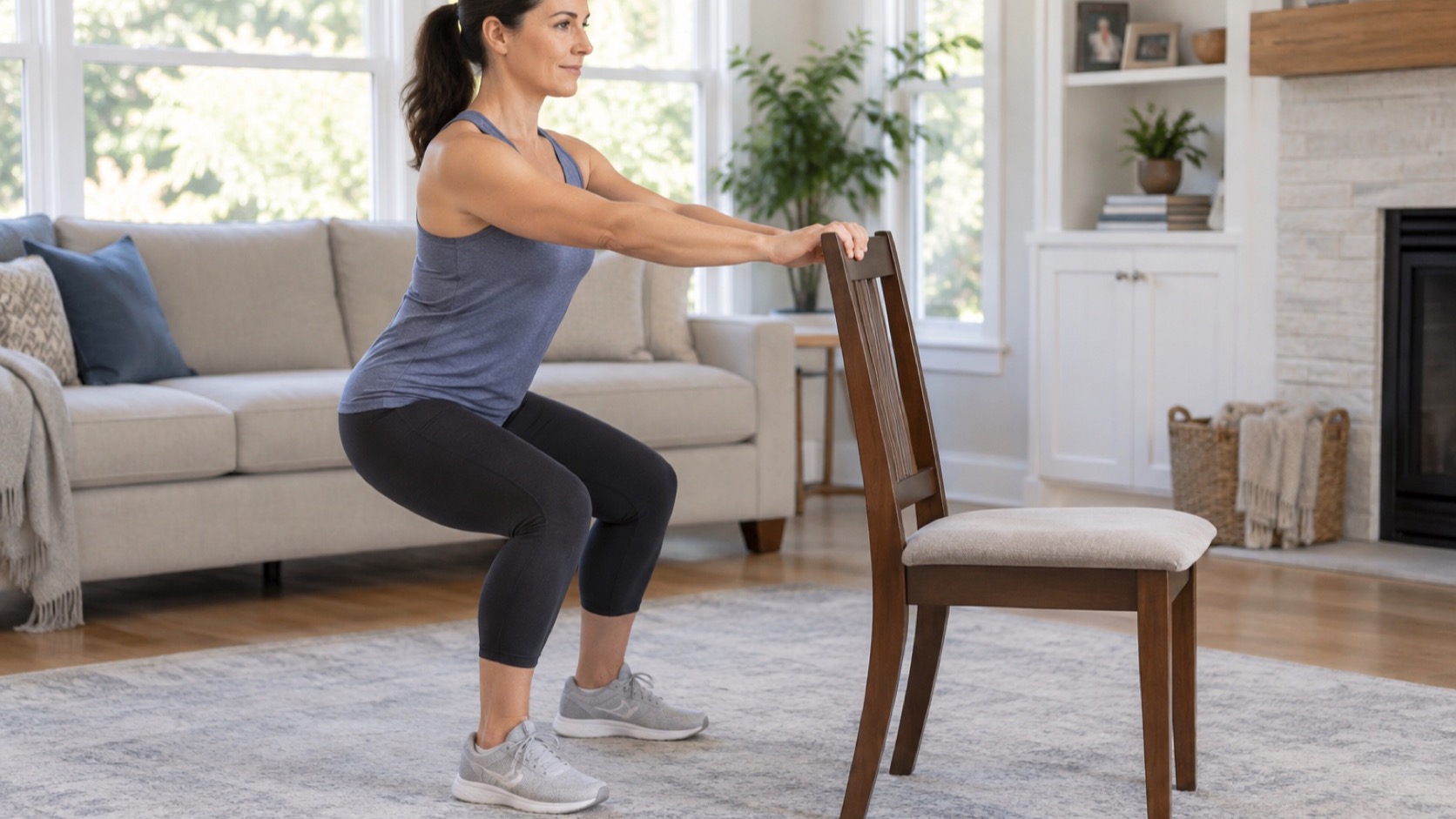
| 🪑 Squat | Chair squat or goblet squat | Split squat (unilateral) |
| 🔗 Hinge | Glute bridge with hold | Banded Romanian deadlift |
| 🚪 Push | Push-up (floor or incline) | Band press or band push-up |
| 🪝 Pull | Band row (anchored) | Towel row or band pulldown |
| 🎒 Carry | Backpack walk | One-arm carry |
- 🔄 Same pattern, different pick — Day A squats with a chair squat, Day B with a split squat; the same pattern gets a new stimulus without any new equipment.
- 🎒 Carry closes both days — a backpack walk on A, a one-arm carry on B; the pattern is short, loaded, and finished in minutes.
- ✏️ The log records the pick — the rep continuum page explains why rep targets ride on top of the template rather than inside it.
- 🏷️ The labels are interchangeable — Day A and Day B are identities for the log, not fixed commitments; swapping whole days is fine, swapping patterns mid-week is not.
- 🧰 The equipment ladder decides the cells — the three equipment tiers page maps every pick to bodyweight, band, and dumbbell versions.
Space Variants: Three Rooms, One Template
The template does not care which room it runs in — it cares that the room exists and that setup stays fast. Three typical homes, one skeleton:
- 🛋️ Living room — a mat and a doorframe anchor; the carry pattern becomes a hallway walk and the floor press stays on the mat.
- 🛏️ Bedroom — quiet and private; low ceilings mean the push pattern runs on the floor or an incline rather than overhead.
- 🚗 Garage — room for a bench and dumbbells; temperature and lighting are the variables, and a chalk line on the floor marks the squat stance.
- 📦 Any room — the Space, Storage & Setup Friction page owns making the setup fast enough to survive daily life; the template assumes it.
📋 A scaffold, not a sentence
Swap any cell in the table for a neighbor within the same pattern — a lunging hinge instead of a band deadlift, a band push-up instead of a floor push-up. The skeleton is what matters: five patterns, both days, roughly the same order. Perfection is the enemy of the second session, and the second session is where the template starts paying.
Resistance bands
A low-space way to begin or supplement resistance training.
⚠️ Bands can snap and unstable anchoring can cause injury; stop movements that provoke pain.
Check price on Amazon →The Set-and-Rep Arithmetic
Once the skeleton exists, the productive question is sets per muscle per week. The volume evidence is the template's engine: strength gains climb with weekly sets up to a plateau (Ralston 2017), and muscle mass responds dose-dependently to weekly volume (Schoenfeld 2017). The template is built to live inside that range, not at its edge.
- 🧮 Ten to twenty weekly sets per muscle is the productive range — two days times five patterns times two to three working sets lands squarely inside it.
- ⏱️ Rest periods set the clock — the rest periods page owns the 90-second-to-3-minute arithmetic that turns five patterns into a session.
- 🦵 Legs get the heaviest share — the squat and hinge patterns carry the largest muscle mass, so they anchor both days rather than alternating with them.
- 🛌 Recovery, not effort, is the usual limiter — the over-40 recovery math page explains why the template's volume stays moderate by design.
How Long a Session Runs by Tier
The same template runs at different speeds depending on the loading tool, because rest periods and changeovers differ. The chart is an editorial estimate of typical session length with the five patterns at honest rest — the numbers assume two to three working sets per pattern, and your clock will differ, which is expected.
- ⏳ Time follows the rests, not the exercises — shorter rests compress the session; the rest periods page shows the strength trade-off at each extreme.
- 📉 The floor is the feature — a 25-minute bodyweight session is a legitimate session, not a warm-up; the template stays identical across tiers, only the clock changes.
- 🧊 The skeleton does not stretch or shrink — five patterns, both days, whether the session is 25 minutes or 60.
When Life Interrupts the Template
Interruptions are the norm, not the exception. The template's job is to make the interrupted week still count.
- 🗓️ One day is survival mode — a single session with all five patterns keeps the week from zeroing out; the 2-Day Minimum page explains why the floor matters.
- 🔁 The missed day slides, it does not cancel — shift the session, never re-plan the week.
- 🛌 A tired week runs lighter, not shorter — same skeleton, one set per pattern, and the week still counts toward the habit.
- 🧳 Travel does not cancel the template — bands pack flat, and a hotel doorframe runs all five patterns with a towel standing in for the row anchor.
- ✅ Two sessions land in most weeks — that is the honest target, and the template is built for it; the strength training after 40 pillar keeps the longer view.
How to Start This Week
- 📝 Pick one pick per pattern from the pattern library, matched to your rung on the equipment ladder.
- 🗓️ Block two 30-minute windows on the calendar, any two days with a rest between.
- 🏃 Run Day A this week, Day B next — the skeleton is the deliverable, not the weights.
- 📒 Log sets, reps, and how the joints felt — the template adapts from that record, and nothing else.
The Bottom Line
- Two full-body days beat split routines at equal weekly volume — frequency evidence (Grgic 2018).
- Both days run the same five patterns with different picks — the skeleton is the requirement.
- Ten to twenty weekly sets per muscle is the volume target the template is built around (Ralston 2017; Schoenfeld 2017).
- Interrupted weeks run one day — survival mode keeps the habit alive until the week clears.
Related Topics
- Grgic et al., "Effect of resistance training frequency on gains in muscular strength: A systematic review and meta-analysis," Sports Medicine (2018)
- Ralston et al., "The effect of weekly set volume on strength gain: A meta-analysis," Sports Medicine (2017)
- Schoenfeld et al., "Dose-response relationship between weekly resistance training volume and increases in muscle mass: A systematic review and meta-analysis," Journal of Sports Sciences (2017)
- Csapo & Alegre, "Effects of resistance training with moderate vs heavy loads on muscle mass and strength in the elderly: A meta-analysis," Scandinavian Journal of Medicine & Science in Sports (2016)