Space, Storage & Setup Friction
Most home programs die of friction, not of weakness. This page treats space, storage, and setup time as training variables — how a visible, low-friction setup supports adherence in small spaces, and the specific routines that keep a living room livable and a workout ready. The home strength plan series assumes the room exists; this page makes it ready in ninety seconds.
What the evidence supports
- New behaviors take weeks of repetition to automate, and context cues — time, place, gear — are part of how habits form (Lally 2010).
- Implementation intentions — linking a behavior to a specific cue — improve follow-through (Gollwitzer 1999).
- Home-based exercise programs achieve participation comparable to center-based ones in the trials that exist (Ashworth 2005).
What remains uncertain
- No trial directly measures the effect of doorframe hooks versus closets on strength outcomes; the storage rules here are translated from habit research.
- How much of home-program adherence is environment versus motivation cannot be separated in the existing studies.
Evidence last reviewed: August 20, 2026. Conclusions may change as new research is published.
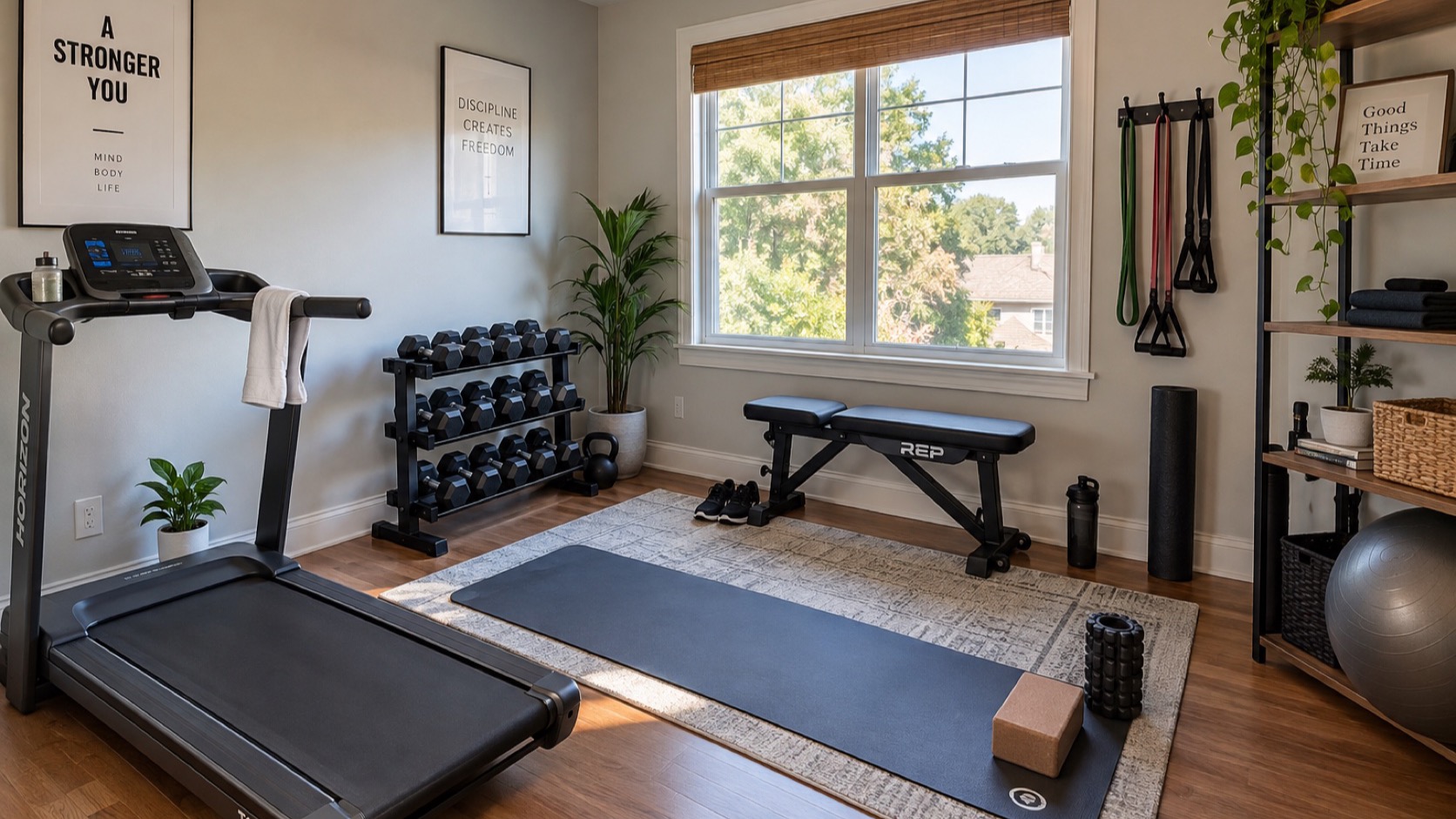
Friction Is the Quiet Enemy of Adherence
The strongest predictor of whether a program survives is whether it is easy to start. Habit research suggests new behaviors take weeks of repetition to automate (Lally 2010), and every minute of setup friction taxes that repetition — the decision to train is made at the moment of starting, not at the moment of planning.
- 📦 Setup cost is a decision cost — the twenty seconds of finding and laying out gear is where sessions are won or lost.
- 🏠 Home versus gym adherence is not the question — trials comparing home-based and center-based programs found comparable participation (Ashworth 2005); the question is whether your setup supports the habit.
- 🧭 The environment is the coach — implementation-intention research shows that linking a behavior to a cue — time, place, gear — strengthens follow-through (Gollwitzer 1999).
- 📉 Friction compounds silently — three skipped sessions a month because of setup is a 25% tax on the 2-Day Minimum the whole series is built around.
- 🧱 Walls are cheaper than willpower — every structural change, a hook, a tray, a kept-down mat, is a permanent decision made once that replaces a daily decision made tired.
Product picks are generic categories, not brands. We may earn a commission on Amazon or iHerb purchases at no cost to you — this never changes our evidence conclusions. Full disclosure
Doorway pull-up bar or suspension trainer
Can expand upper-body pulling options in a small home space.
⚠️ Incorrect installation or using an unsuitable door frame can cause falls; shoulder pain requires modification or assessment.
Check price on Amazon →The 90-Second Rule
The rule is simple: from decision to first rep should take ninety seconds or less. Anything slower is a friction problem, not a willpower problem — and unlike willpower, friction can be redesigned.
- ⏱️ Gear within arm's reach of the mat — bands on a hook, dumbbells on a tray, not in a closet across the room.
- 🚪 One anchor point per room — a doorframe anchor that stays mounted beats one that gets set up and taken down every session.
- 🧹 A ready floor — the mat lives down; a two-minute sweep is setup, and a swept floor is a standing invitation.
- 📉 Measure it once — time the transition from decision to first rep; if it exceeds ninety seconds, redesign the storage, not your motivation.
Rooms, Ranked by Setup Cost
The table ranks typical rooms by setup cost — the time and friction between deciding to train and training. The rankings are practical synthesis; your floor plan and housemates are the real referees.
| Room | What works | Friction notes | Verdict |
|---|---|---|---|
| 🛋️ Living room | Mat plus a doorframe anchor; dumbbells in a corner basket | Moves for guests; needs the five-minute reset after sessions | Good default |
| 🛏️ Bedroom | Mat beside the bed; bands on a closet hook | Private and quiet; low ceilings keep presses on the floor or incline | Quiet option |
| 🚗 Garage | Full bench and dumbbell setup; chalk-friendly floor | Temperature swings; needs lighting and a clear floor to be ready | Best if you have it |
| 🚪 Hallway | Doorframe anchor; wall-space squats | Narrow; blocks traffic at peak hours | Supplement only |
- 🛋️ The living room usually wins — floor space, a doorframe, and visibility all in one room.
- 🚗 The garage wins on space and loses on climate — and on the walk between the couch and the first set.
- 🚪 Hallways are supplements, not homes — narrow and trafficked; fine for a band anchor, wrong for a mat.
- 📐 The room decides the gear — the three equipment tiers page prices what fits each room.
- 🧭 The ranking changes with the season — the garage wins in spring, the living room in winter; a setup that can move between rooms is a setup that survives.
📦 Visible beats organized
Out of sight is out of routine. A hook on the door is a reminder; a bin in the closet is a cancellation notice. Open storage — hooks, baskets, a tray, a mat that stays down — keeps the gear in view without making the room look like a gym. The cue is part of the training, and the cue works best when it is already out.
Layered, breathable bedding
Can make it easier to adjust bedding during overnight warmth or temperature swings.
⚠️ Comfort response varies; it does not evaluate or treat persistent sleep disruption, hot flashes, or sleep apnea.
Check price on Amazon →Storage That Survives Daily Life
Storage has two customers: the workout and the rest of the household. The designs below serve both without turning the living room into a rack display.
- 🪝 Visible beats organized — a hook beats a bin because a bin hides the cue; the callout above is the whole philosophy.
- 🧺 Baskets over closets — open storage keeps the gear in sight without looking like a gym.
- 🪑 Furniture doubles as equipment — a sturdy chair is a box, a step, and a bench; the pattern library treats furniture as a legitimate tier.
- 📦 The five-minute rule for the rest — anything that cannot be reset in five minutes will not be reset, and an un-reset room is tomorrow's skipped session.
The Weekly Friction Ledger
Setup time is a weekly cost you can measure, and measuring it changes the design conversation. The chart is an editorial estimate of typical weekly setup and teardown minutes per tier, assuming a permanent anchor for bands and a mat that stays down.
- 📊 The ledger makes friction visible — two weeks of entries tell you which setup to change, and the answer is usually the storage, not the gear.
- ⏳ Permanent anchors are the highest-leverage purchase — a mounted door anchor removes the setup from every session for the life of the plan.
- 🧮 Weekly minutes convert to sessions — thirty minutes of weekly friction is a session's worth of effort spent before the first rep; the recovery math page explains why effort is a budget.
The Five-Minute Reset
The reset is the first rep of the next session. A room that returns to normal in five minutes gets used twice a week; a room that stays disassembled gets used occasionally.
- 🧹 Two minutes to return gear — bands to hooks, dumbbells to the tray, backpack to the hook.
- 🪑 One minute to fold and stand the mat — or leave it down if the room allows; a kept-down mat is the cheapest cue in this entire page.
- ⏲️ Thirty seconds to log the next session's pick — the full-body template page's log note becomes the room's instruction card.
- 🧽 Maintenance is setup in disguise — a monthly mat wipe and a yearly gear audit keep the setup trustworthy; broken bands and creaky anchors are friction you can see coming.
- 🔁 The reset is the first rep of next session — the 2-Day Minimum habit math depends on a room that is ready before you are.
Adjustable dumbbells
Allows progressive loading at home across common strength movements.
⚠️ Poor technique or rapid load increases raise injury risk; not required to begin moving more.
Check price on Amazon →Small-Space Wins Worth Stealing
- 🚪 The doorframe is a gym — an anchor, hooks, and a pull-up bar that doubles as a towel rack.
- 🪑 The chair is a rack — box squats, step-ups, and incline push-ups from one piece of furniture; see the equipment ladder for the rung logic.
- 🎒 The backpack is a load cell — carries and weighted push-ups without new gear, stored on a hook by the door.
- 📏 Measure the mat, not the room — a two-by-one-and-a-half-metre mat fits any floor, and the strength training after 40 pillar's whole case runs on that footprint.
- 🪞 A full-length mirror doubles as a form check — it lies less than memory, and in a bedroom it costs nothing extra.
Questions, Answered Briefly
- ❓ I have almost no floor space — can I still train? — Standing patterns and doorframe work need about a metre of clear floor; the equipment ladder page covers the zero-footprint options in detail.
- ❓ Should I buy storage furniture before gear? — Usually the reverse. Gear that stores itself, bands and a backpack, beats gear that needs furniture; storage problems are usually gear-choice problems in disguise.
- ❓ How do I handle housemates or family? — Schedule sessions like meetings and reset the room every time; the five-minute reset is also a peace treaty, and a predictable schedule makes the shared room predictable for everyone.
- ❓ Does visible gear look like clutter? — Open storage reads as intentional when it has a home, a hook, a basket, a corner; scattered gear reads as mess. The difference is the home, not the visibility.
The Bottom Line
- Setup friction, not equipment quality, decides whether sessions happen — the environment is the coach.
- The 90-second rule — decision to first rep — is the design target for storage and room choice.
- Visible, open storage beats organized closets — the cue is part of the training (Gollwitzer 1999).
- The five-minute reset keeps the room livable and the next session ready — it is the first rep of tomorrow.
Related Topics
- Lally et al., "How are habits formed: Modelling habit formation in the real world," European Journal of Social Psychology (2010)
- Ashworth et al., "Home versus center based physical activity programs in older adults," Cochrane Database of Systematic Reviews (2005)
- Gollwitzer, "Implementation intentions: Strong effects of simple plans," American Psychologist (1999)
- Gardner, "A review and analysis of the use of 'habit' in understanding, predicting and influencing health-related behaviour," Health Psychology Review (2015)