Building Power: The Quality That Fades First
The series has trained strength, muscle and bone. This folder trains the quality that leaves first: power — force delivered fast. It declines earlier and more steeply than strength, it underwrites ordinary moments like catching a stumble or rising off a low sofa, and it answers to training at every age studied so far. Five pages cover it: why it fades, what the trials measured, how to program fast-intent work, how to land safely, and how to test it at home.
What the evidence supports
- Power declines earlier and more precipitously than strength, and peak power tracks functional limitations in older adults (Reid & Fielding, 2012).
- Strength falls much faster than muscle mass: 2.6–4.1% per year by group against roughly 1% for leg lean mass in 1,880 older adults over three years (Goodpaster et al., 2006).
- Rate of force development is trainable in older adults with explosive-type and heavy-resistance work (Maffiuletti et al., 2016).
- Pooled randomized trials show power training with a modest edge over traditional strength training for physical function — the measured outcomes are function and power, not hard endpoints (recent meta-analyses, 2019–2022).
- Progressive plyometric and power protocols in older adults have not shown an increase in injuries in the studies that tracked them; the literature is small (Vetrovsky et al., 2019).
What remains uncertain
- No trial has shown that power training prevents a fall, injury, or disability. A multimodal RCT recorded fall rates but found no significant difference and could not isolate power training.
- Annual power-decline rates vary by measurement and population, so the field speaks in directions rather than a single curve.
- The optimal prescription is not settled: low-load and high-load power training have produced similar power gains in the small comparisons available.
- How much of power training's benefit is simply extra training, rather than something specific to speed intent, is not fully separated.
Evidence last reviewed: October 5, 2026. Conclusions may change as new research is published.
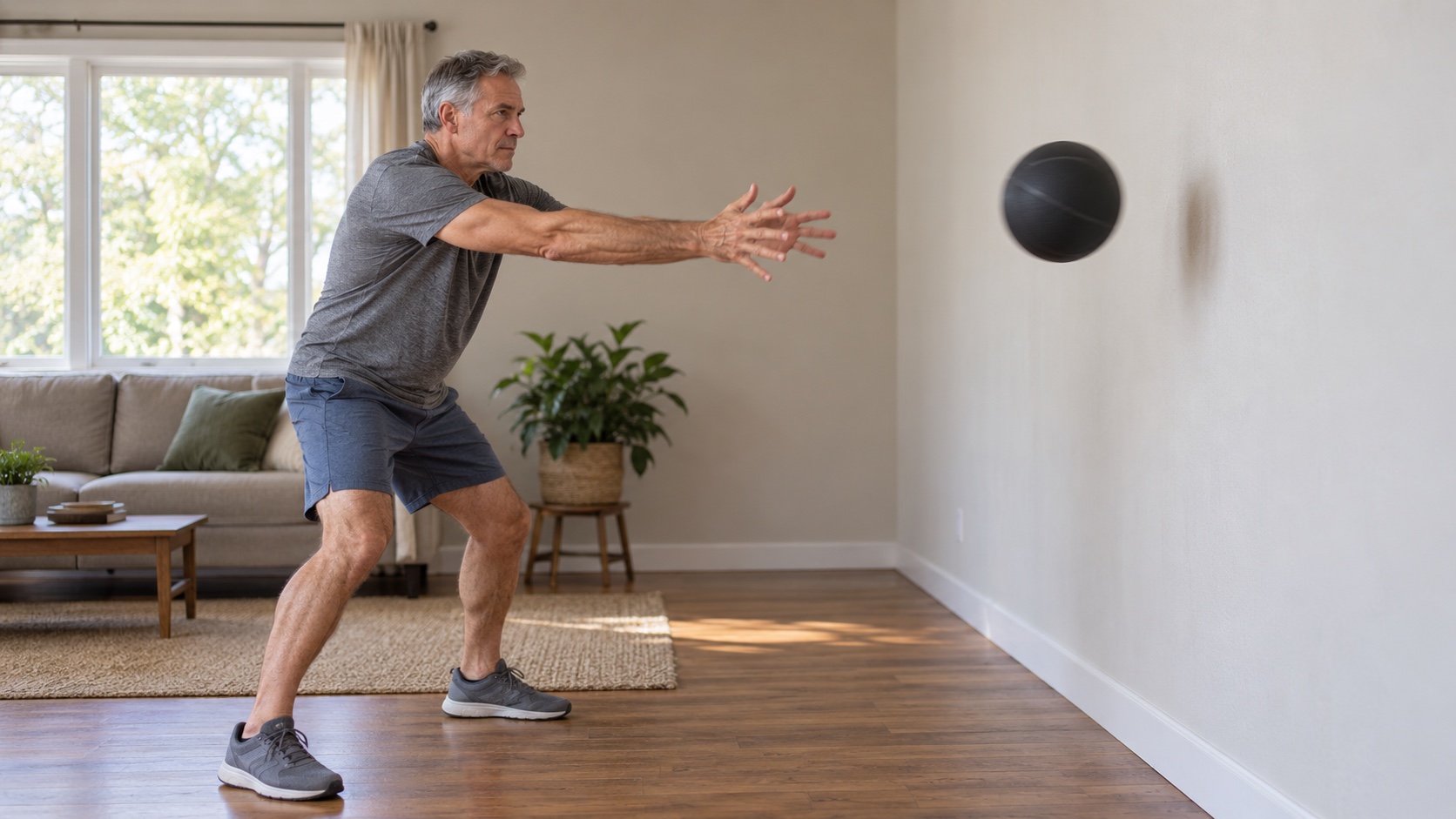
Two Halves of the Same Word
Strength and power are trained in the same room but they are not the same quality, and they do not age at the same rate.
- 🏋️ Strength is how much force a muscle can produce, however slowly — the number a heavy bar measures.
- ⚡ Power is that force multiplied by velocity — how much of it arrives in the half-second that matters.
- 🪜 Why the split matters practically: people can add strength and still move slowly, because slow-heavy and fast-light efforts lean on partly different physiology — fiber recruitment, firing rate, and how completely the muscle switches on in the first milliseconds.
Why Speed Goes First
The decline story is the reason this folder exists rather than a section inside the loading pages. Read the three numbers below as the folder's spine: they are the ones the sibling pages stand behind, each from a primary paper.
- ⏳ The order of loss: mass drifts away gradually, the capacity to convert what remains into fast force slides faster; power is documented as declining earlier and more steeply than strength.
- 🔌 The mechanism is part wiring: motor units grow fewer and larger, discharge rates fall, and fibers shift slower — much of that evidence is cross-sectional, which the subtopic says plainly.
- 🧓 Why it matters to a person, not a lab: the moment that decides whether a stumble stays a stumble is a fast, unplanned effort — no warm-up, no second attempt.
- 🚫 What is not claimed here: that training power prevents falls or disability. Cohorts link power to better daily function; trials have not tested the hard outcomes.
The Trials, in One Screen
The evidence base is modest and consistent, and its boundaries matter as much as its findings.
| Outcome | What the trials show | Confidence |
|---|---|---|
| ⚡ Muscle power | Power training improves power; comparisons generally favour it over traditional strength training for this quality | 🟢 Moderate — pooled randomized trials |
| 🚶 Physical function | A modest edge for power training over strength training on function tests in pooled analyses | 🟡 Low-to-moderate — small trials, heterogeneous protocols |
| 🧗 Falls & injuries | Progressive protocols have not shown increased injury rates; falls were not the measured outcome in most studies | 🟡 Preliminary — safety signal only |
| 🏥 Disability, hospitalisation, mortality | Not assessed in pooled power reviews; one multimodal trial found no significant falls-rate difference | ⚪ Untested |
🔎 Read the endpoints, not the enthusiasm
"Power training improves function" is supported. "Power training keeps you independent" is a reasonable hope that has not been tested as an outcome. The distinction is worth keeping because it changes what you expect from the work — better movement now, not a promise about your future.
The Programming, Condensed
There is a full programming page in this folder; the version a reader needs in thirty seconds is below. Loads, sets and rests are labelled where they are coaching convention rather than trial-verified prescription.
- 🏃 Intent beats load. Light-to-moderate loads moved with the intent to accelerate train power; grinding a heavy bar slowly trains something else. Common ranges sit around 30–60% of a one-rep max at maximal velocity intent — convention, supported by physiology more than by head-to-head trials.
- ⏱️ Short sets, full recovery. Roughly 3–6 quality reps, stop a set when speed visibly drops, and rest long enough that the next set is fast again. Fatigue is the enemy of this quality.
- 📍 Placement matters. Power work goes after the warm-up and before fatiguing volume, while you are fresh.
- 🧱 Speed before load, load before complexity. Add velocity intent to movements you already own, then add weight, then add jumps — in that order.
- 🪑 Equipment is minimal: a chair, a wall, a step, optionally a light dumbbell or a small ball.
Where It Fits in the Week
Power work does not need its own day. It slots into the sessions you already have, as long as it goes in fresh rather than after heavy volume.
- 🗓️ Two exposures a week is the usual starting dose — the pooled trials ran two to three sessions per week, mostly supervised, and two is enough to make progress while strength work continues.
- 📥 Front of the session — after the warm-up, before the heavy sets; speed work done after eight sets of squats trains fatigue tolerance instead.
- ⏳ Ten minutes is a real dose — three to five short efforts with full recovery fit into the start of an ordinary lifting day without extending it.
- 🔁 Keep the movements stable for weeks — progress the intent and the load, not the exercise menu; variety is the enemy of learning a fast movement pattern.
A Field Number Worth Knowing
The folder's testing page covers three home tests. The five-times sit-to-stand is the one to know first, because it measures the same quality this topic trains — how fast you rise — and published reference values exist for older adults.
Run it the same way each time — same chair height, same footwear, arms crossed or free as you choose but consistently — and watch the trend across eight to twelve weeks rather than any single morning's score.
Landing Safely, in Short
- 🪜 Build the ladder in rungs: speed reps on the floor, then step-downs and step-ups, then small hops in place, then small hops forward. Weeks per rung, not days.
- 🤫 Quiet landings are the skill: knees tracking over toes, hips back, feet flat, minimal noise — the sound is the feedback.
- 🛑 Skip impact entirely if you have symptomatic joints, a recent injury, osteoporosis, or a clinician's instruction against it; the speed-rep layer still works without leaving the ground.
- 👀 Supervision earns its place the first time you jump, or if you cannot tell whether your landing is quiet.
Testing It at Home
Three field tests cover the quality well enough for personal tracking: the five-times sit-to-stand (speed of rising), the 30-second chair stand (endurance-adjacent, kinder to people with balance concerns), and — only if you already jump safely — a countermovement jump. The testing page explains the protocols, the repeatability rules and what a single score cannot tell you.
What This Folder Does Not Claim
- 🚫 No fall prevention claim. Most pooled power trials measured function, not falls. A separate multimodal Osteo-cise RCT measured falls but found no significant rate difference and cannot isolate power training.
- 🚫 No replacement claim. Power work does not replace strength training, protein, or the rest of the series — it is a quality added to them.
- 🚫 No universal prescription. The dose ranges are conventions; the trials have not settled the optimum, and the honest pages say so.
- 🚫 No jumping for everyone. Impact is optional; speed intent is the non-optional part.
How This Folder Was Built
Each page's numbers were checked against primary sources — cohort papers for the decline data, systematic reviews for the training effects, and the position stands behind the load ranges. Where a figure could not be verified, the page says "convention" or "not quantified" rather than dressing a coaching norm as a trial result. Where evidence stops — demonstrating prevention of falls, disability, or mortality — every page says so. A trial that measures falls without a significant difference is not evidence of prevention; observational and physiological reasoning is labeled separately.
Questions, Answered Briefly
- ❓ Is power training just lifting lighter weights fast? Roughly, at the start — light-to-moderate loads moved with intent to accelerate. Jumps and throws are the more developed versions, not the entry point.
- ❓ Do I have to jump? No. Speed reps on the floor train the same quality without impact; the ladder exists for people who want the jump versions and can do them safely.
- ❓ How often? Twice a week fits alongside strength work; the trials ran two to three sessions per week, usually supervised.
- ❓ Is it too late at 70 or 80? The pooled trials included adults well past 60, and the reviews see responsiveness across old age. Less reserve means slower progress, not none.
- ❓ Will this keep me from falling? That is the hope and a reason some people train it, but prevention has not been demonstrated: a multimodal trial recorded falls without a significant rate difference and cannot isolate power training. Training may improve qualities used in stumble recovery, but an individual fall-risk benefit is unknown.
The Bottom Line
- Speed leaves before strength — power declines earlier and steeper, and strength itself falls about three times faster than the muscle mass behind it.
- The trials support function, not fate — pooled trials show modest functional gains from power training; falls were not assessed in the pooled comparisons; the Osteo-cise multimodal RCT recorded falls but found no significant difference and cannot isolate power training.
- The dose is simple, the labels are honest — light-to-moderate loads with speed intent, short sets, full recovery; the load ranges are convention, and the pages say so.
- Impact is optional, intent is not — the floor version works; the ladder to small hops is for those who can do it safely.
- You can measure it at home — the five-times sit-to-stand and its relatives track the quality, as long as you watch the eight-week trend rather than a single number.
Go Deeper: Subtopics
- 🔎 Why Power Declines First — why speed leaves before strength, and what the decline looks like after 60. Read it →
- 🔎 What the Trials Show — what the pooled randomized trials measured — and never measured. Read it →
- 🔎 The Programming Rules — light loads, fast intent, short sets and where power work sits. Read it →
- 🔎 Landing Safely — the progression ladder from floor speed to small hops, and who skips impact. Read it →
- 🔎 Testing Power at Home — three field tests, reference values and how to track the trend. Read it →
Related Topics
- Gianoudis J, et al., “Effects of a Targeted Multimodal Exercise Program Incorporating High-Speed Power Training on Falls and Fracture Risk Factors in Older Adults,” Journal of Bone and Mineral Research (2013), 12-month Osteo-cise RCT (n=162); falls IRR 1.22 (95% CI 0.72–2.04), not statistically significant; the multimodal design cannot isolate power training.
- Reid KF, Fielding RA, "Skeletal muscle power: a critical determinant of physical functioning in older adults," Exercise and Sport Sciences Reviews (2012)
- Goodpaster BH, Park SW, Harris TB, et al., "The loss of skeletal muscle strength, mass, and quality in older adults: the Health, Aging and Body Composition study," Journals of Gerontology Series A (2006)
- Metter EJ, Conwit R, Tobin J, Fozard JL, "Age-associated loss of power and strength in the upper extremities in women and men," Journals of Gerontology Series A (1997)
- Hunter SK, Pereira HM, Keenan KG, "The aging neuromuscular system and motor performance," Journal of Applied Physiology (2016)
- Maffiuletti NA, Aagaard P, Blazevich AJ, et al., "Rate of force development: physiological and methodological considerations," European Journal of Applied Physiology (2016)
- Balachandran AT, Steele J, Angielczyk D, et al., "Comparison of power training vs traditional strength training on physical function in older adults: a systematic review and meta-analysis," JAMA Network Open (2022)
- Bandeira-Guimarães M, et al., "Optimal intensity of power training in older adults: a scoping review," Sports Medicine Open (2023)
- Vetrovsky T, Steffl M, Stastny P, Tufano JJ, "Is plyometric training safe for older adults? A systematic review," Sports Medicine (2019)
- Chodzko-Zajko WJ, et al., "American College of Sports Medicine position stand: exercise and physical activity for older adults," Medicine & Science in Sports & Exercise (2009)
- Bohannon RW, "Reference values for the five-repetition sit-to-stand test: a descriptive meta-analysis of data from elders," Perceptual and Motor Skills (2006)