Landing Safely: Progression and Joints
Speed reps, small steps and — for some bodies — modest hops: that is the impact half of power training, where joints and tendons do their hardest work. This page walks the ladder rung by rung, sets out the landing cues that matter, and draws the safety line honestly: who should skip impact entirely, and when supervision is worth it.
What the evidence supports
- A 2019 systematic review in Sports Medicine pooled 12 studies of low-volume plyometric training in adults 60 and older (289 participants); no study reported increased injuries or adverse events (Vetrovsky 2019).
- A 2018 meta-analysis of jump training in healthy adults aged 50 and older — nine studies, thirteen training groups — found moderate gains in muscular power and a single acute injury across the pooled studies (Moran 2018).
- The safety record belongs to progressive protocols — small doses, built over weeks to months, generally supervised. It does not extend to maximal jumping or athlete-style plyometrics.
What remains uncertain
- Almost every study enrolled healthy older adults; people with painful joints, recent injuries or osteoporosis were largely excluded — the data barely speak to them.
- Whether unsupervised protocols are as safe is untested, and no trial speaks to joint health over years.
- Whether jumping is even needed is open — the power-vs-strength function trials (20 trials, 566 participants) mostly skipped impact (Abou-Setta 2022).
Evidence last reviewed: October 5, 2026. Conclusions may change as new research is published.
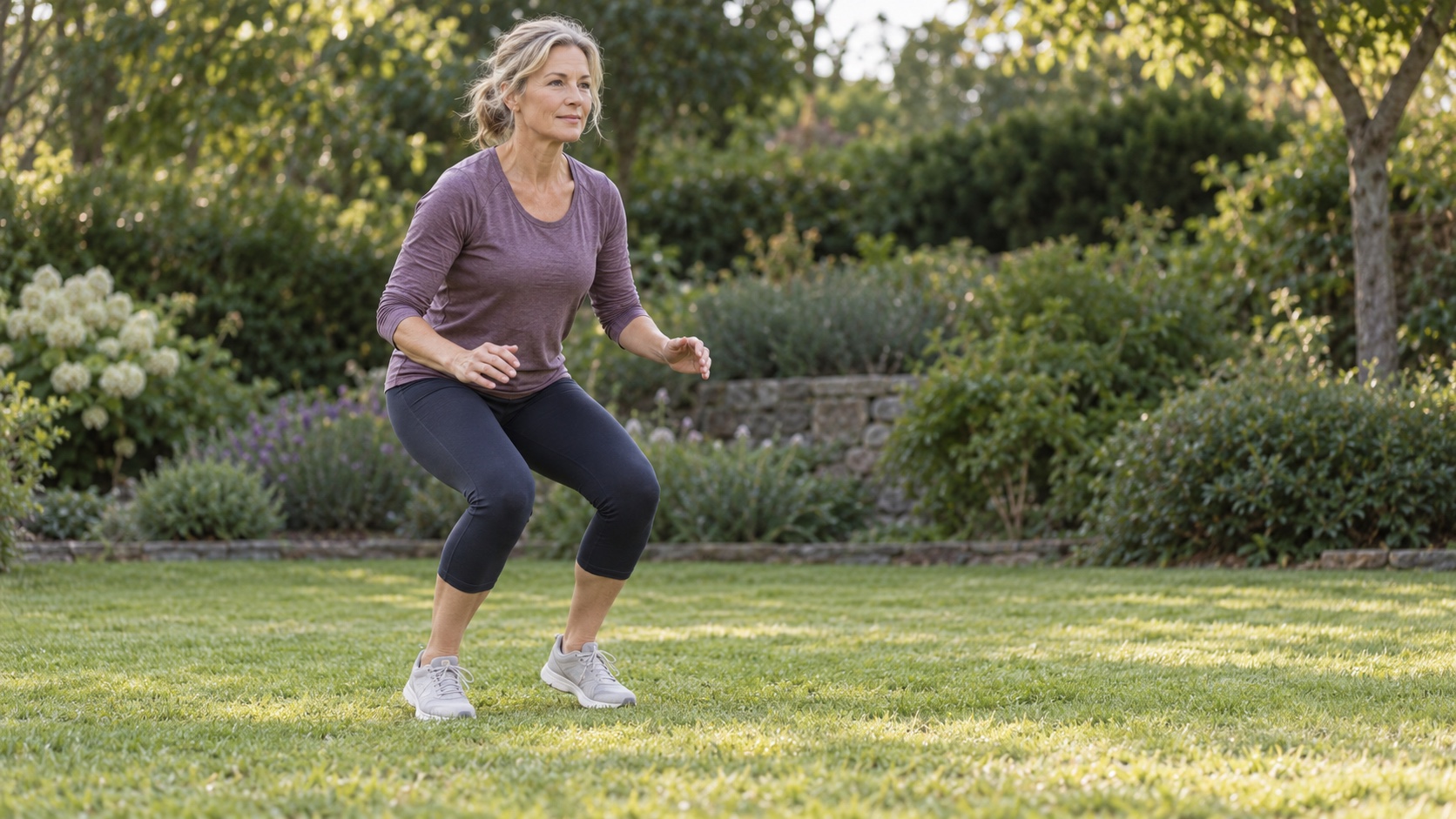
Why Impact Is the Part People Get Wrong
Power work on the floor is muscle work. Leave the ground and every repetition adds a landing — and the landing, not the takeoff, is where the forces concentrate. In a fraction of a second the body absorbs a multiple of its own weight, and joints, tendons and connective tissue take that load in a compressed window. The usual mistake is not jumping; it is skipping the progression and borrowing the athlete versions — depth jumps, high boxes — with no safety record in unprepared bodies.
- 🪂 The landing is the cost — the landing is a rapid deceleration the legs, hips and spine absorb; quieter, longer absorptions spread the same force over more time.
- 🧱 Tendons work on a slower clock — muscle recovers in days; tendon and bone adapt over weeks and months. Impact tolerance is built, never assumed.
- 🪜 The ladder is the point — every protocol with a safety record here was low-volume and progressive (Vetrovsky 2019); each rung rehearses deceleration at a speed the tissues tolerate.
The Ladder, From Floor to Air
Five rungs, five jobs: from fast muscle work with both feet planted to small hops with air time — one rung at a time, weeks, not days. If a rung feels uncomfortable or sounds loud, the fix is time on the rung below.
| Rung | What it is | Move on when | Stop signals |
|---|---|---|---|
| 🪑 Speed reps in place | Fast, light reps of a movement you already own — chair stands, say; feet planted, no flight. | Quick reps stay smooth, even and pain-free. | ⚠️ Joint ache outlasting the session; unevenness that will not clean up. |
| ⬇️ Step-downs | Slow, controlled lowering from a low step — the second half of a landing, rehearsed alone. | You lower slowly, quietly and evenly, hips level. | ⚠️ The knee drifts inward; the step feels like a fall. |
| 📦 Low box step-ups | Stepping onto a low box and down with soft, unhurried contact. | Step-downs feel stable and quiet; single-leg work is familiar. | ⚠️ The step down thumps or cannot stay quiet. |
| ⬆️ Small hops in place | The first flight phase: tiny two-foot hops, landing in the same spot. | Hops stay quiet and even across a short set. | ⚠️ Landings get louder through the set; a joint pinches. |
| ➡️ Small hops forward | Small forward hops — a little direction, a little more demand. | Forward hops stay as quiet as the in-place version. | ⚠️ Quiet disappears or confidence drops; stumbles are data. |
The stop column outranks the rest: a rung that hurts, swells or gets louder overnight means stepping down and rebuilding — rushing the ladder is the one move every rung argues against.
Landing Mechanics That Matter
Landing is a skill with one honest scoreboard: noise. Quiet means the deceleration spread over more time and more muscle; a thump means the stop happened all at once, with joints catching the surplus. These cues are standard jump-landing coaching — practice-based, not trial-tested — and most apply on every rung.
| Cue | What it trains | The check |
|---|---|---|
| 🤫 Land quiet | A longer absorption window — noise measures abruptness. | You barely hear the contact. |
| 🦵 Knees over toes | Knee alignment under load — forward over the foot, not caving in. | Kneecaps track over the middle toes. |
| 🍑 Hips back | Sitting into the landing instead of dropping onto the knees. | Chest leans forward; hips reach back. |
| 🦶 Whole foot | A stable base — ball of the foot settling flat, not riding up on the toes. | The foot lands ball-to-flat and stays down. |
| ⏸️ Absorb, then rise | Post-landing control: proof the depth was chosen. | You can pause before standing up. |
None of this asks for athleticism; it asks for patience — and if you cannot tell whether your landing is quiet, that is useful information.
🦵 Quiet landings, unhurried ladder
The landing should sound softer than the takeoff, and the ladder should take longer than you want. Every protocol with a safety record in older adults was small, slow and supervised; rushing the rungs is how a good idea becomes a joint problem.
Volume Discipline
Impact work is measured in quality, not sweat. The jumping in the pooled research was small: a few reps per set, full recovery, upper limits around ten jumps per set for adults fifty-plus (Moran 2018). None of it was work to fatigue — fatigue is where the skill degrades and landings get loud.
- 🎯 Reps stay crisp — ten jumps per set was a ceiling, not a target (Moran 2018); end the set while every rep still matches the first.
- ⏱️ Rest fully — jumping uses the same fast energy system as heavy lifting — a minute or more between sets, until breathing and legs are quiet.
- 🛑 Stop before fatigue — grinding late reps trains sloppy landings — loading without practice.
- 🗓️ Space it out — up to three short sessions a week was the pooled ceiling; fewer — or none in a heavy week — is fine.
Who Should Skip Impact
The clean safety record has an asterisk: the studies enrolled healthy, community-dwelling older adults (Vetrovsky 2019). If any of the following applies, the flying rungs are off the menu — floor-level speed work may still be available within professional limits.
- 🦴 Osteoporosis, or a clinician's instruction against impact — fragile bone and hard landings are a combination to leave alone; if you have been told to avoid impact, that stands.
- 🦵 Symptomatic joints — knees, hips or a back that hurt in activity or flare afterwards: settle the symptom first — the impact rungs wait. Persisting pain is a reason to see someone, not to train through.
- 🩹 Recent injury — anything recently torn, strained or repaired: impact reloads tissue before its time, and the calendar that counts is a clinician's.
- 💪 No strength base yet — jumping adds to a strength foundation; it is not a shortcut around one. The Resistance Training protocol covers that base.
- 🫀 Cardiac symptoms or a history — chest discomfort, breathlessness at low effort, or a known heart condition: intense work, impact included, belongs in a clinician's plan — not a web page's.
And say it plainly: the pooled power-training reviews did not measure falls. A separate multimodal Osteo-cise trial in 162 older adults recorded falls but found no significant rate difference; it cannot isolate the effect of power training or jumping. Age alone is not the veto either: the reviews ran into the late seventies, but "eligible for the studies" and "ready today" are different questions.
When Supervision Is Worth It
One detail is easy to miss: the protocols were generally run under supervision (Vetrovsky 2019). Mechanics are hard to feel from the inside; a coach or clinician can see in one set what self-assessment misses for months.
- 🧑🏫 Your first jumps — one supervised session beats a season of guessing; a physiotherapist or qualified coach who works with older adults is the right hire.
- 🔁 An injury history — a repaired knee, a cranky hip or a tricky back deserves professional eyes before it takes on impact.
- 👂 You cannot hear your own landing — some people genuinely cannot tell whether their contact is quiet; an observer settles it in minutes.
- 🏠 No supervision available — stay a rung lower, keep volume tiny, and film a set — the camera answers the one question that matters: is the landing quiet?
This is one of five pages in the series: Why Power Declines First makes the case, The Programming Rules sets the weekly structure, Testing Power at Home measures where you stand, and What the Trials Show keeps score of the research. Progressive Overload covers adding stimulus without rushing; the parent Building Power topic holds the series together.
Questions, Answered Briefly
- ❓ Do I have to jump at all? — No. Speed is the quality; flight is optional. Fast floor reps train much of what jumping trains — and the pooled power-vs-strength trials mostly skipped impact (Abou-Setta 2022).
- ❓ Is jumping bad for my knees? — Not in the studies: progressive protocols reported no increase in injuries among healthy older adults (Vetrovsky 2019). But "safe in healthy volunteers" is not "safe for every knee" — symptomatic joints should skip impact.
- ❓ How do I know a rung is finished — and how long does the ladder take? — A rung is done when it stays quiet, even, pain-free and a little boring across several sessions; the studied protocols ran weeks to months, and the top rung is not mandatory.
- ❓ What if I get sore after a session? — Soreness that fades within a few days is common. Joint pain, swelling or lingering soreness is a stop signal: step down a rung, and see someone if it persists.
- ❓ Does any of this prevent falls? — The pooled comparisons did not assess falls. Osteo-cise (162 older adults) recorded falls in a multimodal program but found no significant difference (IRR 1.22; 95% CI 0.72–2.04); that result cannot isolate jumping or power training.
The Bottom Line
- Landings, not takeoffs, are where impact work loads joints and tendons — make the landing the skill you practice.
- Climb one rung at a time, weeks per rung; the studied versions are low-volume and progressive (Vetrovsky 2019).
- Keep sets small and rests full — stop while every repetition still matches the first (Moran 2018).
- Skip impact with symptomatic joints, recent injury, osteoporosis or a clinician's instruction against it, and supervise your first jumps.
Related Topics
- Gianoudis J, et al., “Effects of a Targeted Multimodal Exercise Program Incorporating High-Speed Power Training on Falls and Fracture Risk Factors in Older Adults,” Journal of Bone and Mineral Research (2013), Osteo-cise RCT; no significant falls-rate difference, multimodal design.
- Vetrovsky, Steffl, Stastny & Tufano, "The Efficacy and Safety of Lower-Limb Plyometric Training in Older Adults: A Systematic Review," Sports Medicine (2019)
- Moran, Ramirez-Campillo & Granacher, "Effects of Jumping Exercise on Muscular Power in Older Adults: A Meta-Analysis," Sports Medicine (2018)
- Abou-Setta et al., "Comparison of Power Training vs Traditional Strength Training on Physical Function in Older Adults: A Systematic Review and Meta-analysis," JAMA Network Open (2022)
- Chodzko-Zajko et al., "American College of Sports Medicine position stand: exercise and physical activity for older adults," Medicine & Science in Sports & Exercise (2009)