Protein: The Muscle-Building Half of the Protocol
You can lift perfectly and still build nothing if the bricks aren't delivered. Protein is the substrate this protocol leans on — the dose, the distribution, and the honest ranking of sources.
What the evidence supports
- Meta-analysis puts the muscle-building plateau around 1.6 g/kg/day, with 2.2 g/kg as a defensible upper target for hard-training or dieting lifters.
- Protein spread across meals in ~30–50 g servings supports synthesis better than one or two big hits.
- Older adults may need more protein per meal — anabolic resistance makes each feeding less efficient.
What remains uncertain
- Whether peri-workout timing matters beyond total daily intake is genuinely contested; total intake wins the meta-analyses.
- The ideal ceiling (2.2 g/kg vs higher) for lean-mass preservation during large calorie deficits is under-studied.
Evidence last reviewed: August 13, 2026. Conclusions may change as new research is published.
The Dose: 1.6–2.2 g/kg
- 📐 The number — 1.6–2.2 grams of protein per kilogram of bodyweight per day. An 80 kg adult: roughly 130–175 g.
- 📊 The plateau — a 2018 meta-analysis of 49 trials found gains plateaued around 1.6 g/kg/day; more helped mainly in energy deficits or advanced lifters.
- ⚖️ The range's ends — 1.6 is the efficient floor; 2.2 covers dieting, aging, and hard-training cases with little downside beyond calories.
Product picks are generic categories, not brands. We may earn a commission on Amazon or iHerb purchases at no cost to you — this never changes our evidence conclusions. Full disclosure
Adjustable dumbbells
Allows progressive loading at home across common strength movements.
⚠️ Poor technique or rapid load increases raise injury risk; not required to begin moving more.
Check price on Amazon →Distribution: 30–50 g Per Meal
- 🍽️ The serving — roughly 30–50 g of protein per meal, 3–4 times a day, keeps muscle protein synthesis ticking.
- 🔑 Why — a single feeding's muscle-building response saturates somewhere in that range; more in one sitting mostly adds calories, not muscle.
- 🌅 Don't skip breakfast protein — a protein-light morning can't be made up at dinner; the per-meal ceiling applies at every meal.
- 🥤 Shakes count — a whey shake is a meal's worth of bricks when food is inconvenient, not an extra on top.
Source Ranking
| Source | Serving | Protein | Notes |
|---|---|---|---|
| 🥛 Whey powder | 1 scoop (30 g) | ~24 g | Complete; the fastest leucine delivery — the convenience option |
| 🍗 Chicken breast | 150 g cooked | ~31 g | Complete and lean; the workhorse |
| 🐟 Salmon | 150 g | ~30 g | Complete, plus omega-3s; fish 2–3× weekly fits the nutrition pillar |
| 🥛 Greek yogurt | 200 g | ~20 g | Complete; slow-digesting casein — a sensible before-bed choice |
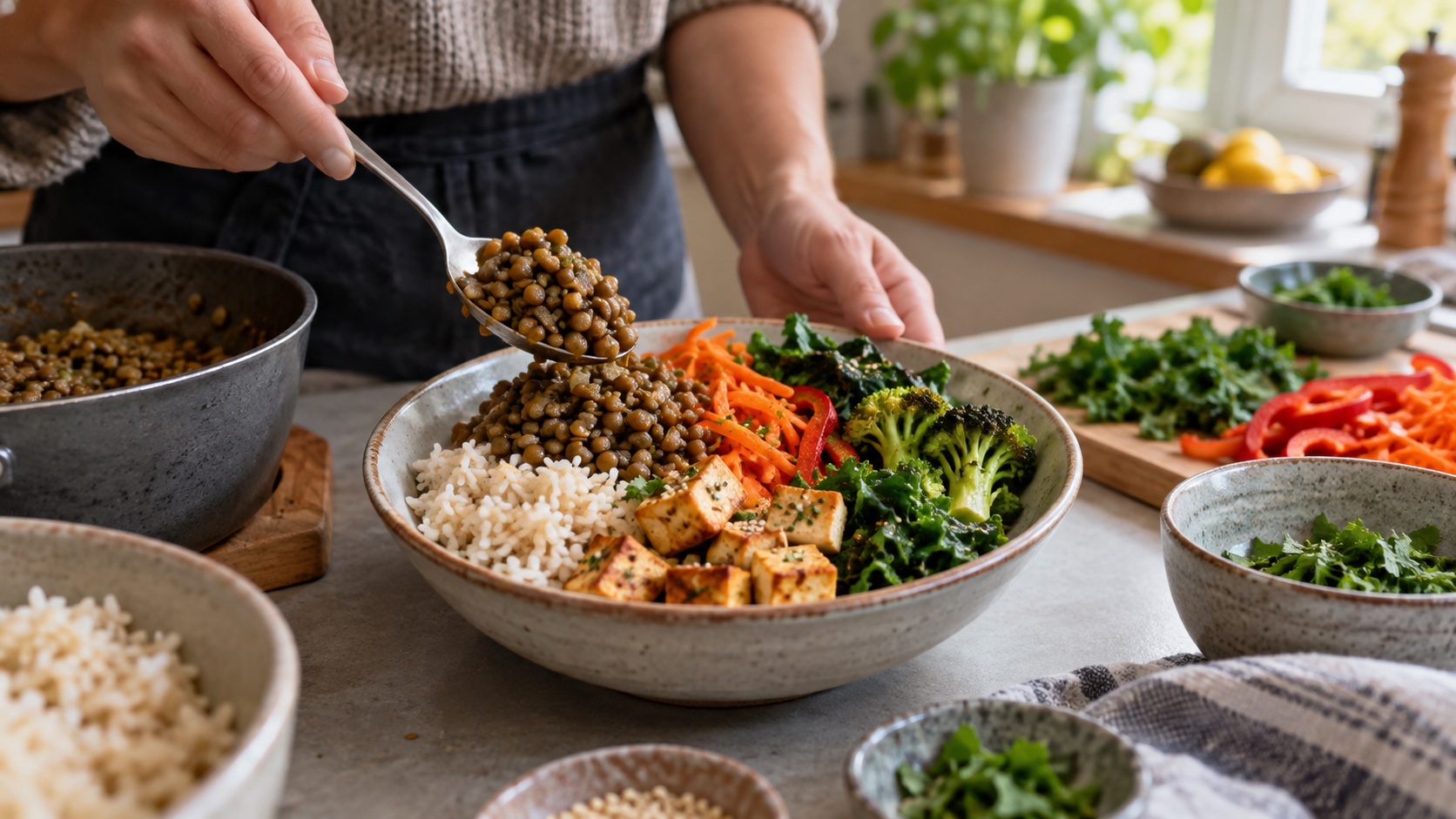
| 🫘 Tofu (firm) | 150 g | ~17 g | Complete but lower leucine density; eat a bigger portion |
| 🥣 Lentils (cooked) | 250 g | ~18 g | Incomplete (pair with grains); more volume per gram |
Timing: Total Daily Wins
The "anabolic window" is mostly marketing — here is what timing research actually shows.
- 🏆 Total first — total daily protein consistently outranks timing in the meta-analyses. Hit the day, then optimise.
- 🍳 Around the workout — a protein meal within a few hours either side of training is sensible and sufficient; a 30-minute "window" is not supported.
- 🧾 The honest order — daily total → per-meal distribution → timing. Optimise in that order.
Protein and Aging
- 🧬 Anabolic resistance — older muscle responds less to each protein feeding; the same dose triggers less synthesis than it did at 25.
- ⚖️ The fix — slightly higher per-meal doses (~40 g) and the upper end of the 1.6–2.2 g/kg range are the standard accommodation.
- 🏋️ Lift anyway — resistance training restores the muscle's sensitivity to protein; the two interventions multiply, neither substitutes.
- 📚 The evidence — human trials support higher targets in older adults; the ~40 g per-meal figure comes from acute synthesis studies.
Hitting the Target Plant-Based
- 🌱 Mix sources — grains plus legumes across the day complete the amino acid picture; soy (tofu, tempeh, edamame) is complete on its own.
- 📈 Portion up — plant sources carry less protein per 100 g; portions must grow with the plate.
- 🥄 Leucine attention — favour leucine-rich picks (soy, lentils, seitan) or slightly higher totals.
- 📊 Do the numbers once — hitting 1.6 g/kg plant-based takes planning; a pea or soy shake closes the gap on busy days.
The Sources People Misjudge
Most people over-credit foods that look protein-rich and under-credit the ones that quietly carry the day. A few honest numbers prevent most shortfalls before they compound:
| Food | The honest grams | The trap |
|---|---|---|
| 🥚 2 large eggs | ~12 g | Counted as a full serving — it's half of one; add yogurt or a third egg |
| 🥜 30 g peanut butter | ~7 g | A fat with a protein cameo, not a protein source |
| 🥯 A large bagel | ~10 g | Looks substantial; adds mostly carbs, not bricks |
| 🥛 250 ml milk | ~8 g | Helpful, but a latte is not a protein meal |
| 🧀 200 g cottage cheese | ~22 g | The underrated staple — a full serving in one bowl |
| 🐟 1 can of tuna | ~25 g | Budget-friendly and shelf-stable — the pantry and travel ally |
Run your usual day through this table once — the shortfall usually announces itself at breakfast and in the snacks.
- 📋 The audit habit — once a month, list yesterday's foods with their real gram values. Ten minutes, and the drift shows itself before the gym or the scale does.
- 🍳 The breakfast rule of thumb — if the first meal of the day can't name at least 25 g, it needs a second source. One egg, a spoon of peanut butter, and toast do not add up to a serving.
Resistance bands
A low-space way to begin or supplement resistance training.
⚠️ Bands can snap and unstable anchoring can cause injury; stop movements that provoke pain.
Check price on Amazon →The Daily Protein Plan
The dose is a day-long engineering problem: for an 80 kg adult, roughly 130–175 g, spread across three or four feedings of 30–50 g. Laid out as a default day, it stops being a chore and becomes a habit. Scale the servings to your own number — the four feedings, not the specific menu, are what carry the result.
| Meal | The default plate | Protein | Why it's there |
|---|---|---|---|
| 🌅 Breakfast | 200 g Greek yogurt + oats, or 3 eggs + toast | ~25–30 g | Sets the per-meal floor early — a protein-light morning can't be repaid at dinner |
| 🍽️ Lunch | 150 g chicken or tofu, rice, vegetables | ~30 g | The workhorse meal — the day's largest single feeding, batch-cooked ahead |
| 🏋️ Around training | Whey shake or 200 g yogurt within a few hours of lifting | ~25 g | Convenience, not magic — it counts toward the total, it isn't extra |
| 🌙 Dinner | 150 g salmon or lentils + grains | ~30 g | Fish 2–3× weekly fits the nutrition pillar; a slower option before bed |
| 🥄 The top-up | If the day ends short: one shake or a bowl of yogurt | ~25 g | The safety valve — audit why you came up short, don't just patch it nightly |
A working default, not a menu mandate — the grams per meal are what matter.
- Fix the number first — 1.6 × your bodyweight in kg, rounded up. Write it somewhere visible once; it doesn't change week to week.
- Anchor breakfast at ~30 g — eggs, yogurt, or a shake. The morning meal is the one people skip, and the one that sets the day's tone.
- Build lunch as the biggest feeding — a palm-plus of chicken, fish, tofu, or tempeh. Batch-cook it on Sunday and lunch takes ninety seconds.
- Put dinner on the 30–50 g rail — meat, fish, or legumes plus grains. The evening meal is where most people finally close out the day's total.
- Count the day backward before bed — short by 25 g? One shake or yogurt bowl closes the gap. The top-up is the repair, not the strategy.
- Recompute monthly — if the scale moves 2+ kg either way, redo the 1.6× math. The plan follows the body, not the other way around.
Where the Evidence Lives
This page is the operational layer — the dose here is a summary. The pillars own the science it rests on:
- 🥩 The dose-response and leucine mechanics — the Nutrition pillar's protein topic owns the full literature: per-meal synthesis data, source comparisons, and the health-span caveats.
- 💪 Why muscle after 40 matters at all — Strength Training After 40 makes the case this dose serves; the substrate only matters if the lifting happens.
- 🩺 Strength as a vital sign — Hidden Vital Signs shows what grip and leg strength predict; protein is the fuel behind those numbers.
- 🧘 Tendons and connective tissue — Stability & Mobility covers the joint and tendon side of training; those tissues need protein and load on the same schedule.
- 😴 The night shift — Sleep: The Science of Repair owns the recovery window: much of the muscle-building response lands while you sleep, and protein sets the table for it.
What to Do When It Goes Wrong
Protein plans fail in five predictable ways — and each has a fix that keeps the lifting intact.
- 🚩 You're never hungry enough for four feedings — appetite loss makes big protein meals feel like punishment. Shrink the meals and keep the servings: whey in coffee, half a yogurt, a boiled egg between tasks. Liquids are the low-appetite lifter's friend — 30 g from a shake needs no appetite at all.
- 🚩 Meat and fish are wrecking the grocery budget — expensive sources are a choice, not a requirement. Eggs, dairy, canned fish, tofu, lentils, and whey powder are among the cheapest grams available; rotate the pricey cuts to weekends and let the staples carry the weekdays.
- 🚩 You're plant-only and the math isn't closing — portion up and leucine-check: grains plus legumes complete the picture, soy stands alone, and a pea or soy shake closes the gap on busy days. Aim for the upper half of the range — plant protein is less efficient per gram, so the total needs headroom.
- 🚩 Protein makes you bloated or uncomfortable — digestive trouble usually traces to one source, not protein itself. Swap whey concentrate for isolate or a plant blend, split servings into four smaller ones, and eat slower. If dairy is the trigger, lactose-free options or non-dairy sources hold the same grams.
- 🚩 Travel keeps breaking the streak — protein travels: shake sachets in the carry-on, yogurt and eggs at any hotel breakfast, hard-boiled eggs and jerky from any gas station. Plan the first and last meal of each day deliberately and let the middle be imperfect — the week's total is what counts.
Questions, Answered Briefly
- ❓ Is more protein better? — Up to ~2.2 g/kg there's little downside beyond calories. Past that, extra protein is mostly expensive fuel: the muscle-building gains plateau around 1.6 g/kg.
- ❓ Can I eat all my protein in one big meal? — Not efficiently. The per-meal response saturates around 30–50 g; the rest of a heroic dinner is mostly calories, not muscle signal. Spread the feedings.
- ❓ Do I need protein powder? — No. Powder is a convenience for short days, travel, and low appetite. Whole foods carry the plan; the powder is the patch, not the program.
- ❓ Will this hurt my kidneys? — In people with healthy kidneys, intakes up to and beyond 2.2 g/kg show no kidney damage in the available evidence. With existing kidney disease, talk to a clinician before changing intake.
This Page in One Workflow
- Compute — 1.6 × kg bodyweight; write the number once.
- Structure — four feedings of ~30–50 g: breakfast, lunch, around training, dinner.
- Stock — three staples you'll actually eat, one of them batch-cooked.
- Run — eat to the day's total; timing is a detail, the total is the job.
- Audit — nightly top-up if short; monthly recompute if weight moved.
🔬 The deep dive
The Nutrition pillar's protein topic owns the full dose-response literature, the leucine mechanics, and the health-span caveats. This page is the training-relevant summary — go there for the receipts.
The Bottom Line
- 1.6–2.2 g/kg daily — the meta-analytic plateau and its sensible ceiling.
- Split it: ~30–50 g per meal across 3–4 meals — per-meal saturation is real.
- Total daily intake beats timing — the anabolic window is mostly mythology.
- Aging raises the bar — ~40 g per meal and the upper range; and keep lifting.
The Daily Checklist
- Day's protein number known before breakfast — 1.6 × kg, already written down
- Breakfast carried ~30 g — eggs, yogurt, or a shake
- Three or four feedings of 30–50 g across the day, none skipped
- Post-training meal within a few hours — food or shake, counted in the total
- Evening total checked — short by 25 g? One top-up closes it
The Weekly Checklist
- Weight checked; 1.6 × kg recomputed if the scale moved 2+ kg
- Fish on the menu 2–3 times this week
- One protein staple batch-cooked for the coming days
- Plant-only? Leucine sources (soy, lentils, seitan) actually on the plate, not just planned
- Budget honest — staples affordable, the fancy cuts optional
Go Deeper: Protein
These five companion pages turn the topic into smaller, testable practices.
- 🔗 The MPS window, honestly
- 🔗 The per-meal dose
- 🔗 Plant proteins & muscle
- 🔗 Protein around training
- 🔗 The supplement tier
Related Topics
- Morton RW, et al. "A systematic review, meta-analysis and meta-regression of the effect of protein supplementation on resistance training-induced gains in muscle mass and strength in healthy adults." British Journal of Sports Medicine (2018)
- Stokes T, et al. "Recent perspectives regarding the role of dietary protein for the promotion of muscle hypertrophy with resistance exercise training." Nutrients (2018)
- Schoenfeld BJ, Aragon AA. "How much protein can the body use in a single meal for muscle-building? Implications for daily protein distribution." Journal of the International Society of Sports Nutrition (2018)
- Moore DR, et al. "Protein ingestion to stimulate myofibrillar protein synthesis requires greater relative protein intakes in healthy older versus younger men." Journals of Gerontology Series A (2015)
- van Vliet S, Burd NA, van Loon LJ. "The skeletal muscle anabolic response to plant- versus animal-based protein consumption." Journal of Nutrition (2015)