Grip Strength, Balance & the Hidden Vital Signs
Your doctor measures blood pressure; your longevity scorecard should also include four physical tests that take 30 seconds each and predict risk remarkably well: grip strength, single-leg balance, walking speed, and chair-rise time. None requires equipment, all are trainable, and together they form a practical snapshot of your functional age.
What the evidence supports
- Grip strength is inversely associated with all-cause mortality in large international cohorts (e.g., PURE study, ~140,000 adults).
- Failing a 10-second one-leg balance test predicted higher ~7-year mortality in middle-aged and older adults.
- Walking speed is among the best single predictors of survival in older adults — sometimes called the "sixth vital sign."
What remains uncertain
- These are prognostic markers — whether training them independently changes lifespan isn't established by trials.
- Thresholds vary by age, sex, and population; use them as guideposts, not grades.
- Device-measured estimates can't yet substitute for direct testing.
Evidence last reviewed: August 13, 2026. Conclusions may change as new research is published.
Why Grip Is a Whole-Body Report Card
Grip strength sounds trivial — a handshake metric. But it tracks total-body muscle mass and nervous-system function well enough that in the PURE study, following roughly 140,000 adults across 17 countries, every 5 kg drop in grip strength was associated with a meaningful increase in all-cause and cardiovascular mortality. A weak grip is rarely an isolated hand problem; it's a cheap, reliable window into systemic strength — which is why geriatricians measure it routinely.
Product picks are generic categories, not brands. We may earn a commission on Amazon or iHerb purchases at no cost to you — this never changes our evidence conclusions. Full disclosure
Adjustable dumbbells
Allows progressive loading at home across common strength movements.
⚠️ Poor technique or rapid load increases raise injury risk; not required to begin moving more.
Check price on Amazon →The Story of the 10-Second Test
The single-leg balance finding deserves its backstory, because it came from the unglamorous world of routine checkups. Researchers in Brazil asked 1,702 adults aged 51–75 — people attending ordinary medical appointments — to stand on one leg with their arms relaxed, and timed them. Over roughly seven years of follow-up, those who couldn't hold the position for ten seconds had a markedly higher mortality rate than those who could, even after accounting for age, sex, and other health measures. The beauty of the test is its brutal simplicity: it needs no equipment, no training to administer, and it aggregates vision, vestibular function, proprioception, strength, and nerve conduction into a single ten-second sample. It doesn't explain why — it flags who should look closer.
Grip Strength, in Numbers
If you buy a dynamometer (an inexpensive hand-grip gauge), here are approximate age-matched references for context:
| Group | Typical range (kg) | Where to pay attention |
|---|---|---|
| Men, 30s–40s | ~45–55 | Below ~40 is worth investigating strength habits |
| Men, 60s–70s | ~32–42 | Below ~28–30 approaches frailty-adjacent territory |
| Women, 30s–40s | ~28–33 | Below ~24 is worth investigating |
| Women, 60s–70s | ~20–26 | Below ~18 approaches frailty-adjacent territory |
Remember: these are population averages, not pass/fail lines, and your dominant hand will naturally score higher. The metric that matters is your trend — grip declining year over year is a signal to take strength training more seriously, regardless of where you sit against the table.
The Four Tests, in One Table
| Test | How to do it | Rough guidepost | What it reflects |
|---|---|---|---|
| Grip strength | Dynamometer (€20–30) or a hanging test: hold a dead hang from a bar | Above the 50th percentile for your age/sex; dead hang ≥ 30 sec is a reasonable general target | Total-body strength, frailty risk |
| Single-leg balance | Stand on one leg, arms relaxed, eyes open; time until support is needed | ≥ 10 seconds (studied threshold for middle-aged and older adults) | Fall risk, neuromuscular control |
| Walking speed | Time yourself over 4 meters at your usual pace | ≥ 0.8 m/s in older adults (the widely used mobility threshold) | Overall function — the "sixth vital sign" |
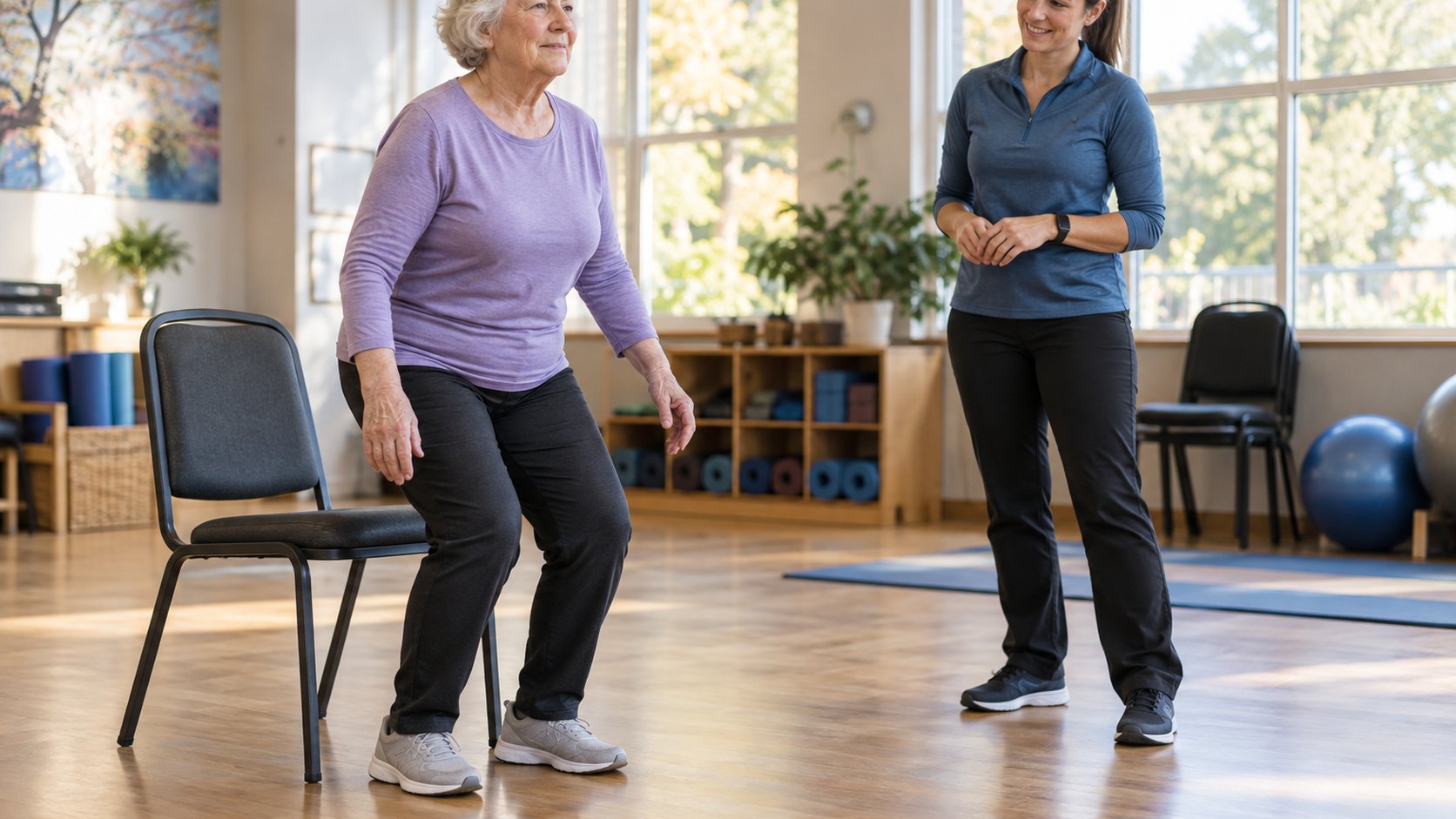
| Chair rise | Count sit-to-stand reps from a chair in 30 seconds, arms crossed | 10+ reps in adults under 70; 8+ is a common floor for older adults | Leg strength and power — your fall "catcher" |
Two important caveats. First, these thresholds come from specific study populations — treat them as guideposts rather than pass/fail grades, and track your own trend over time, which matters more than any single value. Second, a poor score is not a verdict: these markers are trainable, usually within weeks. The point of measuring is to find the leak, not to document it.
From Score to Strategy
Each test points at a specific fix:
Weak grip → train strength
Farmer's carries, dead hangs, and any pulling exercise build grip — and the full-body strength it represents (see the strength topic).
Short balance → daily practice
Single-leg stands while brushing your teeth, tandem walking, and the 10-minute stability routine. Balance improves fastest of all the markers.
Slow gait → walk more, walk faster
Brisk daily walks and intervals (walk fast between two lampposts, recover, repeat) directly target gait speed.
Few chair rises → leg strength
Squats, step-ups, and the chair-rise test itself practiced as exercise — 3 sets, 3 times a week.
📅 Measure quarterly
Do all four tests four times a year — birthday, solstices, whatever's memorable — and write the numbers down. Functional markers drift slowly; a trend line catches decline years before you'd notice it in daily life. That's the entire value proposition of self-measurement: early detection of something that responds to simple training.
Hand-grip dynamometer
Can track grip-strength performance over time when measured consistently.
⚠️ Readings can be affected by pain, arthritis, technique, and device variation; a result is not a diagnosis.
Check price on Amazon →The Sitting-Rising Test, Scored
The sit-to-rise test is worth a closer look because it's the most integrative of the four. The standard scoring: start sitting cross-legged on the floor, then stand up without using hands, knees, forearms, or the side of a leg for support — and reverse back down. You start with 10 points and lose one for each support point used, plus half a point for visible instability. In the Brazilian cohort study that made it famous, adults 51–80 who scored lowest had substantially higher mortality over ~6 years of follow-up than the highest scorers — the difference between "gets up from the floor unassisted" and "can't" carrying real prognostic weight. Practice it weekly (safely, near something to grab); most people improve their score within a month.
From Data to a Doctor Conversation
These tests earn their keep when they change what you do next. A declining grip, shortened balance, or slower gait is worth bringing to a primary-care visit as specific, dated numbers — not "I feel weaker lately." Three consecutive quarterly measurements showing a trend gives a clinician something far more useful than a complaint: a baseline, a direction, and a starting point for investigation (strength programs, medication review, neurological assessment if indicated). Self-measurement isn't self-diagnosis; it's the evidence you hand to the person trained to interpret it.
Building a Personal Dashboard
A simple table — or notes app — is all the infrastructure you need:
| Metric | Jan | Apr | Jul | Oct |
|---|---|---|---|---|
| Grip strength (dominant hand, kg) | ||||
| Single-leg balance (seconds) | ||||
| 4-meter walk time (seconds) | ||||
| Chair rises in 30 seconds | ||||
| Sit-to-rise score (out of 10) |
Two rules keep the dashboard healthy. Same conditions each time: same shoes, same time of day, same chair height. And no self-grading: the goal is data, not verdicts — a bad quarter is exactly the information the system exists to surface.
The Gait-Speed Story
Of the four tests, walking speed has the longest research pedigree. In a landmark 2011 analysis pooling nine cohorts of older adults, gait speed predicted survival with striking consistency — each 0.1 m/s faster walking pace associated with a meaningful reduction in mortality risk across every population studied, which is why geriatricians sometimes call it the "sixth vital sign." The practical test is almost embarrassingly simple: mark four meters, walk at your usual comfortable pace, and divide. A result below roughly 0.8 m/s flags reduced mobility and is a standard trigger for further assessment in older adults. But here's the encouraging asymmetry: gait speed is trainable, and it's trainable through the simplest intervention in this pillar — walking itself, done daily and occasionally briskly. The same activity that predicts your risk is also the prescription for lowering it.
Meditation cushion or supportive chair accessory
May make a meditation practice more physically comfortable.
⚠️ None expected; meditation can be difficult or unsettling for some people and is not a replacement for mental-health care.
Check price on Amazon →The Limits of Self-Testing
One note of restraint, because intellectual honesty matters more than a clean narrative: self-tests have real limitations. Technique drift (a slightly different foot position, a supportive wall you're not admitting to using) can move a balance time by seconds. Motivation on test day changes performance. And none of these tests diagnose anything — they're screening signals, not conclusions. Their proper use is directional: track them consistently, treat big declines as prompts to see a professional, and treat small improvements as evidence the training is working. A test you take seriously but not literally is worth more than a lab result you misuse.
The Bottom Line
- Grip, balance, gait, and chair-rise are the physical vital signs — cheap, fast, and remarkably predictive in large cohorts.
- They're markers, not verdicts: each one is trainable, balance fastest of all.
- Track trends quarterly, not single values — your slope matters more than your score.
- A bad score points to a specific fix — carries and hangs for grip, daily balance practice, brisk walking for gait, squats for chair rise.
Go Deeper: Subtopics
- 🔎 Grip norms by age & sex — percentile tables and what "average for 60" really means. Read it →
- 🔎 Grip as a longevity biomarker — the PURE study and cohort data: why a handshake predicts mortality. Read it →
- 🔎 Chair-rise & gait speed — the other zero-equipment tests clinicians use, and what they screen for. Read it →
- 🔎 When grip declines — frailty and sarcopenia screening: interpreting the trend, not the single number. Read it →
- 🔎 Building grip deliberately — carries, hangs, and grippers: a minimal grip-training toolbox. Read it →
Related Topics
- Leong et al., "Prognostic value of grip strength: findings from the Prospective Urban Rural Epidemiology (PURE) study," The Lancet (2015)
- Araujo et al., "Successful 10-second one-legged stance performance predicts survival in middle-aged and older individuals," British Journal of Sports Medicine (2022)
- Studenski et al., "Gait speed and survival in older adults," JAMA (2011)
- de Brito et al., "Ability to sit and rise from the floor as a predictor of all-cause mortality," European Journal of Preventive Cardiology (2014)
- Jones et al., "A 30-s chair-stand test as a measure of lower body strength in community-residing older adults," Research Quarterly for Exercise and Sport (1999)