Walking, Rucking & Daily Movement Multipliers
Walking is the least glamorous intervention in longevity and one of the best-supported. This page turns it into volume: the step dose that actually matters, the pace that upgrades a stroll into training, a backpack that adds a strength stimulus — and the small daily multipliers that quietly stack thousands of steps.
What the evidence supports
- All-cause mortality risk falls as daily steps rise, flattening around 7,000–10,000 depending on age; the biggest win is escaping the lowest step counts.
- Brisk cadence — roughly 100+ steps per minute — adds intensity, and faster walking pace tracks with better outcomes beyond total steps.
- Post-meal walking blunts the post-meal glucose curve, with the most replicated data in type 2 diabetes.
What remains uncertain
- Rucking-specific health outcomes are thin — load-carriage studies come mostly from military populations.
- Whether 10,000 beats 7,000 steps matters is unclear; the curve flattens, so the marginal step gets cheaper.
Evidence last reviewed: August 13, 2026. Conclusions may change as new research is published.
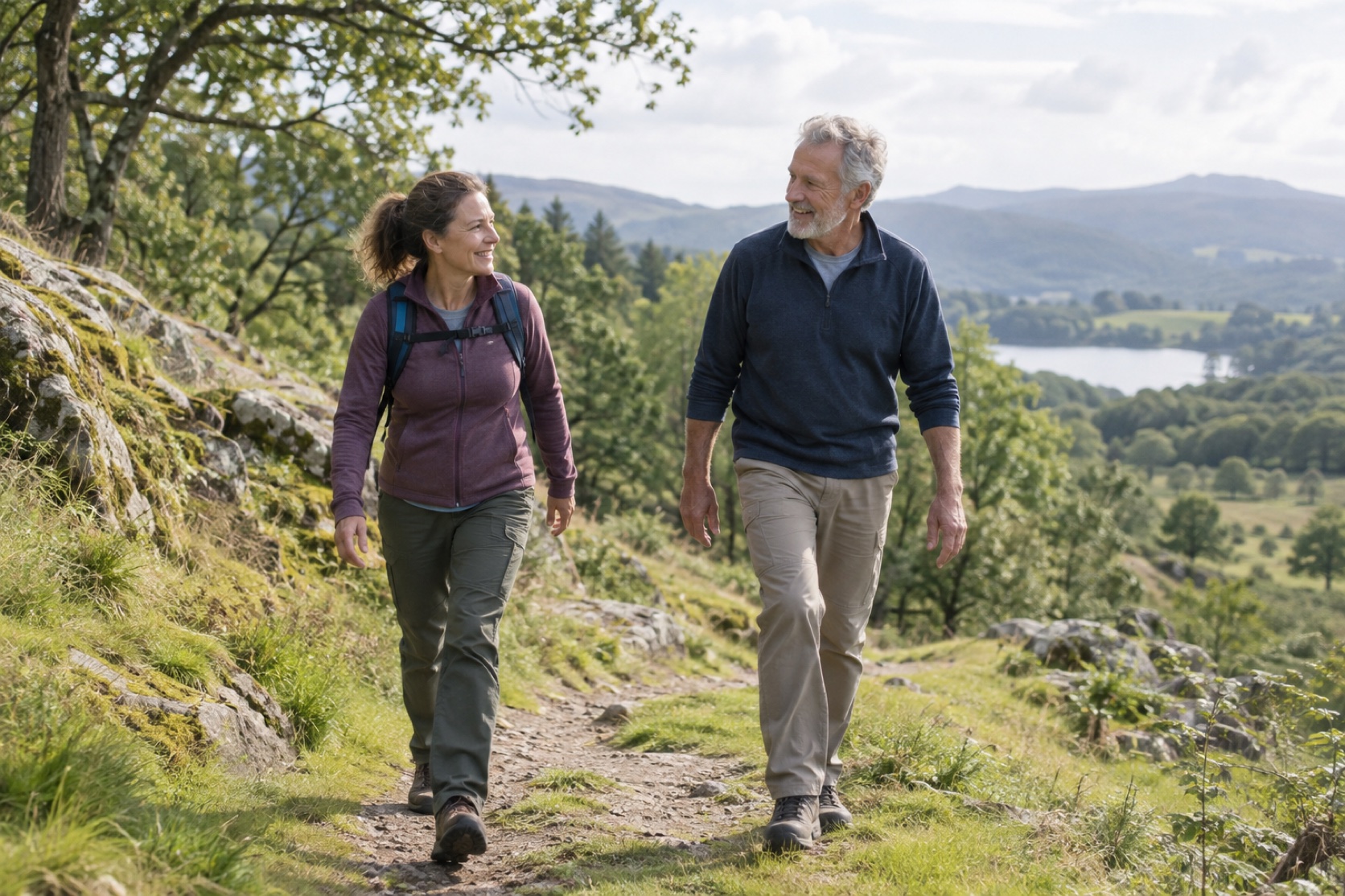
The Step-Count Dose
The Walking pillar topic owns the step-count science: dose-response reductions in mortality up to roughly 7,000–10,000 daily steps depending on age, with 6,000–8,000 for adults over 60. This page turns those numbers into a week.
- 📉 The steep end — the curve is steepest at the bottom: moving from 3,000 to 7,000 steps buys most of the benefit, and every step after 10,000 buys less.
- 🎯 The working band — aim for a weekly average in the 7,000–10,000 range, or 6,000–8,000 past 60. A band, not a quota.
- 📊 The baseline week — before changing anything, wear a phone or watch for one week and record your actual average. No judgment, just data. Most people overestimate their steps by thousands.
- 🪜 The honest ramp — add roughly 1,000–2,000 steps above baseline, hold for two weeks, then reassess. Sudden volume jumps are how feet and knees file complaints.
Product picks are generic categories, not brands. We may earn a commission on Amazon or iHerb purchases at no cost to you — this never changes our evidence conclusions. Full disclosure
Smart band or smartwatch
Can make activity, exercise, and routine patterns easier to notice over time.
⚠️ Step, heart-rate, and sleep estimates can be inaccurate and may encourage unhelpful over-monitoring; consumer readings are not medical diagnoses.
Check price on Amazon →Pace Matters More Than People Think
Not all steps are the same step. Cadence is the cheapest upgrade: brisk is roughly 100–120 steps per minute — conversational but not singable.
- 🗣️ The talk test — can talk comfortably, can't sing: that's brisk. It's the same boundary Part 2 uses, which makes a brisk walk zone 2 by another door.
- ⏱️ The cadence check — count steps for 15 seconds on a walk; 25–30 steps is brisk. No device required.
- 🔄 The overlap rule — brisk walking and easy running sit close on effort; the walk wins on joint load and repeatability, so it's the better default volume for most days.
- 🚶♀️ Strolls still count — an ambling walk isn't training, but it's still steps, still energy, still a break from the chair. The dose chart doesn't ask about pace.
| Cadence | Feels like | What it counts as | Verdict |
|---|---|---|---|
| Under ~100 steps/min | Easy stroll, can sing | Volume and recovery — real, not training | Moderate |
| ~100–120 steps/min | Brisk, can talk not sing | Zone 2 by another door | Best |
| 120+ steps/min | Power walk, breathy | Interval-adjacent effort, occasional | Moderate |
Cadence bands are approximate — your "brisk" is whatever sits at the talk-but-not-sing boundary.
Rucking: The Weighted Walk
Rucking — walking with a weighted backpack — is walking's honest progression lever. The benefits are real but modest: energy cost rises roughly in proportion to the load you carry, the spine and bones get a mild loading stimulus, and the posture work is constant. It is not a dramatic cardio upgrade and it does not replace strength training.
- ⚖️ The working load — 10–20% of bodyweight. At 10%, a 45-minute walk burns noticeably more and feels familiar; at 20% you're working. Beyond 20%, joint stress climbs faster than fitness return.
- 🪜 How to start — begin with an empty pack or 5 kg for 20–30 minutes on flat ground, once or twice a week. Add load only after weeks of comfort — weight before duration is the classic mistake.
- 🧍 The form cues — pack cinched high and tight against the upper back, sternum strap done up; short, quick strides; land under your hips; torso tall with a tiny forward lean from the ankles. If you're rounding forward, the pack is too heavy or too low.
- 🧱 The honest ceiling — rucking is a volume multiplier, not a program. It pairs with the Strength pillar rather than competing with it.
| Phase | Load | Session | Focus | Verdict |
|---|---|---|---|---|
| Weeks 1–2 | Empty pack or ~5 kg | 20–30 min, flat, easy | Form: pack high, short strides | Start |
| Weeks 3–8 | 10% bodyweight | 30–45 min, 1–2×/week | Comfort at load before adding more | Progress |
| Months 3–6 | ~15% | 45–60 min, gentle hills | Duration before weight | Moderate |
| 6 months+ | 20% cap | Weekly staple | Stop here — more load adds joints, not fitness | Moderate |
A progression skeleton — your comfort at each phase decides when you move to the next.
The Daily Movement Multipliers
The biggest step-count levers are not workouts. They're decisions that cost ten seconds and pay in hundreds of steps, every single day.
- 🅿️ Park far — the far corner of the lot, the street over, the stop before your usual one. It sounds trivial; it's several hundred steps a day with zero schedule cost.
- 🪜 Take the stairs — stairs are the rare "incidental" that's actually training: real cardiovascular work with a strength chaser. Two floors a day beats zero, and it compounds.
- 📞 Walk your calls — any call that doesn't need a screen becomes a walk. A 30-minute conversation is ~2,000 steps that otherwise never happen.
- 🍚 The after-meal 10-minute walk — the most evidence-backed multiplier in the list. A short walk after the largest meal blunts the post-meal glucose curve; the Glucose 101 topic owns the mechanism. Three meals a day is three built-in walk slots.
- 🧮 The arithmetic — park far, stairs, two walked calls, three after-meal laps: that's most of the gap between 4,000 and 8,000 steps, with no dedicated workout on the calendar.
The Commute Multiplier
The commute is the biggest structural lever in the whole step system — and the least available to most people. Worth the honest treatment.
- 🚶 The math — a 20-minute walk each way is roughly 4,000–5,000 steps a day, five days a week, before any other decision gets made. Nothing else in this list runs unattended.
- 🚲 The bike version — cycling a few kilometers each way trades steps for zone-2-adjacent minutes and buys the same "training without a workout" property.
- 🧠 The side benefit — the walk in and the walk home are also a hard boundary between work and life; the Downshift Habit topic in the Stress pillar would file this under unwinding: a fixed transition that tells the day it's over.
- 🗺️ The honest limit — if the distance, the weather, or the route make it unsafe or impractical, the commute is not a moral test. Build the same 4,000 steps from the other multipliers and drop the guilt.
Tracking Steps Without Obsession
Steps are data, not a scoreboard. The system survives on the weekly average and dies by the daily streak.
- 📅 The weekly average rule — judge the 7-day average against the band, not Tuesday against Wednesday. A 4,000-step travel day inside a 9,000-step week is fine.
- 🚫 Streaks are a trap — a 200-day streak turns one bad day into an identity crisis. The dose-response cares about your average, not your consecutive count.
- 🎯 Steps are not training — 10,000 ambling steps do not replace the zone 2 sessions from Part 2 or the intervals from Part 3. Steps are the volume layer; training is the intensity layer.
- 🤳 The device rule — phone in pocket, watch on wrist, either is fine; the estimate differs between them, so pick one and keep it. The trend is the measurement, not the day's exact count.
Where the Evidence Lives
This page is the operational layer — the science behind each number has a home in the pillars, and this series references rather than repeats it:
- 🚶 The step-count science — the Walking topic owns the dose-response, the cadence data, and the rucking levers.
- 🐢 Why the base volume matters — the Zone 2 Training topic owns the aerobic machinery that brisk walking feeds.
- 🍚 The after-meal walk mechanism — the Glucose 101 topic owns post-meal spikes and the walks that blunt them.
- 🧪 Measuring what it's doing — Part 4 of this series owns the tests that show whether the volume is working.
- 📅 How it fits the week — the 3-2-1 Formula topic owns the weekly packaging: walking is the fill, not the feature.
- 😴 Why recovery sets the ceiling — the Sleep: The Science of Repair topic owns the adaptation window that all this volume pays into.
What to Do When It Goes Wrong
Movement systems fail in predictable ways, and most failures have a low-drama fix. Five scenarios that actually happen:
- 🚩 Steps stalled around 3,000–4,000 a day — the workouts aren't the problem; the incidental volume is. Park far, walk one call, take one after-meal lap — the multipliers, not the treadmill, close this gap.
- 🚩 Rucking hurts your lower back — the pack is almost always too low or too loose. Cinch it high against the upper back, do up the sternum strap, drop the load, shorten the stride. If it still hurts, ruck less and see someone who treats backs.
- 🚩 You're at 10,000 steps but fitness isn't moving — steps are not training. Add the brisk pace (Part 2) and the intervals (Part 3); the step count was never the aerobic stimulus.
- 🚩 Knees or feet started complaining after a step-count jump — you ramped too fast. Drop back to the previous week's average, check the shoes, and rebuild in 1,000–2,000-step increments with a two-week hold at each level.
- 🚩 The commute changed and your steps collapsed — rebuild with a fixed 20-minute morning walk at the same time the commute used to happen. The habit slot matters more than the distance.
Questions, Answered Briefly
- ❓ Do I really need 10,000 steps? — No. The dose-response flattens around 7,000–10,000 depending on age. If you're at 4,000, getting to 7,000 is most of the benefit.
- ❓ Does rucking replace a strength session? — No. It adds postural and bone-loading stimulus and a bigger energy burn, but the Strength pillar's program remains the muscle signal.
- ❓ Does walking count as zone 2? — Brisk walking that reaches "can talk, can't sing" counts. An ambling stroll is still good volume — the dose chart pays it — just not training.
- ❓ My step streak is making me anxious — drop the streak. The evidence cares about your weekly average in the band, not about 365 consecutive days.
🎒 Volume is the quiet engine
Zone 2 and intervals are the training layers, but steps are the base they sit on — the daily volume that keeps the aerobic engine idling warm. Most of it costs nothing: a far parking spot, a walked call, a lap after dinner. Small, boring, and it compounds.
The Bottom Line
- 7,000–10,000 steps a day — 6,000–8,000 past 60 — and the biggest win is escaping the bottom of the range.
- Pace upgrades a stroll into training — brisk is roughly 100+ steps per minute, the talk-but-not-sing boundary.
- Ruck at 10–20% bodyweight — start light, cinch the pack high, add duration before weight.
- The multipliers are the system — after-meal walks, commute, stairs, and parking choices quietly make the total; track a weekly average, not a streak.
This Page in One Workflow
- Run the baseline week — record your actual daily steps with no changes and no judgment.
- Set the band — 7,000–10,000, or 6,000–8,000 past 60, judged as a weekly average.
- Build the skeleton — one scheduled brisk walk plus after-meal laps around the largest meal.
- Stack the multipliers — commute segment, stairs, walked calls, far parking.
- Review the weekly average, adjust — inside the band, nothing changes; below it, add one multiplier; above it, enjoy the margin.
The Daily Checklist
- One 20–30 minute brisk walk done or scheduled — the skeleton of the day
- After-meal 10-minute lap, especially after the largest meal
- Stairs over elevator; far parking spot taken
- One phone call walked
- Cadence check on one walk: can talk, can't sing
- Steps logged into the weekly average, not the daily mood
The Weekly Checklist
- Weekly step average inside the band — 7,000–10,000, or 6,000–8,000 past 60
- One or two ruck sessions at the current load, pack cinched high
- Brisk pace verified on at least three walks (100+ steps per minute)
- One commute segment walked or cycled, if the route allows it
- Feet, knees, and lower back checked — no more than one big change added per week
Go Deeper: Walking, Rucking & Daily Movement Multipliers
These five companion pages turn the topic into smaller, testable practices.
Related Topics
- Paluch AE, et al. "Daily steps and all-cause mortality: a meta-analysis of 15 international cohorts." Lancet Public Health (2022)
- Saint-Maurice PF, et al. "Association of daily step count and step intensity with mortality among US adults." JAMA (2020)
- Tudor-Locke C, et al. "How many steps/day are enough? For adults." International Journal of Behavioral Nutrition and Physical Activity (2011)
- Reynolds AN, et al. "Advice to walk after meals is more effective for lowering postprandial glycaemia in type 2 diabetes mellitus than advice that does not specify timing: a randomised crossover study." Diabetologia (2016)
- Quesada PM, Mengelkoch LJ, Hale RC, Simon SR. "Biomechanical and metabolic effects of varying backpack loading on simulated marching." Ergonomics (2000)
- Knapik JJ, Reynolds K. "Load carriage in military operations: a review of historical, physiological, biomechanical, and medical aspects." Journal of Special Operations Medicine (2012)