The Desk-Bound Counter
A desk day is a step shortage and a metabolic event at the same time — but the fix is smaller than the problem looks. This page sorts the sitting-break evidence into what actually changes outcomes, the dose of movement snacks that early trials suggest matters, and the honest limits of interrupting a chair versus training in it.
What the evidence supports
- High daily sitting time is associated with higher all-cause mortality risk — an association that weakens as total physical activity rises.
- In tightly controlled lab experiments, breaking up prolonged sitting with short, light walks measurably lowers post-meal glucose and insulin responses.
- The mortality association is far stronger at the low-movement end: the desk-bound are the population with the most to gain.
What remains uncertain
- Most sitting-break evidence is acute laboratory data measured over hours, not years — the long-term translation to disease outcomes is inferred, not proven.
- Whether the benefit comes from breaking the sitting per se or just from accruing more light activity is hard to separate.
- Standing desks interrupt posture, not metabolism — standing in place does not show the same metabolic signal as walking breaks in the trials.
Evidence last reviewed: August 15, 2026. Conclusions may change as new research is published.
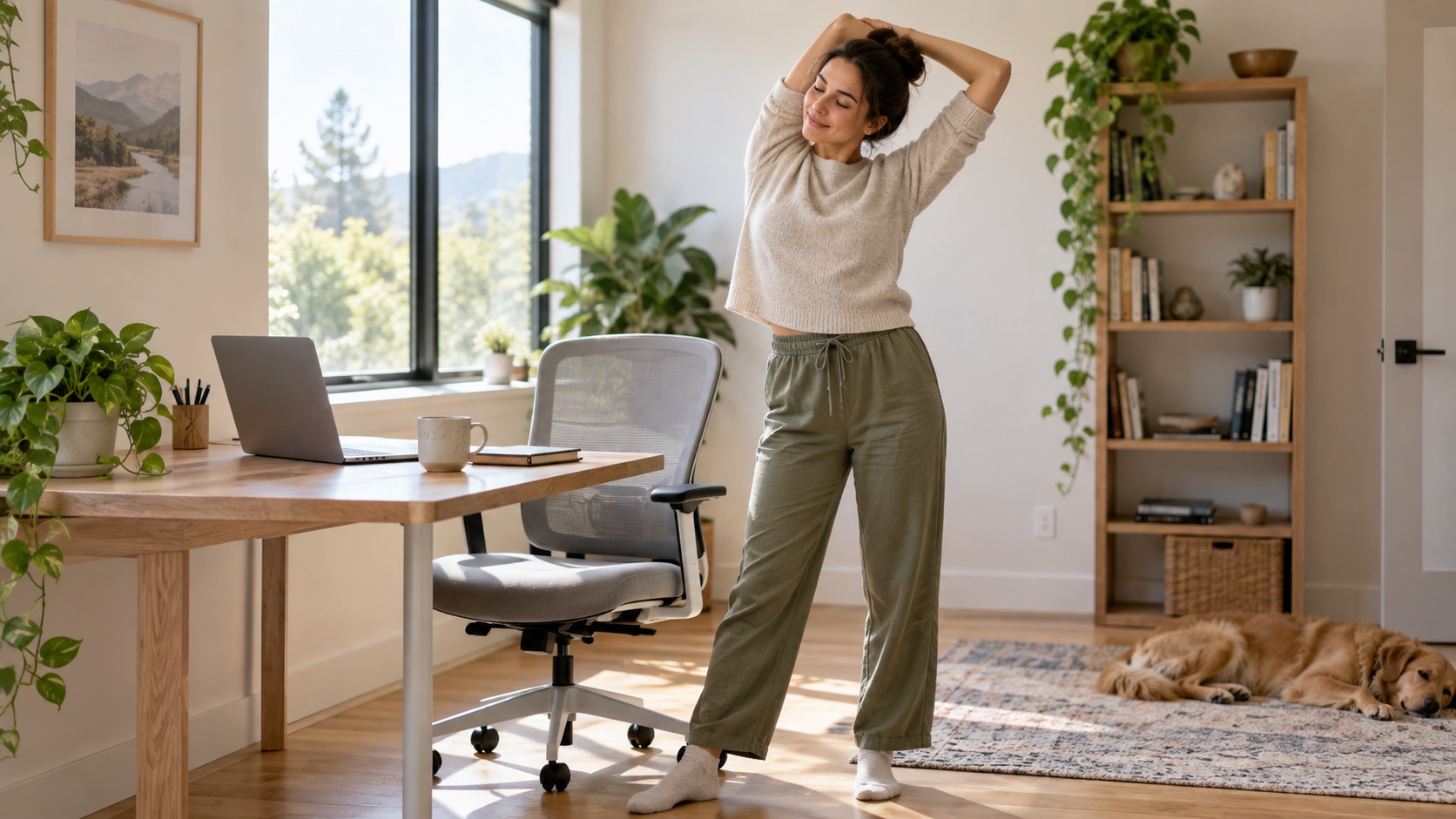
The Desk Day as a Dose Problem
A desk day has two problems that look like one. The first is a step shortage: sitting for eight hours typically leaves a person several thousand steps under a working floor, because the incidental movement a standing or walking life produces never happens. The second is metabolic: uninterrupted sitting concentrates the post-meal glucose profile of each meal into a flatter, longer exposure. The Walking & Rucking parent page treats the step floor; the Walking topic owns the step-count science underneath. This page handles the other half — the sitting-break evidence and the snacks that interrupt the chair.
The honest scope disclaimer: the sitting-break literature is strongly skewed toward acute laboratory experiments and observational cohorts, so this page is deliberately about what appears to work, with the permanent caveat that long-term randomized outcomes are still being built.
Product picks are generic categories, not brands. We may earn a commission on Amazon or iHerb purchases at no cost to you — this never changes our evidence conclusions. Full disclosure
Smart band or smartwatch
Can make activity, exercise, and routine patterns easier to notice over time.
⚠️ Step, heart-rate, and sleep estimates can be inaccurate and may encourage unhelpful over-monitoring; consumer readings are not medical diagnoses.
Check price on Amazon →What the Sitting Data Show
The population-scale picture is consistent and worth stating without overstatement. In a harmonized meta-analysis pooling over one million people, higher daily sitting time was associated with higher all-cause mortality — but the association weakened as moderate-to-vigorous activity rose, with the highest physical activity effectively cancelling most of the sitting signal (Ekelund et al., The Lancet, 2016). A large national cohort examining patterns, rather than totals, found the same thing wearing a different costume: adults with the most sedentary patterns also had the highest mortality risk (Diaz et al., Annals of Internal Medicine, 2017). Two honest readings fall out. First, sitting is not destiny if the rest of the week carries enough movement. Second, and more operationally, the person who both sits all day and trains little is the exact risk profile the desk-bound counter exists to address.
The Movement Snack
The acute experiments give the desk day its cleanest tool. In the classic paradigm, subjects who broke up eight hours of sitting with brief, frequent walks — two to three minutes of light effort every twenty to thirty minutes — produced substantially smaller post-meal glucose and insulin excursions than the same people sitting uninterrupted (Dunstan et al., Diabetes Care, 2012). The effect is acute and short-lived, but it is also free and repeatable every single desk day, which is exactly the profile of a habit that pays without requiring a schedule.
The dose from the trials is the part to copy precisely: two to three minutes of light walking every twenty to thirty minutes, targeted especially after meals. That is the snack: short enough not to break focus, frequent enough to matter, and it slots into the day as a timer-fired habit rather than a willpower event.
- ⏲️ The 30-minute timer — set a recurring 30-minute reminder; when it fires, two or three minutes on your feet, moving enough to feel your heart rate lift slightly.
- 🚶 The post-meal snack matters most — the trials show the largest glucose effect right after eating, so the lunch break is the priority one of the day.
- 🍵 The refill trick — drink from a small cup and use the refill as the timer; a two-minute kitchen lap every thirty minutes converts a bad habit into a good one.
- 🤝 The walking meeting — move the one-on-one to a walk; it is the snack that also removes an hour from the chair, and it pairs well with the downshift habit of a fixed end-of-day boundary.
- 📈 The additive truth — snacks never replace a training session, but they add substantial light activity on top of it; the desk counter and the workout are complements, not rivals.
The snack's other virtue is that it defends the rest of the protocol: each two-minute lap is a few hundred steps toward the floor, and the walk-away-from-the-chair transition resets posture that a long sit degrades. The desk counter is not a substitute for the commute or the after-meal walk — it is the background motion that keeps a sedentary day from quietly canceling them.
The Standing-Desk Honesty
The standing desk deserves its own paragraph, because it is the most oversold fix in the category. Standing interrupts posture but not metabolism — the controlled trials that showed glucose and insulin benefits used walking breaks, and standing in place has not shown the same acute metabolic signal. That is not a verdict against standing desks; they genuinely reduce back soreness and hours of static load. But the honest read is that they occupy a different category than movement snacks, and swapping a chair for a standing perch is not the dose that the glucose data pay.
| Fix | What it actually does | The honest verdict | Read |
|---|---|---|---|
| 🚶 Walking breaks, 2–3 min every 30 | Blunts post-meal glucose in controlled trials; adds daily light activity | The metabolic evidence is the strongest in this category | Strong signal |
| 🧍 Standing desk | Improves posture and comfort; minor movement change | Useful, but not the metabolic dose the trials reward | Comfort first |
| 💺 Sitting uninterrupted | Long flat glucose exposures; step deficit through the whole day | The pattern the counter exists to interrupt | The target |
When Snacks Are Not Enough
The limits need stating with equal honesty. Movement snacks metabolically blunt meals and rescue some daily movement, but they do not move the aerobic needle: eight two-minute laps do not accumulate into the zone-2 volume that drives cardiorespiratory fitness, which is why the Zone 2 Training series and the cardio conditioning series still require actual sessions. And for someone whose glucose numbers are already flagged, a walking break is a complement to — never a substitute for — what their clinician advises. Anyone managing diabetes or prediabetes should treat glucose management as clinical territory; nothing here prescribes.
⚠️ The breaks blunt; the sessions build
Two minutes on your feet every half hour is a metabolism rescue, not a training program — it keeps the desk day from being a step and glucose disaster, but the zone-2 and interval sessions still own the fitness. Optimistic, honest, and both true at once.
The Desk-Day Baseline, Measured
Like every multiplier on this series, the desk counter starts with measurement, not resolution. Wear the step device through one ordinary desk day and note two things: the total, and how many of your sitting blocks ran past 60 minutes without a break. That second number — the long-block count — is the sitting-break baseline, and it is the one that the timer habit fixes first. Most people find the total is lower than expected and the long blocks are more common than comfortable.
Questions, Answered Briefly
- ❓ Is sitting really "the new smoking"? No — that is headline inflation. Sitting is associated with higher risk that movement largely offsets; the accurate read is that high sitting plus low activity is the risky combination.
- 🧍 Is standing better than sitting? For comfort and posture, often yes. For the glucose effects that the walking-break trials show, no — the metabolic signal belongs to walking, not standing.
- ⏰ I work deep-focus blocks. Won't breaks destroy flow? Two minutes barely registers against a 90-minute block, and the 30-minute timer can be paused for deep work — the lunch break is the priority regardless.
- 🛒 Do quick errands count as snacks? Yes — any light walking breaks the sitting dose. The kitchen lap, the parking-lot path, the post-lunch stroll all count toward the same effect.
- 🩺 My glucose is already flagged — is this enough? No. This is background metabolics, not treatment. Work the snacks alongside your clinician's plan for diabetes or prediabetes; the breaks support, they never replace.
The Bottom Line
- Sitting is a background risk, not a verdict — the mortality association weakens as total activity rises, so the desk counter is one part of a movement whole.
- The snack is two to three minutes every half hour — light walking breaks blunt post-meal glucose in controlled trials, and the lunchbreak snack is the one that matters most.
- Standing desks fix comfort, not metabolism — the glucose evidence belongs to walking breaks; treat standing as a posture tool and snacks as the metabolic one.
- Breaks complement sessions, never replace them — the desk counter rescues the day, but the zone-2 and interval work still owns the fitness.
Related Topics
- Dunstan et al., "Breaking up prolonged sitting reduces postprandial glucose and insulin responses," Diabetes Care (2012)
- Ekelund et al., "Does physical activity attenuate, or even eliminate, the detrimental association of sitting time with mortality? A harmonised meta-analysis of data from more than 1 million men and women," The Lancet (2016)
- Diaz et al., "Patterns of sedentary behavior and mortality in U.S. middle-aged and older adults: a national cohort study," Annals of Internal Medicine (2017)