Chair-Rise & Gait Speed
Grip gets the headlines, but the tests clinicians trust most involve legs: how fast you walk four meters, and how many times you can stand from a chair. This page covers the two workhorses of geriatric assessment — gait speed and the chair-rise family — with the exact protocols, the guideposts, and what a poor score is really screening for.
What the evidence supports
- Gait speed predicts survival with striking consistency across nine pooled cohorts: each 0.1 m/s faster pace associated with roughly 12% lower mortality (Studenski et al., JAMA, 2011).
- A gait speed below 0.8 m/s is the widely used mobility threshold that triggers further assessment in older adults.
- Chair-rise performance is a validated proxy for lower-body strength, and slow five-times sit-to-stand predicts recurrent falls (Buatois et al., JAGS, 2008).
What remains uncertain
- Thresholds come from specific study populations; the exact guideposts shift between cohorts.
- Self-administered tests are noisier than supervised ones — motivation and technique drift are real.
- Whether improving gait speed itself changes survival is untested; these are screening tools, not interventions.
Evidence last reviewed: August 15, 2026. Conclusions may change as new research is published.
Product picks are generic categories, not brands. We may earn a commission on Amazon or iHerb purchases at no cost to you — this never changes our evidence conclusions. Full disclosure
Smart band or smartwatch
Can make activity, exercise, and routine patterns easier to notice over time.
⚠️ Step, heart-rate, and sleep estimates can be inaccurate and may encourage unhelpful over-monitoring; consumer readings are not medical diagnoses.
Check price on Amazon →Gait Speed: The Sixth Vital Sign
Walking speed is the most-studied functional test in geriatrics, and the landmark evidence is a 2011 JAMA paper by Studenski and colleagues that pooled nine cohorts — 34,485 older adults in total. Across every cohort, faster gait predicted longer survival, and the relationship was a clean staircase: each 0.1 m/s of extra speed carried roughly a 12% lower mortality risk, from the slowest walkers (under 0.4 m/s, who rarely walk independently outdoors) to the fastest (1.4 m/s and up). The nickname "sixth vital sign" comes from exactly this: few measurements that take four seconds stratify risk so well.
The home version is embarrassingly simple. Mark four meters on a flat floor, start a stopwatch as the person starts walking at their usual comfortable pace, stop it at the line, divide. A time over five seconds (under 0.8 m/s) is the conventional attention line in older adults — the threshold at which falls, disability, and hospital outcomes all measurably worsen. Give yourself a meter of runway before the start line and after the finish, so the clock only runs while you are at cruising speed. The bands below come from the Studenski analysis and are worth knowing as context rather than as grades.
The Chair-Rise Family
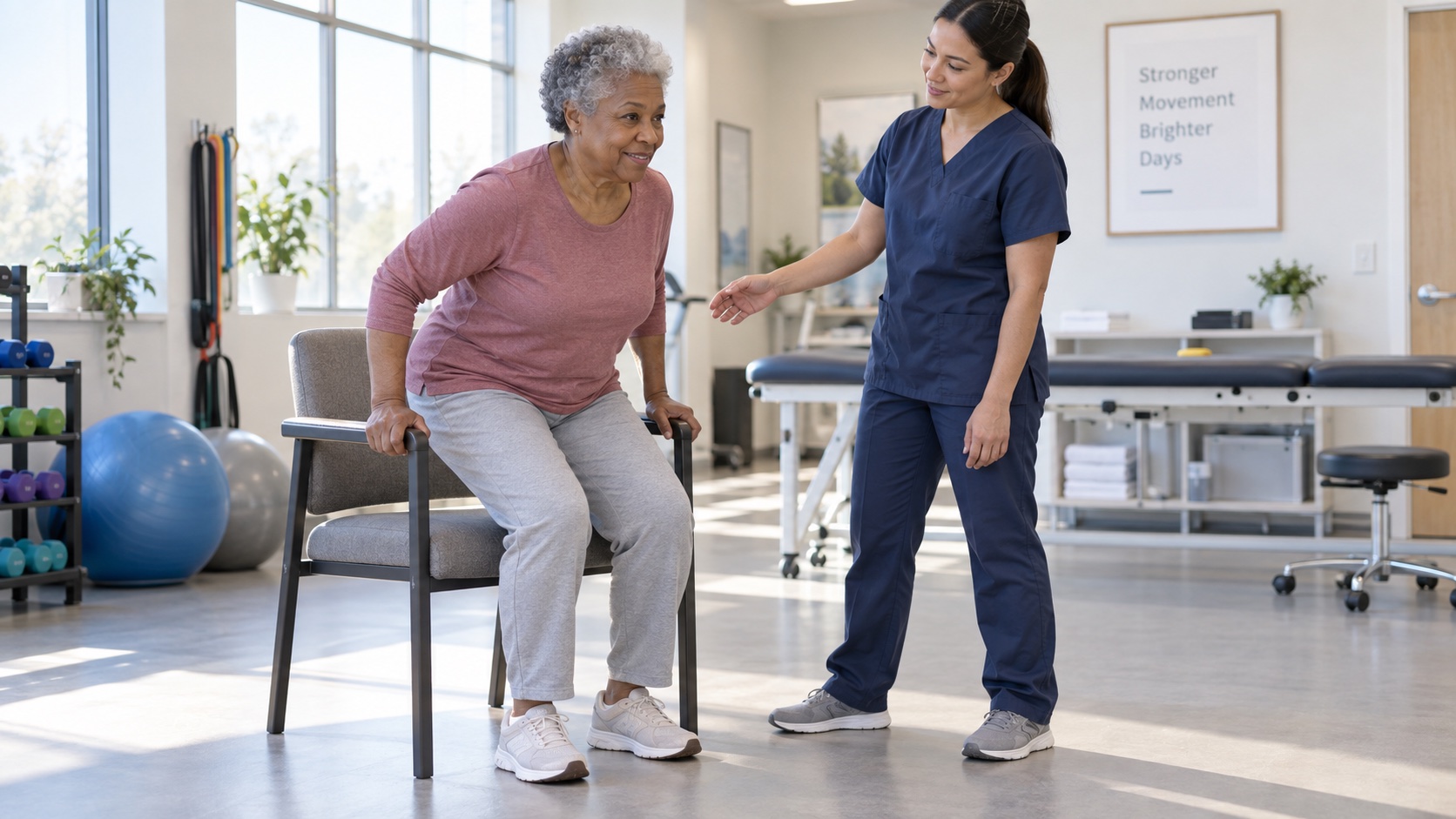
If gait speed measures how you move, the chair-rise tests measure how you lift yourself — lower-body strength and power in their most functional form. Two versions dominate practice. The 30-second chair stand, developed by Jones and colleagues (Research Quarterly for Exercise and Sport, 1999) for community-dwelling older adults, counts how many times you rise to full standing and sit back down in half a minute with arms crossed. The five-times sit-to-stand is the leaner cousin: rise and sit five times, as fast as you safely can, and record the total time. Whitney and colleagues validated it for people with balance disorders (Physical Therapy, 2005), and Buatois and colleagues showed in older adults that times beyond roughly 15 seconds flagged the recurrent fallers (JAGS, 2008).
Protocol discipline decides whether your numbers mean anything. Use a standard chair — about 43 cm seat height, no arms, against a wall so it cannot slide. Feet flat, arms crossed over the chest, and stand to full hip and knee extension on every rep. The difference between "rising with momentum" and "rising with legs" is exactly what the test is measuring, so do not bounce off the seat and do not use your hands. Count only complete stands. If you cannot yet manage the standard version, start from a higher seat or with a light hand assist — note the modification, standardize it, and the trend still counts.
The Zero-Equipment Battery, Side by Side
| Test | Protocol | Rough guidepost | What it screens for |
|---|---|---|---|
| 🚶 4-meter gait | Walk 4 m at usual pace, timed from a moving start | ≥ 0.8 m/s in older adults; each 0.1 m/s above it tracks lower risk | Overall functional decline, fall risk, survival |
| 🪑 30-second chair stand | Arms crossed, full stands in 30 s | 10+ reps is a common floor through the 60s; 8+ for the 70s and beyond | Lower-body strength, sarcopenia |
| ⏱️ Five-times sit-to-stand | Five stands as fast as safely possible, timed | Beyond ~12–15 s draws attention; healthy 60-somethings often finish under ~11 s | Leg power, recurrent fall risk |
| 🦩 One-leg stand | Stand on one leg, arms relaxed, eyes open | ≥ 10 seconds (the studied threshold for middle-aged and older adults) | Balance, neuromuscular control |
| 🧮 SPPB (three tests scored 0–12) | Balance stands + 4 m gait + 5 chair rises | Below ~9 is the zone trials use to flag emerging disability | Composite lower-extremity function |
The SPPB: Three Tests, One Score
Individually these tests are good; combined they are the field's workhorse. The Short Physical Performance Battery, introduced by Guralnik and colleagues in 1994 (Journal of Gerontology), scores three items — standing balance in progressively harder stances (feet together, semi-tandem, tandem), the 4-meter walk, and five chair rises — into a 0–12 scale. In the original cohort, low SPPB scores predicted disability and nursing home admission years ahead, and the battery has been the standard lower-extremity measure in ageing research ever since. For a self-tester its value is different: it forces you to measure all three systems — balance, gait, and leg strength — on the same day, which is precisely the discipline the parent topic's quarterly dashboard recommends. One system declining while the others hold is a different, more informative finding than "I feel a bit older." The scoring also keeps you honest — points come from each component equally, so the battery cannot be gamed by training one test alone.
What These Tests Screen For
A screen is not a diagnosis, and keeping that boundary clear is the difference between useful self-testing and self-diagnosis. A slow gait or a long sit-to-stand time is a flag that raises the probability of several things worth looking at:
- 💪 Sarcopenia: chair-rise counts are a standard field test for probable low muscle strength — one arm of the sarcopenia definition alongside grip.
- 🍂 Fall risk: slow sit-to-stand and poor balance are the two strongest simple predictors of falls, and falls are the event that cascades.
- 🏥 Surgical and hospitalization risk: gait speed is used pre-operatively to estimate who will struggle after major surgery.
- 🫀 Silent disease burden: walking speed integrates heart, lungs, joints, nerves, and brain — a decline can be the first visible trace of any of them.
None of these conclusions belongs to a stopwatch at home. The tests earn their keep by deciding when to hand dated numbers to a professional — the framing the parent topic sets out — not by replacing that professional's judgment.
🪑 The 15-second self-check
The leanest routine that captures this page: once a month, time your 4-meter walk and your five chair rises, and write both down next to the date. Ninety seconds of effort, two numbers, and within a year you own a trend line that no single clinic visit can produce. The quarterly audit folds these into the full dashboard.
Questions, Answered Briefly
- 🏃 What if my usual pace is faster than my timed pace? That is the point of the test — "usual pace" is the standard instruction precisely because it measures how you actually move through life, not how you move when showing off.
- 🪑 Do chair height and arm use really change the score? Enormously. A higher seat and a hand assist can double your count. Chair against the wall, ~43 cm seat, arms crossed — every time.
- 🧓 I'm under 60 — do these thresholds apply? The studied thresholds were built in older populations. Younger adults should mostly track their own trend, with the parent topic's guideposts as loose context.
- 📉 My gait speed dropped 0.05 m/s in a quarter — panic? No. 0.1 m/s is roughly the threshold for a meaningful change (Perera et al., JAGS, 2006); smaller drifts are often noise. Two consecutive drops that sum past 0.1 are worth a conversation.
- 🏋️ Can I train these directly? Yes — the tests are also the exercises. Chair rises practiced as sets, and brisk walking itself, are the interventions with the most direct line to these numbers.
- 🛒 What is the everyday version of these tests? The same movements at normal speed: rising from a low sofa without using your hands, carrying groceries a block, keeping up with a walking partner. The tests exist because those everyday movements degrade silently first.
The Bottom Line
- Gait speed is the most validated functional test in geriatrics — each 0.1 m/s tracks roughly 12% mortality risk across nine pooled cohorts.
- The chair-rise family measures leg strength and power — the systems that catch you, and the fall-risk flags clinicians watch.
- 0.8 m/s and ~12–15 s on the five-times sit-to-stand are the attention lines — guideposts, not verdicts.
- These are screens, not diagnoses: their job is to hand dated, trended numbers to a professional when something moves.
Related Topics
- Studenski et al., "Gait speed and survival in older adults," JAMA (2011)
- Perera et al., "Meaningful change and responsiveness in common physical performance measures in older adults," Journal of the American Geriatrics Society (2006)
- Guralnik et al., "A short physical performance battery assessing lower extremity function: association with self-reported disability and prediction of mortality and nursing home admission," Journal of Gerontology (1994)
- Jones et al., "A 30-s chair-stand test as a measure of lower body strength in community-residing older adults," Research Quarterly for Exercise and Sport (1999)
- Buatois et al., "Five times sit to stand test is a predictor of recurrent falls in healthy community-living subjects aged 65 and older," Journal of the American Geriatrics Society (2008)
- Whitney et al., "Clinical measurement of sit-to-stand performance in people with balance disorders: validity of data for the Five-Times-Sit-to-Stand Test," Physical Therapy (2005)