Building Grip Deliberately
Grip is trainable at any age, and it takes astonishingly little equipment: something to carry, something to hang from, and a small spring device. This page builds the minimal toolbox — carries, hangs, grippers, and pinches — with doses, progressions, and the honest caveat that the hands' tendons recover slower than their muscles.
What the evidence supports
- Handgrip training improves grip strength in older adults, with modest pooled effect sizes across trials (Labott et al., Gerontology, 2019).
- Progressive resistance training two to three times weekly produces substantial strength gains at any age (Peterson et al., Ageing Research Reviews, 2010).
- Grip is a marker that responds — the same squeeze that tracks decline also tracks rebuilding.
What remains uncertain
- Grip-specific training has never been shown to change mortality — the biomarker logic is indirect.
- Optimal doses (sets, frequency, load) for grip work are not well standardized across studies.
- Whether the carryover from grip training to daily function is larger than from general strength training is unclear.
Evidence last reviewed: August 15, 2026. Conclusions may change as new research is published.
Product picks are generic categories, not brands. We may earn a commission on Amazon or iHerb purchases at no cost to you — this never changes our evidence conclusions. Full disclosure
Adjustable dumbbells
Allows progressive loading at home across common strength movements.
⚠️ Poor technique or rapid load increases raise injury risk; not required to begin moving more.
Check price on Amazon →Why Train Grip at All
The honest reason is not the biomarker literature — no trial shows that squeezing a gripper adds years. The practical reasons are simpler. Grip strength tracks whole-body muscle, and training the whole body through real movements — deadlifts, rows, carries — builds grip as an unavoidable side effect. For people who cannot yet do those movements, or who have plateaued on them, targeted grip work is a legitimate on-ramp: it is trainable at any age, needs almost no equipment, and its gains show up in ordinary life — jars, luggage, grandchildren, the garden. The training studies agree on the direction: Labott and colleagues' meta-analytic review (Gerontology, 2019) found grip training reliably improves grip strength in older adults, and Peterson and colleagues' larger meta-analysis (Ageing Research Reviews, 2010) showed the same for progressive strength training generally, in people who had been sedentary for decades. And for everyone in between, grip work is insurance: the chain only lifts what the hands will hold, so a strong support grip keeps deadlifts, rows, and carries alive as the years add up.
The Toolbox, Side by Side
| Tool | How | Starting dose | What it builds |
|---|---|---|---|
| 🧺 Farmer's carry | Walk tall holding heavy weights at your sides | 2–4 sets × 30–60 s or 20–40 m, heavy enough to need focus | Support grip, core, posture — the highest-value tool |
| 🪝 Dead hang | Hang from a bar, shoulders engaged, feet off the floor | Build from 10–30 s toward 60 s; 2–3 sets, or one daily set | Support grip, shoulder stability, spine decompression |
| 🖐️ Gripper | Squeeze a spring or adjustable gripper to full close | 3 × 5–10 per hand, 2–3 days a week | Crushing grip, targeted loading, asymmetry work |
| 🤏 Plate pinch | Pinch two weight plates together between thumb and fingers | 2–3 holds of 20–30 s per hand | Pinch grip, thumb strength — the weak point for many |
| 🧻 Towel pull | Rows or hangs gripping a towel draped over the bar | Swap in for regular hangs or rows occasionally | Grip with a thicker, harder-to-hold surface |
Carries: The Highest-Value Tool
The farmer's carry — walk with a heavy dumbbell or kettlebell in each hand — is the one grip exercise worth doing even if you never touch the rest of this page, because it trains grip inside a movement that also loads the core, the traps, and the postural muscles that keep you upright. That is why it appears as a core pattern in the resistance training protocol. The technique is minimal: stand fully tall, shoulders back, chest up, and walk with short, controlled steps. The weight should be heavy enough that your grip and your posture are both working — if you could stroll for ten minutes, it is too light; if you are leaning or shuffling, it is too heavy.
- 📈 Progression: add distance or time first, then weight — 30 seconds to 60 seconds, 20 meters to 40, then heavier.
- 📅 Frequency: one or two carry slots per week is plenty; they slot naturally at the end of a strength day.
- 🧺 No equipment version: heavy shopping bags, a filled bucket, or a suitcase held away from the body all work — the pattern is what matters.
Hand-grip dynamometer
Can track grip-strength performance over time when measured consistently.
⚠️ Readings can be affected by pain, arthritis, technique, and device variation; a result is not a diagnosis.
Check price on Amazon →Hangs: A Pull and a Posture Exercise
The dead hang is the simplest entry point in the whole pillar: grab a bar, lift your feet, and hold. Two details separate a useful hang from a strained one. First, keep the shoulders engaged — pull the shoulder blades slightly down and together rather than letting the body dangle loose from the joint capsule; this turns the hang into shoulder-stability work, the territory of the stability topic. Second, progress by accumulating time, not by white-knuckling: start wherever you are — 10 seconds, 20, 30 — and add a few seconds per week toward a minute. Because hangs are low-fatigue and need no setup beyond a bar or a tree branch, they suit the daily micro-dose pattern better than any other grip tool: one set while the coffee brews, every day, is a legitimate program.
One caution: if hanging provokes shoulder or elbow pain, this tool is not for you right now — switch to carries or grippers and let a professional look at the joint. Loading through a painful shoulder is how small problems become chronic ones.
Grippers and Pinches: The Isolation Options
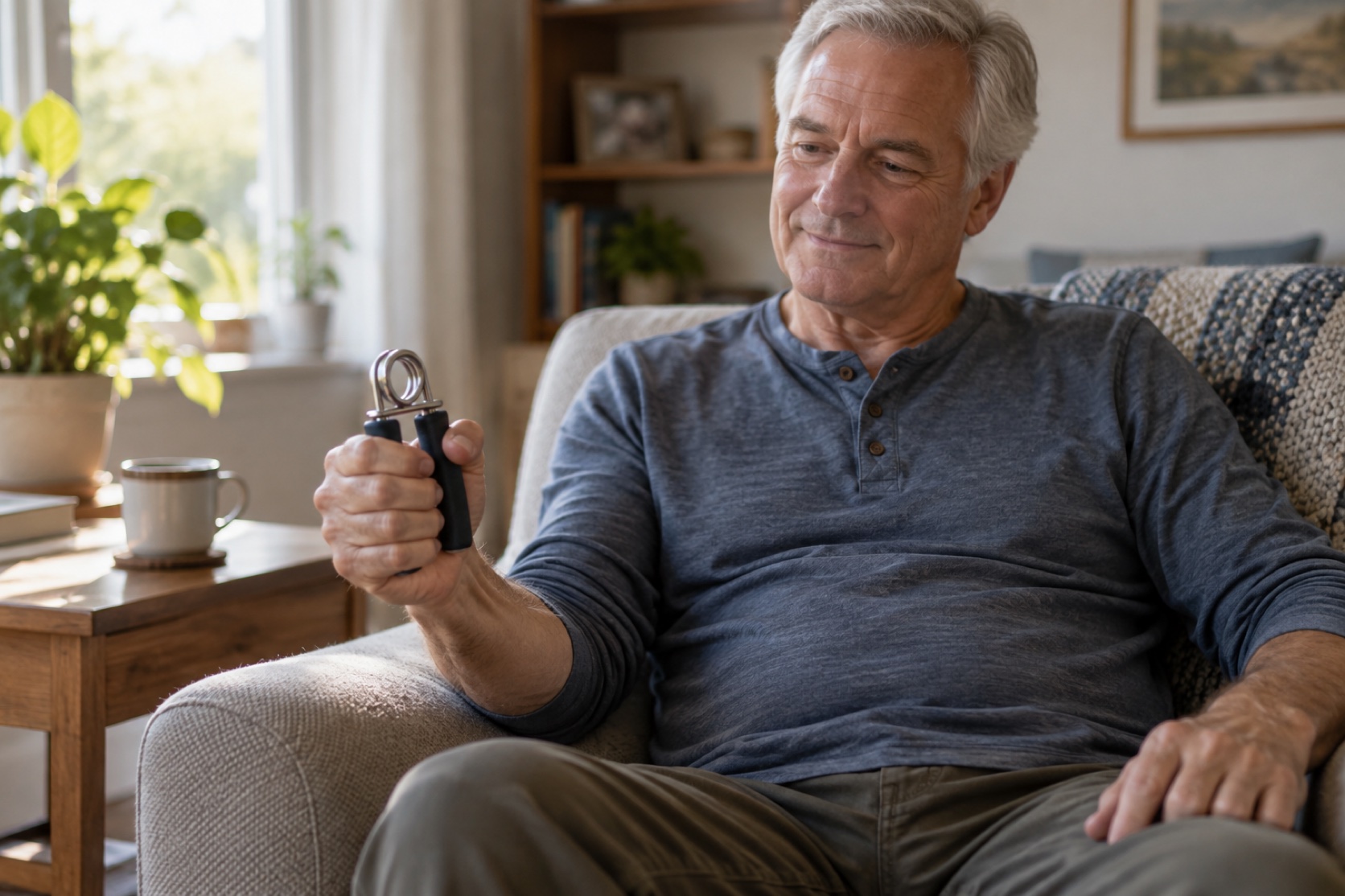
The gripper — the spring-loaded hand exerciser — is the most familiar and the most misused tool. Its strengths are real: it loads each hand independently, it travels, and it can be dosed precisely. A sensible protocol is three sets of five to ten full closes per hand, two or three days a week, using a resistance you can close completely for every planned rep; a gripper you can barely budge builds frustration, not strength. Progress by stepping up resistance when all sets close cleanly. Plate pinches train the often-neglected thumb: pinch two smooth weight plates together, hold twenty to thirty seconds, and add a plate or time when it gets easy. Isolation work earns its slot in three situations: a stubborn asymmetry between hands, a period when heavier training is off the table, or a desk-bound week when the gripper is all the gym that fits.
Where Grip Work Fits in the Week
Grip training has one scheduling rule worth enforcing: it goes last. A fatigued grip fails on deadlifts, rows, and pull-ups — the exercises that matter more — so tuck carries, hangs, and gripper sets at the end of a session, or on their own day. The 3-2-1 formula makes this easy: a carry finisher on a strength day and a daily hang are the whole program. The other rule is symmetry: grip work is unusually easy to dose one hand at a time, so use that — same sets, same resistance, both hands, every time, unless you are deliberately closing a measured gap.
The recovery caveat deserves its own sentence, because it is the most common way people hurt themselves here. Muscles adapt faster than tendons; the forearms' grip muscles can feel fresh within a day while the tendons feeding them are still accumulating strain from last week's pinch holds. Soreness in the belly of the forearm is ordinary; pain at the elbow, the wrist, or the joints of the fingers is not, and it is the signal to reduce load or frequency before it becomes a diagnosis. Finally, let the dynamometer coach you: if the quarterly number is climbing, keep the dose; if it plateaus for two quarters, add a set or step up the resistance.
⚠️ Hands that hurt need rest, not reps
Gripping through joint or tendon pain — elbows, wrists, fingers — reliably converts minor irritation into chronic tendinopathy, which is clinician territory and slow to heal. Pain during or after grip work means reduce the load, change the tool, or stop and get an assessment. The gauge will still be there next quarter; the tendon has to last decades.
Kettlebell
A compact option for loaded carries, hinges, squats, and presses.
⚠️ Ballistic movements require skill; avoid using pain or instability as a training signal.
Check price on Amazon →Questions, Answered Briefly
- 🏋️ Is grip work enough on its own? No — it is the supplement, not the program. Whole-body strength work is what moves the systems grip reflects; the toolbox here closes a specific gap.
- ⏱️ How long until I see it in the numbers? Most training studies measure at eight to twelve weeks; at your quarterly cadence, expect the second or third measurement to show movement. Earlier changes are usually noise.
- 🖐️ Which tool first? Carries, if you can — the most function per minute. Add hangs for shoulder and spine benefits. Grippers and pinches earn their place later, for asymmetry or convenience.
- 🪝 I can hang for 10 seconds — is that bad? It is a starting point, not a grade. The 30-second general target in the parent topic is reachable for most adults within months of consistent practice.
- 🦴 My grip is strong but I still train it daily — too much? Daily hangs at moderate effort are fine for most people; daily maximal gripper or pinch work is not. Effort and tendon pain, not calendar frequency, are the load meters.
The Bottom Line
- Grip is trainable at any age — training studies show measurable gains within 8–12 weeks in older adults.
- The toolbox is four tools: carries for function, hangs for support and shoulders, grippers and pinches for targeted or convenience work.
- Carries are the highest-value choice — grip trained inside posture, core, and whole-body loading.
- Schedule it last, train both hands, and respect tendons — joint or elbow pain means back off, because tendons recover slower than the muscles that pull on them.
Related Topics
- Labott et al., "Effects of exercise training on handgrip strength in older adults: a meta-analytical review," Gerontology (2019)
- Peterson et al., "Resistance exercise for muscular strength in older adults: a meta-analysis," Ageing Research Reviews (2010)
- Lopez et al., "Benefits of resistance training in physically frail elderly: a systematic review," Aging Clinical and Experimental Research (2018)
- Bohannon, "Grip strength: an indispensable biomarker for older adults," Clinical Interventions in Aging (2019)
- Leong et al., "Prognostic value of grip strength: findings from the Prospective Urban Rural Epidemiology (PURE) study," The Lancet (2015)