Movement as Meditation
Meditation does not require sitting still. A whole family of practices — mindful stretching, slow qigong sets, tai chi forms, and walking meditation — carry the attention loop through the body in motion. What they share matters more than their names: a slow tempo, a felt anchor, and no performance goal. This page maps the category, gives a quiet entry point in mindful stretching, and is honest about when movement meditation is the wrong tool.
What the evidence supports
- Slow-movement practices (tai chi, qigong, yoga asana) are associated with reduced stress and anxiety symptoms across many trials and reviews.
- Mindful stretching and slow movement are feasible for people who find seated practice uncomfortable, giving meditation a body-first on-ramp.
- Moving attention through the body is a standard, teachable structure — the same noticing-and-returning loop, with a larger anchor.
What remains uncertain
- Whether the attention training in slow movement equals seated meditation's — the head-to-head data are thin.
- Whether effects come from the movement, the attention component, the class setting, or the instructor — rarely separated in trials.
- Whether one slow practice (qigong, tai chi, stretching) outperforms another — no credible ranking exists.
Evidence last reviewed: August 20, 2026. Conclusions may change as new research is published.
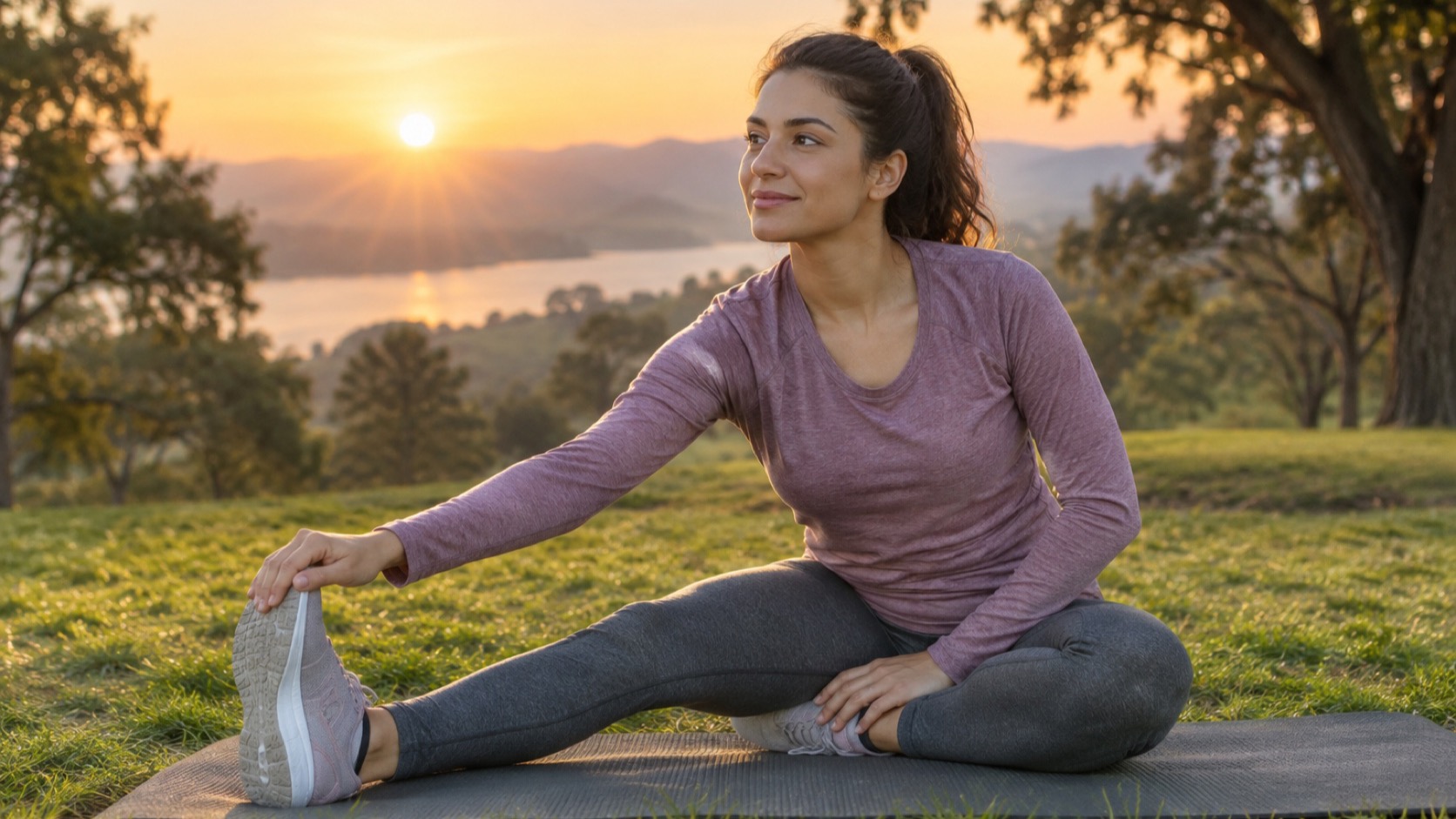
One Category, Many Names
Walking meditation is the best-known movement practice in the mindfulness tradition, but it sits inside a larger category: meditation that happens while the body moves. Tai chi, qigong, slow-flow yoga, mindful stretching, and even a deliberately slow kitchen clean-up all belong to it. What makes them meditation rather than exercise or housework is not the activity — it is where attention is assigned during the activity.
- 🐢 Slow tempo: the pace is set so that sensation can be felt. If movement is faster than noticing, it is no longer this practice.
- 🫀 Felt anchor: attention rides a bodily signal — the stretch, the weight shift, the breath moving the ribs — not a counting goal.
- 🚫 No performance target: no reps to failure, no range to hit, no score. The measure is attention staying in contact with the body.
- 🔄 Same loop: sustain on the movement, wander off, notice, return. The walking-method page (the-walking-meditation-method.html) names this loop; the movement versions just give it a bigger anchor.
The evidence for the category is reviewed honestly on the sibling page the-mindful-movement-evidence.html. Here the job is the craft: what the practices are, and how to do them.
Product picks are generic categories, not brands. We may earn a commission on Amazon or iHerb purchases at no cost to you — this never changes our evidence conclusions. Full disclosure
Meditation cushion or supportive chair accessory
May make a meditation practice more physically comfortable.
⚠️ None expected; meditation can be difficult or unsettling for some people and is not a replacement for mental-health care.
Check price on Amazon →Mindful Stretching: The Quietest Entry Point
Mindful stretching is the lowest-friction entry because it needs nothing — no forms to memorize, no class, no equipment. One stretch becomes a complete practice when it is done slowly enough to feel and held long enough to watch.
- Pick one stretch — a standing forward fold, a shoulder roll, a calf stretch against a wall. One is enough for a session.
- Move into it slowly — a count of five or more to reach the position, so the sensation has time to appear.
- Rest at the edge, not past it — a firm stretch feeling, never sharp pain. The practice lives inside the comfortable range.
- Watch the sensation for several breaths — where exactly is the pull? Is it changing? Let attention sit there like a visitor.
- Come out slowly, then pause — notice the after-feeling in the stretched area before the next repetition.
Three to five minutes of this is a complete session. The safety line is simple: sharp or spreading pain is a stop signal, not a challenge to breathe through — persistent pain during movement warrants physiotherapist input. Stretching here is attention practice, not flexibility training; it is not a treatment for any condition and does not replace medical care.
Qigong and Tai Chi: Slow-Motion Attention Training
Qigong and tai chi are the classical versions — choreographed sequences performed slowly, with attention on the whole body and the breath. The forms are memory aids: a sequence learned once, then walked through slowly, giving attention a long continuous thread to follow.
- 🧵 The form is the thread: each posture flows into the next, so the anchor is the sequence itself — attention follows the whole body through it.
- 🫁 Breath-coupled: movements are timed to inhales and exhales in most schools, which couples the attention anchor to the arousal signal — the same bonus the breath gives seated practice.
- 🎓 The learning hump: forms take weeks to memorize, which is real cost. Beginners can start with a single repeated movement — "cloud hands" or a simple weight-shift — before any full form.
- 👥 Class effects are real: most trials deliver these in classes, and the social setting plausibly contributes to outcomes. Home practice is fine; class practice is not a confound to apologize for.
A single repeated movement practiced for ten minutes carries most of the attention benefit with none of the memorization — an honest shortcut for people who want the practice without the syllabus.
Moving Attention Through the Body
The third flavor of movement meditation has no fixed form at all: attention simply travels through the body while it moves, like a body scan set in motion. Where the body-scan practice (body-scan-night.html) moves attention through a still body, this version moves it through a walking or stretching body.
- 👣 Start at the feet — sole contact, weight shifting, as in the walking method.
- 🦵 Ride up the legs — calf, knee, thigh, hip — as the walking cycle repeats.
- 🫁 Take in the torso — the breath moving the ribs, the pelvis swinging.
- 🤲 Finish at the hands and arms — their swing, their weight, their temperature.
This is the most portable of the movement practices because there is no protocol to remember — and the one that drifts most easily into ordinary walking. The fix is the same everywhere: catch it, and return to the feet.
Non-slip exercise or yoga mat
Provides a stable, comfortable surface for mobility or floor-based exercise.
⚠️ None expected; it does not treat pain or replace injury-specific care.
Check price on Amazon →A Sample 10-Minute Slow-Movement Session
Here is a complete ten-minute session mixing the three flavors — stretching, a repeated movement, and moving attention — with no equipment required.
- Minutes 0–2: settle standing — feet hip-width, eyes soft. Feel the weight through the soles, then the breath moving the ribs.
- Minutes 2–5: one mindful stretch — a slow standing forward fold, or a shoulder roll in slow motion. Move in over a count of five, rest at the comfortable edge for several breaths, come out slowly.
- Minutes 5–8: one repeated qigong-style movement — a slow weight shift from foot to foot, arms tracing a soft circle with each shift; attention follows the whole body through it.
- Minutes 8–10: moving attention downward — from the hands, down the arms and torso, to the legs and feet, letting each region be felt as the movement continues.
- Closing: stand still for a few breaths — notice the after-feeling, then move on.
The sample is structure, not doctrine — what makes any ten minutes meditation is attention riding a felt surface the whole time.
When Movement Meditation Is the Wrong Tool
The category is broad, but it is not universal. Movement meditation is a poor fit when the body itself is the obstacle, and the honest move is to say so.
- 🩹 Injury or pain: sharp pain during any movement is a stop signal. Rest, recovery, and physiotherapy input outrank practice — no meditation replaces them.
- 🏃 When the goal is conditioning: movement meditation does not build cardiorespiratory or strength stimulus. If the goal is fitness, the exercise page (movement-meditation-vs-exercise.html) is the right door.
- 🌀 When restlessness needs stillness: some agitated states settle better with a small, still anchor than with more motion. The focused-attention topic (focused-attention.html) covers the seated option.
- 📉 When it becomes avoidance: choosing slow movement every day to dodge a difficult seated session is a signal worth noticing — the practices complement, not substitute for, each other.
🌿 Slow is a feature, not a bug
In exercise, slow means inefficient. In movement meditation, slow is the whole mechanism: it is what gives attention time to land on a sensation, notice it change, and return after drifting. If a practice feels almost boringly slow, that is the practice working.
Questions, Answered Briefly
- ❓ Which practice should I pick? — The one you will actually do. Mindful stretching needs nothing; qigong adds structure; tai chi adds a class. There is no evidence one outranks the others.
- ❓ Do I need to learn the full tai chi form? — No. One repeated movement practiced slowly is a legitimate practice with the same attention structure.
- ❓ Is stretching-while-watching-TV the same thing? — Not quite. The attention must ride the sensation; a screen recruits it away. If the TV is on, it is stretching, not meditation — both fine, different activities.
- ❓ Can movement meditation replace seated meditation? — For weeks at a time, yes, comfortably. As a permanent substitute, the honest answer is that we lack the data to call them equivalent — many practitioners run both.
- ❓ I feel nothing when I stretch slowly. Am I doing it wrong? — No — a faint warmth or a slight change over successive breaths is often all there is. If truly nothing, move slightly further into the stretch or switch to the weight-shift movement, which is harder to miss.
The Bottom Line
- Movement meditation is a real category, not a compromise — slow tempo, felt anchor, no performance goal, same attention loop.
- Mindful stretching is the quietest entry point — one stretch, done slowly and watched for several breaths, is a complete session.
- Qigong and tai chi are attention training with choreography — and one repeated movement captures most of the practice without the learning hump.
- Pain and conditioning goals outrank practice — stop at sharp pain, and treat exercise and movement meditation as different jobs.
Related Topics
- Jahnke, Larkey, Rogers, Etnier & Lin, "A comprehensive review of health benefits of qigong and tai chi," American Journal of Health Promotion (2010)
- Wang, Bannuru, Ramel, Kupelnick, Scott & Schmid, "Tai Chi on psychological well-being: Systematic review and meta-analysis," BMC Complementary and Alternative Medicine (2010)
- Field, "Yoga clinical research review," Complementary Therapies in Clinical Practice (2011)
- Teut et al., "Mindful walking in psychologically distressed individuals: A randomized controlled trial," Evidence-Based Complementary and Alternative Medicine (2013)
- The Meditation & Mindfulness topic (stress/meditation-mindfulness.html) — the site's evidence owner for meditation effects