The Walking-Meditation Method
Walking meditation is not a stroll with good intentions — it is a formal practice with a structure: settle, walk slowly, feel the feet, pause at the turn, end standing. It runs the same attention loop as seated practice while the body is upright and moving, which makes it a genuinely different training environment rather than a lighter version. This page gives the step-by-step method, maps the attention loop onto it, and names the failure modes that turn the practice back into ordinary walking.
What the evidence supports
- Walking meditation is taught as a formal practice in MBSR-style programs, giving it decades of clinical use and a settled basic structure.
- Programs that include walking meditation report the same class of stress and mood effects as seated programs — consistent, though rarely isolated from the rest of the course.
- A moving, felt anchor (the feet) is continuously available, which makes it a practical alternative when breath awareness is faint or anxiety-provoking.
What remains uncertain
- Whether walking meditation trains attention better or worse than seated practice — no credible head-to-head ranking exists.
- Whether upright posture, the moving anchor, or eyes-open format each contribute separately — untested as independent variables.
- Whether very slow walking is necessary or merely conventional — trials rarely compare walking speeds.
Evidence last reviewed: August 20, 2026. Conclusions may change as new research is published.
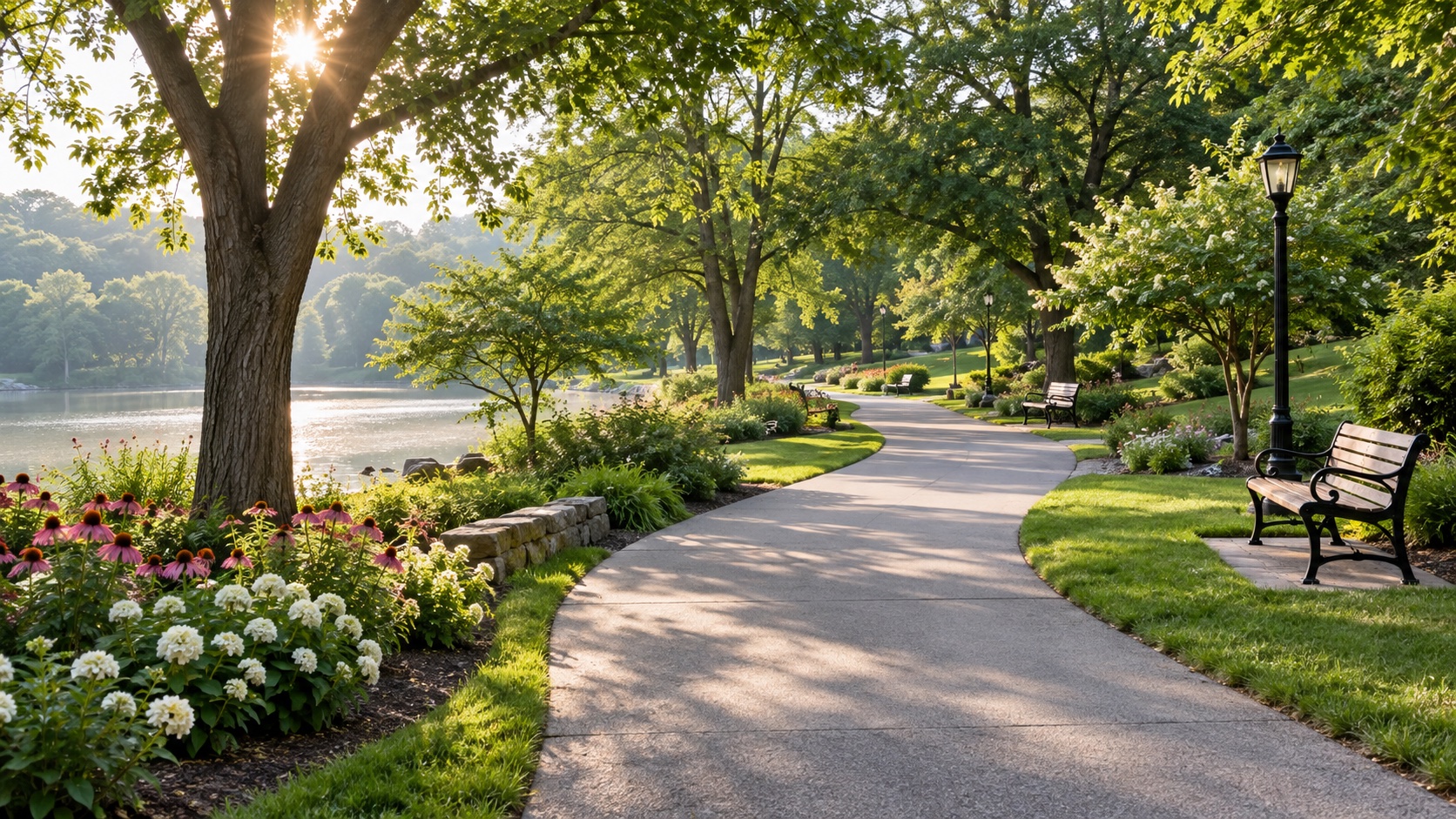
A Formal Practice, Not a Lighter Version
The word "formal" does heavy lifting. In the clinical tradition that carries walking meditation — Jon Kabat-Zinn's stress-reduction program, where it has been taught for decades — it is a structured exercise with a beginning, a middle, and an end, practiced on purpose and usually on the same short path each time. It is not a walk you take while thinking pleasant thoughts, and it is not exercise wearing a meditation hat (the exercise question is owned by the sibling page movement-meditation-vs-exercise.html).
- 🎯 One job: to keep attention in contact with the felt experience of walking — the weight shifting, the foot lifting, the sole meeting the ground.
- 📐 A shape: settle standing, walk a short distance, pause, turn, walk back. The turn is part of the practice, not an interruption.
- 🧭 An anchor: usually the feet, sometimes the legs as a whole, sometimes the whole-body sense of walking — chosen before the first step, kept for the session.
- 🚶 A pace: slower than your everyday walk, slow enough that each step is felt, fast enough that you are still walking rather than posing.
What makes it formal is not the slowness — it is that attention has an assigned job and the session has a protocol. That is what separates it from the informal mindfulness practice of "just notice your walk to the bus," which is a fine habit but a different activity (the off-cushion sibling mindfulness-off-cushion.html owns that territory).
Product picks are generic categories, not brands. We may earn a commission on Amazon or iHerb purchases at no cost to you — this never changes our evidence conclusions. Full disclosure
Comfortable walking shoes
May improve comfort and consistency for walking-based activity.
⚠️ Footwear cannot correct every pain problem; persistent foot, knee, or hip pain warrants appropriate evaluation.
Check price on Amazon →The Method, Step by Step
The classic structure below is the one used in MBSR-style teaching. Nothing here is a performance — the point is the sequence, because the sequence is what gives attention a container to work inside.
- Find a path of 10–15 meters — indoors or out; a hallway, a garden strip, or a patch of floor works. Familiar is better than scenic.
- Stand at one end for about a minute — feet planted, arms loose, eyes soft and slightly lowered. Feel the weight of the body arriving through the legs.
- Choose the anchor before moving — sole contact is the default; legs-as-a-whole and whole-body walking are the alternatives.
- Walk slowly to the other end — a natural, unhurried rhythm. Let attention ride the sequence of lifting, swinging, placing, weight-shifting.
- At the end, pause and stand for a few breaths — feel standing as its own experience, then turn slowly and walk back.
- End standing for about a minute — let the practice close the way it opened, then carry the settled feeling into ordinary walking.
A full session is usually 10–20 minutes of this out-and-back loop. The build — cue, route, anchor choice, and how to keep the habit alive — is detailed on the sibling page the-10-minute-walking-practice.html.
The Attention Loop on Foot
The fine-grained work on seated attention (Hasenkamp et al., NeuroImage, 2012) described the practice as a four-phase cycle: sustaining, wandering, noticing, and returning. Walking meditation runs the exact same cycle; only the furniture changes.
- 🦶 Sustaining: attention tracks the heel-to-toe roll of one step after another. The moving signal gives it a continuous surface to rest on.
- 💭 Wandering: the mind leaves for a plan, a worry, or a to-do list. Walking does not prevent this — it just happens at walking speed.
- 👀 Noticing: you catch the drift, often at the far end of the path, mid-turn. The catch is the event that matters.
- 🪝 Returning: attention comes back to the feet, without commentary. The return is the rep — the focused-attention topic (focused-attention.html) explains why the return, not the staying, is what trains.
Beginners often assume walking will be easier because the body is busy. In practice the drift rate is similar; the difference is that the loop gets more reps per session because the anchor is harder to lose than a subtle breath sensation. That is the honest case for walking as a first practice: not that it is gentler, but that the loop is easier to catch yourself in.
How Walking Differs From Seated Attention
Seated and walking practice share the loop but differ on every practical axis, and the differences are the reason to choose one over the other on a given day.
| Aspect | Seated attention | Walking meditation |
|---|---|---|
| 🧍 Posture | Still, supported; the body disappears quickly | Upright and moving; the body stays present in the frame |
| 👁️ Eyes | Usually closed | Open, soft gaze, slightly lowered |
| 🦶 Anchor | Breath or contact point — still | Feet, legs, or whole-body walking — moving |
| 😴 Drowsiness risk | Higher — stillness invites sleepiness | Lower — the body's motion keeps arousal up |
| 🌍 Distraction exposure | Lower — the room is small | Higher — scenery, sounds, and people arrive |
| 🔄 Loop reps | Fewer, longer phases | More frequent catches; more reps per session |
| ⏰ Best use | Deep single-point settling | Restless days, low-energy days, travel, sitting fatigue |
The Common Failure Modes
Walking meditation fails in recognizable, fixable ways. Almost all of them come from attention leaving the feet and going somewhere more interesting.
- 🏃 Walking too fast: past a certain pace the practice collapses into light exercise — the body takes over and attention rides along. If you cannot feel each step, slow down.
- 📸 Sightseeing: eyes on the horizon and the mind on the view. Soft gaze, lowered, keeps the visual field small enough to ignore.
- 🎭 Waiting for a feeling: expecting each step to feel profound. The practice is ordinary sensation, noticed on purpose — profundity is not a requirement.
- 🐢 Forcing slowness: walking so slowly that balance and self-consciousness take over. Slower than normal, not slower than possible.
- ⏭️ Skipping the pauses: treating the standing moments as dead time. They are half the practice — the transition from moving to still is where noticing sharpens.
A Realistic Starting Protocol
The simplest honest plan: ten minutes, three or four times a week, on the same short route, with the feet as the anchor for the first month. Keep the speed slow enough to feel each step, keep the eyes soft, and treat the standing pauses as part of the session. When ten minutes feels reliably doable — not reliably easy, just doable — extend to fifteen, then twenty, before adding anything else.
Two caveats belong up front. First, this is attention training, not conditioning: it does not replace exercise, and the sibling page movement-meditation-vs-exercise.html spells out the difference. Second, if walking itself is painful or limited by injury, the practice adapts — a seated "standing" meditation or a very short assisted route still runs the same loop, and persistent pain during movement warrants a physiotherapist's input rather than a longer walk. Nothing on this page treats or diagnoses any condition.
🦶 The feet are the anchor; the scenery is not
Every time you catch yourself watching the view, that is a notice event — congratulations, the loop just fired. The practice is not about never looking up; it is about coming back to the felt step. A session full of catches is a good session.
Questions, Answered Briefly
- ❓ Is slower always better? — No. Slow enough to feel each step is the criterion; beyond that, extreme slowness adds balance effort and self-consciousness without a tested benefit.
- ❓ Do I need a special path? — A familiar 10–15 meter strip beats a scenic trail. Novel scenery recruits attention; familiarity lets it stay on the feet.
- ❓ Does walking meditation count as exercise? — Not meaningfully. At practice pace it is a light activity, and the goal is attention, not stimulus. See the comparison page for the full split.
- ❓ Can I do it with limited mobility? — Yes — the loop runs on any felt movement: standing weight-shifts, a few steps with support, or attention to the legs in a chair. Pain is the stop sign, not the pace.
The Bottom Line
- Walking meditation is a formal practice with a shape — settle, walk, pause, turn, end — not a stroll with good intentions.
- The attention loop runs the same on foot as on the cushion — sustain, wander, notice, return — and the feet are a harder anchor to lose than the breath.
- Pace is a means, not the goal — slow enough to feel each step; faster than that, it quietly becomes exercise.
- Start at ten minutes, three to four times a week, on one familiar route — the build and the habit machinery live on the 10-minute practice page.
Related Topics
- Kabat-Zinn, Full Catastrophe Living: Using the Wisdom of Your Body and Mind to Face Stress, Pain, and Illness (1990) — origin of the formal walking-meditation structure used in MBSR
- Teut et al., "Mindful walking in psychologically distressed individuals: A randomized controlled trial," Evidence-Based Complementary and Alternative Medicine (2013)
- Hasenkamp, Wilson-Mendenhall, Duncan & Barsalou, "Mind wandering and attention during focused meditation: A fine-grained temporal analysis of fluctuating cognitive states," NeuroImage (2012)
- Goyal et al., "Meditation programs for psychological stress and well-being: A systematic review and meta-analysis," JAMA Internal Medicine (2014)
- The Meditation & Mindfulness topic (stress/meditation-mindfulness.html) — the site's evidence owner for meditation effects