The 10-Minute Walking Practice
Ten minutes is the smallest dose of walking meditation that feels like a real practice — long enough to settle, walk, and return, short enough to survive a busy day. The build that makes it durable has four parts: a cue that fires automatically, a route that requires no decisions, an anchor chosen in advance, and a habit design that tolerates missed days. This page assembles all four into a practice you can start tomorrow.
What the evidence supports
- Small daily behaviors become automatic through consistent cue–action pairing — habit formation modeled in real-world studies over weeks to months.
- Short mindful-walking sessions (10–15 minutes) are feasible and acceptable in randomized protocols, and reduced distress over four weeks in one small trial.
- Fixed cues (same time, same trigger) predict higher adherence than motivation-dependent scheduling in behavior-change research.
What remains uncertain
- Whether 10 minutes of walking meditation produces the same effects as longer sessions — no dose-response data exist.
- Whether daily practice beats every-other-day practice at this dose — untested as a direct comparison.
- Whether habit strength for meditation behaves like habit strength for other behaviors — plausible, inferred, not measured in meditation trials.
Evidence last reviewed: August 20, 2026. Conclusions may change as new research is published.
The Design Principle: Ten Minutes, Zero Setup
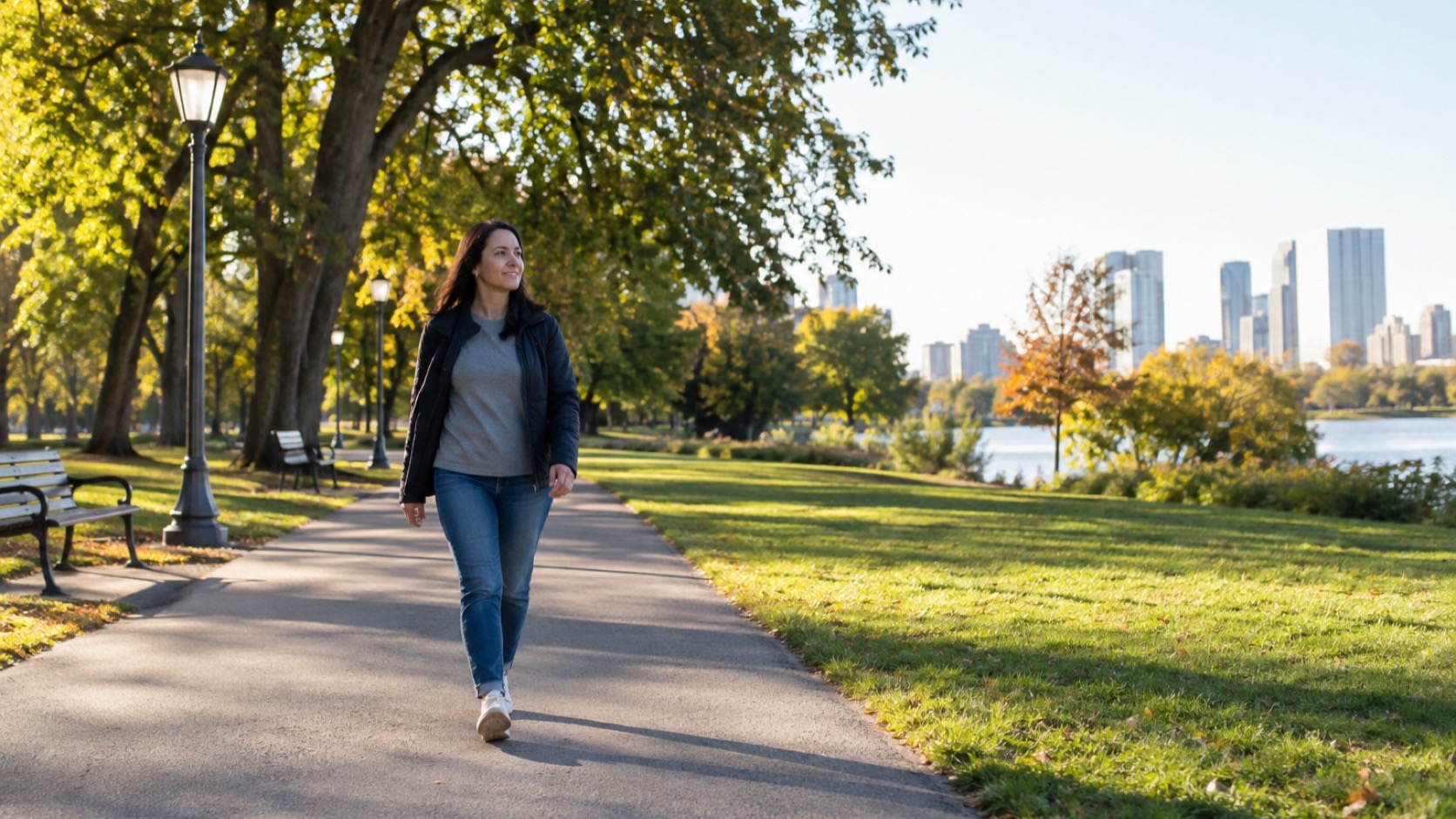
Habits survive when the friction is low enough that the decision to skip is more effort than the decision to do. Ten minutes of walking meditation is nearly friction-free: no mat, no app, no change of clothes, no class schedule. The design goal is a practice that can run inside any day, in ordinary shoes, on a route you could walk with your eyes closed — which, given the lowered gaze, you almost do.
- 🎯 Small enough to start: ten minutes is under the boredom threshold of the habit-forming brain and over the threshold of a felt practice.
- 🧰 Nothing to pack: the entire kit is a path, a pair of feet, and a decision about where attention goes.
- 📏 Honest about the evidence: the method page (the-walking-meditation-method.html) carries the practice science; this page carries the habit engineering.
Product picks are generic categories, not brands. We may earn a commission on Amazon or iHerb purchases at no cost to you — this never changes our evidence conclusions. Full disclosure
Comfortable walking shoes
May improve comfort and consistency for walking-based activity.
⚠️ Footwear cannot correct every pain problem; persistent foot, knee, or hip pain warrants appropriate evaluation.
Check price on Amazon →The Four Pieces
The build has four components, and each one removes a decision so the practice can run on autopilot. Skip any of them and the practice still works — it just costs more willpower, which is exactly the resource habits are designed to save.
- 🔔 The cue: one fixed trigger — after lunch, after the last email, when the kids are in bed. Same trigger every day. The cue should be something that already happens daily, so the practice rides it.
- 🛤️ The route: one fixed loop of 10–15 meters, indoors or out, chosen once and never re-decided. Novelty recruits attention away from the feet; familiarity lets it stay.
- 🦶 The anchor: one anchor, picked before the first step and kept for weeks — sole contact is the default, with the full menu below.
- 📓 The log: one line per day — date and a 1–5 "returns" rating, or simply a checkmark. The log is a trend line, not a report card.
The Anchor Menu
The anchor is where attention lives during the ten minutes. The menu is short on purpose — an anchor you can remember is an anchor you can use.
| Anchor | What you track | Best for | Watch for |
|---|---|---|---|
| 🦶 Sole contact | Each foot's landing and lift | Default; most reliable signal | Losing it on familiar ground |
| 🦵 Legs as a whole | The swing and weight-shift of the whole leg | When the feet feel faint or numb | Broadening into "walking" and drifting |
| 🫁 Breath at walking pace | Inhale and exhale matched to steps | When the body wants a second signal | Controlling the breath instead of watching it |
| 🌍 Whole-body walking | The overall sense of the body moving through space | Outdoor routes, longer sessions | Expanding into sightseeing |
The rule from the attention craft still applies: pick one per session and keep it for weeks. Switching mid-walk is restlessness wearing a technique disguise.
The First Week
A complete first week is simpler than people expect, because the goal in week one is not depth — it is the cue firing.
- Day 1–2: walk the route once — ten minutes, sole contact, no judgments. If your mind never leaves the feet, that is a lovely surprise, not the standard.
- Day 3–4: keep the cue strict — same time, same route. Notice how the route itself starts to feel like the entry to the practice.
- Day 5–6: add the standing bookends — one minute settling before, one minute standing after, so the session has a beginning and an end.
- Day 7: log and look — one line for the week; if the cue fired most days, the build is working. The depth comes later, on its own schedule.
Week two keeps the same shape and adds nothing — the temptation to "do more" is the habit's first test. If the cue fired five or more times, the design is working; keep the route, keep the anchor, and let the log show the trend. When the ten minutes stop requiring a decision — usually a few weeks in — the natural next step is fifteen minutes, then twenty, one step at a time, exactly like the practice itself.
Keeping It Going
The habit science here is the firmest ground the build stands on: habits form through repeated cue–action pairing, take weeks to months to automate (Lally et al., 2010), and survive on identity — "I am someone who walks ten mindful minutes" — more than on motivation. A few rules follow directly.
- 📌 Anchor to a daily constant: the cue must be something that happens every day without negotiation — a meal, a commute, a bedtime routine.
- 🧱 Missed days are data, not failure: the research pattern is that missing a day does not break a forming habit; missing the cue system does. If you miss, the fix is to fire the cue tomorrow, not to double up.
- 🌧️ Build a weather backup: an indoor route for rain, a hallway loop for cold, a "shoes optional" version for the worst days. The backup is what makes the cue fireable every day.
- 📈 Extend only after automatic: when ten minutes runs without willpower — usually after a few weeks — extend to fifteen before adding any other change. One variable at a time.
Troubleshooting
Most stalls come from a small, fixable design flaw rather than a personal failing. The table below covers the common ones.
| Symptom | Likely cause | Fix |
|---|---|---|
| 😴 Boredom by minute three | Attention is on the route, not the feet | Return to sole contact; slow down until each step is felt |
| 🏃 Pace creeps up every session | The walk is becoming a commute | Re-set the pace at the standing start; treat speed as a signal to check |
| 📱 Cue keeps getting skipped | The trigger is not fixed enough | Tie the cue to something you never skip — a meal, not a mood |
| 🩹 Discomfort or pain while walking | Medical territory, not a technique problem | Stop, rest, and get physiotherapist or clinician input before resuming |
| 🎯 Feels like nothing is happening | Expecting a feeling instead of running the loop | Judge the session by returns, not by felt depth — the mastery check pattern from the focused-attention topic |
The pain line deserves emphasis: walking meditation is not a treatment for any condition, and persistent pain or concerning symptoms during movement warrant professional input — a longer walk is never the answer to a pain signal.
🧭 Same route, same time, same anchor
Three samenesses and the practice runs itself. The route stops asking for decisions, the time stops asking for motivation, and the anchor stops asking for technique. What remains is the one thing that was ever supposed to vary: the quality of your attention on the steps.
Questions, Answered Briefly
- ❓ Is ten minutes really enough? — Enough to be a real practice: settle, walk, return, end. Whether it matches longer sessions for every outcome is untested — start with ten because you will do it.
- ❓ Morning or evening? — Whichever has a fixed daily anchor. The cue matters more than the clock hour.
- ❓ What if I miss three days in a row? — Restart at the cue, not at guilt. The route and anchor are still there; the habit resumes faster than it started.
- ❓ When do I go longer? — When ten minutes no longer requires willpower — usually after several weeks of consistency — extend to fifteen, then twenty. One variable at a time.
- ❓ What if my only available time is a crowded lunch break? — Use it. A short indoor loop, a stairwell landing, or even a slow lap around a parking lot keeps the loop running; the anchor is the feet, not the scenery.
The Bottom Line
- Ten minutes is the right starting dose — small enough to survive any day, long enough to be a felt practice.
- The build is four pieces, each removing a decision — a fixed cue, a fixed route, a chosen anchor, and a one-line log.
- Habits form through cue–action pairing, not motivation — missed days are data; the cue system is the thing to protect.
- Extend only after the practice runs on autopilot — and treat pain during walking as a stop signal that outranks any schedule.
Related Topics
- Lally, van Jaarsveld, Potts & Wardle, "How are habits formed: Modelling habit formation in the real world," European Journal of Social Psychology (2010)
- Gardner, "Making health habitual: The psychology of 'habit-formation' and general practice," British Journal of General Practice (2012)
- Teut et al., "Mindful walking in psychologically distressed individuals: A randomized controlled trial," Evidence-Based Complementary and Alternative Medicine (2013)
- Goyal et al., "Meditation programs for psychological stress and well-being: A systematic review and meta-analysis," JAMA Internal Medicine (2014)
- The Meditation & Mindfulness topic (stress/meditation-mindfulness.html) — the site's evidence owner for meditation effects