Movement Meditation vs Exercise
A tai chi class and a strength session both move the body, and confusing them costs people in both directions: exercisers assume a mindful practice is training, and meditators assume exercise will carry the attention work. They are two different games with different goals — one trains the body's physiological systems, the other trains attention and regulation. This page draws the line, says when each fits, and shows how a week can honestly contain both.
What the evidence supports
- Exercise has an enormous evidence base for cardiorespiratory fitness, strength, and metabolic health — effects movement meditation does not claim to replicate.
- Movement-based meditation has its own consistent evidence for stress, anxiety, and mood — effects exercise alone does not fully duplicate.
- Physical activity guidelines recommend 150–300 minutes of moderate exercise weekly — a target no slow-movement meditation practice reaches at meditation pace.
What remains uncertain
- Whether "mindful exercise" — doing a workout with attention — delivers both benefits at once; appealing, but untested as a package.
- Whether movement meditation provides any meaningful physiological stimulus at all — it is light activity at best.
- Whether exercise and meditation interact, amplify, or merely add — the interaction question is open.
Evidence last reviewed: August 20, 2026. Conclusions may change as new research is published.
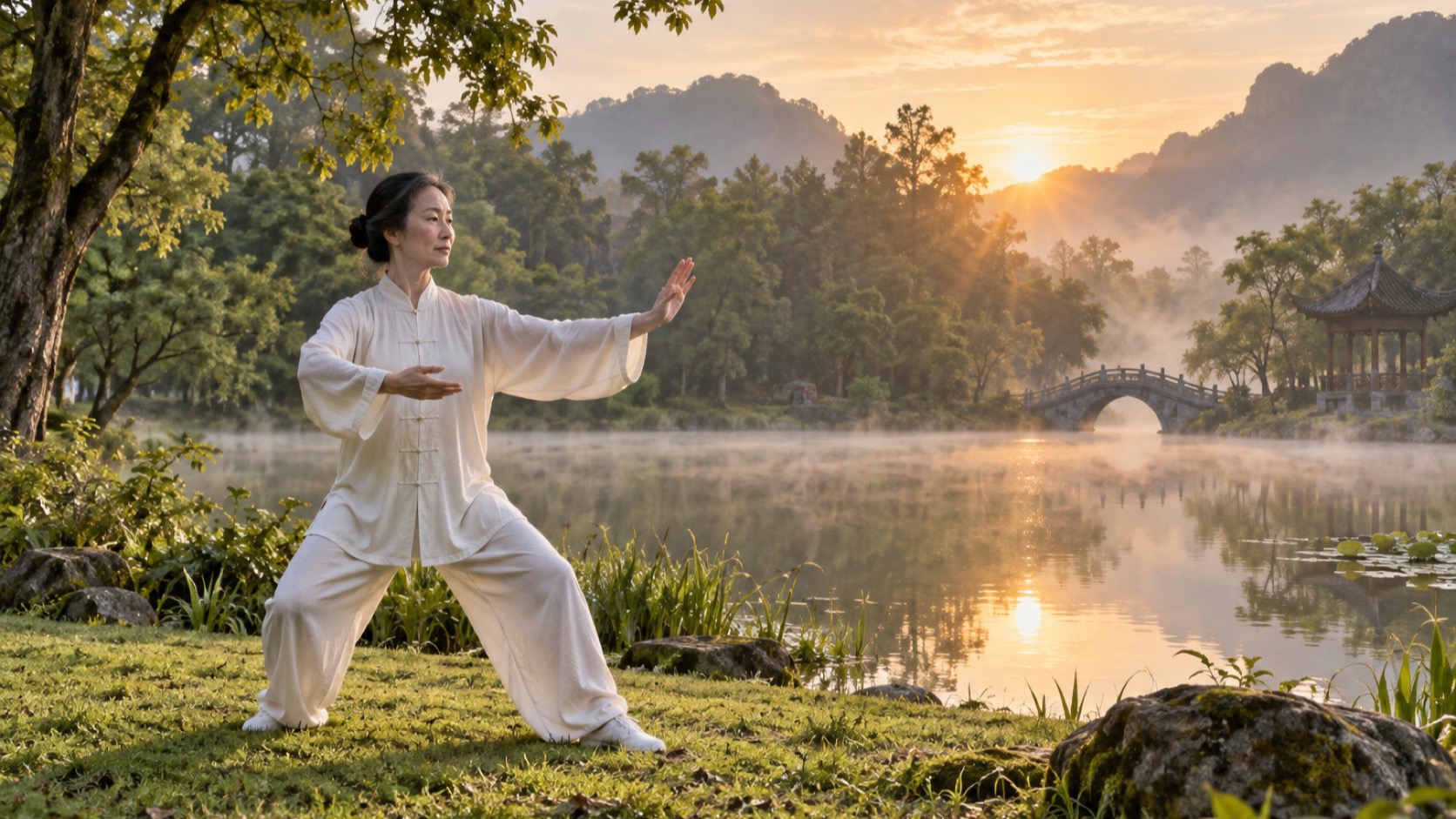
Two Different Games
The cleanest way to separate them is to ask what each activity is trying to do to you. Exercise is a physiological stimulus: it loads the heart, lungs, and muscles past their current comfort so the body adapts. Movement meditation is an attention exercise: it moves the body slowly so attention has a felt surface to train on. The body is the shared instrument; the target of training is not.
- 🏋️ Exercise trains capacity: aerobic fitness, strength, endurance, metabolic flexibility. Progress is measured in load, reps, and time.
- 🧘 Movement meditation trains regulation: the noticing-and-returning loop, attention stability, and the settled state that follows. Progress is measured in catch speed and return effort.
- 📏 The dose scales differ: exercise benefits grow with intensity and volume; meditation's benefits track consistency and attention engagement, not how hard the body worked.
Product picks are generic categories, not brands. We may earn a commission on Amazon or iHerb purchases at no cost to you — this never changes our evidence conclusions. Full disclosure
Meditation cushion or supportive chair accessory
May make a meditation practice more physically comfortable.
⚠️ None expected; meditation can be difficult or unsettling for some people and is not a replacement for mental-health care.
Check price on Amazon →What Exercise Is For
The physical activity guidance is about as close to consensus as health science gets: adults benefit from 150–300 minutes of moderate aerobic activity weekly, plus muscle-strengthening sessions (Physical Activity Guidelines for Americans, 2018; WHO guidelines, 2020). The evidence behind that target spans cardiorespiratory fitness, blood pressure, glucose regulation, and musculoskeletal health — outcomes that belong to exercise and nothing else on this page.
- ❤️ Cardiorespiratory fitness: the strongest exercise-specific outcome — brisk walking, running, cycling, and swimming all build it; meditation pace does not.
- 💪 Strength and bone load: resistance training and impact activities build and preserve musculoskeletal tissue — no slow-movement practice substitutes.
- 🩸 Metabolic health: regular moderate-to-vigorous activity is associated with better glucose handling and lipid profiles in large cohorts.
The companion page on the walking method (the-walking-meditation-method.html) is explicit that a practice pace of roughly 45 steps per minute is nowhere near the exercise zone. If fitness is the goal, exercise is the tool — movement meditation does not quietly replace it.
What Movement Meditation Is For
Movement meditation's job is the same as seated meditation's job, done on foot: a slow, repeatable loop of sustaining attention, noticing drift, and returning. Its evidence is for stress, anxiety, mood, and the subjective quality of attention — outcomes that exercise influences too, but through a different pathway and with a different dose-response.
- 🧠 Attention training: the sustain-wander-notice-return loop, run at a pace where each step can be felt — see the method page for the loop in detail.
- 😌 Regulation practice: the settled, low-arousal state after a session is the transferable skill, the same one seated practice produces.
- 🚪 An on-ramp: for people who will not sit still — or cannot — movement meditation is a legitimate entry to the practice family, not a consolation prize.
Comfortable walking shoes
May improve comfort and consistency for walking-based activity.
⚠️ Footwear cannot correct every pain problem; persistent foot, knee, or hip pain warrants appropriate evaluation.
Check price on Amazon →Where They Overlap
The line is cleanest at the extremes and blurriest in the middle, and the middle is where most people actually live. Gentle yoga, tai chi, and qigong sit on the boundary: at class pace they deliver modest physiological stimulus and real attention practice at once. The honest framing is that they are mostly meditation with a side of light activity — useful, but not a fitness program.
- 🧘 Yoga asana: the slow practice is attention training; the vigorous practice is exercise. The same form can be either, depending on pace and intent.
- 🥋 Tai chi: a 45-minute class is light-to-moderate activity for many adults, plus a full attention session — the most genuinely dual practice on the list.
- 🚶 Brisk mindful walking: picking up the pace to exercise range drops the meditation quality; keeping it slow keeps the attention but loses the stimulus. You generally get one at a time.
When Each Fits
The practical question is not which is better — it is which goal is live right now.
| If your goal is… | Reach for… | Why |
|---|---|---|
| ❤️ Cardiorespiratory fitness | 🏃 Exercise — brisk walking, cycling, running | Only exercise moves the dose into the training zone |
| 💪 Strength and bone health | 🏋️ Resistance training | Load is the stimulus; no slow practice provides it |
| 🧠 Attention stability | 🧘 Movement meditation or seated practice | The loop is the training; pace is irrelevant to it |
| 😌 Stress and mood | ⚖️ Either — both have evidence | Choose the one you will sustain; they are not exclusive |
| 🚪 Getting started with meditation | 🚶 Walking meditation or mindful stretching | Lowest friction entry when sitting still feels impossible |
Coexistence: A Week That Has Both
The two practices coexist without competition because they occupy different slots in a week. A workable pattern: three to four exercise sessions (a brisk walk, a strength session, a ride) plus four to five short movement-meditation sessions, either on separate days or stacked at different times of day. The attention practice does not need to be saved for the gym — a ten-minute walk at lunch is a complete session, as the build page (the-10-minute-walking-practice.html) shows.
- 🗓️ Separate the jobs: a workout is a workout; a practice walk is a practice walk. Trying to fuse them usually degrades one — brisk attention-walking rarely delivers either fully.
- 🔄 Use one to recover from the other: a slow practice walk can be the cool-down after a hard session — attention work on tired legs is its own honest practice.
- 📉 Drop rules: when time collapses, keep the exercise (the physiological base is the harder thing to rebuild) and shrink the meditation to a five-minute minimum rather than dropping it — the 10-minute page's habit machinery covers this.
| Day | Exercise slot | Meditation slot |
|---|---|---|
| 📅 Monday | 30-min brisk walk at lunch | 10-min practice walk after dinner |
| 📅 Tuesday | — | 10-min practice walk at lunch |
| 📅 Wednesday | 40-min strength session | 5-min mindful stretch as cool-down |
| 📅 Thursday | — | 10-min practice walk after dinner |
| 📅 Friday | 30-min bike or jog | — |
| 📅 Weekend | One longer outdoor activity | One 15-min practice walk |
This is a template, not a prescription — the point is the shape: roughly three exercise sessions and four to five meditation sessions, never competing for the same minutes. When both are present, neither has to apologize for taking time from the other.
⚖️ Neither substitutes for the other
Exercise will not give you the attention loop, and movement meditation will not give you the training stimulus. The person who needs both is everyone with both goals — which is most people. Dropping one because the other feels productive is the trap this page exists to name.
Questions, Answered Briefly
- ❓ Can't I just do exercise mindfully? — You can, and it is pleasant, but "mindful exercise" is not established as a substitute for either activity's core benefit. Treat it as a bonus, not a package deal.
- ❓ Is tai chi enough exercise for me? — For adults needing light activity, sometimes; for the 150–300 minute moderate target, usually not alone. The honest answer depends on your baseline — and it is not a medical claim either way.
- ❓ I only have 20 minutes a day. What wins? — Split it: ten minutes of brisk walking plus ten minutes of practice walking. Both doses are meaningful; neither is wasted.
- ❓ Does exercise replace meditation for stress? — Exercise has its own stress evidence, but the outcomes overlap rather than duplicate. If the goal includes attention and regulation, keep a meditation slot.
- ❓ I have an injury and cannot exercise right now. Is movement meditation a stand-in? — No — and this matters. Movement meditation is not exercise in any dose, and it is not a treatment for the injury. Rest, rehabilitation, and clinician guidance come first; a slow practice can coexist once movement is safe.
The Bottom Line
- Exercise trains physiological capacity; movement meditation trains attention — same body, different target, different dose-response.
- The evidence bases do not overlap cleanly — 150–300 weekly exercise minutes is an exercise target; the attention loop is a meditation target.
- The middle practices are mostly meditation with light activity — gentle yoga, tai chi, and qigong are honest attention practice, not fitness programs.
- A week can hold both without competition — separate the jobs, use practice walks as cool-downs, and protect the exercise slot when time is short.
Related Topics
- Piercy et al., "The Physical Activity Guidelines for Americans," JAMA (2018)
- World Health Organization, WHO Guidelines on Physical Activity and Sedentary Behaviour (2020)
- Wang et al., "Tai Chi on psychological well-being: Systematic review and meta-analysis," BMC Complementary and Alternative Medicine (2010)
- Goyal et al., "Meditation programs for psychological stress and well-being: A systematic review and meta-analysis," JAMA Internal Medicine (2014)
- Jahnke et al., "A comprehensive review of health benefits of qigong and tai chi," American Journal of Health Promotion (2010)