The Mindful-Movement Evidence
Movement-based meditation has a surprisingly large evidence base — hundreds of trials of tai chi and qigong, decades of yoga research, and a smaller but real literature on mindful walking. The honest summary is more interesting than either hype or dismissal: the effects are consistent and modest, the quality is mixed, and the studies rarely isolate the "movement" from the "meditation." This page sorts the strong findings from the soft spots and says plainly what we do not know.
What the evidence supports
- Tai chi and qigong are associated with reduced stress, anxiety, and depressive symptoms across multiple systematic reviews and meta-analyses.
- Mindful walking reduces psychological distress in randomized trials — including a small RCT showing benefits over a waitlist control.
- Yoga practice is associated with improved mood and reduced anxiety in large review literatures, with effects in the small-to-moderate range.
What remains uncertain
- Whether the movement, the attention component, the class setting, or the instructor drives the effects — trials rarely separate them.
- Whether movement practices train attention the way seated meditation is proposed to — plausible, but head-to-head data are thin.
- Dose and durability: how much practice, for how many weeks, and how long effects persist — largely unanswered.
Evidence last reviewed: August 20, 2026. Conclusions may change as new research is published.
What the Literature Actually Is
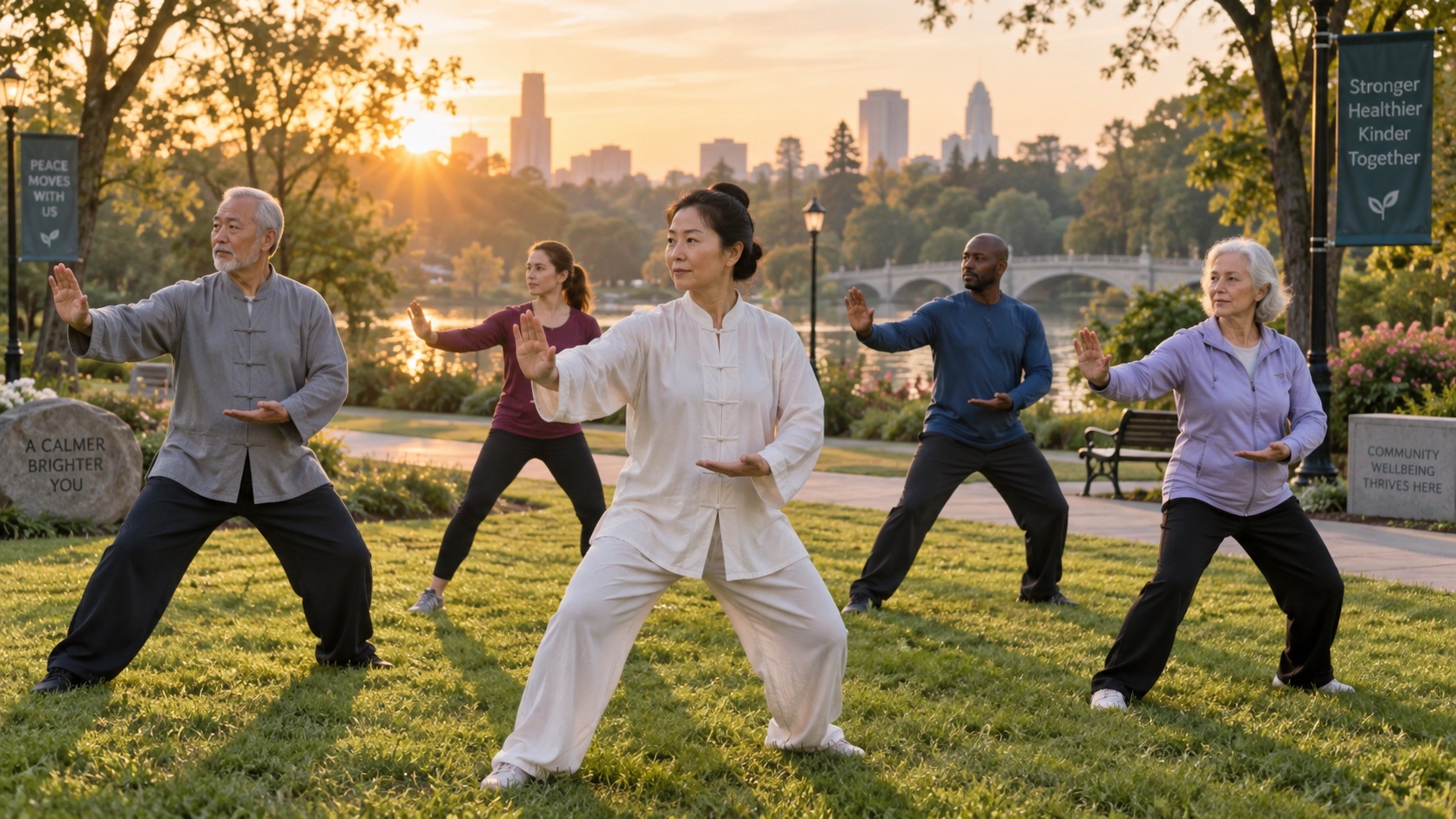
The phrase "movement-based meditation research" covers four unevenly studied practices. Tai chi leads the field with a large trial base, qigong and yoga are close behind, and mindful walking is the smallest literature by far — often studied inside MBSR-style courses rather than on its own. Knowing which practice carries which evidence matters, because a finding about tai chi is not automatically a finding about walking meditation.
- 🥋 Tai chi: hundreds of trials and multiple meta-analyses; most study psychological well-being, stress, and quality of life in adults, often delivered as weekly classes.
- 🌬️ Qigong: dozens of trials with similar findings; the review literature consistently describes small-to-moderate effects on stress and mood.
- 🧘 Yoga: a very large review base; effects on anxiety and mood are consistent, with the usual caveats about heterogeneous protocols.
- 🚶 Mindful walking: the smallest base — a handful of randomized trials, mostly small; effects look promising, not settled. It is usually studied inside MBSR-style courses, so its standalone evidence is younger than its classroom history.
Product picks are generic categories, not brands. We may earn a commission on Amazon or iHerb purchases at no cost to you — this never changes our evidence conclusions. Full disclosure
Meditation cushion or supportive chair accessory
May make a meditation practice more physically comfortable.
⚠️ None expected; meditation can be difficult or unsettling for some people and is not a replacement for mental-health care.
Check price on Amazon →The Strongest Findings
The consistent thread across reviews is well-being, not performance. When the trials are pooled, movement-based practices reliably move self-reported stress, anxiety, and mood in the direction people want — with effect sizes in the small-to-moderate range, similar in magnitude to what seated meditation programs show.
| Study / review | Design | What it found | Verdict |
|---|---|---|---|
| 🔎 Jahnke et al. (2010), qigong & tai chi review | Narrative review, ~77 studies | Consistent benefits for stress, mood, and quality of life; calls for better trials | Good |
| 📐 Wang et al. (2010), tai chi meta-analysis | Meta-analysis, 21 RCTs | Tai chi associated with reduced stress, anxiety, depression, and better mood | Good |
| 🧘 Field (2011), yoga review | Review of clinical trials | Yoga consistently associated with reduced anxiety and improved mood | Moderate |
| 🚶 Teut et al. (2013), mindful walking RCT | RCT, ~64 distressed adults | Mindful walking reduced distress versus waitlist; effects at 4 weeks | Moderate |
| 🧠 Meditation programs broadly (Goyal et al., 2014) | Meta-analysis, 47 trials | Meditation programs — including movement-based styles — reduce anxiety and depression modestly | Good |
"Good" here means the finding is consistent across independent reviews, not that it is large. A modest, reproducible effect on stress symptoms is a real outcome — it is just not a dramatic one, and it is not a treatment claim for any diagnosis.
Where the Evidence Gets Soft
The same literature has structural weaknesses that honest reading has to carry. None of them sink the practices; all of them cap what can be claimed.
- 🧪 Small samples: many trials enroll a few dozen participants, so effect estimates are imprecise and often fail to survive subgroup splits.
- 👥 Active versus inactive controls: benefits are clearest against waitlists. Against an active control — another class, another practice — the differences shrink or vanish, which is the honest test of a specific effect.
- 🧑🏫 Instructor and group effects: the class is a social intervention too. A pleasant weekly group with a skilled teacher may carry much of the benefit regardless of the specific movements.
- 📉 Adherence and drop-out: trials report attendance generously; real-world adherence is lower, and the effect sizes in the reviews may not survive everyday practice frequency.
- 📰 Publication bias: small positive trials are easier to publish than small null ones, so the pooled estimates skew optimistic — a standard caution for this whole field.
The Attention Question
The claim that movement practices train attention — the reason this page lives in a meditation protocol — is the least tested part of the evidence. The mechanism is plausible: slow movement with a felt anchor runs the same sustain-wander-notice-return loop that seated attention research describes (Hasenkamp et al., NeuroImage, 2012). But direct evidence that movement meditation improves attention better than, say, walking without instructions is sparse, and the few comparisons that exist do not support a strong ranking.
The honest position: the attention-training case for movement meditation is an inference from the seated literature plus a plausible mechanism, not a settled finding. The sibling pages on the method (the-walking-meditation-method.html) and on the daily build (the-10-minute-walking-practice.html) are written accordingly — they describe practice craft, not prescription.
Non-slip exercise or yoga mat
Provides a stable, comfortable surface for mobility or floor-based exercise.
⚠️ None expected; it does not treat pain or replace injury-specific care.
Check price on Amazon →The Dose-Response Gap
A question every practitioner eventually asks — how much, how often, for how long — is the question the literature answers worst. Most trials deliver a packaged program: 60-minute classes, two or three times a week, for eight to twelve weeks. That package is a study convenience, not an established optimum, and the dose-response curve underneath it is essentially unmapped.
- 📅 Frequency: whether daily short sessions beat twice-weekly long ones is untested head to head. The habit literature — see the 10-minute build (the-10-minute-walking-practice.html) — suggests consistency matters, but that is an inference, not a movement-practice finding.
- ⏱️ Session length: no trial compares ten minutes against forty within the same practice. The practical case for short sessions is feasibility and adherence, not measured equivalence.
- 🗓️ Duration: most positive results are measured at eight to twelve weeks. Whether effects grow, plateau, or fade over a year of practice is largely unstudied.
- 🔄 Maintenance: follow-up data are thin. The honest framing is that these practices look beneficial while practiced, with the durability question open.
The practical consequence is freeing rather than frustrating: since no dose has been crowned, the rational choice is the smallest dose you will sustain, which is the design philosophy of the 10-minute practice page. A year of ten-minute days almost certainly beats eight weeks of sixty-minute classes followed by nothing — the evidence cannot prove it, and the logic of adherence supports it.
What This Means for You
The practical translation of this evidence is more modest and more useful than a headline. First, the practices are low-risk attention and well-being tools: the side-effect profile is dominated by the usual class-schedule friction, not by harm. Second, because no practice clearly outranks another, the rational choice is the one you will sustain — adherence beats style. Third, because active-control comparisons are the honest test, expect the benefit to be real but not dramatic; a practice that reliably makes a stressful week feel lighter is worth having, and that is the scale of what the data support.
None of this is a treatment claim. Movement-based meditation is not established as a treatment for any diagnosed condition, it does not replace medical care, and if a symptom persists or worsens, a clinician — not a longer practice — is the next step. The meditation protocol's series lead (meditation-protocol.html) frames the whole practice family with the same caution.
📏 Effect size is not your experience
A pooled effect in the small-to-moderate range describes averages across trials. Your experience of a practice is a single person's data point, and it can legitimately be much larger or much smaller than the average. The studies set expectations; they do not set your outcome.
Questions, Answered Briefly
- ❓ Is tai chi more evidence-backed than walking meditation? — For well-being outcomes, yes — far more trials. For attention training, both are thinly tested; the volume gap is about history and funding, not proven superiority.
- ❓ Why don't the studies isolate walking meditation? — It is usually taught inside MBSR-style courses, so it inherits the course's effects and the course's confounds. Standalone trials are rare and small.
- ❓ Does class setting matter? — Likely yes. The social and instructional components are inseparable from the movements in most trials, which is a reason to treat a pleasant class as a feature.
- ❓ How much practice do the trials suggest? — Most programs run 30–60 minute sessions, two to three times a week, for 8–12 weeks. Whether less works is not well tested — start smaller and be consistent.
- ❓ Why is the rating only three stars if there are hundreds of trials? — Volume and quality are different things. The trials are numerous but heterogeneous, mostly small, and rarely isolate the practice's specific ingredient — which caps what any pooled estimate can claim.
The Bottom Line
- The evidence is real but modest — movement-based practices are consistently associated with small-to-moderate improvements in stress, anxiety, and mood.
- The field is uneven — tai chi and yoga carry the literature; mindful walking is young; none of it isolates "movement" from "meditation" cleanly.
- The attention-training claim is an inference, not a finding — plausible mechanism, thin direct data; the method pages are craft, not prescription.
- Adherence beats style — with no clear winner between practices, the rational choice is the one you will keep doing.
Related Topics
- Jahnke, Larkey, Rogers, Etnier & Lin, "A comprehensive review of health benefits of qigong and tai chi," American Journal of Health Promotion (2010)
- Wang, Bannuru, Ramel, Kupelnick, Scott & Schmid, "Tai Chi on psychological well-being: Systematic review and meta-analysis," BMC Complementary and Alternative Medicine (2010)
- Field, "Yoga clinical research review," Complementary Therapies in Clinical Practice (2011)
- Teut et al., "Mindful walking in psychologically distressed individuals: A randomized controlled trial," Evidence-Based Complementary and Alternative Medicine (2013)
- Goyal et al., "Meditation programs for psychological stress and well-being: A systematic review and meta-analysis," JAMA Internal Medicine (2014)
- Hasenkamp et al., "Mind wandering and attention during focused meditation," NeuroImage (2012)