Walking & Movement Meditation: Attention in Motion
Sitting is one seat; the moving body is another. Walking meditation takes the noticing-and-returning loop that breath practice trains and anchors it in the body in motion — the feet, the gait, the breath at walking pace. This page covers the formal slow walk, movement as informal meditation, the honest evidence for both, and the boundary that keeps mindful movement from being mistaken for exercise.
What the evidence supports
- Movement-based mindfulness programs — yoga, tai chi, qigong — reduce anxiety and stress symptoms with small-to-moderate effect sizes in meta-analyses (Cramer et al., 2018; Wang et al., 2010).
- Walking meditation is a standard component of MBSR, the clinical program with the largest meditation evidence base (Kabat-Zinn, 1990).
- For some people, moving practice is more accessible than sitting — a practical fit that matters for adherence.
What remains uncertain
- Whether walking meditation specifically outperforms sitting meditation or ordinary walking is not established; trials rarely isolate it.
- Whether the attention component of mindful movement is the active ingredient — or whether the movement alone carries most of the benefit — is unresolved.
- The right dose, pace and frequency for moving meditation have no settled answer; the ladder below is pragmatic, not adjudicated.
Evidence last reviewed: August 20, 2026. Conclusions may change as new research is published.
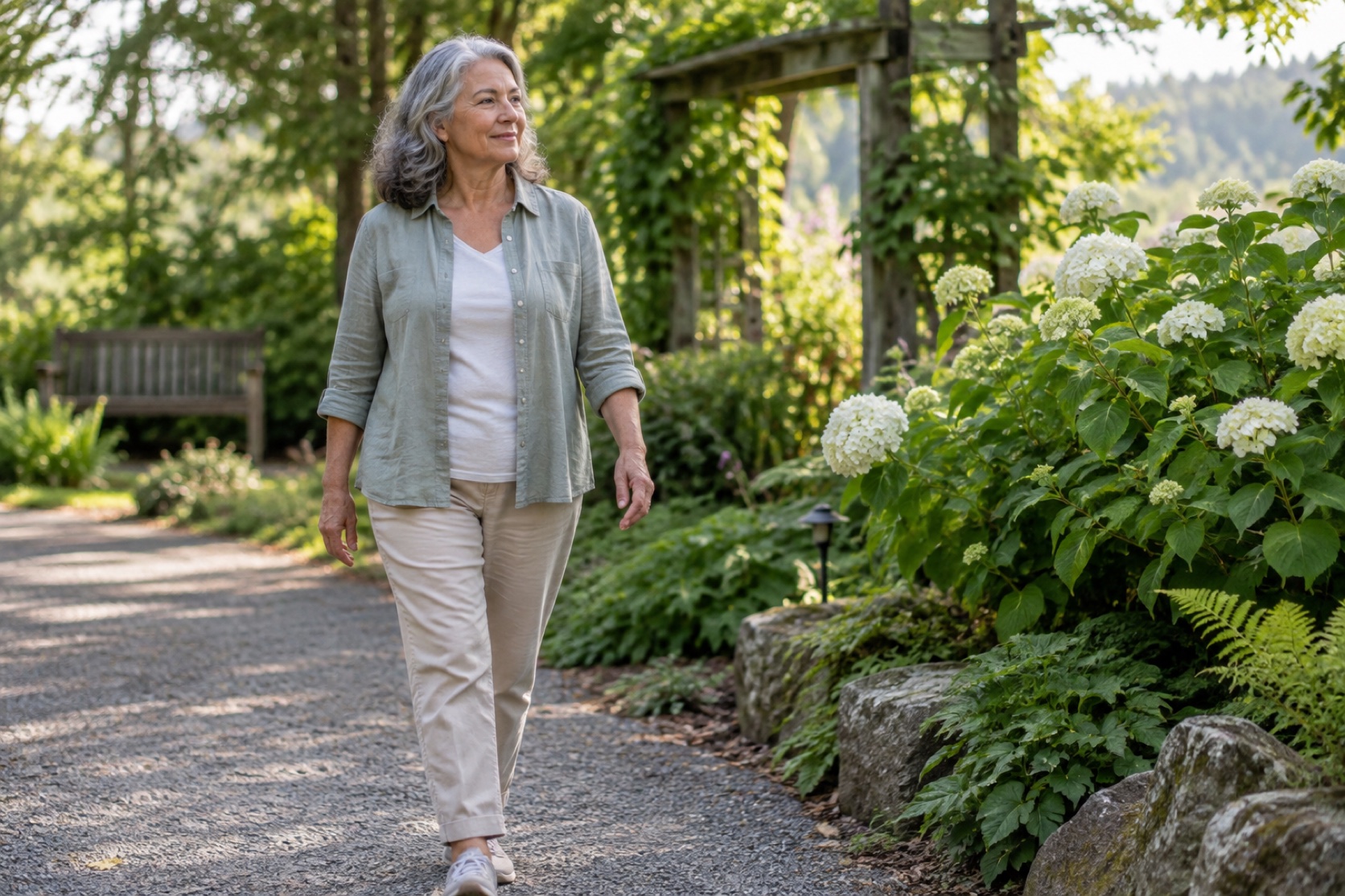
What Walking Meditation Is — and Is Not
Walking meditation takes the same noticing-and-returning loop as breath practice and gives it a moving anchor: the feet, the legs, the rhythm of the gait, the breath at walking pace. It is not a walk with a side order of thinking, and it is not a performance of calm. The practice succeeds when attention keeps returning to the body in motion, not when the walk looks graceful.
- 🚶 The object is the body in motion: contact of the feet, swing of the arms, weight shifting from heel to toe, the breath settling into walking rhythm.
- 🧠 The skill is the same: notice when the mind drifts, return to the next footfall, and do not add a second problem about having wandered.
- 🌍 It travels: a corridor, a pavement, a park path, a kitchen floor — the anchor goes wherever the body goes.
- ⚖️ It is not exercise: a slow mindful walk may barely raise the heart rate. That is not a failure; it is a different job with a different outcome.
| Format | What you attend to | Best when |
|---|---|---|
| 🐢 Slow formal walk | One lane of 10–15 steps, turned at each end; the contact of each foot | First sessions; learning the method |
| 🚶 Normal-pace walk | Gait rhythm, breath, one chosen sensation | Commutes, dog walks, lunch breaks |
| 🧹 Movement as meditation | The chore itself — dishes, stairs, sweeping | Ordinary moments; transfer practice |
| 🌬️ Breath-and-step | A breath count matched to steps (inhale three, exhale three) | A structure for restless sessions |
Product picks are generic categories, not brands. We may earn a commission on Amazon or iHerb purchases at no cost to you — this never changes our evidence conclusions. Full disclosure
Comfortable walking shoes
May improve comfort and consistency for walking-based activity.
⚠️ Footwear cannot correct every pain problem; persistent foot, knee, or hip pain warrants appropriate evaluation.
Check price on Amazon →Why Movement Makes a Good Anchor
Sitting practice asks attention to rest on a subtle object while the body stays still. Movement meditation asks the same of a loud object: a body that continuously generates sensation. Each footfall supplies a fresh signal to return to, which makes the noticing-and-returning loop easier to see, especially for anyone whose sitting sessions dissolve into physical discomfort.
- 📍 Continuous feedback: every step offers a new sensation; the anchor never runs out of material.
- 🪑 Lower physical friction: for people with back or hip discomfort that makes sitting unworkable, moving can be more accessible — a practical reason, not a claim of superiority.
- 🔁 Rhythm as structure: the gait supplies a built-in tempo, and counting steps or breaths gives a wandering mind a gentle scaffold.
- 🌿 The outdoors factor: walking outside adds light, air and novelty. The evidence that nature lifts mood belongs to the walk, not the practice.
None of this means moving practice is a better meditation — it is a different entry point. The series lead's advice stands: the practice you can actually do daily beats the one you admire from the couch. If sitting has never held, start here.
The Walking-Meditation Method
The classic form comes from the MBSR lineage: choose a lane of ten to fifteen steps — indoors is fine, a hallway or a room will do — and walk it slowly, turn at each end, and walk back. Attention rests on the sequence of standing, lifting, moving and placing. Slowness is a tool, not a goal: slow enough that each phase of a step is observable, and no slower.
- 🦶 Standing start: feel both feet on the ground, let the weight settle, and notice the intention to move before it happens.
- 👣 Slow steps: lift one heel, move the foot, place it down; keep the pace slow enough that lifting, moving and placing are each felt.
- 🔄 The turn: pause at the end of the lane, notice the turn as a full movement, and return the way you came.
- 🧭 When the mind wanders: it will, within seconds at first. The return to the next footfall is the training rep; the wandering is not a defect.
- ⏱️ Duration: five minutes is a real session; ten is generous. The companion method page walks through this in full detail.
🧭 The slow lane is a skill, not a spectacle
Walking at a quarter of your normal pace in a public place can feel exposed — common and temporary. Practice the slow lane at home or in an empty hallway first, and let the normal-pace version carry the public practice. The attention is the point; the pace is only a means to it.
Movement as Meditation: The Informal Practice
The formal lane is training; the informal practice is transfer. Movement as meditation means choosing one ordinary movement — dishes, stairs, the walk between meetings — and giving it the same treatment: one movement at a time, fully felt. The Off the Cushion topic owns the general transfer into daily life; this section is the movement-specific version.
- 🧽 One chore, one attention: choose the dishes or the sweeping; feel the water, the grip, the weight; return whenever the mind leaves.
- 🪜 Stairs as anchor: each step is a footfall; climb one flight noticing the legs doing the work.
- 🚪 Doorway pauses: at each threshold, one breath and one look at what is actually in front of you.
- 📵 Pocket rule: leave the phone in the pocket or bag for the practice window; alerts wait.
The informal practice is where the habit pays rent: a kitchen, a stairwell and a sidewalk give three practice slots a day without scheduling one. It is also worth doing badly — a returned-to chore counts even when half of it ran on autopilot.
What the Evidence Can and Cannot Say
The evidence for movement-based mindfulness is moderate and layered. Yoga and tai chi programs — which bundle movement with attention and breath — reduce anxiety and stress symptoms with small-to-moderate effect sizes in meta-analyses. What the research has not settled is how much of that benefit comes from the attention component and how much from the movement itself — possibly most of it, with mindfulness as a pleasant rider.
| Layer | Example question | Honest interpretation |
|---|---|---|
| 🌊 Acute state | Do I feel less activated after a mindful walk? | Plausible; short-lived; not evidence of lasting change |
| 🧘 Trained attention | Do I notice drift sooner after weeks of moving practice? | Partly supported; adherence and transfer vary widely |
| 🏃 The movement itself | Is a slow walk good for the body? | Walking has independent health evidence, but intensity matters |
| 🧪 Head-to-head | Does walking meditation beat sitting meditation? | Not established; individual fit is the practical guide |
MBSR includes walking meditation as a standard component, but trials rarely isolate it, so the practice inherits the program's evidence rather than owning its own. The prudent summary: mindful movement is reasonable, modest and replicated — and it is not a treatment for any condition.
Simple visual timer
Can reduce friction for short breathing, mobility, or meditation breaks.
⚠️ None expected; it does not treat anxiety, panic, depression, or trauma-related symptoms.
Check price on Amazon →Movement Meditation vs Exercise
The two are easy to confuse and worth keeping separate. Movement meditation trains attention; exercise trains the cardiovascular and muscular systems under deliberate load. A slow mindful walk does not substitute for the training the Exercise pillar describes, and no amount of noticing will build the aerobic base that zone 2 does. The two can share a day — a mindful lunch walk and a real session — but they answer different questions.
| Dimension | Movement meditation | Exercise |
|---|---|---|
| 🎯 Job | Attention training | Physiological stress and adaptation |
| 💓 Intensity | Comfortable; breath stays easy | Deliberate; often uncomfortable |
| ⏱️ Dose | 5–20 minutes at any pace | Weekly minutes and sessions per guidelines |
| 🏆 Outcome measured | Noticing and return | VO₂ max, strength, body composition |
The Zone 2 Training topic and the Cardio Protocol own the training evidence; the companion page develops the comparison in detail. The boundary rule: mindful movement complements training, it does not replace it — and it should never be sold as a shortcut to fitness.
The 10-Minute Walking Practice
Ten minutes is a generous dose for a moving meditation and a realistic one for a workday. The structure: two minutes to settle, six minutes of walking with a chosen anchor, two minutes to close. Pick one anchor before you start — the feet, the breath, or the rhythm of the gait — and return to it every time the mind drifts.
- 🗓️ Pick a recurring window: the last block of the commute, a lunch walk, the dog walk. Attaching to an existing walk is the anchor.
- 🧍 Two minutes to settle: stand still first, feel the ground, and name the intention — "ten minutes, feet as anchor."
- 🚶 Six minutes of walking: normal pace is fine; return to the anchor each time the mind leaves.
- 🌗 Two minutes to close: stop, feel the body after movement, and name the next task. The close is part of the practice, not an interruption of it.
Daily beats long, and short sessions that survive a bad week beat long ones that get skipped. If ten minutes is too much on a given day, five is a real session and two is a floor; the companion practice page turns this structure into a full protocol.
Building the Habit: Where the Ladder Bends
Walking meditation bends the series ladder in useful ways: it needs no cushion, quiet room or protected block — just a route and a willingness to leave the phone in the pocket. The Habit Formation Protocol owns the anchoring mechanics; this section applies them to a moving practice.
- 📍 Anchor to an existing walk: attach the practice to a walk that already happens — the dog, the commute, the coffee run. The walk is the cue; the attention is the practice.
- ☔ Have an indoor loop: a hallway or a room circuit keeps the habit alive on bad-weather days; the Meditation Environments topic covers shaping the space.
- 🔁 The two-day rule: one missed session is noise; two in a row is a pattern worth fixing before it becomes a pause.
- 📉 Shrink when life shrinks: a two-minute doorway practice beats a skipped twenty-minute session, every time.
The one bend to watch: a skipped walking practice looks identical to an ordinary day. If the practice keeps dissolving, shrink the dose first — and if that does not hold, the series lead's troubleshooting applies unchanged.
When to Slow Down or Stop
The clinical boundary here is simple and firm. Movement practices are not a treatment for any condition, and they are not a substitute for medical care or for the exercise training described elsewhere on this site. Persistent pain, worsening symptoms, dizziness, chest discomfort or balance concerns during movement warrant input from a clinician or physiotherapist — stop the practice until that conversation happens, and never push through pain to protect a streak.
- 🩺 Persistent pain: stop the movement that hurts and seek input. A mindful walk is not a test of willpower.
- 😵 Dizziness or unsteadiness: sit down; do not practice near traffic or stairs when balance is uncertain.
- ❤️ Concerning symptoms: chest discomfort, severe breathlessness or collapse risk are medical territory, not protocol territory.
- 🧑⚕️ Clinician territory: if a condition limits movement, ask a professional what is safe before experimenting.
🩺 The clinical boundary
Nothing on this page diagnoses, prescribes or promises. Movement meditation is an attention practice with modest, replicated support — not a treatment for any condition and not a replacement for exercise training. If movement hurts, or symptoms appear or worsen, the right next step is a clinician or physiotherapist, not a longer session.
Questions, Answered Briefly
- ❓ Is walking meditation easier than sitting meditation? — For some people it is more accessible, especially early on; a practical fit, not a demonstrated advantage.
- ❓ Can I count my lunch walk as meditation? — If attention returns to the walk whenever it drifts, yes. If the phone is in hand, it is a walk with company.
- ❓ Does mindful movement count as exercise? — It can contribute light activity, but it does not replace the training the Exercise pillar and Cardio Protocol describe.
- ❓ How long until it feels natural? — Most accounts point to weeks of short sessions; consistency matters more than session length.
The Bottom Line
- Movement is an anchor, not a reward — attention returns to the body in motion the way it returns to the breath.
- Start with the formal slow walk — ten to fifteen steps, one lane, the turn felt fully — before informal experiments.
- Treat mindful movement as attention practice, not exercise — the evidence does not support it replacing training.
- Pain and safety outrank the practice — persistent pain or concerning symptoms warrant a clinician or physiotherapist.
Go Deeper: Walking & Movement Meditation
These five companion pages turn the topic into smaller, testable practices.
- 🔗 The Walking-Meditation Method
- 🔗 Movement as Meditation
- 🔗 The Mindful-Movement Evidence
- 🔗 Movement Meditation vs Exercise
- 🔗 The 10-Minute Walking Practice
Related Topics
- Kabat-Zinn, J., Full Catastrophe Living (1990) — the MBSR lineage that includes walking meditation as a core practice
- Goyal, M. et al., “Meditation programs for psychological stress and well-being: a systematic review and meta-analysis,” JAMA Internal Medicine (2014)
- Cramer, H. et al., “Yoga for anxiety: a systematic review and meta-analysis of randomized controlled trials,” Depression and Anxiety (2018)
- Wang, C. et al., “Tai Chi on psychological well-being: systematic review and meta-analysis,” BMC Complementary and Alternative Medicine (2010)
- Zeidan, F. et al., “Mindfulness meditation improves cognition: evidence of brief mental training,” Consciousness and Cognition (2010)
- Field, T., “Yoga clinical research review,” Complementary Therapies in Clinical Practice (2011)