Body Scan & the Night Practice
The body scan is the evening tool in this series: fifteen to twenty minutes of moving attention through the body, feet to crown, that releases the day's tension and hands you toward sleep. This page is the technique, the timing, and the one rule this practice uniquely breaks — in bed, falling asleep is not failure.
What the evidence supports
- Mindfulness programs that include body scans improve sleep quality and reduce insomnia symptoms in randomized trials.
- The scan reliably reduces self-reported tension and is a core component of clinical programs for pain conditions.
- Slow-exhale breathing patterns reduce physiological arousal and improve mood in controlled laboratory studies.
What remains uncertain
- Whether the scan outperforms plain relaxation audio head-to-head is largely untested.
- The exact sweep order, pacing, and timing are clinical convention, not evidence-ranked choices.
- That falling asleep mid-scan in bed beats other wind-downs rests on plausibility and sleep-hygiene logic more than direct trials.
Evidence last reviewed: August 13, 2026. Conclusions may change as new research is published.
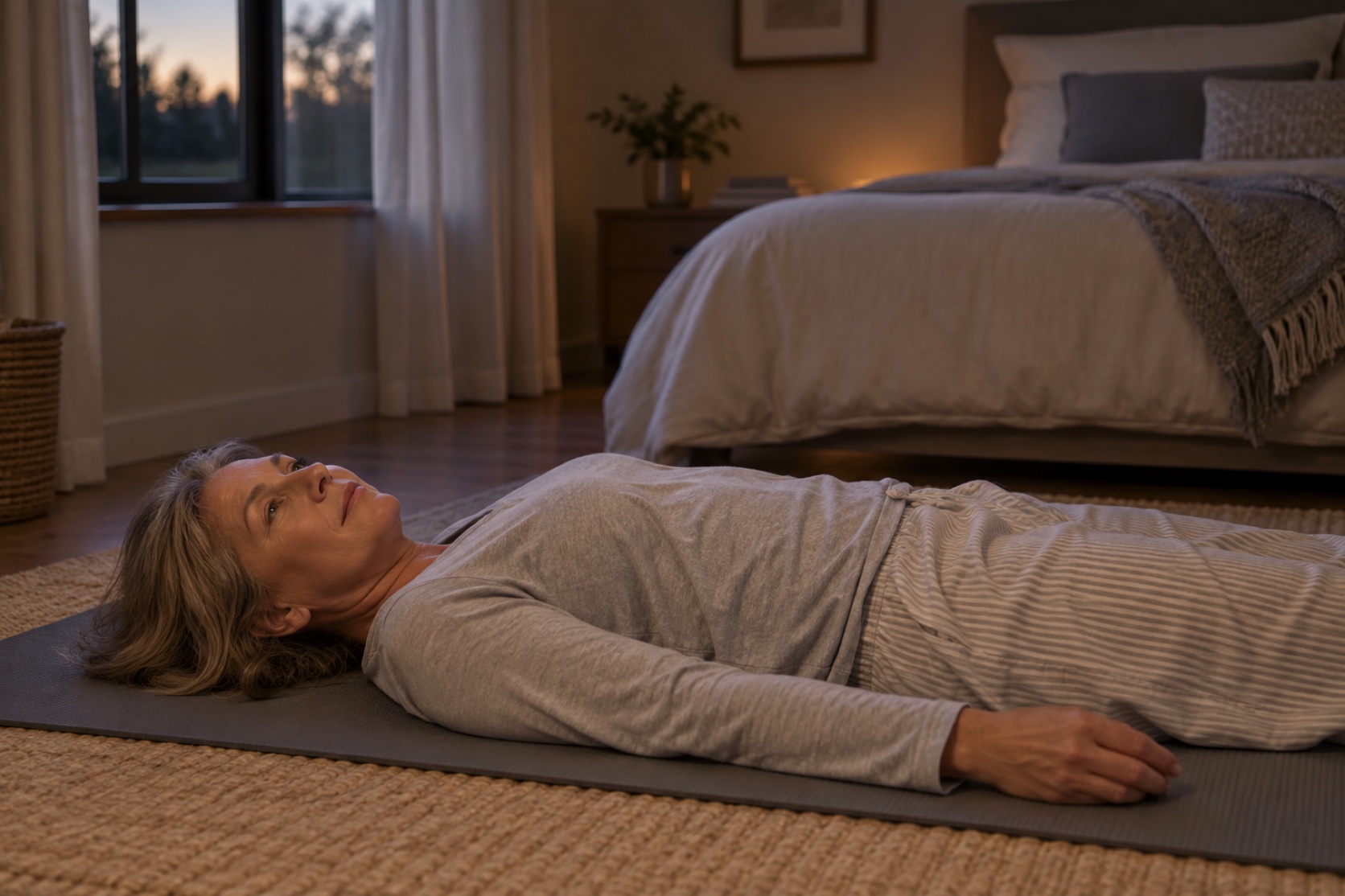
What the Body Scan Is
A body scan is exactly what it sounds like: you sweep attention through the body, region by region, from the feet to the crown, noticing whatever is there — pressure, temperature, tightness, the breath moving, or nothing at all — and changing none of it. The instruction that matters is the last one: the scan is an observation pass, not a relaxation exercise you perform on yourself. Tension that releases, releases on its own once it's noticed; tension that doesn't is simply observed.
- 🏥 The lineage — the scan comes from the clinical mindfulness-based stress reduction program developed for chronic pain patients in the late 1970s, which is why this style carries more "used in medicine" evidence than most meditation variants.
- 🔦 What attention is doing — attention is a flashlight, and you walk it over the body slowly enough that each region gets real light. Most held tension is invisible simply because it's never looked at.
- 📐 The shape — fifteen to twenty minutes, lying down or seated, eyes closed. The lying-down version is standard for the evening, and that's the version this page builds around.
- 🤲 The attitude — interested, not corrective. The scan's quiet power is the instruction to change nothing, which is itself a lesson the nervous system learns from.
The Sweep: Feet to Crown
The order matters less than the pace, and the pace is slow. Two or three minutes per zone, longer on the spots that hold. Five passes:
| Pass | What you cover | What tends to hide there |
|---|---|---|
| 🦶 Lower body | Feet, ankles, calves, knees, thighs — contact, weight, warmth | Curled toes; braced thighs from a standing day |
| 🌀 Pelvis, belly, lower back | The seat of the body; the breath moving here | The day's grip in the lower back |
| 🫁 Chest and upper back | The ribcage's rise and fall | Shallow-breathing tightness across the shoulders |
| 🖐️ Hands to shoulders | Hands, wrists, arms, shoulders, neck — let them drop | The typing clench; the shrugged shoulders; the forward head |
| 🙂 Jaw, face, crown | Teeth unclenched, eyes soft, brow released; finish at the top of the head | The jaw clamp; the furrowed brow |
- ⏱️ The pace rule — fifteen to twenty minutes for the full sweep; if you're done in five, you skimmed. Slowness is the dose.
- 🔁 The return rule — attention will leave for thoughts, repeatedly. Same as Part 2: notice, come back to the last region, continue. The scan's long track of regions makes it forgiving — there is always a "next spot" to resume.
- 🛋️ The lying-down setup — on your back, arms a little away from the body, palms up or neutral, a pillow under the knees if the lower back complains. The position that says the day is over.
Why the Evening: The Sleep Cascade Handoff
The scan's natural home is the evening, and it slots into a specific place: after the dimming step of the Sleep Protocol's evening cascade. The Evening Cascade page owns the full sequence — dinner winding down, lights dimming, screens leaving the bedroom. The scan is the last active station on that line: the bridge between "day is over" and "lights out."
The sleep science behind the handoff lives in the pillar — the Science of Repair topic covers what sleep is for and why protecting the wind-down matters. This page only claims the operational layer: where the session goes and what it does there.
- 🌇 Why the slot works — by evening, the day's tension has a full day's accumulation behind it, and attention is still fresh enough to run the scan before sleepiness takes over.
- 🧲 The handoff logic — the scan pulls attention out of tomorrow's problems and into the body, which is exactly where the cascade wants it: the last cognitive demand of the day, followed by nothing.
- 📉 The arousal direction — a scan doesn't sedate; it just stops adding stimulation. Against a dimmed room and a body that has wound down, that's enough to let the cascade continue on its own.
The Bedtime Variant: Drifting Off Is Allowed
In bed, lights out, scan from the feet, and let sleep take over whenever it arrives. This is the one session in the entire series where falling asleep is not a failed rep but a successful handoff.
- 🛏️ The setup — the evening routine's last step: teeth, lights off, lie down, begin the sweep. No timer needed — sleep sets the session length.
- 😴 The rule reversal — everywhere else in this series, sleep mid-session means the time slot was wrong. Here it's the target behavior. Gone by the calves? The scan did its job in record time.
- 🌙 If you wake mid-scan — resume from the last region or start again at the feet; both are fine, no grade. The practice is the noticing, and a 2 a.m. resumption is noticing in action.
- 🎁 The honest floor — even on nights the scan doesn't buy a faster sleep onset, fifteen lying minutes of slow attention is a downshift the nervous system keeps. The session pays out either way.
The 4-7-8 Pairing
When the day has run hot and the body won't take the handoff, add a breathing round before the scan. The pairing: three or four rounds of 4-7-8 breathing seated at the bedside, then lie down and sweep.
- 🔢 The pattern — inhale through the nose for four counts, hold for seven, exhale through the mouth for eight. Three or four rounds, then stop — this is a reset, not a session.
- 🫁 Why it pairs — the Breathwork topic owns the physiology of slow exhales and the arousal reset, and the Cortisol 101 topic owns the evening decline this rides. One lever, then the other: breathing drops the arousal, the scan lands the attention.
- ⚠️ The hold, honestly — the seven-count hold is the only piece with a caution: if holding feels like strain, drop it (four in, eight out) or use the physiological sigh instead. The benefits don't depend on forcing the hold.
- 🛌 The sequence — dim (cascade) → 4-7-8 seated at the bedside → lie down → sweep feet to crown → sleep when it comes.
| Pattern | How | Reach for it when | Verdict |
|---|---|---|---|
| 4-7-8 | In 4, hold 7, out 8 — three or four rounds | Wired but not panicked | Promising |
| 4-in, 8-out | The same, hold dropped | Holds feel like strain | Good default |
| Physiological sigh | Two quick ins, one long out | An active stress spike | Good |
The Breathwork pillar owns the full menu and the cautions — this table is the bedside shortlist.
The Daytime Version
The scan also runs in daylight, in a different shape: shorter, seated, eyes open or closed, aimed at the day's tension hotspots rather than at sleep.
- 🪑 The setup — chair, five to ten minutes, the abbreviated route: hands, jaw, shoulders, belly. Same noticing, no sleep goal, no lying down (that's the evening's version).
- ⏰ The good slots — after the lunch dip, mid-afternoon, before a hard conversation, after training when the body is buzzing.
- 🧑💻 The desk version — ninety seconds at the keyboard: feel the feet on the floor, release the jaw, drop the shoulders, take one full breath. A scan in miniature, and the version that actually fits a workday.
- 🔗 The transfer — this is also the bridge to Part 5's off-cushion practice: the scan is the body's version of the noticing loop from Part 2.
| Version | Position | Length | Sleep allowed? | Best for |
|---|---|---|---|---|
| 🌆 Evening scan | Lying down or seated | 15–20 min | No — that's the bedtime variant's job | The nightly tension release |
| 🛌 Bedtime variant | In bed, lights out | Until sleep | Yes — it's the target | Sleep onset itself |
| ☀️ Daytime micro-scan | Seated, eyes open or closed | 90 sec–10 min | No | Midday tension spikes |
Where the Evidence Lives
This page is the operational layer. The science behind each station lives in the pillars and sibling protocols, referenced rather than repeated here:
- 🛌 What sleep is for, and why the wind-down matters — the Science of Repair topic owns the sleep case.
- 🌙 The full evening sequence — the Evening Cascade page owns the dimming step this scan follows and the steps that come after.
- 🫁 The breathing patterns — the Breathwork topic owns the 4-7-8 mechanics and cautions.
- 😌 The evening cortisol decline — the Cortisol 101 topic owns the physiology of the daily rhythm this practice rides.
- 🧠 What meditation overall does — the Meditation & Mindfulness topic owns the trial evidence for the practice family.
What to Do When It Goes Wrong
Night practice fails in predictable ways — and most failures are the schedule or the setup, not the technique. Five situations that actually happen, with the response that works:
- 🚩 You finish the scan more awake than when you started — directed attention is a mild stimulant, which is why the scan belongs after dimming, not at the computer. Move it later, dim first, add the 4-7-8 rounds before, and use the in-bed variant so sleep can interrupt.
- 🚩 You keep falling asleep before the crown — in the bedtime variant, that's the successful version. If it happens in a daytime or chair scan, sit upright and shorten to the abbreviated route.
- 🚩 Some body parts feel numb or absent — normal. When a region won't report in, imagine its shape or recall its weight; there's no requirement to feel anything specific.
- 🚩 Tension spikes the moment you attend to it — noticing can briefly amplify a sensation; that's attention turning the lights on, not a problem. Don't fight it — pass through the region and move on; the release often arrives after the pass.
- 🚩 Restless legs, itches, or discomfort — shift deliberately, scratch, then return to the last region. Restlessness is part of the material, not a defect. Persistent pain is different: change the position, prop the knees, and treat the setup as the fix, never the endurance.
Questions, Answered Briefly
- ❓ Do I have to lie down? — No. A chair or cushion works for the evening scan; lying down is for the bedtime variant and the deep evening. The lying version is the sleep-adjacent one, not the required one.
- ❓ What if I fall asleep at minute three? — In the bedtime variant, that's a successful session. In any other slot, move the session earlier or sit upright — and consider that your sleep debt is talking.
- ❓ Can I use a guided recording? — Yes — the scan is the style where guidance genuinely helps, because the sweep order is easy to lose. Part 2's "graduate to silence" rule applies least here.
- ❓ Scan or breath session at night — which one? — The scan. The breath practice from Part 2 belongs earlier in the day, where drowsiness is a nuisance rather than the goal; the scan is built for the evening slot.
🛌 Sleep is not the bug
The bedtime scan is the one session where drifting off is the feature. Asleep by the knees? The practice didn't fail — it completed. Every other session, stay awake; this one, let go.
The Bottom Line
- Sweep feet to crown, fifteen to twenty minutes — noticing, never changing; slowness is the dose.
- Run it in the evening, after the cascade's dimming step — the scan is the bridge to lights out.
- In bed, falling asleep is the successful ending — the one practice where sleep isn't failure.
- Pair 4-7-8 breathing first when wired — breathing drops the arousal, the scan lands the attention.
This Page in One Workflow
- Dim — finish the cascade's dimming step; screens are already leaving the bedroom.
- Breathe — three or four rounds of 4-7-8 seated at the bedside, only if wired.
- Lie down — the bedtime variant, lights out, pillow under the knees if needed.
- Sweep — feet to crown, region by region, changing nothing.
- Let go — sleep when it comes; if it doesn't, the scan itself was the session.
The Daily Checklist
- Evening scan or bedtime variant scheduled after the dimming step
- 4-7-8 rounds done first if wired — holds never forced
- Sweep completed feet to crown (or as far as sleep allowed)
- Tension spots noticed, not fought
- Phone out of the bedroom or face-down on silent
- Daytime micro-scan taken if tension spiked (90 seconds counts)
The Weekly Checklist
- One full twenty-minute sweep completed at least once this week
- Bedtime variant audited: sleep-onset time on scan nights noted
- One unguided scan — no audio this session
- 4-7-8 checked against the Breathwork page's cautions — holds skipped if straining
- Cascade slot reviewed: scan still after dimming, still before bed
- Sleep onset unchanged after a month? Review the full Evening Cascade page
Go Deeper: Body Scan & the Night Practice
These five companion pages turn the topic into smaller, testable practices.
- 🔗 The body-scan protocol
- 🔗 The sleep evidence
- 🔗 The pain application
- 🔗 Scanning in bed
- 🔗 The 10-minute night version
Related Topics
- Kabat-Zinn, "An outpatient program in behavioral medicine for chronic pain patients based on the practice of mindfulness meditation," General Hospital Psychiatry (1982)
- Dreeben, Mamberg & Salmon, "The MBSR body scan in clinical practice," Mindfulness (2013)
- Rusch et al., "The effect of mindfulness meditation on sleep quality: a systematic review and meta-analysis of randomized controlled trials," Annals of the New York Academy of Sciences (2019)
- Balban et al., "Brief structured respiration practices enhance mood and reduce physiological arousal," Cell Reports Medicine (2023)
- Hölzel et al., "Mindfulness practice leads to increases in regional brain gray matter density," Psychiatry Research: Neuroimaging (2011)