Shift Work Harm Reduction
Night and rotating shift work is where the sleep-evidence gets serious: several decades of large cohort studies associate it with higher cardiovascular and metabolic risk, and that association is dose-response — more years, more risk. This page does not pretend the levers erase the association; it lays out the harm-reduction layer that survives scrutiny — light management, strategic napping, and rotation design — so that a shift worker can be honest about the stakes and still act on the pieces that are in their control.
What the evidence supports
- Rotating night shift work is associated with higher coronary heart disease risk in a dose-response pattern — more years, higher association (Vetter et al., JAMA, 2016).
- It is also associated with higher type 2 diabetes risk in large prospective cohorts (Pan et al., PLoS Medicine, 2011).
- Bright light during the shift and darkness at home can shift the circadian clock toward night-work alignment (Eastman & Martin, Annals of Medicine, 1999), and planned on-shift naps measurably improve late-shift alertness (Smith-Coggins et al., Annals of Emergency Medicine, 2006).
What remains uncertain
- These are observational associations — night workers differ in many ways, and no adjustment fully isolates shift work's own contribution.
- Whether harm-reduction strategies reverse the cardiometabolic risk is not established; the levers improve sleep and alertness, and the risk reduction is inferred, not proven.
- The absolute risk is modest — most night workers never develop the outcomes in question — which matters for keeping the risk in proportion.
Evidence last reviewed: August 15, 2026. Conclusions may change as new research is published.
The Rotation Evidence, Stated Honestly
The headline finding is dose-response and it is from enormous cohorts. In the Nurses' Health Study, women who worked five or more years of rotating night schedules showed a higher associated risk of coronary heart disease than women who never worked nights, and the association climbed with each additional band of years (Vetter et al., JAMA, 2016). A separate pair of Nurses' cohorts found rotating night work of three or more years associated with higher type 2 diabetes risk (Pan et al., PLoS Medicine, 2011). Two honest glosses keep these numbers in proportion: the associations are moderate, not overwhelming, and most people in the exposed groups never had the event; and the studies are observational, so the exact contribution of the schedule versus the lifestyle that grows up around it is not fully separable. What the evidence does support is straightforward: shift work is a real metabolic stressor, and years of it compound — which is the entire argument for building a harm-reduction layer rather than ignoring the problem.
Product picks are generic categories, not brands. We may earn a commission on Amazon or iHerb purchases at no cost to you — this never changes our evidence conclusions. Full disclosure
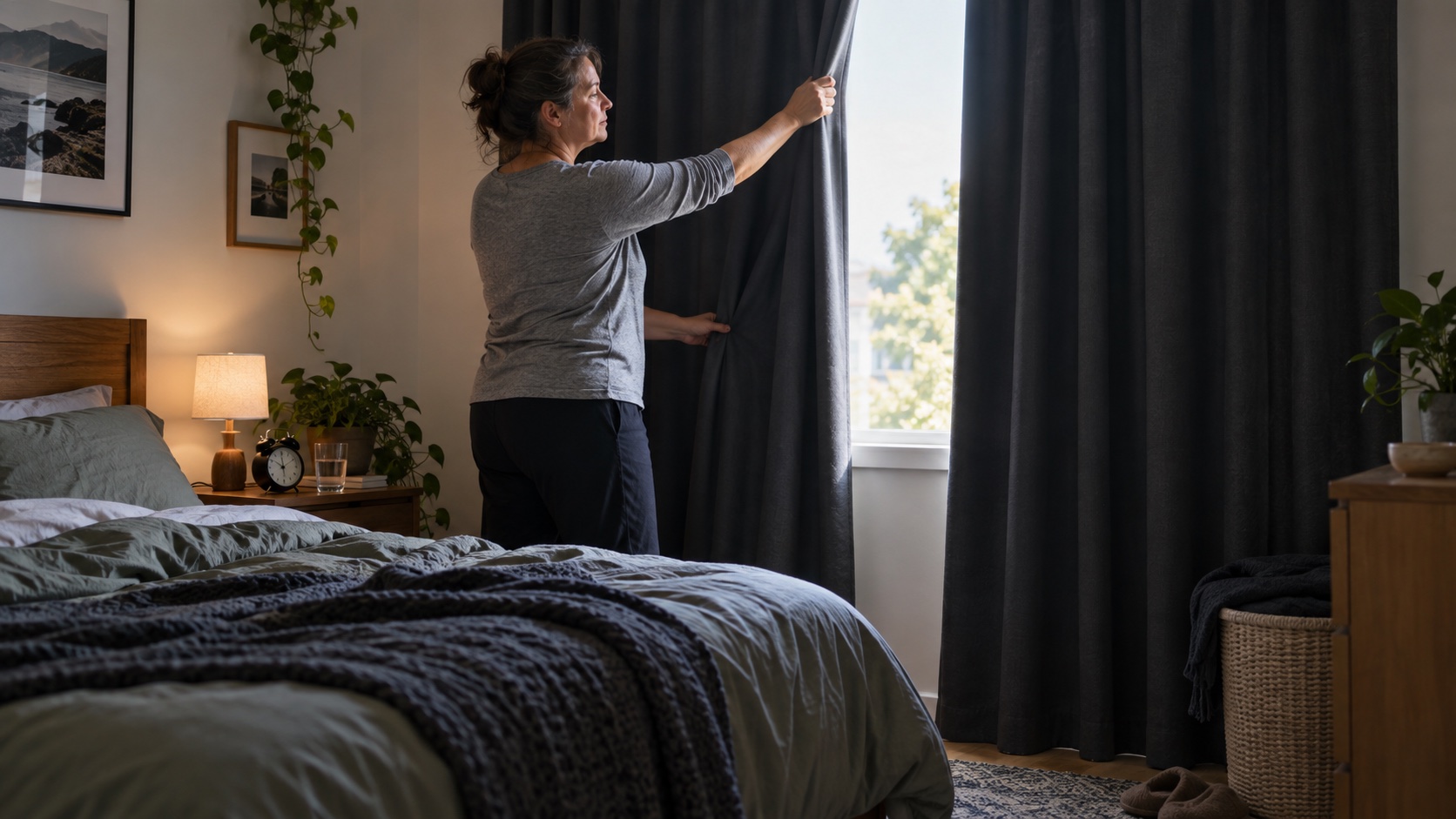
Blackout shades or curtains
May reduce unwanted bedroom light and make a dark sleep setting easier to maintain.
⚠️ None expected from the product itself; install securely and preserve a safe route to exits.
Check price on Amazon →Light Is the Main Lever
The single strongest environmental lever a shift worker controls is light, because the clock is set by it. The light-and-dark plan for night-shift adaptation is deceptively simple and unusually well documented: expose yourself to bright light early in the shift to anchor wakefulness, then cut light — dim light, blue-blocking lenses, dark glasses on the commute home — so that the clock receives "night is coming" signals as daytime sleep approaches (Eastman & Martin, Annals of Medicine, 1999). The dose-response work showing that even indoor-level light shifts the clock steeply (Boivin et al., Nature, 1996) is what makes the "dim the tail of the shift" instruction more than a guess. The circadian-rhythm topic owns the clock biology; the practical flow looks like this.
Reusable earplugs
May reduce intermittent environmental noise at bedtime.
⚠️ Improper use can irritate the ear canal; users who need to hear alarms or caregiving cues should choose cautiously.
Check price on Amazon →Napping on the Shift
The best trial evidence in the whole shift-work literature may be the planned-nap study. In a randomized trial of emergency-department physicians and nurses working three consecutive night shifts, a scheduled 40-minute nap opportunity at 3 am — with about 25 minutes of actual sleep — led to fewer performance lapses, less fatigue, and less subjective sleepiness at the end of the shift, compared with working through (Smith-Coggins et al., Annals of Emergency Medicine, 2006). The honest addendum is built into the trial itself: immediately after the nap, memory was briefly worse, and the nap group did not drive any better on the simulated commute home. Strategic napping helps the shift; it is not permission to sleep-drive. The practical dose is the 20–30 minute window carried over from the nap prescription, timed to the low point of the shift.
⚠️ Melatonin is clinical territory
Melatonin is frequently discussed in shift-work circles, and it is precisely the kind of supplement this site does not dose or time for anyone. The right product, timing, and dose vary with the shift schedule and the individual's clock, and the decision belongs to a healthcare professional familiar with the situation — especially because getting the timing wrong can deepen the very misalignment it is meant to fix. The light-and-schedule scaffolding on this page is the lifestyle layer; melatonin, if used, is a clinical conversation.
The Rotation Itself
How a rotation is designed matters, and it has mattered for forty years. In one of the founding studies of applied chronobiology, shift schedules redesigned around circadian principles — rotating in the forward direction (day to evening to night) with rest days built between rotations — improved worker satisfaction, subjective health, and productivity, and reduced turnover (Czeisler et al., Science, 1982). The reason is the re-entrainment ceiling: the human clock adjusts by roughly an hour a day, so a rotation shorter than about a week never lets the body fully catch its new schedule before being yanked to the next one. Where the employer has control, the evidence favors forward rotation, slower change, and preserved sleep blocks between schedule changes; where you are the one adapting, the same principles argue for protecting that first daytime sleep block after a night shift as the keystone of the whole week.
Your Shift-Work Layer
None of the levers is a cure; together they are a layer. A workable set, in priority order:
- ☀️ Run the light plan — bright early in the shift, dim and blue-blocked late, dark at home; the flow diagram above is the template.
- 💤 Protect the post-shift sleep block — treat the first daytime sleep after a night shift as sacrosanct: dark room, earplugs or quiet, cool temperature, phone on silent; the bedroom-engineering protocol owns the room setup.
- 😴 Nap strategically — a 20–30 minute nap at the shift's low point beats caffeine alone; the trials back it.
- ☕ Standardize the caffeine — a fixed early-shift caffeine anchor, with the cutoff timed so it does not degrade the daytime sleep block; the caffeine topic has the six-hour rule.
- 🍽️ Keep meals regular — shift work scrambles eating too; keeping meal timing steadier is the metabolic half of the harm-reduction effort.
- 🩺 Track the long game — blood-pressure and metabolic checks across years, not one snapshot; the quarterly-audit mindset owns the trend.
Warm, dimmable bedside light
Makes a lower-light evening routine easier to follow.
⚠️ None expected; avoid treating a bulb choice as a cure for insomnia.
Check price on Amazon →Levers at a Glance
| Lever | What to do | Evidence read | Verdict |
|---|---|---|---|
| ☀️ Light plan | Bright early shift, dim late, dark at home | Adaptation protocol plus light dose-response trials | Core lever |
| 💤 Strategic nap | 20–30 min at the shift's low point | Randomized trial: fewer lapses, less fatigue | Strong support |
| 🧭 Protected sleep block | First daytime sleep after nights, guarded | Sleep-restoration evidence plus regularity data | Keeps the week |
| ☕ Caffeine timing | Early anchor, timed cutoff | Timing trials; effect depends on the schedule | Timing is key |
| 💊 Melatonin | Dose and timing with a clinician | Individual, schedule-dependent; not a blanket fix | With clinician |
Questions, Answered Briefly
- 💔 Does night shift work permanently damage my heart? The evidence associates years of rotating nights with higher coronary risk, but the absolute risk is moderate and modifiable factors are real; the honest answer is that harm reduction works on the margin, not that the career is a sentence.
- 🔄 Is permanent night shift better or worse than rotating? The evidence is mixed; some workers adapt better to a stable schedule, while the quantity and quality of daytime sleep and the social alignment often decide it. Individual differences dominate.
- ⏰ How long does my clock take to adapt to nights? About an hour a day — so a week of nights never fully re-entrains, which is exactly why the light plan and the protected sleep block matter more than "trying to adjust."
- 😴 Should I sleep as much as possible in the daytime? Yes, and protect it like a commitment — the daytime sleep block is the keystone; everything else is layered around it, not instead of it.
- 🩺 When should I get checked? If you carry metabolic risk factors already, or tiredness turns into frank sleepiness that is hard to resist, that is a clinician conversation — the flag page covers the signs.
The Bottom Line
- Shift work is a real, dose-response metabolic stressor — more years of rotating nights, higher associated coronary and diabetes risk in large cohorts.
- Light is the main lever — bright early, dim late, dark at home, and a protected daytime sleep block; the ordering does the clock work.
- Napping on the shift is trial-supported — a 20–30 minute planned nap reduced fatigue and lapses at the end of night shifts in a randomized trial.
- Harm reduction improves the margin; it is not a guarantee — the levers are worth running for a career on nights, and the cardiometabolic trend is worth tracking across years.
Related Topics
- Vetter C, et al., "Association between rotating night shift work and risk of coronary heart disease among women," JAMA (2016)
- Pan A, Schernhammer ES, Sun Q, Hu FB, "Rotating night shift work and risk of type 2 diabetes: two prospective cohort studies in women," PLoS Medicine (2011)
- Åkerstedt T, "Shift work and disturbed sleep/wakefulness," Sleep Medicine Reviews (1998)
- Eastman CI, Martin SK, "How to use light and dark to produce circadian adaptation to night shift work," Annals of Medicine (1999)
- Smith-Coggins R, et al., "Improving alertness and performance in emergency department physicians and nurses: the use of planned naps," Annals of Emergency Medicine (2006)
- Czeisler CA, Moore-Ede MC, Coleman RH, "Rotating shift work schedules that disrupt sleep are improved by applying circadian principles," Science (1982)