Bedroom Engineering: Temperature, Darkness, Noise
You spend roughly a third of your life in one room, and that room is either working for your sleep or against it. The body doesn't negotiate with the environment — it responds to it. This page turns the bedroom into engineering: the three numbers that matter, the cheap fixes that beat the expensive ones, and a 12-point audit you can run tonight.
What the evidence supports
- Cool bedrooms (~18–20°C / 65–68°F) measurably shorten sleep onset and improve sleep continuity and deep sleep in controlled studies.
- Even low-level bedside light is associated with lighter, more fragmented sleep; eye masks improve perceived sleep in noisy, lit settings.
- Earplugs and continuous background sound reduce the disruptive effect of sudden noise on sleep.
What remains uncertain
- Mattress and pillow science is thin relative to mattress marketing — medium-firm helps some backs, but personal comfort predicts better.
- Claims that white or pink noise "boosts" deep sleep rest on small, mixed studies; masking is the well-supported mechanism.
- Specific lux and decibel cutoffs are practical targets synthesized from physiology research, not single-trial verdicts.
Evidence last reviewed: August 13, 2026. Conclusions may change as new research is published.
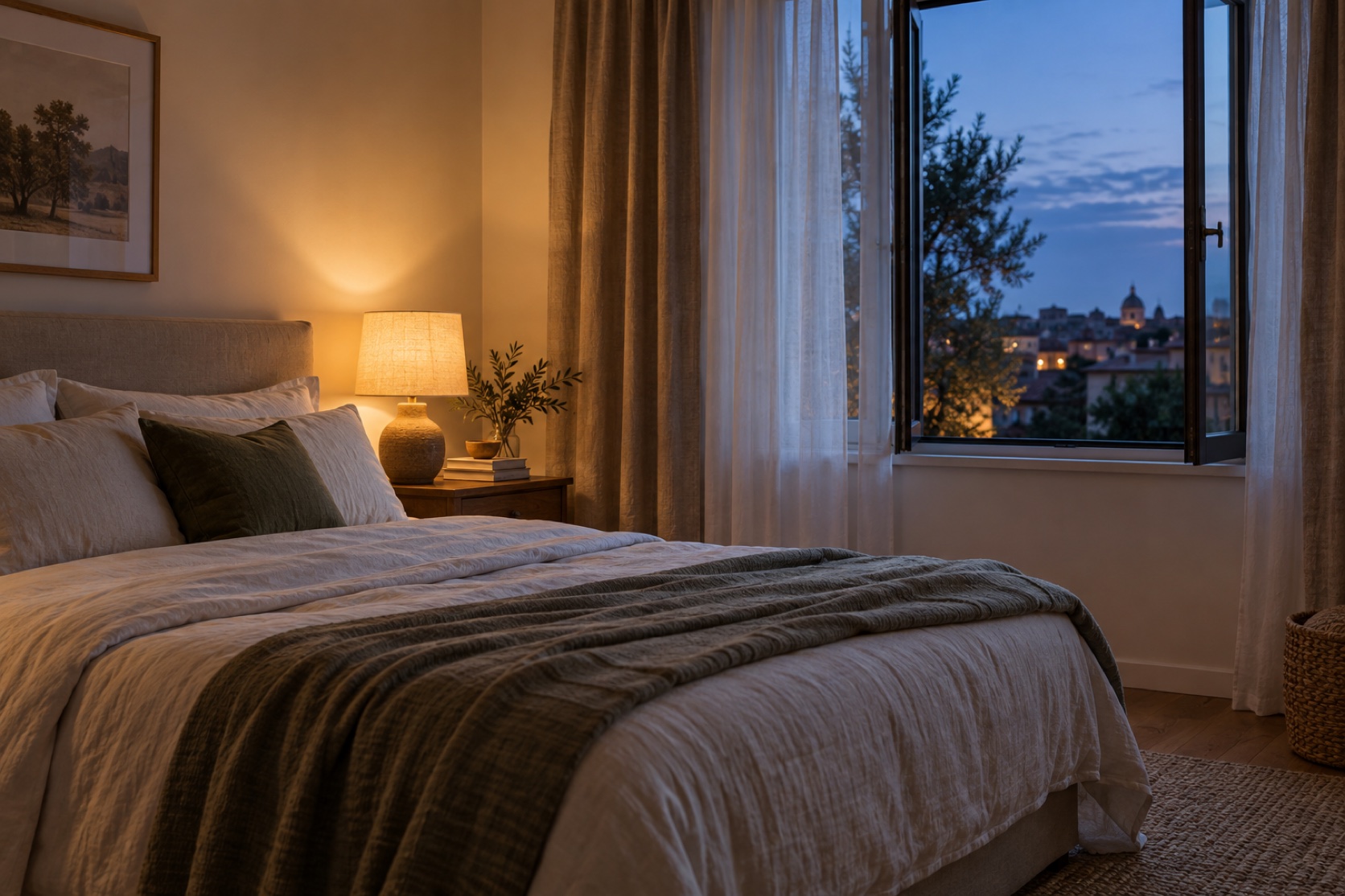
Temperature: The Room That Lets You Fall
Sleep onset is a cooling event. Your core temperature needs to fall roughly a degree below its daytime level for sleep to begin and stay there through the night — and the room decides how hard that is.
- 🌡️ The number — 18–20°C (65–68°F) is the range sleep studies converge on. Bedrooms above ~24°C measurably reduce slow-wave sleep and increase waking; below ~16°C, most people wake to fix the covers instead.
- 🛁 The bath trick — a warm shower or bath 1–2 hours before bed raises skin temperature, then the post-bath drop hands your onset signal a head start.
- 🧦 The vasodilation line — warm hands and feet are how the body opens its own radiators: dilated vessels in the periphery dump core heat fastest, which is why a cool room with warm feet puts you to sleep faster than a warm room with cold feet.
- 🧺 Bedding — layers beat one heavy duvet, breathable fibers (cotton, linen) beat heat-trapping ones, and the classic "one foot out of the covers" move is legitimate thermoregulation, not folklore.
- ☀️ The hard season — summer nights above ~24°C are where most people fail the temperature test. A fan on low, light cotton, and keeping afternoon sun out of the bedroom help more than fighting the AC all night.
Darkness: Getting Under 10 Lux
Light is the strongest circadian signal in your house, and the bedroom's job at night is to get below the level the brain notices — under ~10 lux at the pillow. Eyelids are shade, not blackout: light still registers through them, and the blue-light pillar details what that suppression costs melatonin.
- 🎯 The target — under 10 lux at pillow level: enough to see shapes, not enough to read. Full dark is better; 10 lux is the ceiling that matters.
- 🪟 Blackout curtains — the upgrade. The usual failure point is the gap above the rod, which leaks more light than the fabric does; a wrap-around rod or a valance fixes it.
- 😎 The eye mask — the cheaper win, and the one that travels. Hospital trials find patients sleep better by their own report with masks, and a mask solves hotel rooms, planes, and a partner's reading light in one purchase.
- 🔴 LED tape — routers, TVs, chargers, smoke detectors, electric toothbrushes: every device ships with a status light pointed at your face. A square of electrical tape or a dot sticker over each one ends the night's quiet light show.
- 📱 The phone-face-down rule — screens light up for every notification, and a face-up phone at 2am is a light leak with a scroll attached. Face down, do-not-disturb on, or out of the room entirely — the series lead argues the strongest version.
- 🚽 The 3am bathroom problem — a bright bathroom fixture at 3am is a daylight event for the circadian system. A dim red or sub-10-lux nightlight keeps the trip from resetting the night.
| Setting | Typical light | What it means for sleep | Status |
|---|---|---|---|
| Evening living room | ~150–400 lux | Melatonin-suppression territory — why the evening cascade dims the house | Avoid |
| Bathroom at 3am | ~200–300 lux | A daylight event if you flip the big switch | Avoid |
| Bedroom, streetlight + thin blinds | ~10–50 lux | Enough to matter, night after night | Moderate |
| Bedroom target | Under 10 lux | Shapes visible, reading not — the working ceiling | Good |
| Blackout + taped LEDs | Under 1 lux | Full dark — where the deepest stages live | Best |
Reading the room: a one-minute light tour of the night (lux figures illustrative ranges).
Product picks are generic categories, not brands. We may earn a commission on Amazon or iHerb purchases at no cost to you — this never changes our evidence conclusions. Full disclosure
Blackout shades or curtains
May reduce unwanted bedroom light and make a dark sleep setting easier to maintain.
⚠️ None expected from the product itself; install securely and preserve a safe route to exits.
Check price on Amazon →Noise: Mask It, Damp It, or Manage the Source
The sleeping brain keeps listening. Noise doesn't have to wake you to hurt you — it fragments sleep architecture, shaving the deep stages that do the repair work. The goal is not silence; it's steadiness.
- 🔇 Earplugs — foam or wax, ~20–30 dB off ambient noise, for the price of a coffee. The highest-leverage tool on this page; comfort and weekly cleaning are the only maintenance.
- 📻 White noise, honestly — a steady sound narrows the gap between the background and the sudden noises (traffic, doors, neighbors) that spike the sleeping brain. That masking is well supported; claims that white or pink noise boosts deep sleep are Promising at best, built on small, mixed studies. Buy it for masking.
- 💑 The snoring-partner problem — earplugs fix your side of the bed. The snoring itself is the flag: loud, nightly snoring with gasps or pauses belongs on the apnea checklist, not in the "more masking" category. Separate bedrooms, when health demands it, is an engineering decision, not a relationship verdict.
- 🔁 Steadiness beats silence — a predictable fan or machine beats an unpredictable street, because the brain habituates to constant sound and startles at change.
The Mattress & Pillow Audit
Mattress science is thin relative to mattress marketing, but two rules hold up: surfaces degrade on a schedule, and comfort is personal.
- 🗓️ The 7–10 year rule — foam and springs sag on a roughly decadal clock. Three signs it's time: a visible body-shaped valley, waking stiffer than you went to bed, and hotel beds consistently feeling better than your own.
- 🧱 Firmness — medium-firm is the setting trials most often associate with less back pain, but preference predicts comfort better than any spec sheet. The real decision tool is the trial window: many sellers offer 60–100 nights, which is long enough to know.
- 🛏️ Pillow for position — side sleepers need thicker, firmer support to fill the shoulder gap; back sleepers, medium; stomach sleepers, thin or none, to keep the neck neutral. One pillow can't serve three positions — match it to how you actually fall asleep.
- 🧼 The hygiene layer — allergen-proof covers on pillow and mattress, washed on the weekly schedule below, do more for morning congestion than any firmness rating.
- 💰 The spending order — mask and earplugs first (about $20), curtains second, mattress last. Fix the cheap variables before replacing the expensive one.
Layered, breathable bedding
Can make it easier to adjust bedding during overnight warmth or temperature swings.
⚠️ Comfort response varies; it does not evaluate or treat persistent sleep disruption, hot flashes, or sleep apnea.
Check price on Amazon →Airflow and the Forgotten Variables
A sealed bedroom gets stale in ways that matter. Small studies find overnight CO₂ climbs in closed rooms — and higher CO₂ tracks with lighter sleep and foggier next mornings.
- 🪟 The fix — a window cracked (even a centimeter, even in winter) or a fan on low. The same fan doubles as your noise masker.
- 💧 Humidity — dry winter air irritates airways; heavy summer air feels warm and close. A humidifier in dry seasons helps, but only if it's cleaned weekly — a dirty one is an airborne-particulate machine.
- 🌬️ The sign it matters — waking with a headache, a dry throat, or a "stuffy room" feeling that lifts the moment you open a window is CO₂ and humidity telling you the air isn't turning over.
The Bedroom Is for Two Things
The bedroom's job list has exactly two entries: sleep and sex. The brain is an association machine, and every work call, scrolling session, and argument held in bed teaches it that this room means arousal.
- 📵 No work, no screens in bed — laptops, feeds, and work chats are the strongest arousal conditioning in the house.
- 🗣️ Arguments move to the kitchen — disagreements happen; they just need to happen somewhere the brain doesn't file as a sleep location.
- 🍽️ No meals in bed — eating attaches a third meaning to the room.
- 🛏️ The 20-minute exit — awake in bed for 20+ minutes? Get up, go dim and boring elsewhere, return when sleepy. The insomnia page runs the full version of this rule.
The 12-Point Bedroom Audit
Twenty minutes, after dark:
- Thermostat at 18–20°C — set before wind-down begins, not after.
- Pillow-level light under 10 lux — a phone light-meter app is precise enough.
- No light shelf above the curtain rod — the gap leaks more than the fabric.
- Every device LED found and taped — router, TV, charger, smoke detector, toothbrush.
- Phone face-down or out of the room — do-not-disturb on.
- Earplugs and eye mask within reach — staged before bed, not hunted at 2am.
- Noise plan chosen — steady sound beats unpredictable sound.
- Mattress inspected — no visible sag, under ~10 years old.
- Pillow matches position — side, back, or stomach, not "whatever's there."
- Air turning over — window cracked or fan on.
- Season plan ready — summer heat and winter dry air both answered.
- The room's two jobs respected — no work, no screens, no arguments.
| Variable | Target | Cheapest lever | The upgrade |
|---|---|---|---|
| 🌡️ Temperature | 18–20°C / 65–68°F | Thermostat + warm feet | Breathable bedding, summer fan |
| 🌑 Light | Under 10 lux at pillow | LED tape + phone face-down | Blackout curtains; eye mask for travel |
| 🔇 Noise | Under ~35 dB ambient | Foam earplugs | White-noise machine or fan |
| 🌬️ Air | CO₂ low, air turning over | Window cracked a centimeter | Low-speed fan; humidifier in dry seasons |
The four targets in one view — the whole page compressed into a card.
🌡️ The one-night audit
After dark tonight, stand in the bedroom and name every light you can see and every sound you can hear, then set the thermostat to 18°C. Three fixes from that list — tape over the LEDs, the mask, the temperature — do more for your sleep than any furniture purchase.
White-noise device
May mask inconsistent background sounds for some sleepers.
⚠️ Volume that is too high may be unsafe for hearing; it may not suit people who find continuous sound disruptive.
Check price on Amazon →Where the Evidence Lives
This page is the operational layer — the science behind each number has a home in the Sleep pillar, and this series references rather than repeats it:
- 🧠 Why the environment matters — the Deep Sleep vs REM topic owns the stage architecture: heat, light, and noise strike slow-wave sleep and REM first, and the pillar explains what those stages do.
- ⚠️ The stakes — the Science of Sleep Repair topic covers what the room is protecting: glymphatic clearance, memory consolidation, the overnight maintenance cycle.
- 🫁 When engineering isn't the answer — the Sleep Apnea topic owns the escalation: an environment that's fixed and sleep that's still unrefreshing points to airway medicine, not more tape.
What to Do When It Goes Wrong
Bedroom fixes fail in predictable ways — and most have a same-week answer. Five scenarios that actually happen, with the response that has worked:
- 🚩 The room is 18°C and you're still too hot — memory foam and dense duvets retain body heat. Swap the duvet for layers, add the fan, and check the mattress material before blaming the thermostat. Regular night sweats are a clinician's conversation, not a thermostat's.
- 🚩 Your partner needs light or sound to fall asleep — that's what the mask and one-earbud setup are for. You can't blackout a shared life, but a $15 mask makes most of it moot.
- 🚩 Earplugs hurt, or you can't hear the kids — try a smaller foam size or wax/silicone plugs, or wear one plug and keep the baby monitor on vibration.
- 🚩 The room is perfect and sleep is still bad — that pattern is the apnea question: unrefreshing sleep plus loud snoring plus daytime sleepiness means evaluation, not more engineering. The apnea pillar has the screening flags.
- 🚩 You rent and can't touch the curtains — a tension rod with a blackout panel inside the window frame, removable window film, or simply the eye mask. The mask wins again: it works in any room on earth.
Questions, Answered Briefly
- ❓ Is colder always better? — No. Below ~16°C most people wake to fix the covers, which costs more than the cold gains. The range matters, not the floor.
- ❓ My partner likes it warm — split the difference with bedding: different duvet weights. It's easier to warm into a cool bed than to cool down in a warm one.
- ❓ Is white noise harmful long-term? — At modest volume, no evidence of harm — keep it under ~50 dB at the pillow, and loud machines away from infants' cribs. Masking is the mechanism, not magic.
- ❓ How do I know it's the mattress and not me? — Three signs: a visible sag, waking stiffer than you went to bed, and hotels consistently feeling better. Any two are a verdict.
The Bottom Line
- Three numbers do most of the work — 18–20°C, under 10 lux, steady sound.
- The mask and earplugs are the ~$20 upgrade that outperforms most four-figure ones.
- Light discipline is LED-by-LED — tape them, face the phone down, close the curtains fully.
- A perfect room and bad sleep is an apnea question, not an engineering one.
This Page in One Workflow
- Audit — run the 12 points tonight. Twenty minutes.
- Set temperature and airflow — thermostat to 18–20°C, window cracked or fan on.
- Kill every light source — tape the LEDs, face the phone down, close the curtains.
- Arm the noise plan — earplugs or machine within reach before bed.
- Re-audit each season — and escalate if sleep stays bad despite a clean room.
The Daily Checklist
- Thermostat at 18–20°C before wind-down begins
- Curtains fully closed — no light shelf above the rod
- Phone face-down or out of the room, do-not-disturb on
- Earplugs or sound machine staged at the bedside
- Window cracked or fan on low
- Any new LED in the room gets taped tonight
The Weekly Checklist
- Bedding washed; mask and earplugs cleaned or replaced
- Mattress surface checked for sag
- Thermostat re-set for the season's shift
- One after-dark lux and noise spot-check (a phone app is enough)
- Full 12-point audit re-run if sleep quality drifted this week
Go Deeper: Bedroom Engineering: Temperature, Darkness, Noise
These five companion pages turn the topic into smaller, testable practices.
Related Topics
- Kräuchi et al., "Warm feet promote the rapid onset of sleep," Nature (1999)
- Okamoto-Mizuno & Mizuno, "Effects of thermal environment on sleep and circadian rhythm," Journal of Physiological Anthropology (2012)
- Haghayegh et al., "Before-bedtime passive body heating by warm shower or bath to improve sleep," Sleep Medicine Reviews (2019)
- Locihová et al., "Effect of the use of earplugs and eye mask on the quality of sleep in intensive care patients: a systematic review," Journal of Sleep Research (2018)
- Basner et al., "Auditory and non-auditory effects of noise on health," The Lancet (2014)
- Radwan et al., "Effect of different mattress designs on promoting sleep quality, pain reduction, and spinal alignment in adults with or without back pain," Sleep Health (2015)