The 18–19°C Evidence
The single most reliable lever in the sleeping room is not a product — it is the temperature of the air. Falling asleep is a cooling event: your core has to shed roughly a degree of heat before the brain will let you drop off, and the room decides how much work that takes. This page walks the actual temperature experiments, the numbers behind the 18–19°C target, and the honest limits of what any thermostat can do.
What the evidence supports
- Core body temperature must fall for sleep onset, and a cool environment makes that drop cheaper — lab studies link ambient heat with longer onset and fragmented, lighter sleep.
- Room temperatures much above ~24–26°C measurably reduce slow-wave sleep and increase wakefulness; that direction is consistent across sleep-lab experiments.
- Peripheral heat loss — warm hands and feet — tracks closely with how fast people fall asleep, which is why cold feet and sleep onset rarely go together.
What remains uncertain
- The experiments are small and lab-based — dozens of sleepers, not thousands — and few tested 18°C specifically against 20°C or 22°C in a head-to-head way.
- The exact lower bound is not certified: below ~16°C, the cost of waking to adjust covers may outweigh the benefit of the cold.
- The 18–19°C target is a practical synthesis from thermoregulation physiology; your bedding, body mass, and partner change the number that is right for you.
Evidence last reviewed: August 15, 2026. Conclusions may change as new research is published.
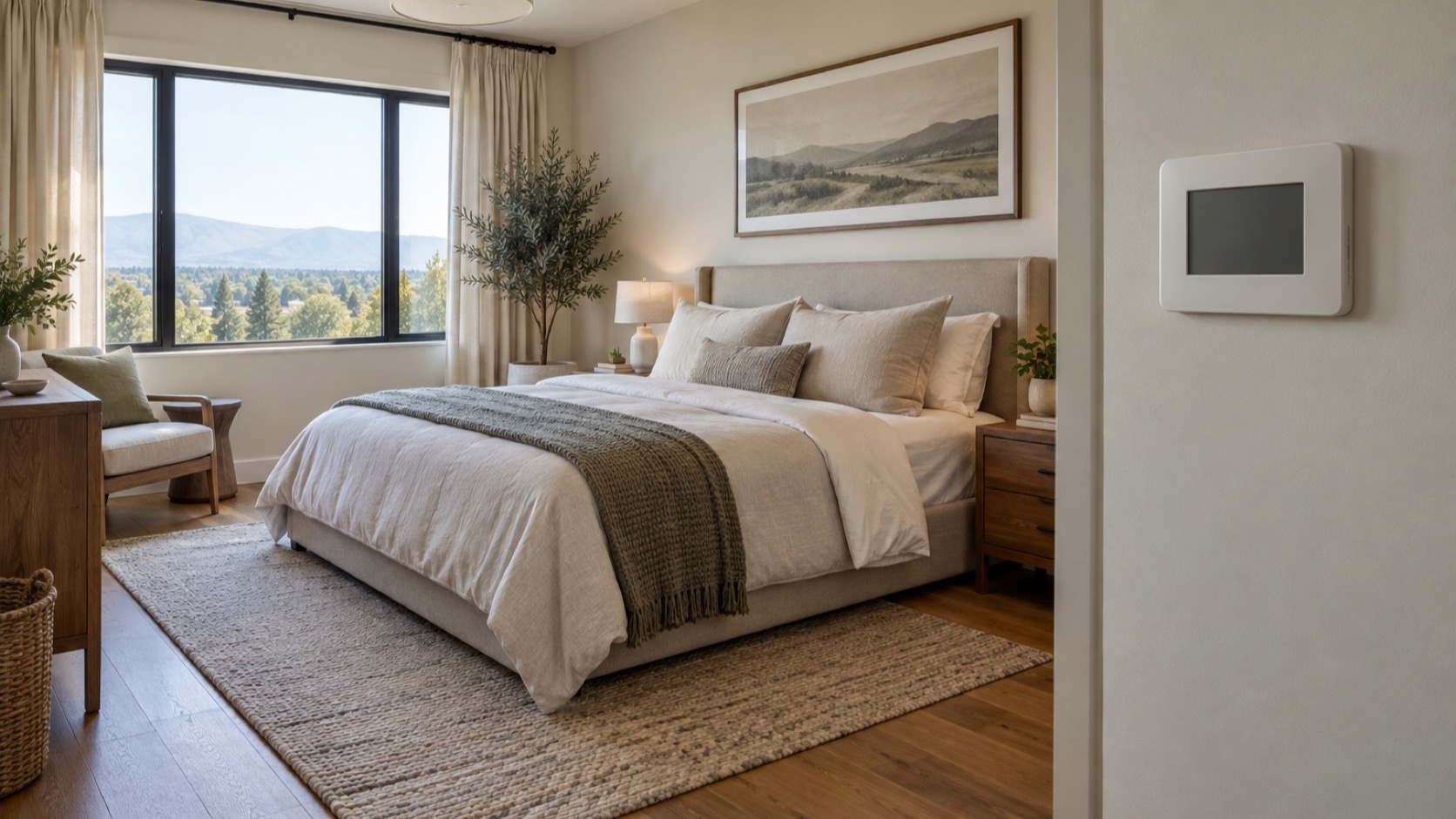
Sleep Onset Is a Cooling Event
Watch a night of sleep in the lab and the first thing you notice is the temperature curve. Core temperature runs high through the day, peaks in the early evening, then falls — by roughly half a degree to a full degree — as the night goes on. Sleep onset sits right at the knee of that decline, not after it. The circadian clock barnacles sleep onto the cooling phase, which is why the same clock that makes you sleepy at 11pm also makes your hands and feet warm at that hour. The body is opening its own radiators: vasodilation pushes warm blood to the skin, heat leaves the core, and the core drop is the signal the brain reads as "night." Room temperature is the throttle on that whole process.
- 🌡️ The core drop is the cue — a ~0.5–1.0°C core-temperature fall precedes and gates sleep onset; the better the room sheds that heat, the faster the gate opens.
- 🧦 The skin is the radiator — temperature rises at hands and feet before sleep, a pattern so reliable it predicts sleep onset better than most sleepiness questionnaires in the small studies that measured it (Kräuchi et al., Nature, 1999).
- 🔥 Heat is the enemy of the drop — a warm room, heavy duvet, or retained body heat all push against the one physiological event sleep actually requires.
- 🧺 Bedding multiplies the room — the same 18°C room feels different under synthetic vs cotton layers; the room and the bed are one thermal system.
Product picks are generic categories, not brands. We may earn a commission on Amazon or iHerb purchases at no cost to you — this never changes our evidence conclusions. Full disclosure
Bedroom thermometer and hygrometer
Can help identify whether a bedroom is consistently too warm, cold, dry, or humid for comfort.
⚠️ Readings do not explain persistent sleep symptoms and should not lead to extreme environmental changes.
Check price on Amazon →What the Temperature Experiments Showed
The classic sleep-lab experiments on ambient temperature go back to the early 1980s. Haskell and colleagues at Stanford recorded sleep stages across several laboratory temperatures and found the pattern that has held since: hot conditions (above roughly 30°C) cut slow-wave sleep, stretched sleep onset, and distributed sleep into shorter, more fragmented pieces — while cool conditions did not cost them those deep stages (Haskell et al., Electroencephalography and Clinical Neurophysiology, 1981). The effect is not linear and it is not dramatic at 19°C; the steep damage is at the hot end of the dial. A systematic review of thermal-environment studies reaches the same conclusion most often cited by sleep clinicians: excess heat is the direction that reliably costs sleep architecture, and the discomfort threshold where people start waking is well above the 18–19°C band (Okamoto-Mizuno & Mizuno, Journal of Physiological Anthropology, 2012).
- 🔥 The hot end is where the damage lives — heat suppresses slow-wave sleep and raises wakefulness in the lab; cold, within reason, does not show the same cost.
- 🌙 Heat hits deep sleep first — slow-wave sleep is the stage most consistently reduced by elevated temperature, and it is the stage the Deep Sleep vs REM topic credits with the night's repair work.
- 🍂 Seasonality is the honest experiment — people sleep measurably worse in hot summer nights and better through cool seasons, a natural experiment in tens of thousands that points the same direction as the lab.
- ⚠️ Small rooms, small trials — most thermal experiments tested dozens of sleepers in climate chambers, so the size of the effect is better established than its fine gradations.
How Sleep Fares Across the Dial
Put the experiments on one axis and the message is visual. The damage is not evenly spread across temperatures — it clusters at the hot end, grows through the "warm," disappears in the cool band this page recommends, and only returns at the cold end as cover-fixing wakefulness. Bar widths below are qualitative: they encode how much the experimental and cohort literature associates each band with disrupted, fragmented sleep. The point is the shape — heat costs, cool does not, and punishing cold costs in a different, smaller way.
Reusable water bottle
Can make regular access to water more convenient.
⚠️ Excessive water intake can be harmful in unusual circumstances; individual fluid needs vary.
Check price on Amazon →Warm Feet, Cool Room
The detail that surprises most people is that the body likes two temperatures at once: a cool room and warm hands and feet. Cooling the air speeds heat loss, but only if the body moves the heat to the surface — and that is what dilated vessels in the feet and hands are for. In the small but famous experiment that tied warm feet to sleep onset, subjects who were given warm feet fell asleep faster and showed the rapid-onset pattern directly (Kräuchi et al., Nature, 1999). The practical translation has become standing advice: cold feet are a common, fixable cause of slow onset, and a warm soak, a hot-water bottle, or simply warm socks at the foot of the bed are cheaper than any thermostat upgrade.
- 🧦 Cold feet stall the drop — constricted vessels keep heat in the core, and the drop that gates sleep can't start; warming the feet unblocks it.
- 🛁 The warm soak doubles as wind-down — the bath trick page runs the full version of this lever.
- 🪵 The cool-cold middle — most people in cool rooms sleep better with the heat they generate managed by breathable layers rather than by turning the thermostat up.
⚠️ Cool is not cold — and heat is a different question
Nothing on this page asks anyone to suffer. Below roughly 16°C the covers themselves become the disruptor, and the cost of waking to fix them outweighs the gain. Similarly, if you are chronically too warm at night — drenching sweats, soaked sheets — that is not a thermostat problem to engineer around; it can be a medication side effect, a hormonal change, or a fever, and it is a conversation for a qualified healthcare professional, not a fan purchase.
Do / Avoid the Thermal Environment
The thermal environment is the easiest part of the bedroom to change tonight. The table below is the working set — what moves the needle, what to skip, and why each row earns its place.
| Move | Do | Avoid | Why |
|---|---|---|---|
| 🌡️ Thermostat | Set 18–19°C before wind-down starts | Turning it up "for comfort" past ~24°C | The core drop needs a sink; heat is the direction that costs slow-wave sleep |
| 🧦 Feet | Warm socks, hot-water bottle, or a short soak | Waking with chronically cold, numb feet and ignoring it | Peripheral heat loss is the onset signal (Kräuchi 1999) |
| 🧺 Bedding | Layers of breathable cotton or linen | One heavy heat-trapping duvet year-round | Layers let the sleeper self-regulate without waking |
| 🌬️ Summer nights | Fan on low; block afternoon sun from the room | Fighting a hot room with a heavy all-night AC battle | Fan + airflow is the cheap thermal fix; the parent page owns airflow |
Practical Rules: The Thermostat Choreography
The 18–19°C band only works if it is set at the right time and read the right way. The nightly choreography is short and repeatable:
- ⏱️ Set it before wind-down, not at lights-out — the room takes time to adjust; the Evening Cascade page slots this into the hour before bed.
- 🌡️ Read the band, not the pixel — 18, 19, 20°C all live in the defensible range; the failure mode is 24+, not 20.5.
- 🛏️ Undress for the room — cool air with breathable layers beats warm air with light covers; adding a layer is easier than engineering the whole room.
- 🔁 Re-tune by season — what works in November works differently in July; the Sleep Protocol series treats the season plan as a standing item.
- 🧯 Stop before the extremes — neither below ~16°C nor above ~26°C is a defensible target; the evidence supports the middle band, not a race to the limits.
Questions, Answered Briefly
- ❓ Is 20°C meaningfully worse than 18°C? No honest study says so. The band is a range; the defensible line is keeping the room on the cool side of ~24°C, not obsessing over two degrees.
- ❓ My partner likes it warm — who wins? Bedding is the bridge: different duvet weights let each sleeper tune their own microclimate in one cool room.
- ❓ Does a cooler room alone fix bad sleep? No — temperature is one of several levers. A cool, dark, quiet room with a stable routine is the combined package; the rest of this folder builds it.
- ❓ What about very cold sleepers or older adults? People who run cold naturally — and some older adults — need the warmth-to-core logic inverted: warm the feet and layers generously before relying on a cold room.
- ❓ Night sweats despite a cool room? That pattern is worth a medical conversation rather than more engineering — persistent night sweats can signal hormonal, infectious, or medication-related causes a clinician should weigh.
The Bottom Line
- Sleep onset is a cooling event — the core must fall ~0.5–1.0°C, and a cool room makes that drop cheap.
- The 18–19°C band is the defensible target — heat is the direction that reliably costs slow-wave sleep; cold within reason does not.
- Warm feet, cool room — peripheral heat loss is the onset signal, so the two temperatures work as a pair.
- The range matters more than the exact degree — stay on the cool side of 24°C and below the extreme ends, and let bedding tune the rest.
Related Topics
- Kräuchi K, Cajochen C, Werth E, Wirz-Justice A, "Warm feet promote the rapid onset of sleep," Nature (1999)
- Haskell EH, Palca JW, Walker JM, Berger RJ, Heller HC, "The effects of high and low ambient temperatures on human sleep stages," Electroencephalography and Clinical Neurophysiology (1981)
- Okamoto-Mizuno K, Mizuno K, "Effects of thermal environment on sleep and circadian rhythm," Journal of Physiological Anthropology (2012)
- Haghayegh S, Khoshnevis S, Smolensky MH, Diller KR, Castriotta RJ, "Before-bedtime passive body heating by warm shower or bath to improve sleep," Sleep Medicine Reviews (2019)