Darkness, Absolutely
Light is the strongest circadian signal in your house, and the bedroom's job after dark is to get below the level the brain notices — under roughly 10 lux at the pillow. Eyelids are shade, not blackout: light still registers through them, and the evening light story is one of the most consistent in sleep science. This page walks the lux numbers, the cheap blackout moves that beat the expensive ones, and the eye-mask fallback that travels anywhere.
What the evidence supports
- Even ordinary indoor room light in the evening measurably suppresses and shortens melatonin — more than people assume from the marketing.
- Screen light before bed delays sleep onset and shifts the clock later; the pattern holds across controlled lab studies.
- Eye masks improve self-reported sleep quality in bright, noisy settings, including hospital wards, in several randomized trials.
What remains uncertain
- The specific "10 lux" ceiling is a practical target synthesized from the dose-response — real, but not a cliff where sleep suddenly toggles off.
- Most happy-bedroom light studies run over nights to weeks; the long-run health impact of chronic bedroom light is an active research area.
- Individual sensitivity varies — older adults, some medications, and shorter melatonin windows change who is affected by what level.
Evidence last reviewed: August 15, 2026. Conclusions may change as new research is published.
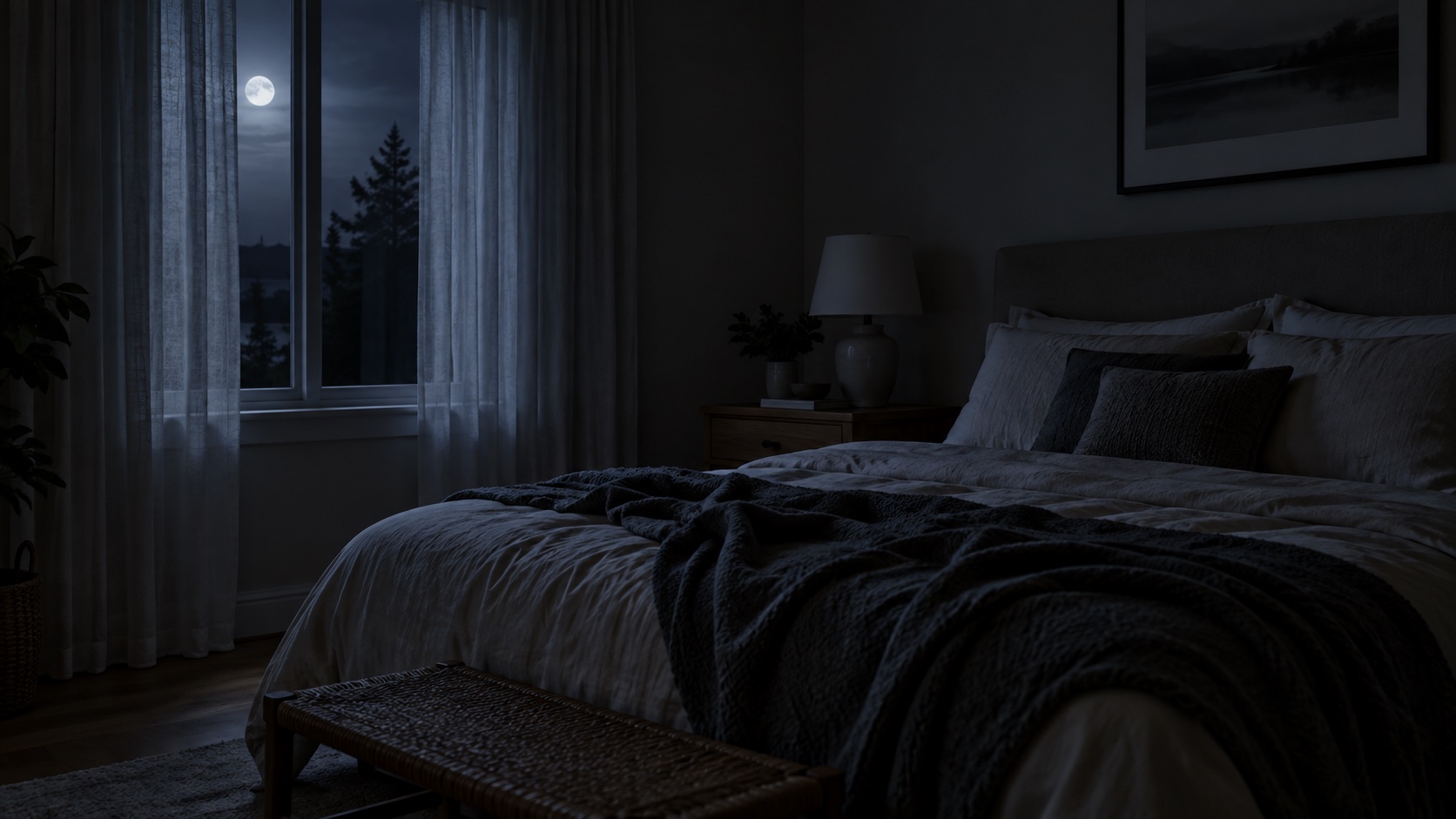
The Brain Reads Light Before You Do
Your conscious brain can call a dimly lit room "dark," but the circadian system reads raw light — and the dose-response is steeper than most people expect. In a controlled lab study, exposure to ordinary room light during the evening suppressed melatonin in most participants and shortened its nightly duration by a meaningful amount (Gooley et al., Journal of Clinical Endocrinology & Metabolism, 2011). The companion finding everyone quotes: people reading on a bright backlit screen in the evening took longer to fall asleep, produced less evening melatonin, and were more alert at their desired bedtime than the paper-book group (Chang et al., PNAS, 2015). The practical reading is blunt — the light that "doesn't bother" you is still being counted.
- 💡 Lux is the unit that matters — lux measures what reaches the eye; a meter app on your phone reads the room more honestly than your eyes do.
- 🌃 Even "dim" counts — the suppression studies used ordinary room light, not floodlights; this is not an all-or-nothing switch.
- 📱 Screens are the evening story — the Caffeine, Alcohol & Blue Light topic owns the full wavelength and timing detail.
Product picks are generic categories, not brands. We may earn a commission on Amazon or iHerb purchases at no cost to you — this never changes our evidence conclusions. Full disclosure
Blackout shades or curtains
May reduce unwanted bedroom light and make a dark sleep setting easier to maintain.
⚠️ None expected from the product itself; install securely and preserve a safe route to exits.
Check price on Amazon →The Lux Map of a Normal Bedroom
Before fixing the light, it helps to know where it is. Most bedrooms leak from a handful of predictable places, and a quick after-dark tour with a phone meter puts them in order. The table reads like a map of where a typical night goes wrong — and reading it takes one honest minute: stand at the pillow, meter the suspects, and fix the top two leaks, because most rooms carry a handful and the top two carry most of the light.
| Light source | The fix | Typical cost | Read |
|---|---|---|---|
| 🌃 Streetlight through thin blinds | Blackout curtains or a tension-rod blackout panel | $15–60 | Fixable |
| 🔴 LEDs on chargers, router, TV, toothbrush | Square of electrical tape over each one | $3 | Cheap win |
| 📱 Phone face-up near the pillow | Face-down, do-not-disturb, or out of the room | $0 | Free |
| 🚽 Bright bathroom at 3am | Sub-10-lux red nightlight instead of the big switch | $10 | Worth it |
| 😎 Hotel, travel, or a partner's reading light | The eye-mask fallback (below) | $10–25 | Travels |
Nighttime Light Leaks, Measured
Same story, drawn as a chart: the typical leaks that put light on the pillow, from the brightest to the near-invisible. Lux values are illustrative ranges for a normal bedroom — the point is the proportions, not the pixels. Every bar above the ~10 lux line is stealing more than a little of the evening's melatonin signal.
Light-blocking sleep mask
A portable option when room light cannot be controlled.
⚠️ Can feel uncomfortable or trap heat for some people; do not use as a substitute for evaluating persistent sleep symptoms.
Check price on Amazon →The Eye-Mask Fallback
The mask is the unsung hero of the darkness protocol: it works in any room on earth, which is precisely what the expensive blackout rig cannot do. The hospital-ward literature is the cleanest evidence — randomized trials in intensive care and general wards repeatedly find that giving patients an eye mask and earplugs improves their self-reported sleep, a setting where light and noise are aggressive and constant (Locihová et al., Journal of Sleep Research, 2018). A mask is not a substitute for a dark room, but it is the portable layer that makes hotels, planes, and the partner who reads at midnight non-events. Treat it as a complement, not a replacement: a genuinely dark room plus a mask beats either alone, and the two together are effectively what the ward trials handed their patients.
- 🕶️ Get one that touches nothing — a contoured or padded mask that sits off the eyelids beats a flat strap-on for actually being worn.
- 🧺 Keep it clean — masks sit on skin all night; the weekly wash rule from the parent protocol applies to them too.
- 🛫 The travel stack — mask plus earplugs plus a fixed wake time is the entire portable sleep kit; the noise half lives on the noise page.
🚽 The 3am bathroom problem
A bright bathroom fixture in the middle of the night is a daylight event for the circadian system — it resets more than a light switch should. The fix is a dim red nightlight kept well under 10 lux, or simply doing the trip by the light from under the door. Your eyes adapt; keep the switch off and the night stays intact.
Melatonin: The Signal, Not the Pill
Darkness earns all this effort because light sits upstream of melatonin — the hormone evening darkness releases and morning light shuts off. Suppression is not subtle: the lab studies show ordinary room light cutting and shortening the melatonin window, the chemical weather the rest of the night is built on. None of this is an argument for melatonin pills — supplements are a separate, thinner-evidence conversation owned by the sleep-saboteurs topic, and dosing them is a clinician's discussion, not a nightly default. Letting darkness protect the hormone your own body makes is the lever with the fewest side effects, and it costs nothing.
- 🌙 Light is the tap — darkness lets endogenous melatonin flow; even dim light throttles it, which is why the lux ceiling lives at the pillow.
- 🌅 Morning light sets the other end — the wake-time light dose, owned by the wake-anchor protocol, completes the daily rhythm this page starts.
- 💊 Pills are a separate question — melatonin supplements carry thin evidence for routine use, and anyone considering them is best served by a conversation with a qualified healthcare professional.
Reusable earplugs
May reduce intermittent environmental noise at bedtime.
⚠️ Improper use can irritate the ear canal; users who need to hear alarms or caregiving cues should choose cautiously.
Check price on Amazon →The 20-Minute Blackout Pass
Once, after dark, run the whole sequence — it takes about twenty minutes and needs no purchases beyond tape and a mask to go from "leaky" to "true dark." Run the first pass on a weekend so you are not racing bedtime, then re-run it after every room change — a new charger, a rearranged nightstand — or the leaks will creep back one LED at a time.
- Measure — phone light-meter app at the pillow; hunt every leak above ~10 lux.
- Blackout the big glass — curtains fully closed, no light shelf above the rod; the gap leaks more than the fabric blocks.
- Tape every LED — router, chargers, TV, smoke detector, toothbrush: a square of electrical tape on each.
- Flip the phone — face-down, do-not-disturb on, out of reach if that is what it takes.
- Stage the mask — within reach for the nights and hotels that need it.
- Re-measure — target under 1 lux; a full-moon-lit room is a sign you missed one.
Questions, Answered Briefly
- ❓ Is a red or amber bulb better than white? Warm-shifted light is dimmer in the wavelengths that drive melatonin suppression, which is why red nightlights feel kinder. The bigger move is lowering the lux, not just recoloring it.
- ❓ My partner needs a reading light — who wins? A clip-on directional light aimed at the page, plus your mask, beats arguing over the room. The mask makes most of these conflicts moot.
- ❓ Does light through closed eyelids matter? Yes — the suppression studies show the response tracks light reaching the retina; lids attenuate but do not stop it, which is exactly why the mask exists.
- ❓ Can I rely on phone blue-light filters instead? A dimmer, warmer screen is better than a bright one, but it still leaks light into the bedroom after lights-out; the filter is a complement, not a replacement for darkness at the pillow.
- ❓ I rent and cannot change the curtains. A tension-rod blackout panel inside the window frame, removable window film, or simply the eye mask — the mask wins again in a rental.
- ❓ Does blackout fabric alone fix a streetlight leak? Only if it covers the gap above the rod — that light shelf leaks more than the fabric blocks, so a wrap-around rod or a valance beats thicker fabric on its own.
The Bottom Line
- The brain counts light your eyes call "dim" — room light suppresses melatonin, and the ceiling worth defending is under ~10 lux at the pillow.
- The cheap wins beat the expensive ones — electrical tape over LEDs, a face-down phone, and a tension-rod panel do most of the work before anyone buys a curtain.
- The eye mask is the portable layer — the hospital-ward trials back masks for sleep in hostile light, and a $15 mask travels.
- Blackout is a 20-minute pass, not a renovation — measure, tape, flip, mask, re-measure; the whole room fixes faster than most people expect.
Related Topics
- Gooley JJ, et al., "Exposure to room light before bedtime suppresses melatonin onset and shortens melatonin duration in humans," Journal of Clinical Endocrinology & Metabolism (2011)
- Chang AM, Aeschbach D, Duffy JF, Czeisler CA, "Evening use of light-emitting eReaders negatively affects sleep, circadian timing, and next-morning alertness," PNAS (2015)
- Locihová H, et al., "Effect of the use of earplugs and eye mask on the quality of sleep in intensive care patients: a systematic review," Journal of Sleep Research (2018)