The Air in the Bedroom: CO₂, Ventilation, Humidity & Allergens
Temperature, darkness and noise get the attention; the air gets a cracked window and good intentions. Yet a bedroom is the least-ventilated room most people use — small, usually closed, occupied for eight hours by one or two exhaling adults. This page owns the fourth environmental variable end to end: what closed rooms actually measure, what the intervention trials did and did not show, humidity guidance for dampness and allergen control, and which of the filters, covers and gadgets on the aisle earn their place.
What the evidence supports
- Bedrooms with the door and window closed accumulate carbon dioxide overnight — closed-room averages near 2,400–2,600 ppm in the dormitory trial, versus 660–835 ppm once ventilation improved (Strøm-Tejsen et al., Indoor Air, 2016).
- In that trial, lower CO₂ came with better objectively measured sleep quality, fresher perceived air, less next-day sleepiness and better concentration — small effects, crossover design, 14–16 participants per experiment.
- Holding mean daily relative humidity under 50% restricts house-dust-mite population growth (Arlian et al., 1999), and damp or mouldy housing is linked to more respiratory symptoms and asthma exacerbation (WHO, 2009).
- Filters help particle and allergen exposure; ozone generators are a documented hazard rather than a grey area (US EPA).
What remains uncertain
- Later and larger field interventions have been mixed: some lowered CO₂ without changing sleep quality, so the size of the real-world benefit is not settled.
- Sleep-specific humidity evidence is thin — the mite threshold is well measured, but the sleep-outcome data are indirect and mostly extrapolated.
- How much low-level CO₂ itself (versus the other pollutants riding with it) affects sleep is debated; it is best treated as a ventilation proxy, not a toxin at bedroom levels.
- Whether bedding covers or filters improve sleep for anyone who is not already sensitized is not established.
Evidence last reviewed: October 5, 2026. Conclusions may change as new research is published.
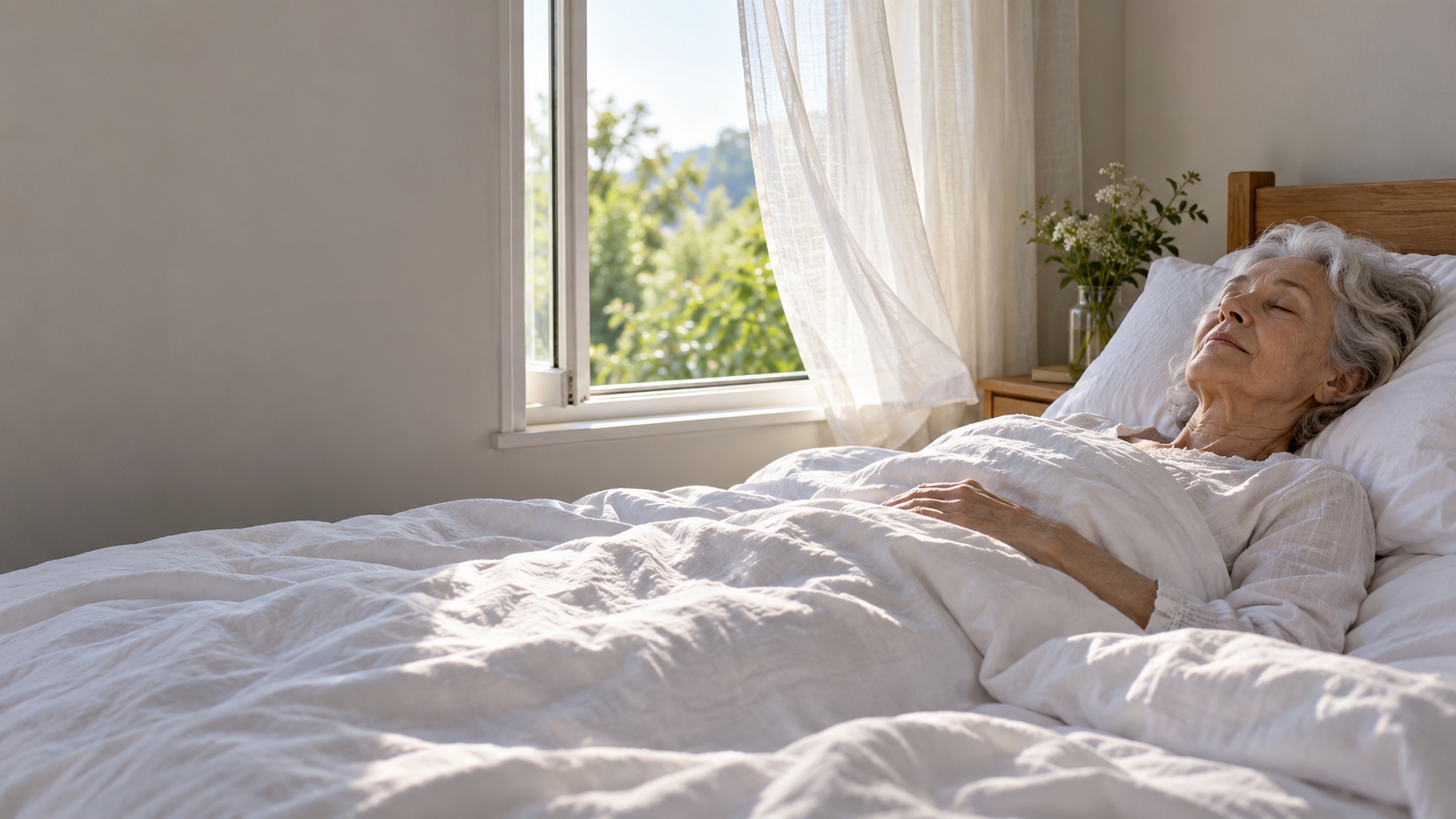
Why Air Was the Forgotten Variable
The sibling pages in this series own temperature, darkness, noise and the mattress — all of which you can see, feel or hear. Air is invisible, which is why it sat in a single paragraph of the bedroom-engineering page while the other variables got their own sections. The physics are simple: a bedroom is small, the door is usually shut, and one adult exhales roughly 200–300 millilitres of CO₂ per minute. Over eight hours, a sealed room concentrates what you breathe out, along with whatever else the room emits — particles, allergens, volatile compounds from furnishings. Ventilation is what replaces it.
- 🌬️ CO₂ is a proxy, not the villain — at bedroom concentrations it is best read as a tracer for how much outdoor air is reaching the room.
- 💧 Humidity is the second dial — too dry irritates airways, too damp feeds mites and mould.
- 🛏️ The bed is the biggest surface — bedding is where mites live and where you spend the night breathing a few centimetres above it.
- 🧭 The goal is boring — move air, hold the humidity band, and skip the gadget aisle's certainties.
What a Closed Bedroom Measures
The clearest numbers come from a Danish dormitory study that measured the same rooms across ventilation conditions. In the first experiment (14 participants), opening a window moved average overnight CO₂ from about 2,585 ppm to 660 ppm. In the second (16 participants), a quiet fan-assisted inlet vent that switched on whenever CO₂ rose above 900 ppm moved the average from about 2,395 ppm to 835 ppm. Temperatures did not differ between the conditions, which is what makes the comparison usable. Monitoring in other countries has found similar ranges — a Wellington monitoring study of 20 bedrooms in damp-flagged households treated CO₂ as a ventilation indicator, noting that concentrations below roughly 800 ppm are commonly used as adequate and that levels within about 400 ppm of outdoor air indicate better exchange. An earlier New Zealand study reported bedroom peaks as high as 4,000 ppm.
| Reading | What it indicates | The honest caveat |
|---|---|---|
| 🌍 ≈420 ppm | Outdoor background — the floor your room is measured against | Varies by city and season; traffic-heavy areas run higher |
| ✅ <800 ppm | Commonly used line for adequate bedroom ventilation | A practical indicator, not a validated sleep threshold |
| 📏 1,000 ppm | Older New Zealand standard (NZS 4303:1990) for acceptable indoor air | Predates newer ventilation and airborne-infection evidence |
| ⚠️ 1,500 ppm+ | Air exchange is struggling; other pollutants accumulate alongside the CO₂ | No study shows this level directly harms a sleeper — it is a signal |
| 🚪 ≈2,400–2,600 ppm | Typical closed-room average measured in the dormitory ventilation trial | Student dormitories, one occupant, specific room volumes |
The Trial Evidence, Stated Carefully
The Strøm-Tejsen trial is the anchor for bedroom-air advice, and it is worth reading honestly rather than as a headline. Participants slept one week in each condition in balanced order; sleep was scored from wrist actigraphy plus morning questionnaires, not from laboratory polysomnography. When CO₂ was lower, objectively measured sleep quality and perceived air freshness improved significantly, and so did reported sleepiness, ability to concentrate, and performance on a logical-thinking test. Those are real findings from a crossover design — but the samples were small, the effects on sleep were modest, and the participants were young adults in dormitories.
The honest picture is mixed at the edges. Some later field interventions have lowered CO₂ in real bedrooms without finding a sleep-quality effect, and a 2025 commentary on the field notes exactly that tension. So the accurate position is: improving bedroom ventilation is low-cost and physiologically sensible, the trial evidence points the right way, and no one should expect a dramatic change in how they sleep.
The Humidity Half
Humidity is the variable with the strongest biological case and the weakest sleep data. The biological case: house-dust mites need moisture, and keeping mean daily relative humidity below 50% — even with brief daily excursions above it — restricts their population growth (Arlian et al., 1999). The dampness case is even better established: the WHO's 2009 guidelines concluded that occupants of damp or mouldy buildings have more respiratory symptoms and asthma exacerbations, in studies across many countries and climates. What is missing is the middle step — trials showing that moving a bedroom from 60% to 45% relative humidity improves sleep in people who are not sensitized. Treat this as allergen-control guidance, not a sleep prescription.
- 💧 The band — If dust mites are a concern, keeping indoor relative humidity below about 50% can help limit their growth; this is allergen-control guidance, not a proven sleep treatment. Avoid excessive dryness if it causes discomfort.
- 🌵 Dry air — may irritate the nose and throat; comfort effects are plausible, but sleep-outcome data are thin.
- 🌫️ Sustained damp — can support mite growth and become a building problem that air-quality gadgets do not solve.
- 🧽 Humidifiers need maintenance — a neglected ultrasonic unit aerosolises whatever is growing in the tank; weekly cleaning is part of the intervention, not an optional extra.
💧 Damp is a building problem
If a wall, window frame or corner smells musty or shows discolouration, ventilation habits are not the fix — moisture is entering from somewhere. That is a landlord or building issue, and the WHO guidance treats remediation of the source as the intervention, not a dehumidifier running in one room.
Allergens, Covers and Filters
Allergen control is where the bedroom aisle overlaps real medicine, and where the evidence gets interesting. Bedding encasings reliably reduce mite-allergen exposure — but in a randomized trial of allergic-rhinitis patients, that reduction produced no measurable clinical benefit (Terreehorst et al., New England Journal of Medicine, 2003), while a later trial of microfine-fibre bedding in adult atopic asthmatics did find improved disease management. The pattern is not that covers are useless; it is that single measures applied broadly underperform, while multi-component plans in people who are genuinely sensitized can help.
| Measure | What it does | Where the evidence stands |
|---|---|---|
| 🛏️ Mite-proof bedding covers | Physically separates you from mite allergen in mattresses and pillows | Exposure down reliably; clinical benefit mixed — clear only in multi-component plans for sensitized people |
| 🌬️ HEPA or high-grade filters | Removes particles: pollen, smoke, pet allergen, dust | Modest symptom gains in allergic rhinitis trials; does nothing for CO₂ |
| 🔥 Candles and incense | Adds combustion particles and aroma compounds to the air | Documented particle source; no sleep benefit established |
| ⚡ Ozone generators and ionisers | Intentionally produce ozone; ionisers produce it as a by-product | Documented hazard — no US federal agency has approved these devices for occupied spaces |
| 🧴 Reed diffusers and sprays | Adds fragrance and volatile compounds at low but continuous levels | Pleasant, occasionally sensitising, and not an air treatment in any measured sense |
The Aisle, Audited
The Environmental Protection Agency's guidance on ozone generators is unusually blunt for a government document: these devices intentionally produce ozone, no agency of the federal government has approved them for use in occupied spaces, and inhaled ozone can damage the lungs — at relatively low amounts it causes chest pain, coughing, shortness of breath and throat irritation, and it can worsen asthma. California's air-quality regulator classifies them as hazardous air purifiers. If a device claims to "purify" air while you are in the room and mentions ozone or "activated oxygen", that is the one purchase on this list to simply not make.
Everything else is a matter of matching the product to a real problem. A filter helps if the problem is particles — pollen in spring, smoke in fire season, a cat that sleeps on the duvet. A filter does nothing for stale air, because CO₂ is a gas and passes straight through. A humidifier helps a dry room, if it is cleaned. A dehumidifier helps a genuinely damp room, if the source of moisture is not a leak. Nothing on the aisle treats the actual sleep problem most often hiding behind these purchases, which is why the last section is the one that matters clinically.
A Practical Protocol
A few low-cost options are available, but their fit depends on room conditions and comfort.
- Flush the room before bed — where outdoor air is clean and it is safe and comfortable, briefly open a window or use a vent to improve air exchange. No trial establishes a universal flush duration.
- Decide the overnight setting deliberately — a vent or window may help where outdoor air is clean and opening it is safe and comfortable; avoid smoke, pollution, security or cold concerns. The temperature trade-off lives on the bedroom-engineering page.
- Hold the humidity band — if dust mites are a concern, below about 50% may limit growth; this is allergen-control guidance, not a sleep prescription. Avoid uncomfortable dryness.
- Skip the ozone aisle — and treat candles and diffusers as atmosphere, not air treatment.
- Test for two weeks — one change at a time, then judge; the effects worth chasing here are small and slow, which is exactly why the trial evidence matters more than the marketing.
Who Should Be More Careful
- 🚨 Asthma or allergic rhinitis that wakes you — nocturnal nasal blockage and asthma symptoms are clinical territory; intranasal corticosteroids improve congestion-related sleep disturbance in allergic rhinitis in randomized trials. Bedroom air is a supporting cast member, not the treatment.
- 😮💨 Loud snoring or witnessed pauses — that pattern deserves evaluation for sleep apnea, not a new filter. See Sleep Apnea.
- 🪟 Ground-floor or accessible windows — security beats ventilation; use vents, a door ajar, or filtered mechanical ventilation instead.
- 🔥 Wildfire smoke or heavy traffic outside — opening the window can make things worse; filtration and closing up is the right call on those days.
- 🧊 Very cold bedrooms — ventilation that drops the room well below the thermal comfort range trades one problem for another; balance both.
Questions, Answered Briefly
- ❓ Do I need a CO₂ monitor? No — it is a diagnostic luxury, not a requirement. It helps if you want to know whether your room actually has a ventilation problem; a stuffy morning that clears when you open a window is a cheaper signal.
- ❓ Will an air purifier help me sleep? If particles or allergens are disturbing you, possibly a little. It cannot fix stale air, because CO₂ passes straight through filters.
- ❓ Is a cracked window in winter worth it? Usually yes, as a trade against the room warming up — but the thermal evidence points to roughly 18–20°C for sleep, so balance the two rather than maximising either.
- ❓ Does the door matter as much as the window? Leaving the door open can help a lot because most homes leak air at the door, not the window — unless the hallway is noisy, smoky or shared with a pet.
- ❓ What about plants, salt lamps and air-purifying paints? Pleasant, occasionally decorative, and not supported as air treatments at bedroom scale. They sit in the aisle category, not the protocol.
The Bottom Line
- Bedrooms concentrate what you exhale — closed rooms reached averages near 2,400–2,600 ppm in the trial monitoring, and ventilation brought them under 900 ppm.
- The trial signal is real but modest — better sleep quality, fresher air and sharper next-day performance at lower CO₂, in small crossover studies; later field work has been mixed.
- Humidity has the better biology and the weaker sleep data — use humidity guidance only for dampness/allergen management, not as a proven sleep treatment; avoid excessive dryness.
- The aisle sells certainty the evidence does not contain — filters help particles, covers help sensitized people in broader plans, and ozone generators are a hazard rather than a shortcut.
Go Deeper: The Air in the Bedroom: CO₂, Ventilation, Humidity & Allergens
These five companion pages turn the topic into smaller, testable practices.
- 🔗 Stuffy Air, Measured
- 🔗 The Ventilation Trials
- 🔗 Moving Air Without Freezing the Room
- 🔗 The Humidity Band
- 🔗 The Clean-Air Aisle
Related Topics
- Strøm-Tejsen P, Zukowska D, Wargocki P, Wyon DP, "The effects of bedroom air quality on sleep and next-day performance," Indoor Air (2016)
- Bennett J, Chisholm E, Trompetter WJ, Davy PK, Campbell A, Halley C, "Stuffy nights: elevated bedroom carbon dioxide concentrations indicate inadequate ventilation in Wellington homes," New Zealand Medical Journal (2026)
- Arlian LG, et al., "Reducing relative humidity to control the house dust mite," Journal of Allergy and Clinical Immunology (1999)
- World Health Organization, WHO Guidelines for Indoor Air Quality: Dampness and Mould (2009)
- Terreehorst I, et al., "Evaluation of impermeable covers for bedding in patients with allergic rhinitis," New England Journal of Medicine (2003)
- US Environmental Protection Agency, "Ozone Generators that are Sold as Air Cleaners" (indoor air quality guidance)
- "Effectiveness of Air Filters in Allergic Rhinitis: A Systematic Review and Meta-Analysis," Indoor Air (2024)