Sleep Tracking & Wearables: Useful Signals, False Precision
Your wrist says you got "six hours and eleven minutes, 54 minutes of deep sleep" — what does that number actually mean, and what should it change? This page separates the signals worth keeping from the false precision: what the sensors measure, which numbers deserve attention, and when the gadget should come off.
What the evidence supports
- Consumer wrist trackers detect sleep versus wake and estimate total sleep time reasonably well against lab polysomnography in healthy adults — good enough for trends, not for diagnosis.
- Sleep duration, timing, and regularity are the variables with the strongest documented links to health outcomes — the same three a paper sleep diary captures.
- Multi-night trends beat single-night scores: averaging over two to four weeks filters out night-to-night noise and device artifacts.
- Tracking can backfire. "Orthosomnia" — striving for perfect device scores — is documented in the sleep-medicine literature.
What remains uncertain
- Stage estimates (deep, REM) show weak, device-dependent agreement with lab PSG; "smart" staging is algorithmic inference, not measurement.
- Whether wearing a tracker improves sleep is not established; at least one randomized cross-over trial found no benefit — and small sleep losses for some participants.
- Consumer sensors cannot diagnose sleep apnea, insomnia, or any sleep disorder. At best they raise questions worth discussing with a clinician.
Evidence last reviewed: August 20, 2026. Conclusions may change as new research is published.
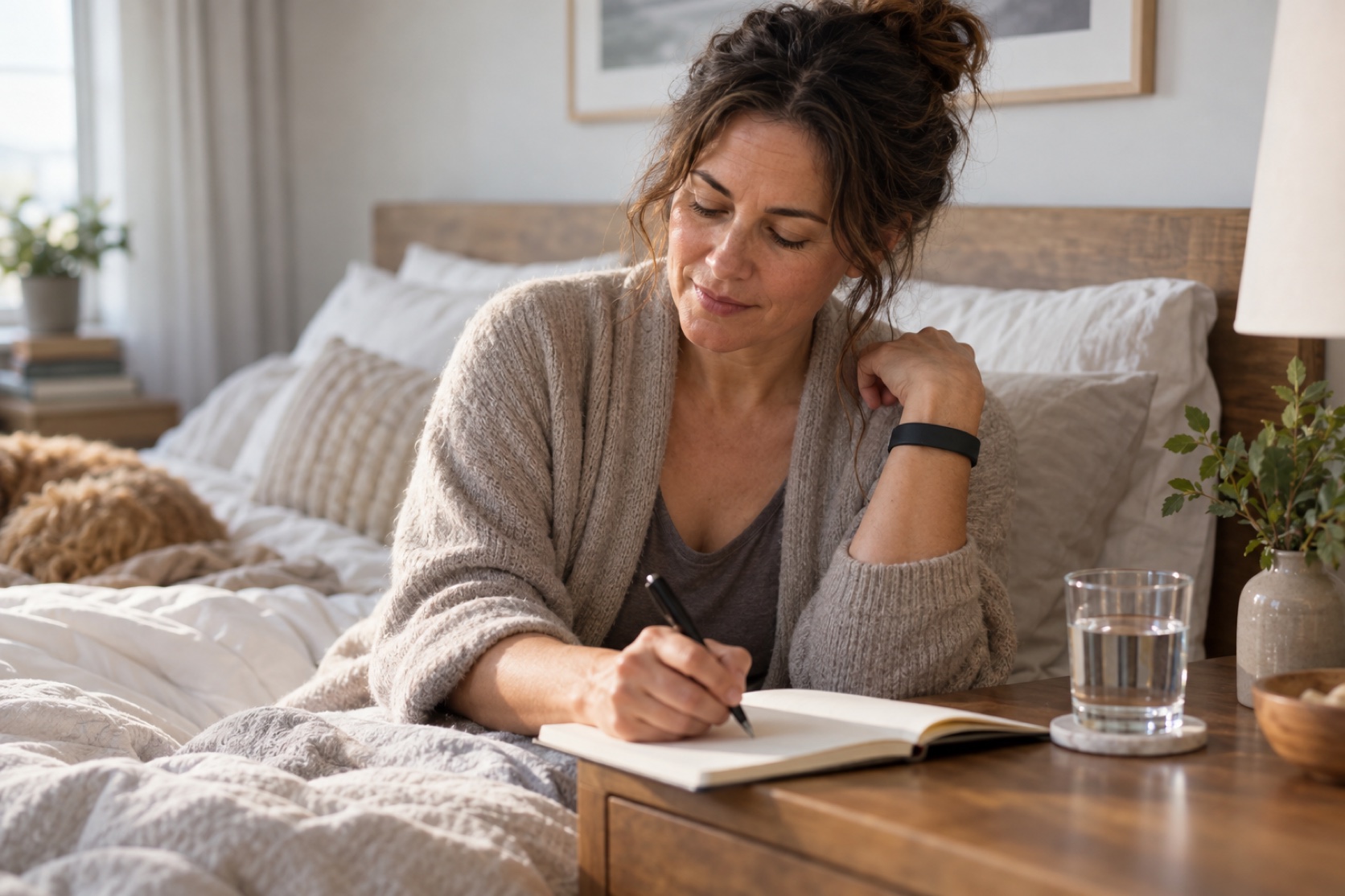
What a Consumer Tracker Actually Measures
A wrist tracker is two sensors and an algorithm. The accelerometer records movement; the optical sensor estimates pulse from light absorption; and a proprietary model turns those two streams into a story about your night. Brainwaves — the actual definition of sleep stages — never enter the picture. The sensor-level detail lives in What Consumer Trackers Measure; here is the honest summary.
- 📳 Movement — an accelerometer samples motion many times per second. It is the workhorse: it tells sleep from wake, marks bedtime and wake time, and estimates total time asleep.
- 💓 Pulse — an optical heart-rate sensor reads blood-flow changes under the skin. Overnight resting heart rate and heart-rate variability add context that refines sleep/wake classification.
- 🫁 Oxygen — many models estimate blood oxygen (SpO2) and flag overnight dips. This is a screening hint with a high artifact rate — motion, band fit, and skin tone all corrupt it — not a measurement of apnea.
- 🧠 "Stages" — deep, light, and REM labels are inferred from movement-plus-pulse patterns by algorithms that differ by brand and update by update. Agreement with lab PSG is weak and variable.
| 📡 Signal | What it actually is | Honest use | Trust |
|---|---|---|---|
| 📳 Movement | Body motion, sampled continuously | Sleep vs wake, timing, total time | Decent for trends |
| 💓 Pulse | Optical heart rate + variability | Refines sleep/wake; resting-HR trend | Useful, noisy at night |
| 🫁 Oxygen | Light-based SpO2 estimate | Overnight-variation flag only | Hint, not diagnosis |
| 🧠 "Stages" | Algorithmic inference from the above | Marketing label; treat as a sketch | Weak vs the lab |
Product picks are generic categories, not brands. We may earn a commission on Amazon or iHerb purchases at no cost to you — this never changes our evidence conclusions. Full disclosure
Smart band or smartwatch
Can make activity, exercise, and routine patterns easier to notice over time.
⚠️ Step, heart-rate, and sleep estimates can be inaccurate and may encourage unhelpful over-monitoring; consumer readings are not medical diagnoses.
Check price on Amazon →The Signals Worth Keeping
The three variables with real evidence behind them — duration, timing, and regularity — are also the three a tracker estimates best, because they are mostly about the clock and the calendar, not about brainwaves. These are the numbers this protocol actually uses.
- ⏰ Total sleep time — average it over the week and compare to your need (roughly 7–9 hours for most adults). The weekly mean is the signal; the single night is noise.
- 🌅 Timing — bedtime and wake time, logged automatically. The wake anchor owns why the fixed morning matters; the tracker's job is showing you the drift you don't feel.
- 📆 Regularity — day-to-day consistency of sleep/wake timing. Irregular schedules are associated with poorer health outcomes across large cohorts; the sleep pillar owns that evidence.
- 📈 The trend — fourteen to thirty nights of weekly means. Direction beats magnitude: is the line moving toward your target, or away from it?
The Numbers to Ignore
Every device ships a headline number: a sleep score, a stage breakdown, a "readiness" grade. These compress a night into a verdict — and the verdict is mostly marketing. The chart below is illustrative, but it reflects the shape of published validation comparisons: agreement is strong where the device is basically a motion detector, and collapses where the device is asked to read brainwaves.
- 🔢 The composite score — a proprietary blend of duration, stages, consistency, and other inputs. There is no standard across brands, and two brands can score the same night differently. It is a number the marketing department designed.
- 🧠 Stage minutes — the weakest output on the screen. Don't reorganize your day around "only 40 minutes of deep sleep."
- 🎯 "Readiness" or "body battery" — sleep, heart rate, activity, and guesses blended into a morning grade. It has no published validation and no action attached to it. Treat it as decoration.
- ⚠️ "Apnea events" — consumer algorithms over-flag by design. A flag is a conversation starter, never a finding.
The Nightly Score Trap: Trends Over Single Nights
A good night and a bad night genuinely look different in the data — but so do a loose band, a late dinner, alcohol, travel, illness, and a few other variables that have nothing to do with how the night went. Single-night scores wobble for reasons the score can't tell you apart. The trend over the nightly score is the whole game: the morning number is a sample of one, and samples of one are noise.
| What you see | What a single night can't tell you | What to do |
|---|---|---|
| One "terrible" score | Measurement noise or one genuinely rough night | Ignore it — watch the 14-night trend |
| One "perfect" score | A good night is not a habit | Keep the cascade — don't chase the number |
| A week of bad scores | A real pattern — or a device artifact (band, firmware, placement) | Check fit, then trust it — the pattern, not the score |
| "Deep sleep" that contradicts how you feel | Stage estimates are the weakest output | Trust the feeling — how you feel plus weekly duration beats the score |
The rule of thumb: judge the weekly mean, never the morning number. If a single score can change your mood, the device is measuring you more than your sleep.
When the Data Starts Running You
Sleep medicine has a name for score-chasing: orthosomnia — striving for perfect device metrics at the expense of actual sleep, described in the Journal of Clinical Sleep Medicine (Baron et al., 2017). The failure mode is familiar to anyone who has checked the app before the coffee: the morning verdict primes the next night's worry.
- 😰 The effort paradox — trying harder to sleep makes sleep harder. A bad score at 7 a.m. is a running start on a worried night at 11 p.m.
- 📵 The fix is subtraction — hide the nightly score, open the app once a week, and take a tracking holiday whenever the number starts running the show. The details of the retreat plan live in When Sleep Data Raises Anxiety.
- 🧾 The mirror test — does the device tell you anything you don't already know? If the answer is no, it's decoration, not data — and decoration can't hurt your sleep.
📵 If the data is making you worse, reduce it
Tracking anxiety is a real, documented failure mode — not a weakness of will. If nightly scores are raising anxiety, hide them, check the app weekly instead of daily, or stop wearing the device for a week. The protocol does not require a gadget; the wake anchor, the evening cascade, and the bedroom rules do the work with or without it.
Where Wearables Can't Go
Consumer devices cannot diagnose sleep disorders — the American Academy of Sleep Medicine's position statement on consumer sleep technology is explicit on this point. A pattern from a wristband is a conversation starter, not a verdict. Two situations short-circuit the whole tracking project: suspected sleep apnea and persistent insomnia. The Wearables & Clinical Questions page walks the full path; the table below is the quick version.
| Device hint | What it might mean | Move |
|---|---|---|
| Nightly "low oxygen" flags | Real dips — or motion and fit artifacts | Mention at the next appointment — don't self-diagnose |
| "Apnea events" feature alerting regularly | Consumer algorithms over-flag by design | Conversation starter — a sleep-study discussion |
| Resting heart rate creeping up for weeks | Illness, overtraining, or poor sleep — context decides | Check context — clinician if it persists with symptoms |
| Poor sleep 3+ nights/week for 3+ months | Chronic-insomnia territory | Clinician — CBT-I or a workup |
The apnea red flags — loud snoring, witnessed breathing pauses, gasping awake — are clinical territory, and the When Sleep Won't Come page plus the sleep apnea pillar own that path. None of these signs prove anything on their own; each raises the odds enough that the next move is a doctor, not a better tracker.
🩺 A device is not a diagnosis
If you suspect sleep apnea, or insomnia has persisted past the 3-nights-for-3-months line, the next step is a clinician — not a new tracker, app, or supplement. Bring the trend data if you have it; clinicians find multi-week sleep records genuinely useful as history. But the judgment belongs to them, and nothing on this site prescribes.
Does Tracking Even Help?
The honest answer: wearing a tracker has not been shown to improve sleep. A randomized cross-over trial in the Journal of Clinical Sleep Medicine (Berryhill et al., 2020) found no sleep benefit from consumer trackers in healthy adults — and small but measurable losses for some participants, most plausibly from the added pressure of being watched by your own wrist.
- ✅ Where it helps — honest feedback on duration and timing; it catches the drift you rationalize away, and it makes the weekly review concrete. That is a real behavioral service.
- ❌ Where it doesn't — it will not fix the light, the caffeine, the bedroom temperature, or the racing mind. The protocol's levers — wake anchor, evening cascade, bedroom engineering, the 20-minute rule — do that work. The sleep pillar explains why that work matters.
- 🧭 The right role — a mirror for the habits the protocol already sets, not a referee with an opinion about your night.
A Low-Friction Tracking Setup
If you track at all, track at minimum effort: the goal is a weekly trend line, not a daily ritual. The full plan — settings, review scripts, and off-ramps — lives in A Low-Friction Tracking Plan; the shape of it is simple.
- ⌚ Wear it to bed, don't study it — syncing is automatic; the app stays closed except for the weekly review.
- 📱 Kill the morning notification — the first-thing score is the front door of the anxiety loop.
- 🗓️ Review once a week — Sunday, five minutes: weekly mean duration, wake-time drift, regularity. One question per week: is this line moving toward the protocol's target?
- 🧹 Audit the hardware — consistent placement, snug band, charged device. Loose bands and dying batteries manufacture bad data.
- ⏸️ Take breaks freely — travel, illness, stress weeks, or any week the number starts running you: the tracker can come off without the protocol failing. It is a tool, not a member of the household.
Questions, Answered Briefly
- ❓ Do I need a tracker for this protocol? — No. A paper sleep diary captures the same three signals: duration, timing, regularity. The tracker's advantage is effort, not insight.
- ❓ Which number should I check each morning? — None, ideally. Look at the weekly mean; the morning score is the trap this page exists to name.
- ❓ My tracker says my sleep is terrible, but I feel fine. — Trust you. How you feel plus the weekly duration beats any composite score, which is the least validated number on the screen.
- ❓ My tracker flagged low oxygen. Now what? — Don't panic, and don't self-diagnose. Repeated flags are worth a clinician conversation — especially alongside snoring or daytime sleepiness. That conversation is a feature, not a failure.
The Bottom Line
- The three signals with evidence — duration, timing, regularity — are also what trackers measure best. Everything else on the screen is inference.
- Single nights are noise; trends are signal. Judge the 14–30-night mean, and ignore stage minutes, readiness grades, and composite scores.
- If tracking raises anxiety, reduce it. Orthosomnia is a documented failure mode; a device should serve sleep, not preside over it.
- A device diagnoses nothing. Suspected apnea or persistent insomnia routes to a clinician — with your trend data as conversation material, not as evidence.
Go Deeper: Sleep Tracking & Wearables: Useful Signals, False Precision
These five companion pages turn the topic into smaller, testable practices.
- 🔗 What Consumer Trackers Measure
- 🔗 The Trend Over the Nightly Score
- 🔗 When Sleep Data Raises Anxiety
- 🔗 Wearables & Clinical Questions
- 🔗 A Low-Friction Tracking Plan
Related Topics
- de Zambotti et al., "Wearable Sleep Technology in Clinical and Research Settings," Medicine & Science in Sports & Exercise (2019)
- Berryhill et al., "Effect of Wearables on Sleep in Healthy Individuals: A Randomized Cross-Over Trial and Validation Study," Journal of Clinical Sleep Medicine (2020)
- Baron et al., "Orthosomnia: Are Some Patients Taking the Quantified Self Too Far?," Journal of Clinical Sleep Medicine (2017)
- Lunsford-Avery et al., "Validation of the Sleep Regularity Index in Older Adults and Associations with Cardiometabolic Risk," Scientific Reports (2021)
- American Academy of Sleep Medicine, "Consumer Sleep Technology: An American Academy of Sleep Medicine Position Statement," Journal of Clinical Sleep Medicine (2023)