When Sleep Data Raises Anxiety
The same tracker that was supposed to reassure can become the thing that keeps you awake. Clinicians have a name for it — orthosomnia, a preoccupation with perfecting sleep-tracking data that worsens the sleep it measures. The number stops being a report and starts being a judge. This page covers how to recognize tracking-driven anxiety, why the score can feed insomnia, and the two reset tools that work: a data holiday and a drastically simpler dashboard.
What the evidence supports
- Case series in the sleep-medicine literature describe patients whose sleep tracking became a source of distress and worsened insomnia, including time spent chasing better scores (Baron et al., Journal of Clinical Sleep Medicine, 2017).
- Attention to sleep — including monitoring it — is a recognized driver in models of insomnia; the more the sleeper watches, the more arousal the watching creates.
- Sleep-restriction and stimulus-control components of cognitive behavioral therapy for insomnia (CBT-I) reduce the time people spend lying awake monitoring sleep, and that reduction tracks improvement.
What remains uncertain
- How common orthosomnia is in the general population of tracker owners is unknown — the clinical descriptions come from people who sought help, which selects for the distressed.
- Whether a data holiday reliably relieves anxiety for everyone has not been tested head-to-head against other approaches.
- The boundary between useful self-monitoring and harmful preoccupation is individual; there is no validated score threshold where tracking flips from helpful to harmful.
Evidence last reviewed: August 20, 2026. Conclusions may change as new research is published.
Product picks are generic categories, not brands. We may earn a commission on Amazon or iHerb purchases at no cost to you — this never changes our evidence conclusions. Full disclosure
Guided journal or notebook
Can support reflection, planning, or brief stress-management practices.
⚠️ Journaling may be distressing for some people; it is not a substitute for mental-health treatment or crisis support.
Check price on Amazon →The Score Stops Reporting and Starts Judging
Somewhere between the second week of tracking and the first streak of bad scores, the device can change roles. At first it is a report — a number you read and file. Then it becomes a performance target: you go to bed hoping for a good score, wake up and check it before you check how you actually feel, and adjust your whole evening around the metric. That is the moment the tool starts working against you. The sleep medicine literature describes patients who became so preoccupied with optimizing their wearable data that the pursuit itself fragmented their sleep (Baron et al., Journal of Clinical Sleep Medicine, 2017).
- 🔎 Checking becomes the first act of waking — the score outranks how rested you feel; your body's report is demoted to a footnote.
- 🎯 Bed becomes a performance stage — "I need to get a good score tonight" is arousal, and arousal is exactly what keeps sleep away.
- 🔄 The loop feeds itself — anxiety about the score fragments sleep, the fragmented sleep produces a bad score, the bad score feeds the anxiety.
- 🧪 It is a recognized clinical pattern — orthosomnia was named in the sleep literature specifically to describe tracking-induced sleep distress (Baron et al., 2017).
How to Recognize Tracking Distress
Tracking anxiety rarely announces itself as anxiety. It shows up as behavior — small rituals around the score that quietly expand. The checklist below is the recognition tool. If two or three of these are true most weeks, the tracking relationship needs adjusting, not more data.
- 😰 Dread before the morning check — you hesitate, or your mood for the day hinges on the number.
- 📉 Score-driven behavior changes — you nap, supplement, or shift routines reactively to chase a better score rather than because you feel off.
- 🛏️ Lying awake monitoring — you check the time, the device, or your "progress" mid-night; the act of watching is part of the wakefulness.
- 🧮 Score vs feeling divergence — a "good" score with a terrible day, or a "bad" score with a great day, and the score still wins the argument.
- 🔁 Re-checking and re-scoring — you reopen the app, compare nights, or question the device's math; the review is compulsive, not informative.
Why the Watching Itself Wakes You
The mechanism is not mysterious. Falling asleep requires your arousal systems to stand down. Monitoring — checking the clock, evaluating how long you have been awake, anticipating the morning score — is the opposite of standing down; it is vigilance with a deadline. This is precisely why classic insomnia treatment asks people to stop trying to force sleep: the effort to control sleep is the counterproductive part (Morin et al., Sleep, 2006). A tracker that invites you to evaluate your performance all night is a machine built to sustain the effort.
- 🧠 Arousal is the enemy of onset — sleep comes when monitoring stops; the score keeps the monitor switched on.
- 🕰️ Clock-watching is a known insomnia pattern — behavioral sleep medicine treats it directly; the device is clock-watching with a dashboard.
- 🔔 Anticipation is enough — you do not need to check at 2am for the anticipation of checking to elevate arousal; the looming ritual does it.
- 🛠️ The fix is to remove the audience — CBT-I's core moves reduce monitoring; removing the tracker is the same move applied to the wearable (Edinger et al., Journal of Clinical Sleep Medicine, 2021).
The Data Holiday
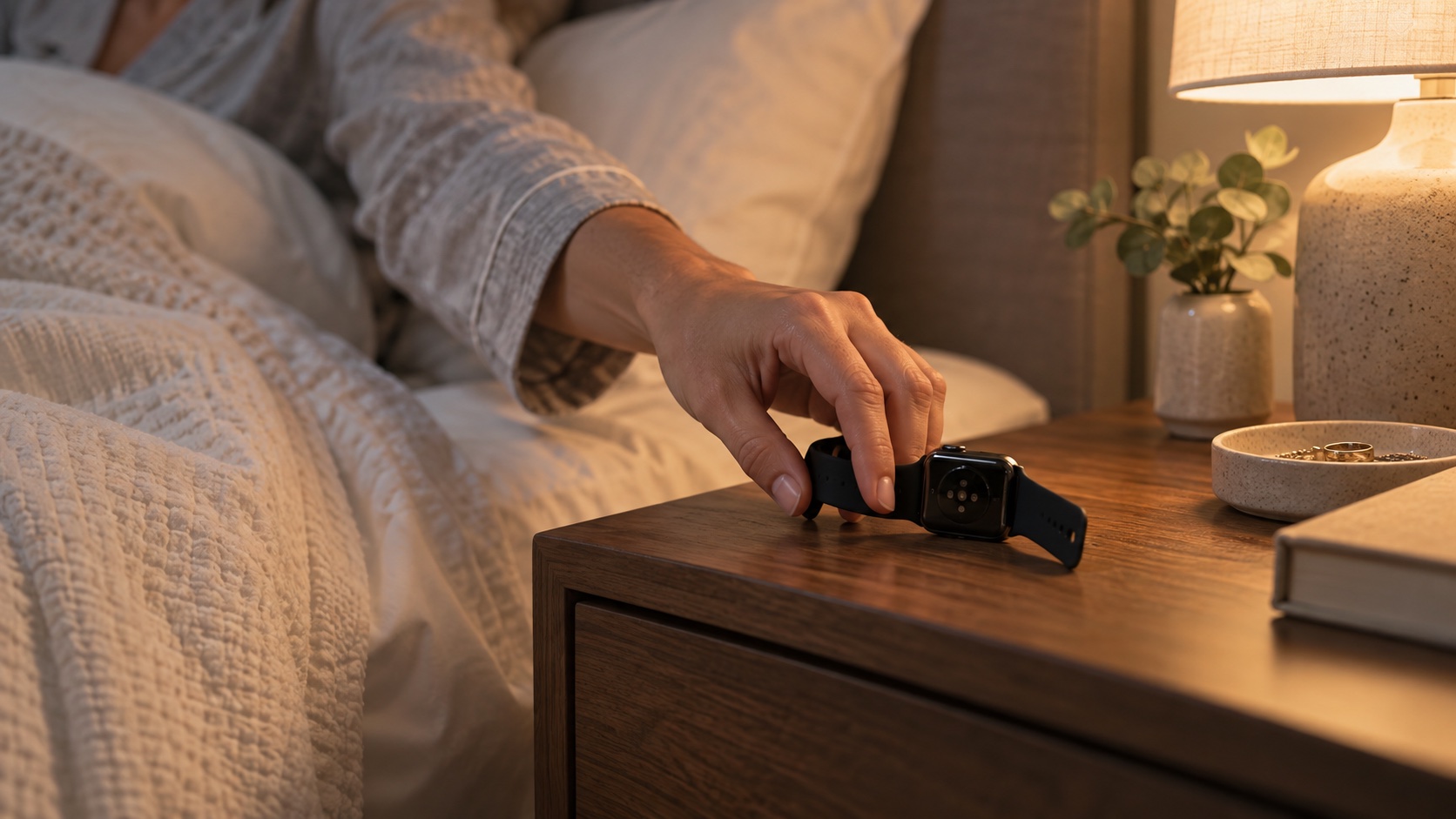
The most direct reset is also the simplest: take the device off — or turn the app's notifications off — for a defined stretch. A data holiday is not quitting tracking forever; it is an experiment that answers one question: does the sleep get better when the score is gone? For people whose tracking has become a source of arousal, the answer is often yes within days.
- 📅 Set a fixed window — one week is a reasonable first experiment; long enough to break the checking habit, short enough to feel low-stakes.
- 📵 Disable, don't just ignore — silence the app's notifications and hide the icon; willpower against a badge count is a losing game.
- 😴 Substitute the body's report — during the holiday, judge the night by how you feel at wake-up and through the day, which is the outcome that actually matters.
- 🔁 Decide deliberately at the end — if the week felt better, the device has earned a demotion, not a return to the throne; see the simpler-dashboard section below.
A Simpler Dashboard
For people who want to keep tracking, the answer is not all-or-nothing — it is a radically reduced feed. The anxiety does not come from having data; it comes from having a score that demands to be judged. Cut the feed down to the two or three numbers that inform behavior and delete the rest.
| Dashboard element | Keep or cut | Why |
|---|---|---|
| ⏰ Bedtime & wake time | Keep | Feeds the regularity behavior; no judgment attached |
| 😴 Total sleep time (weekly) | Keep | Weekly average informs whether duration is in range |
| 📊 Daily score | Cut | A single judgment number; the highest-anxiety element |
| 🌙 Stage pie charts | Cut | Weakest layer of the device, strongest source of score-chasing |
| 🔔 Notifications & streaks | Cut | Designed to pull you back to the app; pure re-engagement pressure |
Many apps let you hide specific cards, disable the daily score, and mute notifications. If yours does not, the honest version of the simple dashboard is the low-friction plan on the next page: a weekly glance, a pen-and-paper note, or nothing at all.
⚠️ If the anxiety persists, tracking is a side issue, not the whole story
A data holiday and a simpler dashboard fix tracker-induced distress. They do not fix insomnia that predates the tracker. If you have had trouble falling or staying asleep for months — with or without the device — that is persistent insomnia, and the well-supported first-line treatment is cognitive behavioral therapy for insomnia delivered by a qualified professional. Reducing the tracking is step one; a clinician conversation is the step that follows when sleep problems persist. The clinical-questions page covers how to have it.
Questions, Answered Briefly
- ❓ Do I have to quit tracking entirely? No. The order of escalation is: simplify first (hide the score, mute notifications), take a short data holiday if needed, and only then consider stopping. Most people find a stripped-down version works.
- ❓ Is my anxiety about the score "real" anxiety? It does not matter what label it gets. If the score reliably raises your heart rate, spoils mornings, or interrupts nights, the tracking relationship needs changing — that is the definition of a tool working against you.
- ❓ What if I feel lost without the data? That feeling is exactly why a data holiday is a week, not a decade. The body's own report — energy, mood, focus — is the metric the data was approximating anyway.
- ❓ How long before a simpler dashboard feels normal? Most people stop reaching for the app within a few days; the checking urge fades fastest when the notifications are gone entirely rather than merely ignored.
- ❓ When is tracking anxiety actually a sleep disorder? When the anxiety outlives the tracker. If months of poor sleep persist with or without the device, that is persistent insomnia territory — a clinician conversation and CBT-I, not a better app, are the evidence-backed next steps.
The Bottom Line
- Tracking can become the problem — score-chasing arousal is a recognized clinical pattern, not a personal failing.
- Recognition beats willpower — dread before the check, mid-night monitoring, and score-vs-feeling divergence are the telltales.
- A data holiday is the reset — one week without the score answers whether the device is helping or hurting.
- If tracking causes anxiety, reduce it — a simpler dashboard or no dashboard; and if insomnia persists regardless, that is a clinician conversation, not a self-diagnosis.
Related Topics
- Baron KG, Abbott S, Jao N, Manalo N, Mullen R, "Orthosomnia: are some patients taking the quantified self too far?," Journal of Clinical Sleep Medicine (2017)
- Morin CM, Bootzin RR, Buysse DJ, Edinger JD, Espie CA, Lichstein KL, "Psychological and behavioral treatment of insomnia: update of the evidence base," Sleep (2006)
- Edinger JD, Arnedt JT, Bertisch SM, et al., "Behavioral and psychological treatments for chronic insomnia disorder in adults: an American Academy of Sleep Medicine systematic review," Journal of Clinical Sleep Medicine (2021)
- Baron KG, Duffecy J, Berendsen MA, et al., "Feeling validated yet? A scoping review of the impact of consumer technologies on sleep behaviour," BMJ Open (2019)