Wearables and Clinical Questions
When sleep problems persist, the wearable becomes evidence — but it is evidence of a pattern, not a diagnosis. A clinician can use your device data to see timing, duration, and consistency at a glance, and that can genuinely help. What the data cannot do is decide what the pattern means or what to do about it. This page covers how to bring a pattern to a clinician well, which patterns deserve the handoff, and how to keep the device in its lane when the stakes get clinical.
What the evidence supports
- Wrist actigraphy is a validated, guideline-endorsed tool for evaluating sleep patterns over days to weeks, including circadian rhythm disorders (Smith et al., Journal of Clinical Sleep Medicine, 2018).
- Multi-night consumer-device data can approximate actigraphy-level timing and duration signals, which is exactly the information a clinician uses to frame a sleep history.
- Sleep diaries and actigraphy together are standard clinical practice; a wearable's trend view is a low-cost version of the diary's most useful column.
What remains uncertain
- Consumer devices are not cleared to diagnose sleep disorders; their stage estimates, in particular, do not meet clinical thresholds for staging sleep.
- Device-specific validation rarely covers the populations and conditions seen in sleep clinics, so clinical interpretation still governs.
- How much weight a given clinician gives to wearable data varies; some will read it with interest, others will lean on the formal sleep study — and both are legitimate.
Evidence last reviewed: August 20, 2026. Conclusions may change as new research is published.
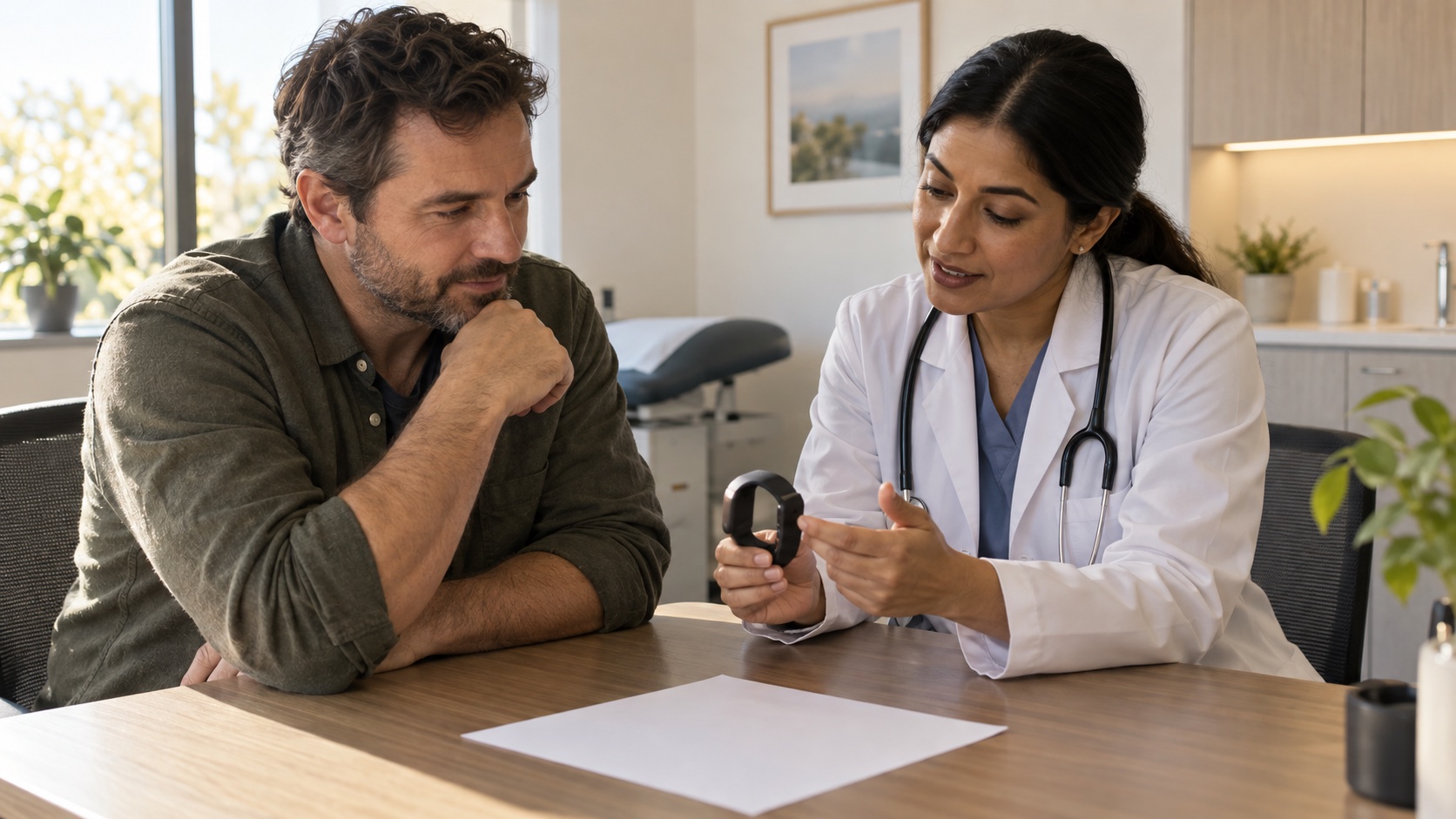
What a Clinician Can Actually Use
The clinical value of a wearable is not the score and not the stages — it is the shape of your sleep over time. Sleep clinicians already use actigraphy, a research-grade version of the same wrist-worn motion sensing, to evaluate how sleep is patterned across days and weeks (Smith et al., Journal of Clinical Sleep Medicine, 2018). Your consumer device produces a cruder version of that same signal, and the honest framing is that a multi-night trend view can be a useful first look — the timing of sleep, the duration, and the night-to-night consistency.
- ⏰ Timing is the most usable column — when you fall asleep, when you wake, and how much that drifts from night to night.
- 📊 Duration trends are next — the weekly average and how often you dip below the range you need.
- 🌙 Stages are the least usable column — a clinician knows the device is guessing; leading with deep-sleep percentages invites a polite redirect.
- 🧾 Data is a supplement, not a referral — it enriches the history; it does not replace the questions a clinician asks or the tests they order.
Product picks are generic categories, not brands. We may earn a commission on Amazon or iHerb purchases at no cost to you — this never changes our evidence conclusions. Full disclosure
Smart ring
Can provide a low-profile way to track personal sleep and activity trends.
⚠️ Consumer sleep and recovery estimates can be inaccurate; daily scores can increase anxiety or over-monitoring for some people.
Check price on Amazon →What the Data Is and Isn't
The cleanest way to think about it: the device reports what your wrist did and what an algorithm inferred. It does not report a diagnosis, and it does not report a treatment plan. When you bring the data to a clinician, you are bringing a description of a pattern — the interpretation belongs to the clinician's training, the clinical interview, and, where indicated, formal testing such as polysomnography.
Which Patterns Deserve the Handoff
Most wearable data never needs a clinician. A rough week after travel, a late project, a shift change — those are life, not medicine. But certain patterns cross from data into clinical territory, and the distinction is worth learning because the cost of missing them is real. The list below is the handoff list — when a pattern looks like this, the right move is a conversation with a qualified healthcare professional, not a deeper dive into the app.
- 🌬️ Loud snoring plus pauses — snoring, witnessed breathing pauses, or gasping at night, especially with daytime sleepiness, is the classic profile that warrants evaluation for obstructive sleep apnea.
- 😴 Persistent insomnia — trouble falling or staying asleep for three months or more, several nights a week, with daytime impact: this is chronic insomnia, and CBT-I is the first-line treatment.
- 🔁 Severe circadian drift — sleep and wake times shifting hours later over weeks, or an inability to align with any schedule, can point to a circadian rhythm disorder worth a clinical look.
- 🚨 Red-flag accompaniments — falling asleep while driving, or legs that demand movement at night (possible restless legs) — both warrant a conversation rather than self-management.
How to Bring the Pattern Well
A wearable is only as useful in the clinic as the way you present it. Done well, it shortens the history-taking. Done poorly, it buries the signal in score complaints. The practical version: bring the trend, not the verdict; bring the question, not the conclusion.
| Do | Don't | Why |
|---|---|---|
| 📅 Print or screenshot 2–4 weeks of timing/duration trends | Lead with "my deep sleep is only 40 minutes" | Timing and duration are the validated layers; stages are guesses |
| 🗣️ Describe symptoms: snoring, pauses, daytime sleepiness | Rely on the app's "apnea risk" score | The clinical picture is symptoms plus testing, not app labels |
| ❓ Ask the question you came with | Expect a prescription from a screenshot | The clinician needs the interview and often formal testing |
| 📝 Keep a simple symptom log alongside the device | Adjust treatment on app data between visits | Device data informs; clinician guidance directs |
⚠️ Suspected sleep apnea or persistent insomnia is a handoff, not a self-diagnosis project
The most important boundary on this page: a consumer device cannot diagnose obstructive sleep apnea or insomnia, and self-treating either from app data is outside the evidence base. If the pattern suggests either condition — loud snoring with pauses and daytime sleepiness, or months of trouble sleeping — the appropriate step is a qualified healthcare professional, who may order formal testing such as a sleep study. The device's job is to start the conversation, not to finish it.
What to Expect From the Clinical Side
A clinician who sees your trend data will use it the way they use a sleep diary: as context. They will still ask about symptoms, medications, shift work, caffeine, and stress — the history the device cannot see. Where a sleep disorder is suspected, they may order polysomnography or a home sleep apnea test, which are the actual diagnostic instruments. The wearable's role is to point, not to prove.
- 🧑⚕️ The interview is the primary instrument — your symptoms and history carry more weight than any trend line.
- 🧪 Formal testing settles formal questions — polysomnography and home sleep apnea tests are how apnea and related disorders get diagnosed, not wristbands.
- 📋 Treatment is guided by the clinician — whether that is CBT-I, PAP therapy for apnea, or circadian timing work, the plan comes from the clinical conversation.
- 🔁 Tracking can continue as a companion — after a diagnosis, wearables can help track adherence and trends; the low-friction plan page explains how to keep that useful without letting it run your nights.
Questions, Answered Briefly
- ❓ Will my doctor take wearable data seriously? Usually, if it is framed as context rather than diagnosis. Clinicians already use wrist actigraphy in sleep evaluation (Smith et al., 2018); a clean two-week timing and duration summary is a reasonable adjunct, and many will appreciate the head start.
- ❓ Should I bring the app's "sleep score" to the appointment? Skip it. The score is proprietary, unvalidated across devices, and carries the weakest layers; lead with timing and duration trends, which is what the clinician can actually use.
- ❓ What if I can't afford a sleep study? That is a conversation to have with the clinician — testing options vary widely, from in-lab polysomnography to home sleep apnea tests, and the right choice depends on your pattern and symptoms, not on any app.
- ❓ Can a wearable track treatment progress? Yes, as a companion — adherence to a consistent schedule, duration trends, and timing stability are all readable. The Sleep Protocol series treats tracking as a follow-along tool, not a treatment itself.
- ❓ Is there ever a case for a consumer device flagging apnea? Some devices now estimate oxygen saturation or flag breathing disruptions, and those signals can be conversation starters. They are not diagnostic: obstructive sleep apnea is evaluated with clinical testing ordered by a professional, and a flagged pattern earns a question, not a conclusion.
The Bottom Line
- Bring the pattern, not the verdict — timing, duration, and consistency are the usable columns; stages and scores are not.
- The device points, the clinician decides — wearable data enriches a history; it does not replace interview, testing, or judgment.
- Snoring with pauses and persistent insomnia are handoff patterns — these earn a clinical conversation, not app-based self-diagnosis.
- Frame it as a question — a two-week trend view plus your symptoms is the best version of wearable evidence you can bring.
Related Topics
- Smith MT, McCrae CS, Cheung J, et al., "Use of actigraphy for the evaluation of sleep disorders and circadian rhythm sleep-wake disorders: an American Academy of Sleep Medicine systematic review," Journal of Clinical Sleep Medicine (2018)
- Chinoy ED, Cuellar JA, Huwa KE, et al., "Performance of seven consumer sleep-tracking devices, polysomnography, and actigraphy: case series," Nature and Science of Sleep (2021)
- Kapur VK, Auckley DH, Chowdhuri S, et al., "Clinical practice guideline for diagnostic testing for adult obstructive sleep apnea," Journal of Clinical Sleep Medicine (2017)
- Edinger JD, Arnedt JT, Bertisch SM, et al., "Behavioral and psychological treatments for chronic insomnia disorder in adults: an American Academy of Sleep Medicine systematic review," Journal of Clinical Sleep Medicine (2021)