Stuffy Air, Measured: What Bedroom CO₂ Actually Runs Overnight
Close the bedroom door, sleep seven or eight hours, and the air around you quietly changes: exhaled carbon dioxide keeps accumulating while almost nothing moves it out. By morning, a closed room can sit several times above the outdoor baseline. That number is a good window into how well the room is ventilated — and this page covers what real bedrooms measure, what the familiar ppm lines mean, and what a reading can and cannot tell you.
What the evidence supports
- Closed-bedroom CO₂ commonly runs several times above the outdoor baseline; dormitory and home studies show the same pattern.
- Ventilation reliably lowers bedroom CO₂, and several studies tie lower-CO₂ nights to better sleep — while others find smaller effects, or none, on self-reported sleep.
- CO₂ is the practical tracer for ventilation: exhaled by occupants, cheap to measure, and rising well before anything else in the room does.
What remains uncertain
- The direct effect of sustained low-level CO₂ on sleep and thinking is debated — a high reading reliably shows only that fresh-air supply was low.
- The familiar lines — 800, 1,000, 1,500 ppm — are ventilation conventions, not measured health cutoffs.
- Single nights vary enormously; a log needs a week or more before it says anything.
Evidence last reviewed: October 5, 2026. Conclusions may change as new research is published.
Why Bedrooms Are Different
A living room gets emptied, aired and walked through all day. A bedroom gets none of that: it is the smallest room in the home, the most continuously occupied, and the least exchanged with outside — the door is shut, the window may be too, and one or two adults keep adding carbon dioxide to air nothing is pushing out. Across seven or eight hours, it adds up.
- 🏠 Little air to begin with — A small volume means the same breathing load that barely registers in a kitchen concentrates where you sleep.
- 🚪 The door is usually closed — A shut door buys privacy and closes off the home's main path for shared air overnight.
- 🫁 You are the source — Every sleeper adds CO₂ all night; it is not leaking from the walls, it is coming from you.
- ⏳ Seven or eight hours, most nights — A long, repeating exposure — which is why the overnight curve deserves a look.
What Closed Rooms Actually Measure
Two lines of research frame the range. In the dormitory experiments by Strøm-Tejsen and colleagues (Indoor Air, 2016), student rooms were measured with and without fresh-air supply: closed-room nights averaged 2,585 ppm in the pilot, against 660 ppm with the window open; the second experiment averaged 2,395 ppm closed, against 835 ppm with an inaudible fan-assisted inlet vent running. On the home side, a Wellington monitoring study (Bennett et al., 2026) ran NDIR sensors in 20 bedrooms for two weeks and found closed rooms routinely above the adequacy indicator, against an outdoor background of roughly 423–425 ppm; an earlier, smaller New Zealand study reported peaks up to 4,000 ppm. Clean outdoor air most places sits near 420 ppm — the differences you see are almost entirely about ventilation, not location.
Read the four bars as a scale of air exchange: both closed-room conditions produced roughly three to four times the CO₂ of the ventilated ones.
The Threshold Lines, Decoded
Every number quoted below is a convention with a job — none is a measured health cliff. The lower the line, the more fresh air the room is exchanging.
| Level | What it indicates | The caveat |
|---|---|---|
| 🌳 ≈420 ppm | 🌍 Outdoor background air | Varies with location and season — cities run higher. |
| ✅ Under 800 ppm | 🌬️ The adequacy indicator in bedroom monitoring | A practical marker, not a certified health threshold. |
| 📏 1,000 ppm | 📐 The line NZS 4303:1990 recommends staying under | An older convention; a tighter target is within ~400 ppm of outdoor air. |
| ⚠️ 1,500+ ppm | 🪟 Poor air exchange | A prompt to look at ventilation, not a diagnosis. |
| 🚩 2,500+ ppm | 🛏️ Where closed dormitory rooms averaged in the trials | A study finding from sealed single rooms — not a household norm. |
The direction that matters is down, night after night.
What CO₂ Is and Isn't
Carbon dioxide is the gas you exhale — a normal product of metabolism and harmless at the levels a bedroom reaches. That ordinariness makes it useful: it is produced by the occupants, mixes through the room, and leaves only when fresh air arrives. CO₂ is a ventilation proxy — a tracer for how sealed a space is.
- 🌬️ A proxy, not the villain — As CO₂ climbs, so do the things that accumulate with it; the number stands in for the room's air quality.
- 🧪 The direct effects are debated — Whether sustained low-level CO₂ itself dents sleep and thinking is contested; some studies find no cognitive effect at all.
- 👃 What rides along with it — Allergens, particles and volatile compounds build up in the same closed air; a CO₂ reading flags that accumulation without measuring it.
- 🧭 The proxy role is the settled part — Whatever the physiology turns out to be, a rising curve means the room is exchanging too little air.
Logging It Yourself
You need one tool — the sensing method matters more than the price.
- 🔬 NDIR, not "eCO₂" — A true NDIR (non-dispersive infrared) sensor measures CO₂ directly by absorption; cheap "eCO₂" readings are estimated from other sensors and can drift.
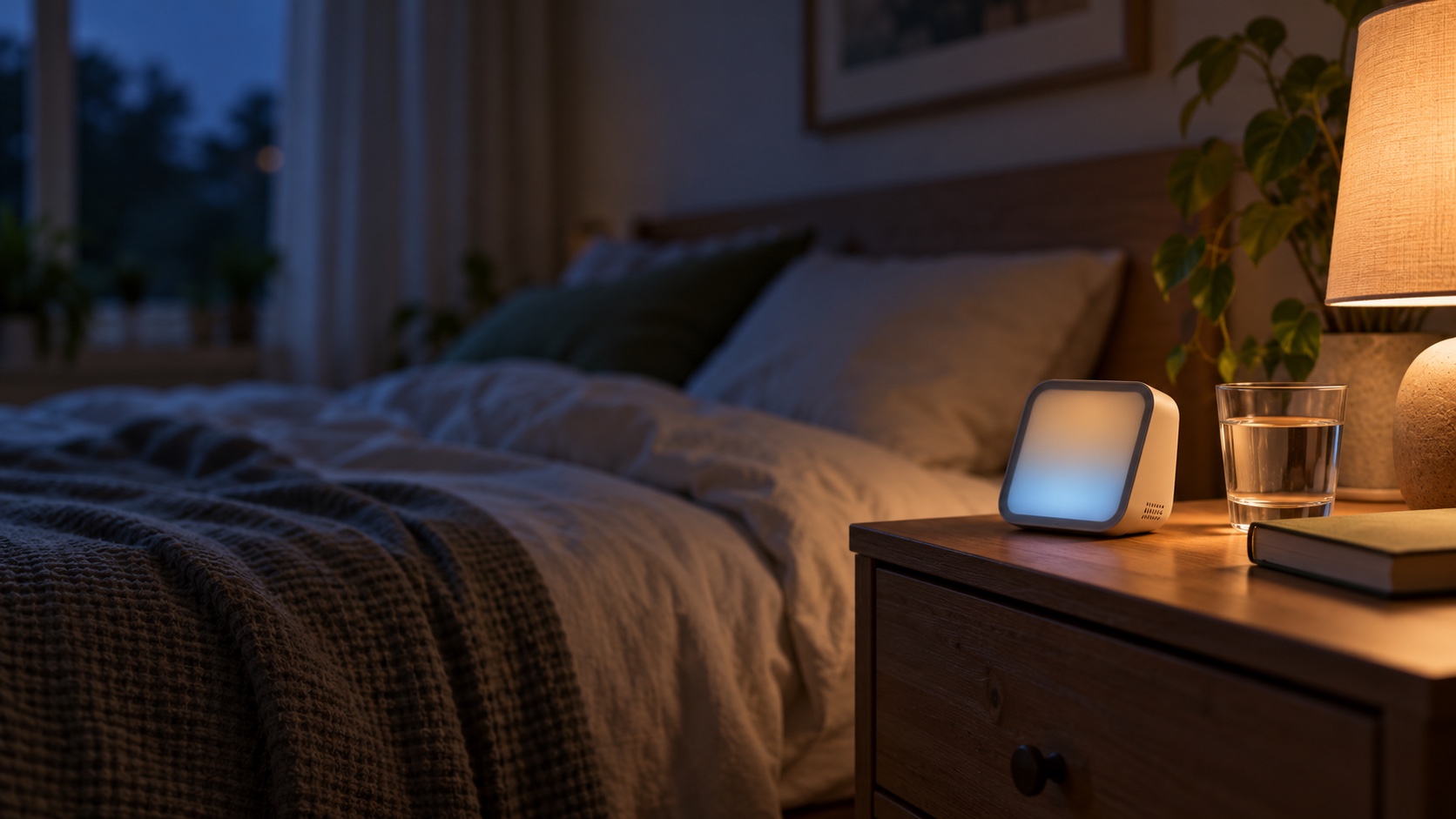
- 🛏️ Breathing height — Put it where a sleeping head is: the nightstand, not the floor or a far shelf.
- 🌬️ Away from moving air — Keep it clear of the window gap and supply vents so it reads the room, not the airstream.
- 🌙 Log the whole night — The overnight curve is the data; one evening glance is not.
- 📅 A week minimum — Nights differ too much to judge from one or two.
Reading Your Own Curve
An overnight log is a shape, not a number — and the shape is consistent. It starts near the evening baseline, bends upward after lights-out, and peaks in the final hours before you wake. Once you can read it, small changes show: a door opened for ten minutes leaves a dent, a cracked window changes the slope, and a second sleeper steepens everything.
- 🌆 Evening baseline — A well-aired room should sit near outdoor levels before bed; a high pre-sleep reading starts the night behind.
- 🌙 The rise after lights-out — The curve bends upward within the first hour or two of a closed door — slowly in a leaky room, steeply in a tight one.
- 🌄 The morning peak — The night's highest reading lands in the final hour before waking; compare that number week to week.
- 🚪 Doors and windows write the curve — A door left open, or a window cracked before bed, visibly flattens the climb.
- 👥 Two sleepers climb faster — A second person roughly doubles CO₂ production, so shared rooms start higher and peak higher.
The Stuffy-Morning Checklist
None of this matters until it shows up in how the morning feels. Each classic signature is a ventilation signal, not a diagnosis.
- 🥍 Dry mouth, dry throat — Waking parched before you have spoken a word is a common stuffy-room report.
- 🤕 A quiet morning headache — A dull headache that fades within an hour of fresh air belongs on the checklist.
- 🏠 The "used air" smell — A stale, enclosed smell when you walk back in means nothing exchanged overnight.
- ✅ The lift test — If the feeling clears after airing the room out, ventilation is a plausible contributor — information, not proof.
🚨 A number is not a diagnosis
A high reading is not a medical finding, and the usual fix is mundane — more air exchange, the subject of the ventilation page later in this series. Persistent unrefreshing sleep, heavy snoring, or morning headaches that continue after the room is ventilated are conversations for a clinician. A sensor can describe a room; it cannot assess a person.
What a Reading Can't Tell You
A CO₂ log answers one question — how much fresh air did this room get — and it deserves to be kept in its lane.
- 🕷️ It doesn't see allergens or particles — Dust-mite allergen, mould spores and fine particles are invisible to a CO₂ sensor; a room can log a beautiful curve and still hold dust.
- 🌙 One night is a sample, not a pattern — Weather, door habits, a late evening in the room, a guest — single nights swing; conclusions belong to weekly averages.
- 🧠 The reading-anxiety trap — Checking the number at 3am turns a ventilation tool into a bedtime stressor; log it overnight, glance in the morning, act weekly.
- 🩺 Sensors measure rooms, not symptoms — Keep a separate ledger of how you actually feel; that is the record worth taking to a clinician if something persists.
Questions, Answered Briefly
- ❓ What level should an overnight room aim for? Under 800 ppm is the adequacy indicator used in monitoring work; within ~400 ppm of outdoor air is a tighter target.
- ❓ My monitor read 2,000 ppm this morning — is that dangerous? No — those levels match closed dormitory rooms in controlled studies; they are a signal to ventilate, not a medical event.
- ❓ Are cheap CO₂ monitors any good? Sensor type, not price, decides. An NDIR unit measures CO₂ directly; "eCO₂" estimates can wander.
- ❓ Is a cracked window enough? Often it changes the curve more than expected; how much depends on the gap, the wind and the room. Even a modest opening beats a sealed room, and your data will show whether it suffices.
- ❓ We sleep with the door open — does that count? It counts as exchange, but with indoor rather than outdoor air; it beats a closed door and falls short of a window.
The Bottom Line
- Bedrooms are the test case — small volume, long occupancy, little exchange; closed-room nights commonly run several times above outdoor air.
- The lines are conventions, not cliffs — under 800 ppm is the adequacy indicator; 1,000 ppm is NZS 4303's recommendation.
- Log, don't guess — one week of NDIR data beats any single morning glance.
- Ventilation is the response, not fear — when the curve is high, the fix is air movement; persistent symptoms get a clinician.
Related Topics
- Strøm-Tejsen P, et al., "The effects of bedroom air quality on sleep and next-day performance," Indoor Air (2016)
- Bennett J, et al., "Stuffy nights: elevated bedroom carbon dioxide concentrations indicate inadequate ventilation in Wellington homes," New Zealand Medical Journal (2026)
- Fan X, et al., "A single-blind field intervention study of whether increased bedroom ventilation improves sleep quality," Science of the Total Environment (2023)
- Akimoto M, et al., "New research on bedroom ventilation and sleep quality suggests that building standards should be revisited (ASHRAE 1837-RP)," Science and Technology for the Built Environment (2025)