Circadian Rhythm 101: Aligning With Your Body Clock
Every cell in your body runs on a 24-hour schedule. When your lifestyle fights that schedule, the cost shows up as poor sleep, sluggish metabolism, and accelerated aging. Here's how the master clock works — and how to live on its time instead of against it.
What the evidence supports
- Light is the dominant cue for the human circadian clock — established in controlled lab studies.
- Shift work is consistently associated with worse metabolic and cardiovascular health in meta-analyses.
- Chronotype (lark vs owl) is substantially heritable, based on twin studies.
What remains uncertain
- Shift-work associations are observational; exact causal pathways are still being untangled.
- How much an individual can shift their chronotype is debated — estimates cluster around ~1 hour.
- Real-world effect sizes for "social jetlag" are less quantified than lab-based circadian effects.
Evidence last reviewed: August 13, 2026. Conclusions may change as new research is published.
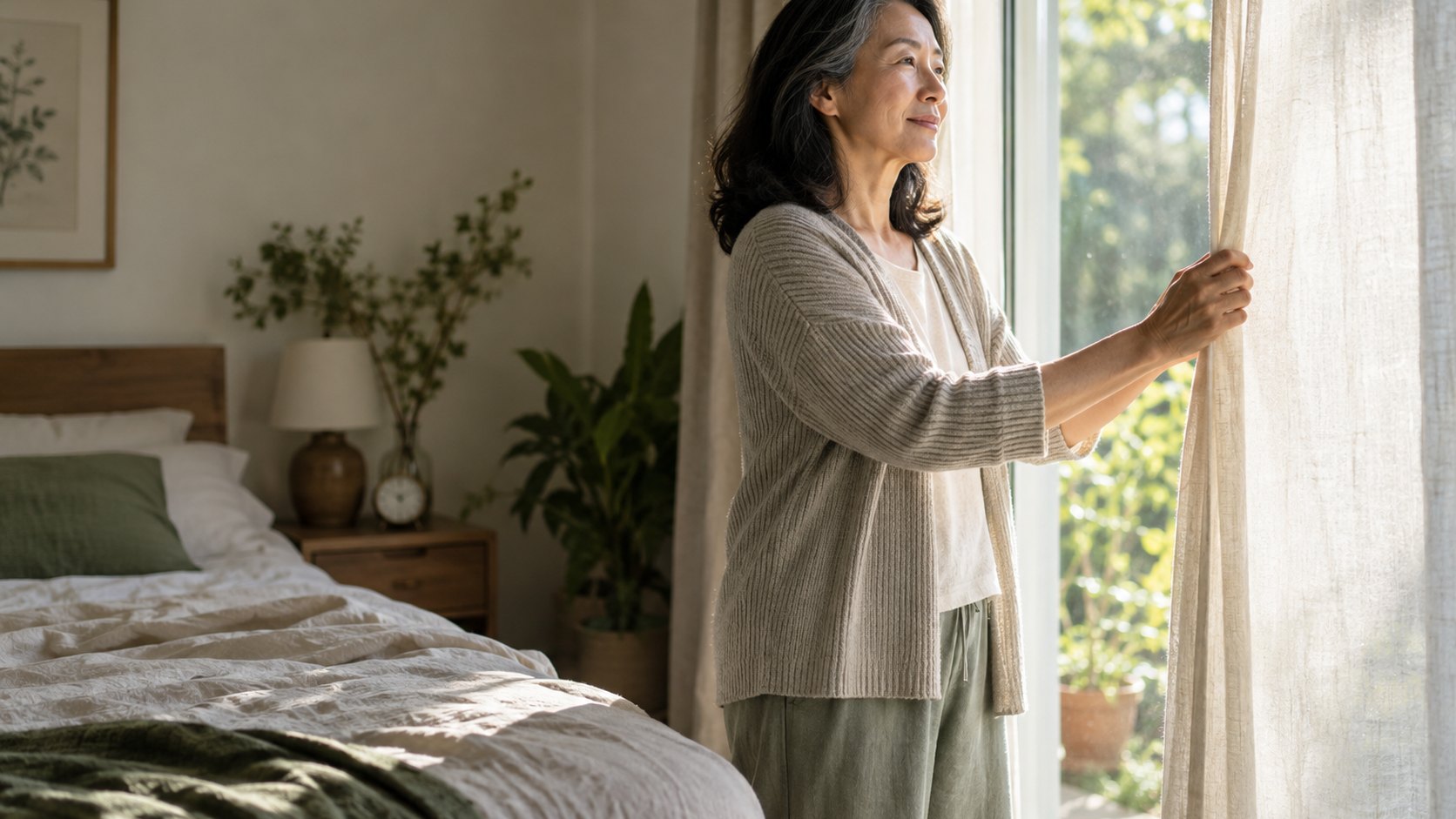
You Have a Master Clock — and Trillions of Little Ones
Deep in the hypothalamus sits the suprachiasmatic nucleus (SCN) — a cluster of ~20,000 neurons acting as your master clock. It syncs to the 24-hour day primarily through light hitting your eyes, then broadcasts timing signals to "peripheral clocks" in your liver, gut, and muscles.
This is why light is called the zeitgeber ("time giver"): it's the strongest cue your biology uses to know what time it is. When light arrives at the right times, your whole body marches in formation. When it arrives at the wrong times — bright screens at midnight, darkness at noon — your clocks drift apart, and every process they govern loses precision.
Clock Genes: The Molecular Gearbox
Inside nearly every cell, a molecular feedback loop ticks out a ~24-hour cycle. Proteins called CLOCK and BMAL1 switch on a set of genes — including PER and CRY — whose protein products accumulate, inhibit CLOCK/BMAL1, then degrade, restarting the loop. This machinery runs in your liver, gut, muscles, and brain cells, and it regulates an estimated 10–40% of the genome's expression — a large fraction of what your genes do depends on what time it is.
The practical consequence: the same input has different effects at different hours. Sunlight at 7am anchors the rhythm; at midnight it disrupts it — "when" is a biological variable.
Product picks are generic categories, not brands. We may earn a commission on Amazon or iHerb purchases at no cost to you — this never changes our evidence conclusions. Full disclosure
Blackout shades or curtains
May reduce unwanted bedroom light and make a dark sleep setting easier to maintain.
⚠️ None expected from the product itself; install securely and preserve a safe route to exits.
Check price on Amazon →The Daily Curve: Two Hormones, One Story
Two hormones trace the rhythm daily: cortisol (wakefulness) and melatonin (sleepiness). They should peak roughly 12 hours apart. This is the healthy pattern:
💡 The cortisol awakening response
Cortisol isn't just a stress hormone — its morning spike gets you out of bed. Healthy rhythms see it jump 50–60% within 30–45 minutes of waking; a blunted spike is associated with chronic stress, burnout, and depression. Morning light fires the spike.
Light: The Right Dose at the Right Time
Light is medicine, and like medicine, it has a dose and a schedule. The rules are simple:
| When | What to do | Why |
|---|---|---|
| Within 1 hour of waking | 10–20 min of outdoor light (or bright indoor light on gray days) | Anchors your clock, fires the cortisol spike, sets the timer for melatonin 14–16h later. |
| Midday | More light is fine — get outside | Reinforces the day signal; outdoor midday light is ~100x brighter than indoor light. |
| After sunset | Dim lights, warm colors, screens down or heavily dimmed | Bright evening light delays melatonin release and pushes your whole rhythm later. |
| Sleep period | Total darkness — blackout shades, cover LEDs | Even small light leaks (5–10 lux) can fragment sleep and blunt melatonin. |
The retinal cells that detect morning light — intrinsically photosensitive retinal ganglion cells — connect directly to the SCN, and they need bright light (thousands of lux) to fire fully. A phone screen at arm's length delivers ~40 lux; a cloudy outdoor morning delivers ~10,000. That's why "just open the blinds" is the cheapest intervention in this entire pillar.
Larks, Owls, and the Genetics of Sleep Timing
Your ideal sleep window is partly written in your genes. Roughly 30–40% of people are "morning larks," 25–30% are "night owls," and the rest fall in between. Chronotype is largely heritable and shifts with age — teenagers skew owl, seniors skew lark.
The problem is that society runs on lark time, and owls pay a real biological tax ("social jetlag"). Research consistently finds that night owls forced into early schedules show worse metabolic health than larks with identical sleep duration. If you're an owl: defend your evening sleep window, maximize morning light exposure (it advances your clock), and avoid bright light after 10pm — it pushes your rhythm even later. You can shift your chronotype by about an hour with consistent effort, but you can't fight it entirely.
Warm, dimmable bedside light
Makes a lower-light evening routine easier to follow.
⚠️ None expected; avoid treating a bulb choice as a cure for insomnia.
Check price on Amazon →Shift Work: The Circadian Crash Test
Nothing stresses the circadian system like shift work — especially rotating or night shifts. The health literature is unambiguous: shift workers have elevated rates of obesity, type 2 diabetes, and cardiovascular disease. The mechanism: they eat, sleep, and get light at times their biology isn't built for, suppressing melatonin and disorganizing peripheral clocks.
If you must work nights, damage control matters: protect daytime sleep with total darkness, use bright light during the shift, keep meal timing consistent on work days and off days, and — hardest of all — limit flipping back to daytime mode on days off. That oscillation creates permanent jet lag.
When You Eat Is a Circadian Signal, Too
Your liver, pancreas, and gut have their own clocks, and they sync to meals. Eating late at night tells your digestive organs it's daytime — while the SCN is telling your brain it's night. The result: organs working out of phase, poorer glucose tolerance at night, and lighter, more fragmented sleep. Two simple rules cover 90% of it:
- Finish eating 2–3 hours before bed. A full stomach raises core temperature and delays sleep onset.
- Keep a consistent meal window. Eating at the same times daily strengthens peripheral clocks; erratic eating desynchronizes them.
- Front-load calories. Glucose tolerance is highest in the morning — the same meal at 8pm produces roughly twice the glucose response.
Jet Lag, Decoded
Jet lag is your SCN failing to fast-forward (or rewind) on demand. The clock can shift roughly one hour per day — and direction matters. Westward travel (flying toward later bedtimes) is easier because your internal day runs naturally slightly longer than 24 hours; eastward travel is harder. Flying US→Europe feels brutal; the return barely registers.
Tools that actually help: adopt destination meal and light timing immediately; seek morning light after eastward travel and evening light after westward; use low-dose melatonin (0.5–1mg) timed to destination bedtime for a few nights. For trips under ~3 days, consider not shifting at all.
Naps and the Afternoon Dip
Around 1–3pm, most humans hit a natural dip in alertness — the post-lunch dip. It's partly sleep pressure building and partly a small circadian trough, and it happens whether or not you ate lunch. Rather than fighting it with caffeine, a short nap is one of the most efficient performance tools known: 10–20 minutes keeps you in light sleep, avoids sleep inertia, and delivers measurable alertness and motor-skill gains for hours. Longer naps (~90 minutes, a full cycle) add memory consolidation but risk grogginess. Keep naps before 3pm and they won't touch your night sleep.
The Seasons Change Your Clock
Circadian biology has a seasonal dimension most advice ignores. At higher latitudes, winter's short days bring later melatonin onset, longer sleep, and lower daytime alertness — in the general population, not just diagnosed seasonal affective disorder (SAD) cases. Your light strategy should change with the season. In summer, a 10-minute morning walk suffices; in winter, you may need 30 minutes, plus a light-therapy lamp (10,000 lux, 20–30 min after waking) — a first-line SAD treatment that also helps winter energy in people without the diagnosis.
The same principle applies to your evening: winter's early darkness is actually a gift to your melatonin — lean into it with dim, warm evenings. And if you live at high latitude or work indoors all day, note that indoor light (~100–500 lux) is a permanent "biological winter" next to outdoor daylight (~10,000–100,000 lux). Getting outside isn't recreation; it's a physiological requirement.
Quick Rhythm Audit
Score yourself honestly — each "yes" is a clock desynchronizer:
| Habit | Clock impact |
|---|---|
| Bedtime varies by >1h between weekdays and weekends | High — weekly social jetlag |
| First light of the day is a screen, not the sky | High — weak morning anchor |
| Bright lights or screens within 1h of bed | Moderate — delayed melatonin |
| Large meal within 2h of bed | Moderate — organ-clock conflict |
| Heavy caffeine after 2pm | Moderate — masked sleep pressure |
| Weekend sleep-in >2h past weekday wake time | Moderate — rhythm drift |
Your Rhythm Reset
- Fix your wake time first. Waking at the same time daily is the single strongest anchor for your circadian rhythm — more than bedtime.
- Get outside within an hour of waking. 10–20 minutes, no sunglasses, no window glass. This is the master signal.
- Dim everything after sunset. Warm lamps, dark mode, and ideally no screens in the last hour.
- Eat on a schedule, not at midnight. Close the kitchen 2–3 hours before bed.
Go Deeper: Subtopics
- 🔎 Light is the master signal — lux, timing, and the ipRGC pathway: why 10 minutes of morning sun beats an hour of evening dimness. Read it →
- 🔎 Chronotypes: larks, owls & social jetlag — the genetics of morningness, and what an owl can realistically shift. Read it →
- 🔎 Meal timing as a clock signal — how food timing entrains peripheral clocks (time-restricted eating link). Read it →
- 🔎 Jet lag & daylight-saving — the travel protocol: light exposure schedules, melatonin timing, east vs west asymmetry. Read it →
- 🔎 Shift work & the misaligned clock — the health evidence, and harm reduction for people who can't choose their schedule. Read it →
Related Topics
- Roenneberg & Merrow, "The Circadian Clock and Human Health," Current Biology (2016)
- Wright et al., "Entrainment of the Human Circadian Clock to the Natural Light-Dark Cycle," Current Biology (2013)
- Merikanto et al., "Associations of Chronotype and Sleep With Cardiovascular Diseases," Chronobiology International (2013)
- Wehrens et al., "Meal Timing Regulates the Human Circadian System," Current Biology (2017)
- LeGates et al., "Light as a Central Modulator of Circadian Rhythms, Sleep and Affect," Nature Reviews Neuroscience (2014)
- Takahashi, J., "Transcriptional architecture of the mammalian circadian clock," Nature Reviews Genetics (2017)
- Knutsson, A., "Health disorders of shift workers," Occupational Medicine (2003)
- Dutheil et al., "Shift work and cardiovascular outcomes: a meta-analysis," Scientific Reports (2020)
- Vyas et al., "Shift work and vascular events: systematic review and meta-analysis," BMJ (2012)
- Gan et al., "Shift work and diabetes mellitus: a meta-analysis of observational studies," Occupational and Environmental Medicine (2015)
- Gu et al., "Total and cause-specific mortality of U.S. nurses working rotating night shifts," American Journal of Preventive Medicine (2015)