The Optimal Bedtime: When Should You Sleep?
"What time should I go to bed?" is the question everyone asks — and the honest answer has two layers. There's a population-level sweet spot in the data, and there's a personalized formula that matters more. This page covers both, plus how to fall asleep faster once you're in bed, and how to wake up without the grogginess.
What the evidence supports
- Large observational studies associate mid-evening sleep onset (~10–11pm) with the lowest cardiovascular risk — but causation is unproven.
- A warm bath or shower 1–2 hours before bed reliably shortens sleep latency in trials and a meta-analysis.
- Consistency of sleep timing is associated with better health independent of total duration.
What remains uncertain
- No randomized trials establish one optimal clock time for everyone; individual chronotype clearly matters.
- Breathing tricks and "cognitive shuffling" have limited or mixed trial support — harmless, but not proven.
- How much of the late-bedtime health association is the timing itself versus sleep loss, shift work, or other confounders.
Evidence last reviewed: August 13, 2026. Conclusions may change as new research is published.
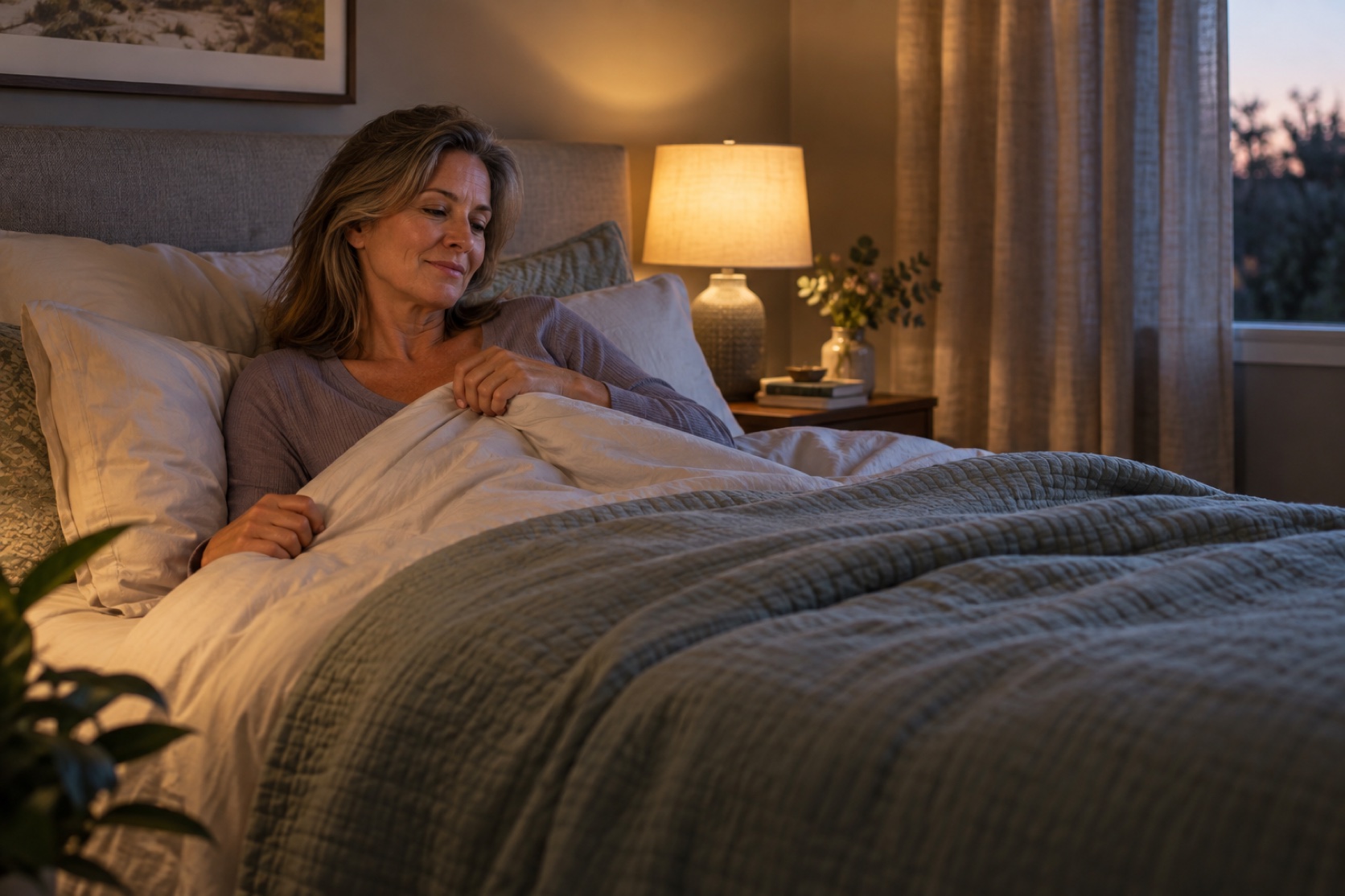
Is There a Universal Bedtime?
One large dataset has given the "best bedtime" question its most famous answer. In a 2021 analysis of ~88,000 UK Biobank participants wearing wrist accelerometers, sleep onset between 10:00 and 10:59pm was associated with the lowest incidence of cardiovascular disease over ~6 years of follow-up — lower than both earlier and later bedtimes, with risk rising notably for onset after midnight.
The crucial caveat: this is observational data, and the people sleeping at 10pm differ from the people sleeping at 1am in many ways beyond bedtime — age, shift work, health status, and life structure. The finding is consistent with other cohort work showing late bedtimes associating with worse metabolic markers, but no trial has randomized people to different bedtimes. Treat the 10–11pm window as a data-informed default, not a biological law.
Product picks are generic categories, not brands. We may earn a commission on Amazon or iHerb purchases at no cost to you — this never changes our evidence conclusions. Full disclosure
Blackout shades or curtains
May reduce unwanted bedroom light and make a dark sleep setting easier to maintain.
⚠️ None expected from the product itself; install securely and preserve a safe route to exits.
Check price on Amazon →Your Personal Bedtime Formula
The more useful question than "what time?" is "what time for me?" — and that follows from two numbers: your fixed wake time and your sleep need (7–9 hours for most adults). Count backwards, then subtract a 15–30 minute buffer for falling asleep:
| Fixed wake time | In-bed window (7.5–9h + drift-off buffer) | Bedtime consistency goal |
|---|---|---|
| 5:00 | 20:00 – 21:30 | Same ±1h, weekends included |
| 6:00 | 21:00 – 22:30 | Same ±1h, weekends included |
| 7:00 | 22:00 – 23:30 | Same ±1h, weekends included |
| 8:00 | 23:00 – 00:30 | Same ±1h, weekends included |
Note what this means: a 6am riser has a different "optimal bedtime" than an 8am riser. Your chronotype sets the window; the population data merely suggests that, all else equal, mid-evening alignment tends to track with better outcomes.
⏰ Consistency beats the clock
Research increasingly suggests that regularity of sleep timing matters at least as much as the absolute hour — irregular sleep schedules are associated with worse cardiometabolic markers independent of duration. If you can hold only one new habit, hold a fixed bedtime and wake time. A "wrong" time kept consistently beats a "right" time kept erratically.
The Late-Night Trap: Revenge Bedtime Procrastination
You know the feeling: the day gave you no time for yourself, so you reclaim it at 11:30pm — scrolling, gaming, one more episode — even though you know exactly what it costs tomorrow. Sleep researchers have a name for this: "revenge bedtime procrastination" (popularized from the Chinese term bàofùxìng áoyè). It isn't laziness or weak discipline; it's a rational rebellion against a day with no leisure, expressed at the one hour you control.
The fix isn't willpower at midnight — willpower's weakest hour. It's restructuring the day so bedtime isn't the only freedom left: protect a genuine leisure block earlier, even 30 minutes right after dinner. Then pair it with a closing ritual — a fixed, pleasant sequence (tea, lights down, book) that marks the day as officially over. When the ritual starts, bedtime becomes a transition rather than a nightly negotiation that gets resolved at 12:40am against your own interests.
The Evening Ramp: How to Fall Asleep Faster
Sleep latency — the time between lights-out and sleep onset — averages 10–20 minutes in healthy adults. If you're regularly at 45+ minutes, something in the ramp is missing. Here are the techniques with the strongest support:
| Technique | How it works | Evidence |
|---|---|---|
| Warm bath/shower 1–2h before bed | Warms the skin, then blood vessels dilate — core temperature drops, which is the body's sleep signal. | Strong — meta-analysis finds ~10 min faster sleep onset |
| Dim lights 90 min out | Removes the light signal that suppresses melatonin. | Strong — melatonin-suppression studies are consistent |
| Cool bedroom (18–19°C) | Makes the core-temperature drop easier to sustain. | Moderate — controlled environment studies |
| Brain-dump journaling | Offloads tomorrow's tasks from working memory before bed. | Moderate — trials in good sleepers and insomniacs |
| 4-7-8 breathing / box breathing | Long exhales activate the parasympathetic "rest and digest" system. | Limited — mechanistic logic is sound; trial data are small |
| Cognitive shuffling | Random word-image sequences crowd out anxious thoughts. | Limited — promising but few controlled studies |
The pattern: physiology first, psychology second. Temperature and light manipulate the biology directly; the mental techniques are worth trying because they're free and harmless, but they're garnish, not the meal.
Book or skill-learning workbook
Can support sustained reading or structured skill practice.
⚠️ None expected; a product cannot prevent dementia or replace assessment of new cognitive symptoms.
Check price on Amazon →The 90-Minute Countdown
All of the above, compressed into one repeatable sequence:
| Time to bed | Action | Why |
|---|---|---|
| T−90 | Warm shower or bath; screens to night mode or off | Starts the core-temperature drop; cuts the melatonin-suppressing light |
| T−60 | Warm lamps only; start the closing ritual (tea, journal, book) | Total light dose falls; the brain learns the sequence = sleep is coming |
| T−30 | Bedroom check: cool, dark, quiet; brain-dump tomorrow's tasks onto paper | Environment is set; working memory is offloaded so it can't spin at lights-out |
| T−0 | Lights out; phone out of reach; clock face turned away | Removes the three most common midnight temptations before they appear |
Run the countdown nightly for two weeks and it becomes automatic — the evening stops being a sequence of decisions and becomes a descent. That's the difference between people who fall asleep in ten minutes and people who "can't switch off": the former stopped deciding an hour earlier.
What to Do When Sleep Won't Come
Lying in bed awake is one of the most effective ways to train your brain that bed is a place for thinking. The evidence-based protocol:
- The 20-minute rule. If you're still awake after ~20 minutes, get up. Go to another room, keep the lights dim, do something calm and boring (paper book, gentle stretching), and return only when sleepy. Repeat as needed — this stimulus-control technique is a first-line insomnia treatment.
- Stop clock-watching. Checking the time converts "I'm awake" into "I'm failing at sleep," which spikes arousal. Turn the clock away — you have an alarm for the morning; the night does not need your monitoring.
- Try paradoxical intention. The counterintuitive CBT technique: instead of trying to sleep, try to stay awake — lying with your eyes open. It removes the performance pressure, which for many people is the actual obstacle. Evidence from small trials is surprisingly consistent.
- Don't "catch up" with a late lie-in. After a rough night, a 10am wake-up feels natural but steals sleep pressure from the next night. Keep the wake time fixed and let tonight's sleepiness do the repair work.
Guided journal or notebook
Can support reflection, planning, or brief stress-management practices.
⚠️ Journaling may be distressing for some people; it is not a substitute for mental-health treatment or crisis support.
Check price on Amazon →Waking Up Well: A Short Guide
The first 30 minutes of your day are decided the night before — and in the first 60 seconds of waking. Three principles cover most of it:
Kill the snooze button
Snoozing fragments the final sleep cycles and extends sleep inertia — the grogginess that takes 15–30 minutes to clear. One alarm, placed across the room if needed.
Light within the hour
Outdoor light fires the cortisol awakening response and tells your SCN the day has started — which also sets tonight's melatonin timer.
Water before caffeine
Eight hours without fluids leaves most people mildly dehydrated. Hydrate first, then coffee 60–90 minutes after waking, when the natural cortisol spike is already doing the job.
Expect sleep inertia — feeling foggy for the first 15–30 minutes after waking is normal biology, not a personal failing, and it clears faster with light and movement. If you're still groggy an hour later after a full night's sleep, that's worth investigating (fragmented sleep, apnea, or too-short duration — see the related topics).
The Bottom Line
- There's a data-informed default: sleep onset around 10–11pm associated with the lowest cardiovascular risk in large cohorts — but it's observational, not law.
- Your formula matters more: fixed wake time minus 7.5–9 hours, minus a 15–30 minute drift-off buffer.
- Consistency is the king habit: same bedtime and wake time ±1 hour, including weekends.
- To fall asleep faster: warm shower 1–2h before bed, dim lights, cool room — then the mental tricks if needed.
- To wake up well: no snooze, morning light, water before coffee, and let sleep inertia clear on its own.
Go Deeper: Subtopics
- 🔎 Chronotype × bedtime — matching the sleep window to your biology instead of fighting it. Read it →
- 🔎 The bedtime formula, worked — wake time minus sleep need minus drift-off buffer, with example schedules. Read it →
- 🔎 Social jetlag — the weekend drift problem: how Saturday sleep-ins tax Monday. Read it →
- 🔎 Revenge bedtime procrastination, in depth — the psychology (day with no leisure) and the restructure-the-day fix. Read it →
- 🔎 The U-curve — what the UK Biobank 10–11pm finding really shows, and why individual timing matters more than the clock. Read it →
Related Topics
- Nikbakhtian et al., "Accelerometer-derived sleep onset timing and cardiovascular disease incidence: a UK Biobank cohort study," European Heart Journal – Digital Health (2021)
- Haghayegh et al., "Before-bedtime passive body heating by warm shower or bath to improve sleep: a systematic review and meta-analysis," Sleep Medicine Reviews (2019)
- Windred et al., "Sleep regularity is associated with risk of mortality," Sleep (2024)
- Trotti, L., "Waking up is the hardest thing I do all day: sleep inertia and sleep drunkenness," Sleep Medicine Reviews (2017)
- Scullin et al., "The effects of bedtime writing on difficulty falling asleep," Journal of Experimental Psychology: General (2018)
- Bootzin & Epstein, "Understanding and treating insomnia," Annual Review of Clinical Psychology (2011)