Shift work & the misaligned clock
Some people don't get to choose their hours. For them, the circadian rules aren't a lifestyle upgrade — they're a hazard to be managed. This page covers what the health evidence actually shows for shift workers, where it's weaker than headlines suggest, and the harm-reduction playbook for working nights and staying well.
What the evidence supports
- Shift work — especially rotating nights — is consistently associated with higher rates of diabetes, cardiovascular disease, and weight gain across meta-analyses.
- Controlled experiments show circadian misalignment alone degrades glucose handling and blood pressure within days.
- Forward-rotating schedules and bright-light exposure measurably improve adaptation in field studies.
What remains uncertain
- These are observational associations; shift workers differ from day workers in many ways, and causal attribution is incomplete.
- The breast-cancer signal that drove early concern has weakened in prospective studies and newer meta-analyses.
- Whether harm-reduction practices change hard outcomes — not just sleep and alertness — has rarely been tested.
Evidence last reviewed: August 15, 2026. Conclusions may change as new research is published.
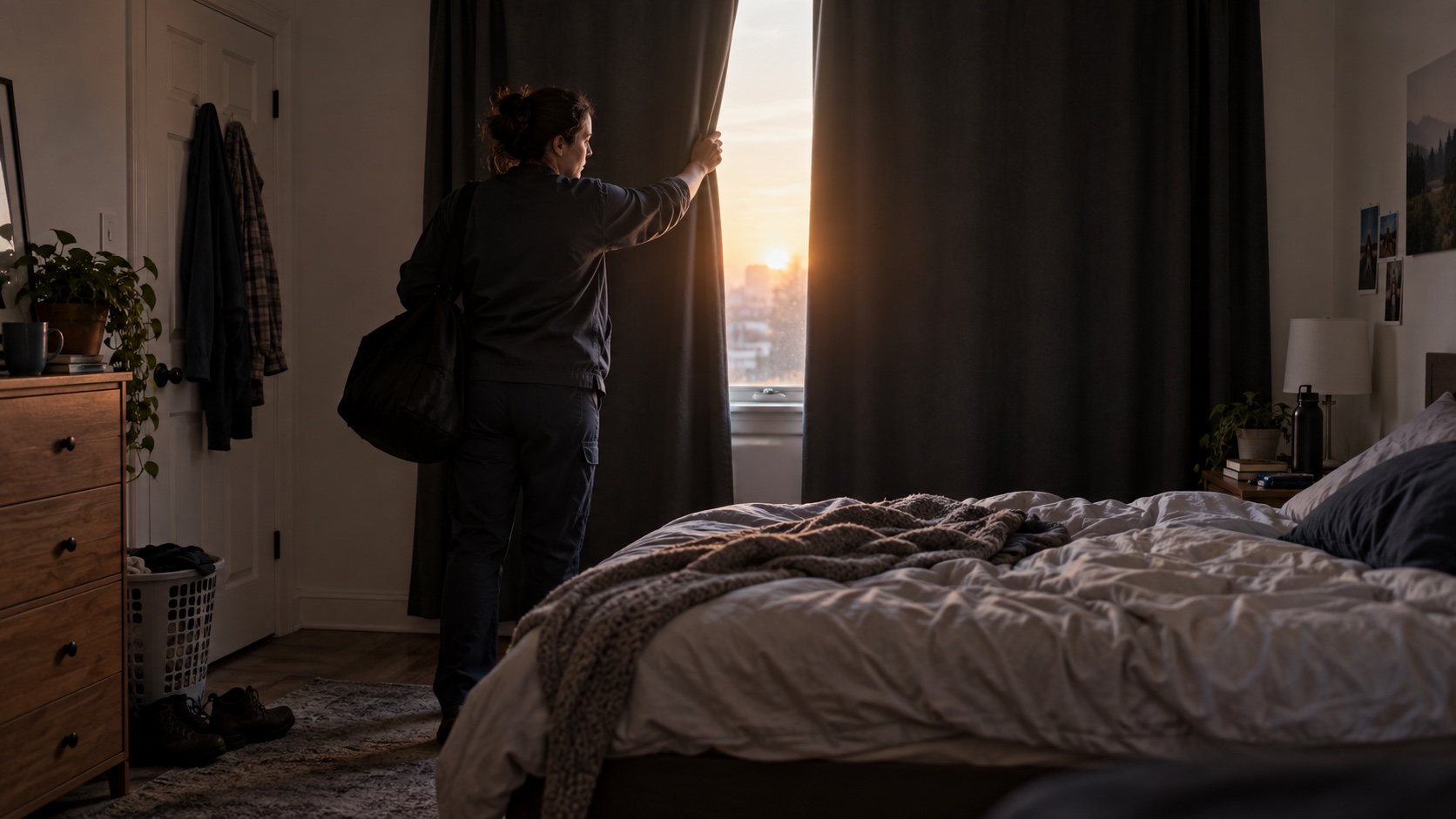
What the Body Experiences on Night Shift
A night shift asks the body to eat, move, and think during its biological night — while its melatonin is rising, its core temperature is falling, and its digestive system has clocked out. The cleanest demonstration of what that does comes from forced-desynchrony experiments, where healthy volunteers live on artificial 28-hour days so that sleep and meals collide with the internal clock. After just days of misalignment, participants showed higher post-meal glucose despite higher insulin, elevated blood pressure, and a reversed cortisol pattern — and three of eight healthy young adults produced glucose responses in the prediabetic range (PNAS, 2009). That experiment is a preview of what chronic night work rehearses nightly, and a large part of why the associations that follow deserve more than a shrug.
Product picks are generic categories, not brands. We may earn a commission on Amazon or iHerb purchases at no cost to you — this never changes our evidence conclusions. Full disclosure
Blackout shades or curtains
May reduce unwanted bedroom light and make a dark sleep setting easier to maintain.
⚠️ None expected from the product itself; install securely and preserve a safe route to exits.
Check price on Amazon →The Health Evidence, in One Chart
The Health Evidence, Honestly Framed
The associations are real and consistent: meta-analyses find shift work linked to roughly a quarter more cardiovascular events (BMJ, 2012) and a graded rise in type 2 diabetes risk with years of exposure (Occupational and Environmental Medicine, 2015). Nurses' Health Study data put all-cause mortality about 11% higher after five or more years of rotating nights (American Journal of Preventive Medicine, 2015). The International Agency for Research on Cancer classified "shift work that involves circadian disruption" as probably carcinogenic to humans — Group 2A — based largely on breast-cancer signals in the same nurses' cohorts (Lancet Oncology, 2007).
Then the honest part. These are observational comparisons, and shift workers differ from day workers in income, access to care, diet, and smoking — factors statistical adjustment handles imperfectly. The breast-cancer evidence has softened considerably: a combined analysis of three large prospective cohorts plus meta-analysis found little overall association with night work (Journal of the National Cancer Institute, 2016). The IARC classification, made on an earlier evidence base, is widely regarded as provisional. And the healthy-worker effect cuts the other way — people who tolerate nights stay in the workforce, which can make the observed risks look smaller than they are. What strengthens the case beyond the confounders is the dose-response: diabetes risk climbs with years of night-work exposure across independent cohorts, which is the pattern you'd expect from a cumulative physiological stress rather than a statistical artifact. Treat the chart above as a hazard map, not a verdict.
Harm Reduction: The Damage-Control Playbook
For people who can't choose their schedule, the goal is to minimize the misalignment — to make the body's clocks agree with the work clock, and to protect daytime sleep. The tools with the best support:
| Intervention | What it does | Evidence |
|---|---|---|
| 💡 Bright light during the shift | Boosts alertness and shifts the clock toward work hours | Good |
| 🌑 Darkness for daytime sleep: blackout shades, sunglasses on the way home | Protects daytime sleep and melatonin | Good |
| 🔄 Forward-rotating schedules (morning → evening → night) | Easier adaptation than backward rotation — a classic field-study finding (Science, 1982) | Good |
| 😴 Strategic naps before or during the shift | Reduces sleepiness, improves performance — see the naps protocol | Moderate |
| ☕ Caffeine at shift start, none in the last 4–6 hours | Alertness without stealing daytime sleep | Moderate |
| 💊 Melatonin before daytime sleep | Modest gains in daytime sleep length in pooled trials (Cochrane, 2014) | Mixed |
| 📅 Keep the schedule stable; limit flipping on days off | Prevents the permanent jet lag of constant oscillation | Good |
| 🍽️ Lighter meals overnight; skip heavy food in the 2–4am trough | Gentler glucose response during the biological night | Limited |
Protecting Metabolic Health on a Night Schedule
The metabolic risk is where the shift-work and glucose topics meet. The practical translation: anchor meals to your shifted schedule and keep that pattern on days off, as the meal timing page describes; front-load your eating into the part of your day when you're most active; and treat annual metabolic screening — blood pressure, fasting glucose, lipids — as non-optional, as laid out in the quarterly audit protocol. Aerobic fitness also appears to blunt some of the cardiovascular association, though that evidence is observational too, and a workout before a night shift doubles as an alertness tool. The one thing the playbook exists to protect, above all, is a solid daytime sleep block — because sleep loss multiplies the misalignment.
⚠️ When to involve a clinician
If you're sleeping your protected block and still fight disabling sleepiness at work — or if you snore, stop breathing in sleep, or notice mood changes — escalate. Some shift workers have undiagnosed sleep apnea on top of schedule problems, and shift-work sleep disorder has prescription treatments (including wakefulness agents such as modafinil) that a sleep clinician can consider. The Cochrane evidence covers these (2014); they are prescription territory, not self-service.
If You Can Leave: What Recovery Looks Like
The reassuring half of the literature: some of the damage appears reversible. In a longitudinal study of French workers, ten years of shift work was associated with cognitive decline equivalent to about six and a half years of aging — but scores recovered substantially in people who had been off shift work for five years or more (Occupational and Environmental Medicine, 2015). In the nurses' cohorts, elevated mortality risk attenuated with time since stopping night work. Leaving the night schedule, when seniority or circumstances allow, is itself an intervention — and the evidence says it keeps paying off. That same logic is the strongest argument for seniority-based bidding: decades of exposure data suggest the longest-serving workers are precisely the ones who should get first claim on day shifts. The honest frame: one observation is a data point, a fortnight is a pattern, and the plan changes on patterns, not on single mornings.
Questions, Answered Briefly
- 🔁 Is fixed night better than rotating? Usually. A stable night schedule lets the clock partially adapt, while constant flipping — especially backward rotation — reproduces permanent jet lag, the pattern the classic field studies flagged as worst (Science, 1982).
- 💊 Do sleeping pills fix daytime sleep? They can force sleep but don't realign clocks, and routine use for shift work has little trial support (Cochrane, 2014).
- 🩺 What should I ask my doctor to check? Blood pressure, fasting glucose, and lipids — annually while on nights — plus an apnea evaluation if you snore or wake unrefreshed despite a protected sleep block.
- 👨👩👧 What about family and social life? Isolation is part of shift work's burden, not a side note — the relationships pillar covers why it matters. Schedule protected family blocks as deliberately as you schedule sleep.
The Bottom Line
- Shift work carries a real metabolic and cardiovascular burden — consistent across cohorts and meta-analyses, with the strongest signal for rotating nights.
- The evidence is observational. The associations are solid; causal certainty and some early cancer signals have weakened on closer inspection.
- Harm reduction is worth doing well. Bright light at work, total darkness for daytime sleep, forward rotation, anchored meals, and schedule stability are the tools with the best support.
- Protect sleep and screen annually. A defended daytime sleep block plus yearly metabolic screening is the minimum standard — and leaving nights, when possible, shows measurable recovery.
Related Topics
- Scheer et al., "Adverse metabolic and cardiovascular consequences of circadian misalignment," PNAS (2009)
- Straif et al., "Carcinogenicity of shift-work, painting, and fire-fighting," Lancet Oncology (2007)
- Vyas et al., "Shift work and vascular events: systematic review and meta-analysis," BMJ (2012)
- Gan et al., "Shift work and diabetes mellitus: a meta-analysis of observational studies," Occupational and Environmental Medicine (2015)
- Gu et al., "Total and cause-specific mortality of U.S. nurses working rotating night shifts," American Journal of Preventive Medicine (2015)
- Schernhammer et al., "Rotating night shifts and risk of breast cancer in women participating in the nurses' health study," Journal of the National Cancer Institute (2001)
- Travis et al., "Night shift work and breast cancer incidence: three prospective studies and meta-analysis of published studies," Journal of the National Cancer Institute (2016)
- Kecklund & Axelsson, "Health consequences of shift work and insufficient sleep," BMJ (2016)
- Czeisler, Moore-Ede & Coleman, "Rotating shift work schedules that disrupt sleep are improved by applying circadian principles," Science (1982)
- Liira et al., "Pharmacological interventions for sleepiness and sleep disturbances caused by shift work," Cochrane Database of Systematic Reviews (2014)
- Marquié et al., "Chronic effects of shift work on cognition: findings from the VISAT longitudinal study," Occupational and Environmental Medicine (2015)