The Range, Tempo, and Load Levers
When a joint complains, the answer is rarely "stop doing the movement." It is "change how you do it." This page maps the three levers you control on any exercise — how far you move, how fast you move, and how much you move — and the order to turn them when demand needs to come down.
What the evidence supports
- Lower loads still drive strength and size when sets are taken close to failure — the load–volume trade-off is well documented (Schoenfeld 2017).
- Slower eccentric tempos raise time under tension and reduce peak force, which is why they are used to dose tendons and joints (Roig 2009).
- Isometric holds at moderate intensity can temporarily reduce tendon pain — a genuine, measured lever (Rio 2015).
What remains uncertain
- Whether a shortened range of motion preserves as much strength as full range is context-dependent; partial-range training appears useful but is not a universal substitute.
- Exactly how much load reduction is "enough" for a given joint varies by person, joint, and day — there is no universal formula.
Evidence last reviewed: August 20, 2026. Conclusions may change as new research is published.
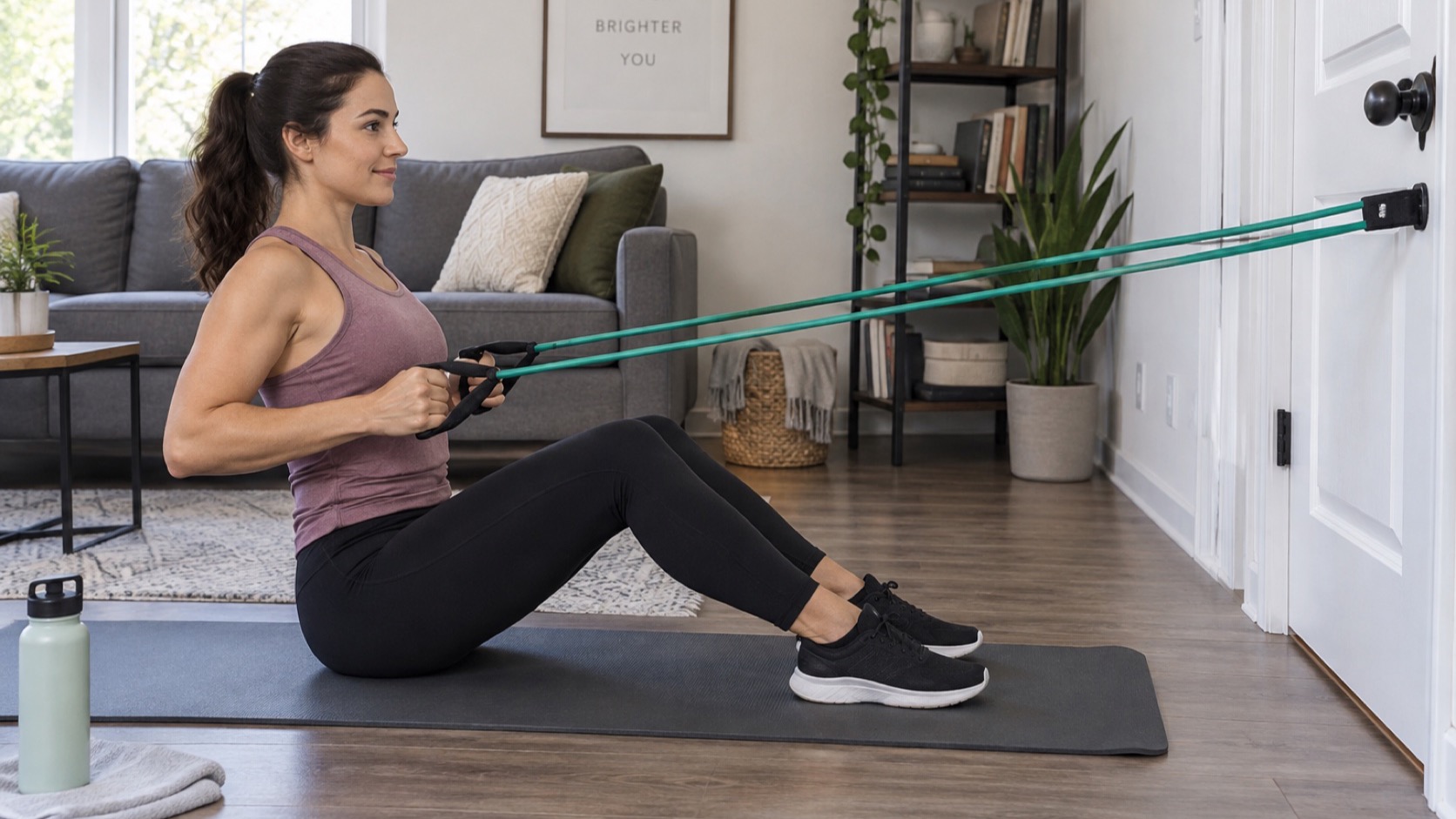
Three Levers, One Movement
Every exercise is a bundle of three dials. Range is how far the joints travel. Tempo is how fast they travel — usually written as seconds for eccentric, pause, and concentric phases (a 3-1-3 squat lowers for three seconds, pauses for one, and rises for three). Load is how much weight is on the bar, dumbbell, or body. The insight that keeps people training for decades: you can turn any one of these dials down without deleting the movement, and the movement pattern is what preserves strength, skill, and joint health (see the Exercise Selection parent topic on why patterns matter).
- 📏 Range is the joint's lever — shortening a squat's depth moves the knee and hip away from the position that hurts; the pattern stays a squat.
- ⏱️ Tempo is the tissue's lever — slowing the eccentric phase changes how force is spread over time, which is how tendons and joints are dosed (Roig 2009).
- 🏋️ Load is the intensity lever — lighter weight with more reps preserves the stimulus while cutting peak force; the rep continuum shows how wide that range really is.
Product picks are generic categories, not brands. We may earn a commission on Amazon or iHerb purchases at no cost to you — this never changes our evidence conclusions. Full disclosure
Adjustable dumbbells
Allows progressive loading at home across common strength movements.
⚠️ Poor technique or rapid load increases raise injury risk; not required to begin moving more.
Check price on Amazon →Range: How Far Is Far Enough
The range lever is the fastest relief valve for a joint that complains at depth. If a full-depth squat hurts at the bottom, a box, bench, or plate under the hips sets a shallower floor without changing the exercise. The trade-off is honest: range contributes to strength and muscle growth, especially at the lengthened position, so the goal is the deepest range that loads without pain — not the deepest range that exists.
- 📐 The pain-free range is the working range — find the depth where the joint stays quiet, train there, and let range creep back as tolerance improves.
- 📈 Partial range is a bridge, not a ceiling — shortened squats or presses maintain the pattern and most of the stimulus; they are the on-ramp back to full range, not a permanent downgrade.
- 🧘 Stance and grip are range in disguise — a wider stance or grip changes joint angles dramatically; before cutting depth, try changing the geometry (covered in detail on the substitutions page).
- 🔁 Log the depth you actually use — "squat to the green box" is recordable; "squat as deep as I feel like" is not, and progressive overload runs on records.
Tempo: The Tissue Timer
Tempo is the lever most lifters ignore and most rehab clinicians reach for first. Slowing the lowering phase spreads the same work over more seconds, which lowers peak force and raises time under tension — exactly the dose tendons and aching joints respond to (Roig 2009). A 3-1-3 tempo on a squat, press, or row keeps the movement identical while changing its character completely.
- 🐢 The slow eccentric is the default first move — three seconds down, controlled, on any pattern that currently hurts; this alone resolves many flare-ups (Roig 2009).
- 🧊 Isometrics as a pain gate — holding a loaded position (like a wall sit or an isometric press) for 30–45 seconds can temporarily reduce tendon pain, a measured effect (Rio 2015).
- ⏳ Slow tempos cost time — a 4-2-4 squat makes a set of eight take nearly a minute and a half; budget for it or use it selectively on the cranky pattern only.
- 🎯 Tempo belongs in the log — writing "3-1-3" next to the weight turns tempo from a vibe into a variable you can progress.
Stable exercise step or bench
Can support step-ups and modified lower-body strength work.
⚠️ Falls are possible if the surface is unstable or height is poorly matched to ability.
Check price on Amazon →Load: The Intensity Lever
The load lever is the one most people reach for last, because it feels like giving up. The evidence says otherwise: when sets are taken close to muscular failure, loads anywhere from roughly 30% to 80% of one-rep max produce similar muscle growth, with lighter loads slightly behind on pure strength (Schoenfeld 2017). Dropping the weight does not delete the stimulus — it just makes the set friendlier to the joint.
- 📉 The 10–20% rule of thumb — when a joint flares, drop the working weight by 10–20% and keep the sets; most patterns tolerate that instantly.
- 🔁 Reps float up as weight comes down — lighter loads naturally live at higher rep counts; the rep continuum keeps the session productive across that whole range.
- 😮💨 Keep effort, not weight, as the target — the RPE / reps-in-reserve page explains how to aim for the same effort with less iron.
- 🚪 Load is the last lever to pull — range and tempo changes keep the pattern intact; dropping weight changes the stimulus most, so it comes after the other two.
Which Lever First
The order is not random, and it is the whole method. Turn the levers in sequence, one at a time, and give each change two to three sessions before judging it — the same discipline the pain-as-information page applies to reading symptoms.
| Order | Lever | What changes | When to use it |
|---|---|---|---|
| 1st | 📏 Range | Joint angle at the painful position | Pain at a specific depth or end of motion |
| 2nd | ⏱️ Tempo | Time under tension, peak force | Tendon pain, sharp pain on the way down |
| 3rd | 🏋️ Load | Absolute force on the joint | Pain throughout the whole movement |
Note the numbers in the order column are just labels — the actual rule is: geometry first, speed second, weight third. Most joint complaints resolve at step one or two, which means most people never need to lose much weight at all.
A worked example makes the sequence concrete. Suppose your knees complain at the bottom of the squat. Session one: shorten the range to a box or plate that keeps the knee quiet, keep the weight, log the depth. If the next morning is stable, repeat once. If the knee still grumbles at the new depth, session three adds a tempo change — three seconds down, pause, up — at the same shortened range. Only if the joint is still loud after that do you drop the load, and you drop it by the 10–20% step, not by half. Three sessions, three deliberate changes, one clear record of what helped. That is the entire method, and it is the same shape whether the joint is a knee, a shoulder, or a wrist.
🎚️ One lever at a time, two sessions at a time
The failure mode is turning all three dials at once — shorter range, slower tempo, lighter weight — and then having no idea which one fixed it, or whether anything did. Change one lever, log it, give it two or three sessions. If the pattern still complains, turn the next lever. If pain worsens across sessions despite the levers, that is assessment territory, not another lever — see the clinician page.
Questions, Answered Briefly
- ❓ Will shorter range shrink my strength? — Somewhat, at the lengthened position; but a maintained pattern beats a lost one, and range can be rebuilt with the ladder.
- ❓ Is slow tempo always better for joints? — Slower eccentrics reduce peak force, but very slow tempos add fatigue and time; use them as a treatment dose, not a permanent style.
- ❓ Can I keep training other movements normally? — Usually yes; levers apply to the cranky pattern, not the whole session. Local problems get local solutions.
- ❓ How do I know the lever worked? — The pattern's pain should be stable or better across two to three sessions, and strength should hold or climb. That is the definition of a working dose.
- ❓ Do the levers apply to machines too? — Yes, with a caveat. Machines let you change the range (seat depth, pad position) and the load directly, but tempo is where they shine — a slow, controlled eccentric on a leg press or lat pulldown is one of the friendliest doses available. The lever logic does not care whether the iron is attached to a bar or a cable.
- ❓ What if every lever makes it worse? — Three worsening sessions on levers is the stopping rule: stop modifying and get an assessment. Modifications are coaching, not treatment.
The Bottom Line
- Every exercise has three levers — range, tempo, and load — and turning one down does not delete the movement.
- Turn them in order: geometry, speed, then weight — most joint complaints resolve before you ever need to lose much load.
- Slow eccentrics and short isometric holds are the tissue-level tools — the levers with direct evidence behind them (Roig 2009; Rio 2015).
- Change one lever at a time, log it, judge it over two or three sessions — and escalate to an assessment if the trend worsens anyway.
Related Topics
- Schoenfeld BJ, et al., "Strength and hypertrophy adaptations between low- vs. high-load resistance training: a systematic review and meta-analysis," Journal of Strength and Conditioning Research (2017)
- Roig M, et al., "The effects of eccentric versus concentric resistance training on muscle strength and mass in healthy adults: a systematic review with meta-analysis," British Journal of Sports Medicine (2009)
- Rio E, et al., "Isometric exercise induces analgesia and reduces inhibition in patellar tendinopathy in male jumping athletes," British Journal of Sports Medicine (2015)
- Helms ER, et al., "Application of the repetitions-in-reserve-based rating of perceived exertion scale for resistance training," Strength and Conditioning Journal (2016)
- Ratamess NA, et al., "Progression models in resistance training for healthy adults," Medicine & Science in Sports & Exercise (2009)