Joint-Friendly Strength Training: Modifications Without Quitting
Joint pain is one of the most common reasons strength training stops — and stopping is usually the wrong move. This page is the modification layer: the range, load, and tempo levers, the substitutions that keep the muscle working, and the ladder back to full training. It is coaching, not treatment.
What the evidence supports
- Exercise — including resistance training — reduces pain and improves function in common joint conditions like knee osteoarthritis (Cochrane review, 2015).
- Pain-limited, tolerable-load training preserves strength far better than stopping: detraining reverses adaptations within a few weeks (Sports Medicine, 2000).
- Lower-intensity resistance training is not clearly superior to higher intensity for knee pain; tolerable load matters more than arbitrary ceilings (Arthritis & Rheumatology, 2014).
What remains uncertain
- No test or image reliably predicts which specific modification will help a given person; guided trial-and-error is the honest default.
- Most trials run weeks to months — how to sustain joint-friendly training across years is far less studied.
Evidence last reviewed: August 20, 2026. Conclusions may change as new research is published.
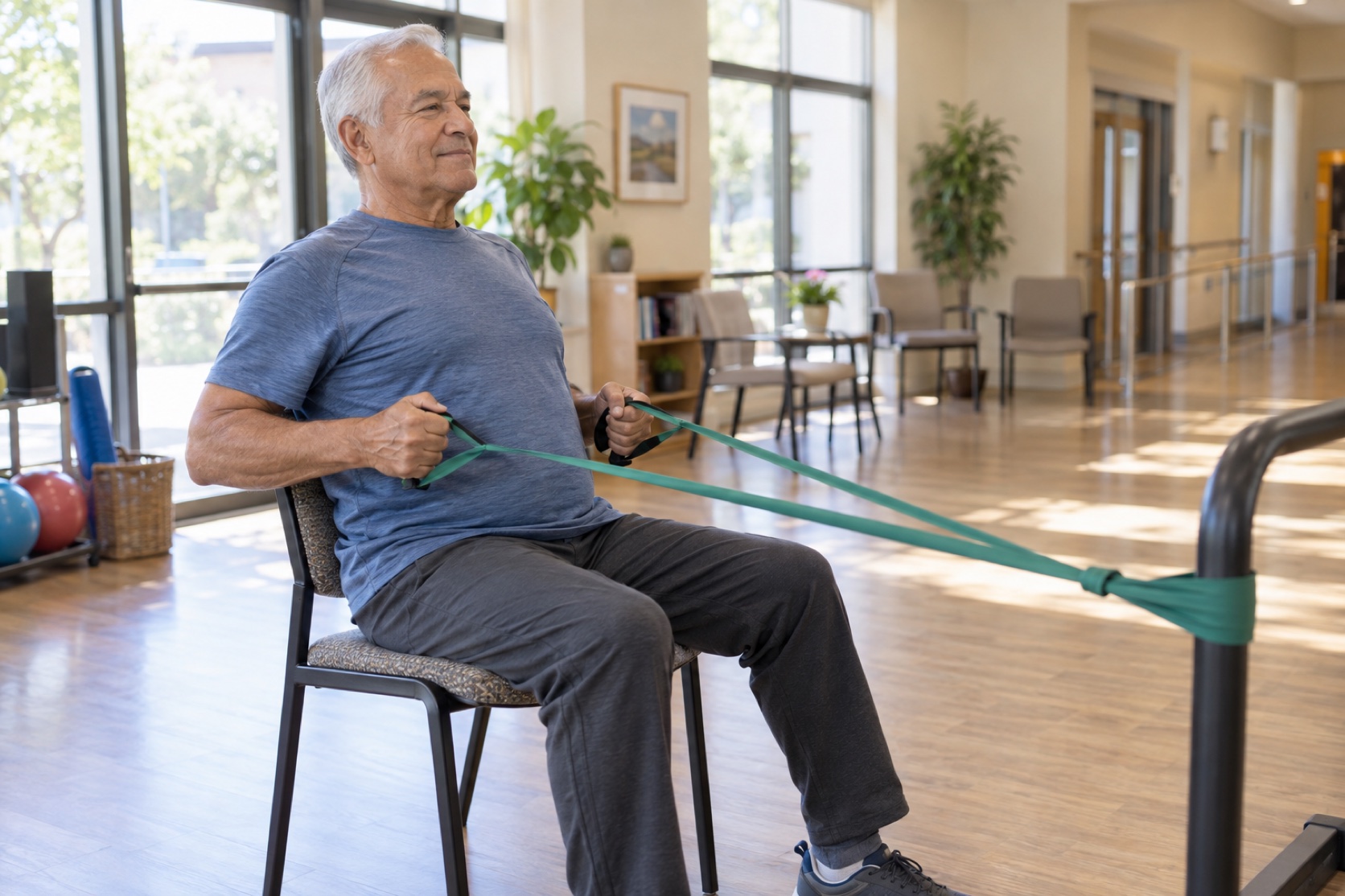
Why Quitting Is the Wrong Default
When a joint complains, the natural reaction is to rest it. Rest is useful for a day or two — and harmful as a lifestyle. Strength that took months to build begins fading within a few weeks of stopping, and the muscle you lose is the muscle that was protecting the joint in the first place.
- 💤 Detraining is fast — measurable strength loss appears within a few weeks of full rest and accelerates after that (Mujika & Padilla, Sports Medicine, 2000). The break you "need" is usually shorter than the break you take.
- 🛡️ Muscle is the joint's armor — stronger supporting muscles are associated with less pain and better function in knee osteoarthritis cohorts; the protective effect tracks strength, not rest.
- 🔁 Avoidance teaches avoidance — the longer a movement is skipped, the more threatening it can feel. Graded, pain-free return is a core rehabilitation principle for exactly this reason.
- 🧭 The question changes — from "can I train at all?" to "how do I train this week?" The modification question is almost always answerable; quitting is the one answer that teaches nothing.
None of this argues for ignoring pain — it argues for answering it with a modification instead of a pause. The rest of this page is exactly that response.
Product picks are generic categories, not brands. We may earn a commission on Amazon or iHerb purchases at no cost to you — this never changes our evidence conclusions. Full disclosure
Adjustable dumbbells
Allows progressive loading at home across common strength movements.
⚠️ Poor technique or rapid load increases raise injury risk; not required to begin moving more.
Check price on Amazon →The Three Levers: Range, Load, Tempo
Before any exercise is removed, three dials can be turned. Each one changes where and how the joint is stressed while the muscle keeps working.
- 📐 Range — train inside the pain-free arc. Depth is a skill you rebuild, not a badge of honor; a half-range squat that is clean beats a full-range squat that grinds.
- 🏋️ Load — a lighter load in the same pattern often lets the joint settle while the muscle still gets a meaningful stimulus. The load is the first thing to cut and the last thing to restore.
- ⏱️ Tempo — slower lowering and a paused bottom remove momentum and change exactly where the joint is stressed. A three-second eccentric is a different exercise than a drop.
The ranking is honest about what the trials show: tolerable, pain-free loading is the best-supported idea in this area, while mobility drills and stretching — popular and pleasant — carry thinner evidence. The levers are not a menu of equals.
The levers also combine. A knee that tolerates a half-depth squat at moderate load may complain at the same depth with more weight — so you can often keep depth and cut load, or keep load and cut depth, but rarely both at once. Pick the combination that keeps the movement clean, then hold everything else steady while it settles.
Pain Is Information, Not a Diagnosis
Soreness and pain are different signals with different jobs. Muscle soreness after training is normal, expected, and fades on its own. Joint pain during a movement is a message about that movement, at that load, on that day — and the correct first response is to listen, not to label yourself.
- 🔥 Muscle soreness — peaks 24–72 hours after unfamiliar work, feels diffuse, and settles with movement. It is a reason to plan recovery, not to stop training.
- ⚡ Joint pain — sharp, catching, or located in the joint line during a specific movement — is a signal to modify that movement: shorten the range, cut the load, slow the tempo, then reassess next session.
- ⏰ The duration rule — pain that persists across several modified sessions, or that worsens through the week rather than settling, has moved past "information" and into "worth a conversation."
- 🚨 The red-flag lane — traumatic onset, swelling after injury, numbness or tingling, weakness, radiating pain, night pain, fever, or unexplained weight loss: these are assessment questions, not modification questions. The Pain Is Information, Not a Diagnosis companion page sorts the two lanes in detail.
⚠️ Pain Is Information, Not a Diagnosis
Nothing on this page diagnoses your joint, and no modification replaces a clinician's judgment. Persistent, worsening, traumatic, neurologic (numbness, tingling, weakness, radiating), or systemic (fever, night pain, unexplained weight loss) symptoms need professional assessment. These modifications are coaching — they keep you training while the question is open.
Substitutions: Same Muscle, Different Pattern
When a specific movement is the problem, the fix is usually a different movement for the same muscle — not a rest week. The table maps common trouble spots to their usual modifications. It is a starting grid, not a prescription.
| Spot | Common pattern | Modification | Verdict |
|---|---|---|---|
| 🦵 Knee | Squat or lunge depth flares pain | Shorten range to pain-free depth, adjust stance, or switch to leg press / step-downs | Works |
| 🏋️ Shoulder | Overhead pressing pinches | Reduce the arc, use a neutral grip, or dumbbells instead of a bar | Works |
| 🖐️ Wrist | Push-ups or curls load the wrist | Push-up handles or blocks, neutral-grip dumbbell curls | Works |
| 🦶 Ankle / foot | Single-leg work wobbles or aches | Hold support, reduce range, seated calf work instead | Depends |
| 🚨 Anywhere | Sharp, catching, or neurologic pain | Stop that movement; assess before substituting | Caution |
Two rules keep substitutions honest. First, the substitute must load the same muscle group — swapping a squat for a bicep curl is a vacation, not a modification. Second, judge the substitute for two or three sessions before judging the substitution; switching weekly never gives anything a fair test. The Exercise Substitutions by Pattern companion page goes pattern by pattern. And a substitution is not a downgrade: it is the same muscle working from a friendlier angle, and it often becomes the movement you keep for good.
Resistance bands
A low-space way to begin or supplement resistance training.
⚠️ Bands can snap and unstable anchoring can cause injury; stop movements that provoke pain.
Check price on Amazon →The Return-to-Loading Ladder
The ladder is how a modified movement becomes a full movement again — a graded return that rebuilds tolerance without relighting the pain. It is the same principle rehabilitation programs use, simplified into rungs.
- 🪜 Rung 1 — the movement exists again — pain-free range, minimal load, a few crisp reps. The goal is a clean movement, not a workout.
- 🪜 Rung 2 — add sets — same light load, more volume, still pain-free throughout.
- 🪜 Rung 3 — add load — the smallest increment your equipment allows, range unchanged.
- 🪜 Rung 4 — add range — work toward the full arc one notch per session, only where it stays clean.
- 🪜 Rung 5 — normal programming — the movement rejoins the double-progression system with everything else.
The ladder rule that matters most: two clean sessions at a rung before climbing, and a return of pain drops you one rung — not to zero, and not into "guess again." The Return-to-Loading Ladder companion page turns this into a week-by-week script.
If a rung feels easy for two weeks straight, you are allowed to skip ahead one rung — the ladder accelerates as tolerance rebuilds. The direction of travel matters more than the pace.
What a Modified Week Looks Like
A modified week is the same skeleton as a normal week — two or three sessions, the same order, the same habits — with the painful patterns swapped and the loads trimmed. Consistency is the point.
- 📅 Keep the schedule — frequency is the habit. Two sessions at the usual times, even with three modified lifts, protect the routine better than one heroic session.
- 🔁 Substitute where it hurts — only the painful patterns change; the rest of the session progresses normally.
- 📉 Trim the affected loads — a modest cut (roughly 10–20%) on re-entering a previously painful movement, per the ladder, not a site-wide deload.
- 📈 Progress everything else — the squat may be waiting on rung three while your rows, carries, and hinges keep climbing. Joint-friendly training is not a pause; it is a reroute.
A useful test for the whole week: if you trained twice and no joint pain carried into the day after, the modification layer worked. If a pattern still complains on the third modified session, that movement moves down a rung or into the substitution table.
Warming Up and Cooling Down Differently
When a joint is the constraint, the warm-up does more work than the session. Five extra minutes of preparation is cheap insurance against the first painful rep — think of it as paying the joint's toll before the work begins. The toll is small; the alternative is a skipped session.
- 🔥 General warm-up first — five to ten minutes of easy whole-body movement (rowing, cycling, walking) raises tissue temperature before the joint is asked to do anything specific.
- 🪜 More ramp-up sets, lighter — where a healthy session uses two or three ramp-up sets, a joint-limited session uses four or five, each a little closer to the working load.
- 🧊 End with movement, not stillness — a few easy pain-free reps of the day's movements after training help the joint settle; static stretching has thin evidence for injury prevention and is not a required closer.
- 🌡️ The first rep rule — the first working set is still a probe: if the modified pattern hurts at the working load, the warm-up earned its keep by telling you before the second set did.
When to Involve a Clinician
Modifications are coaching, not treatment, and they have limits. Certain patterns deserve professional assessment rather than another round of lever-turning. The companion page When to Involve a Physiotherapist or Clinician goes deeper; the short list:
- 🩺 Persistent — a few weeks of honest modification without improvement; the modification layer has done its job and the question has moved on.
- 📉 Worsening — pain that spreads, intensifies across sessions, or starts waking you at night.
- 🧠 Neurologic — numbness, tingling, weakness, or pain that radiates down a limb.
- 🦴 Traumatic — a fall, twist, pop, or injury with swelling; a physiotherapist or physician should assess before you load it again.
- 🩸 Systemic — fever, unexplained weight loss, fatigue, or night sweats alongside the pain; these belong in a medical lane, not a gym lane.
A clinician visit and continued training are not opposites. Most physiotherapy for common joint pain includes exercise — often the same modified patterns on this page, prescribed to your specific findings. The Range, Tempo & Load Levers companion page is the toolkit you can bring to that conversation.
For the impact-graded version of fast work, see Landing Safely.
Questions, Answered Briefly
- ❓ Will lighter training lose my gains? — No. Pain-free lighter training maintains most of what you built; stopping loses it. The detraining evidence is unambiguous that the loss comes from rest, not from lighter work.
- ❓ Should I train through the pain? — No. Pain is information; the modification is the response. Push the pain-free boundary gently, and never grind through sharp or catching pain — that is how a manageable problem becomes a week off.
- ❓ Is switching exercises better than modifying them? — Sometimes. Try range, load, and tempo first, because the movement pattern itself is usually worth keeping; substitute when the pattern is the problem. The substitution table is where that decision lives.
- ❓ How long before a modification counts? — Two to three sessions of the same modification. Constant switching never gives any adjustment a fair test, and the ladder needs clean rungs to climb. And when a modification does work, keep it in the toolbox — many lifters keep the joint-friendly version even after the pain settles.
The Bottom Line
- Pain is information, not a diagnosis — modify the movement, don't quit the training.
- Three levers before any substitution — range, load, tempo — then the pattern swap.
- Climb the ladder, two clean sessions per rung — pain drops you one rung, never to zero.
- Red flags beat modifications — persistent, worsening, traumatic, neurologic, or systemic symptoms earn professional assessment.
Go Deeper: Joint-Friendly Strength Training: Modifications Without Quitting
These five companion pages turn the topic into smaller, testable practices.
- 🔗 Pain Is Information, Not a Diagnosis
- 🔗 The Range, Tempo & Load Levers
- 🔗 Exercise Substitutions by Pattern
- 🔗 The Return-to-Loading Ladder
- 🔗 When to Involve a Physiotherapist or Clinician
Related Topics
- Fransen M, et al. "Exercise for osteoarthritis of the knee." Cochrane Database of Systematic Reviews (2015)
- Juhl C, et al. "Impact of exercise type and dose on pain and disability in knee osteoarthritis: a systematic review and meta-regression analysis of randomized controlled trials." Arthritis & Rheumatology (2014)
- Kristensen J, Franklyn-Miller A. "Resistance training in musculoskeletal rehabilitation: a systematic review." British Journal of Sports Medicine (2012)
- Lewis JS. "Rotator cuff tendinopathy: a model for the continuum of pathology." British Journal of Sports Medicine (2009)
- Smith BE, Littlewood C, May S. "An update of stabilisation exercises for low back pain: a systematic review with meta-analysis." BMC Musculoskeletal Disorders (2014)
- van der Heijden RA, et al. "Exercise for treating patellofemoral pain syndrome." Cochrane Database of Systematic Reviews (2015)
- Mujika I, Padilla S. "Detraining: loss of training-induced physiological and performance adaptations." Sports Medicine (2000)