Exercise Substitutions by Pattern
A cranky knee does not have to mean the end of squatting. This page maps the joint-friendly variations for each of the five movement patterns — squat, hinge, push, pull, and carry — and the substitution logic that keeps the pattern alive while the joint gets what it needs.
What the evidence supports
- Exercise therapy for knee osteoarthritis works across many exercise types; the specific variation matters less than consistent loading (Fransen 2015).
- Load-modified and stance-modified variations can reduce joint stress while preserving muscle activation — the basis of the substitution approach.
- For shoulder pain, progressive loading through a pain-acceptable range helps regardless of the exact exercise chosen (Littlewood 2012).
What remains uncertain
- Head-to-head trials of specific variations for specific complaints are scarce; most guidance comes from clinical experience and biomechanics.
- Whether one variation prevents future injury better than another is not established — substitution is about tolerance, not protection magic.
Evidence last reviewed: August 20, 2026. Conclusions may change as new research is published.
The Substitution Logic
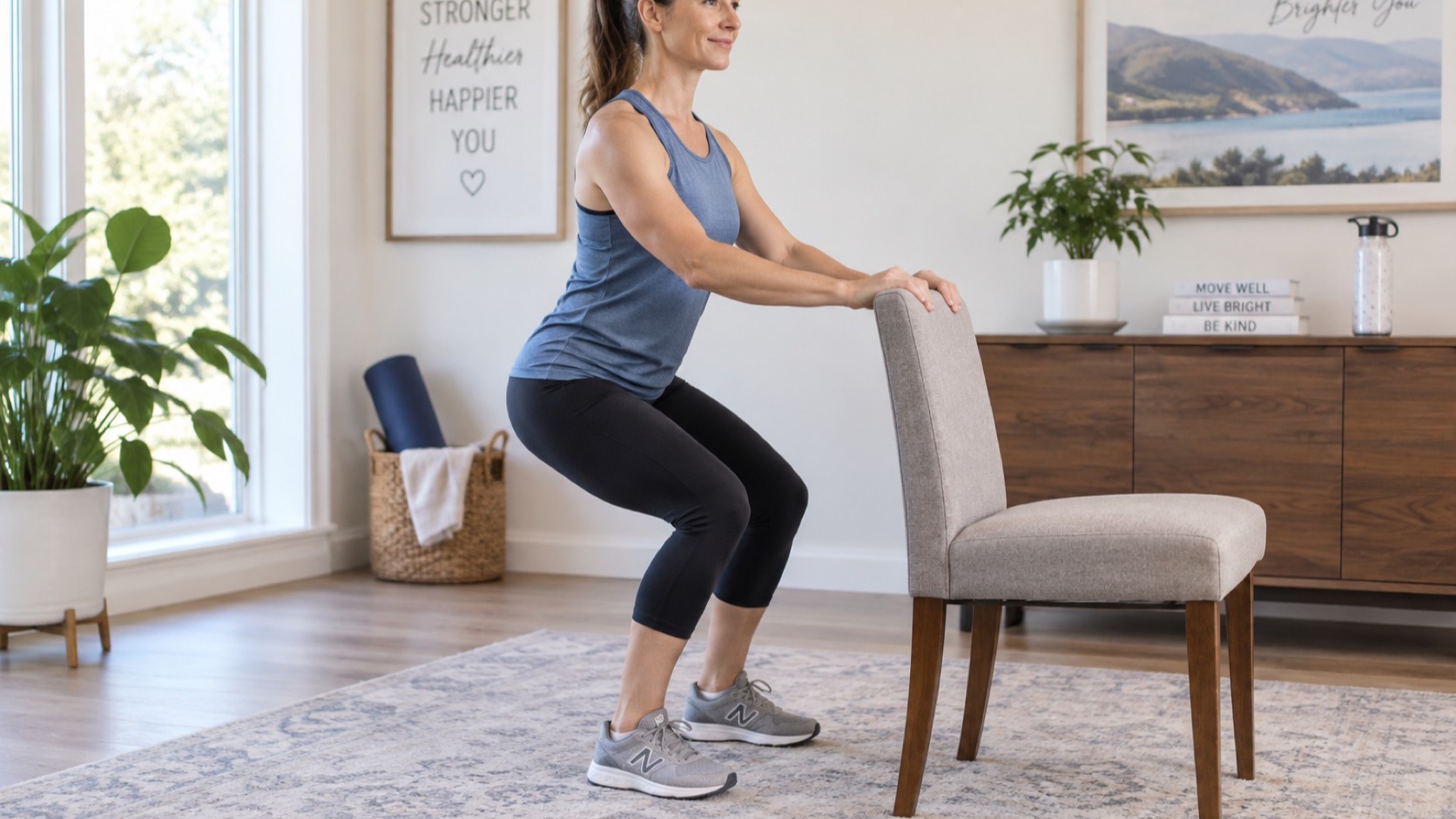
The Exercise Selection parent topic builds the program from five patterns because patterns are the verbs of training — they carry strength, skill, and joint health across decades. A substitution changes the noun: the squat becomes a goblet squat, a box squat, a split squat. The pattern survives, which means the progress does too. The rule is simple — swap the exercise, never the pattern — and the menu below is organized exactly that way.
- 🔄 Swap for tolerance, not for novelty — the substitution exists because the current variation bothers a joint, not because variety is inherently virtuous.
- 🧭 Keep the pattern's job intact — the substitute must still train the same movement and roughly the same muscles; otherwise it is a different exercise, and the session's balance shifts.
- 📏 Pair substitutions with the levers — a new variation often needs a shorter range, slower tempo, or lighter load for the first sessions; levers and substitutions work together.
- 📓 Log the swap — note the variation, the range, and how the joint felt; that record is what tells you whether the swap worked or needs another turn of the dial.
Product picks are generic categories, not brands. We may earn a commission on Amazon or iHerb purchases at no cost to you — this never changes our evidence conclusions. Full disclosure
Adjustable dumbbells
Allows progressive loading at home across common strength movements.
⚠️ Poor technique or rapid load increases raise injury risk; not required to begin moving more.
Check price on Amazon →The Five-Pattern Substitution Menu
The table below is the working menu. No variation here is declared universally best — the honest reading is that each one trades a different joint stress for a different stability demand, and the right choice depends on which joint complains (Fransen 2015; Littlewood 2012).
| Pattern | Joint-friendly variations | What it spares | Best when |
|---|---|---|---|
| 🦵 Squat | Goblet squat, box squat, split squat, leg press | Knee and low-back load; depth control | Knee pain at depth, limited ankle mobility |
| 🍑 Hinge | Trap-bar deadlift, Romanian deadlift, hip thrust, kettlebell swing | Low-back shear, hamstring strain | Back sensitivity, tight hamstrings |
| 🤸 Push | Incline push-up, dumbbell floor press, band press, landmine press | Shoulder impingement positions, wrist load | Shoulder or wrist pain at lockout |
| 🏋️ Pull | Lat pulldown, band row, chest-supported row, neutral-grip pull-up | Biceps and shoulder irritation | Elbow or shoulder pain in overhand pulling |
| 🧳 Carry | Suitcase carry, racked carry, farmer carry, offset carry | Grip and shoulder position | Shoulder fatigue in overhead carry, grip limits |
Two patterns deserve extra notes. Squats: the box squat is the classic knee-saver because it sets a fixed depth and shifts some load to the glutes and hamstrings, and the goblet position naturally limits how much you can overreach. Pushes: the floor press and incline variations remove the end-range shoulder position that provokes many shoulders — the substitution that resolves most pressing complaints without touching the pattern.
How to Read the Menu
The menu is a decision aid, not a prescription. When a joint complains, you pick the variation that removes the specific stress — then you apply the lever logic from the levers page to the new exercise. Here is the reading order:
- 🎯 Name the joint and the position — knee at depth, shoulder at lockout, wrist under load. The complaint names the variation.
- 🔁 Try the closest swap first — the smallest change that removes the stress; goblet before split squat, floor press before incline push-up.
- 📉 Start the swap lighter — a new variation is a new skill; give it 10–20% less load for the first sessions and let the log catch up.
- ⏳ Judge over three sessions — if the swapped variation is stable or improving after three sessions, it is the new working exercise; if not, move one row down the menu or escalate.
A note on why the closest swap wins: each step away from the original exercise also steps away from its specific training effect. A goblet squat still trains the squat pattern with near-identical muscle demands; a leg press trains the legs but abandons the trunk and balance demands that make the squat a squat. The smallest sufficient change keeps the pattern's training effect intact, which means the substitution preserves the very thing it is protecting — the ability to keep squatting, hinging, pressing, pulling, and carrying for years. That is the entire point of the exercise.
Kettlebell
A compact option for loaded carries, hinges, squats, and presses.
⚠️ Ballistic movements require skill; avoid using pain or instability as a training signal.
Check price on Amazon →Worked Swaps: Three Common Cases
Reading about variations is one thing; applying them is another. The three cases below are the most common substitution requests in joint-friendly training, each with the swap, the lever pairing, and the realistic timeline. Use them as templates for your own version of the same conversation with your joints.
| Case | The swap | Lever pairing | Timeline |
|---|---|---|---|
| 🦵 Knee pain at squat depth | Barbell squat → goblet squat or box squat | Shorten range to a pain-free depth; keep the load | 2–3 sessions to judge; range creeps back over weeks |
| 🤸 Shoulder pain at press lockout | Overhead press → dumbbell floor press | Slow the eccentric to 3 seconds; drop load 10% | Usually quiet by session two; rebuild lockout later |
| 🏋️ Elbow pain in pulling | Barbell row → chest-supported row | Neutral grip; pause at the top of the row | 1–2 sessions; return to free rows via the ladder |
Notice the pattern across all three: the swap removes the specific stress, the lever sets a friendly dose, and the timeline is measured in sessions, not months. That is the whole method working as designed.
Substitution Traps
Substitution fails in predictable ways, and all of them are avoidable. The four traps below account for nearly every abandoned swap:
- 🕳️ The pattern swap in disguise — replacing a squat with a leg extension changes the pattern, not the exercise; the knee may be happier but the program has lost its squat.
- ⚖️ The equal-load assumption — a box squat at the same weight as a free squat is a different dose; load the variation by its own effort, not by nostalgia.
- 🎢 The swap shuffle — changing variations every session to dodge discomfort; pick one, log it, and let the three-session judgment do its work.
- 🏃 The pain relocation — the swap moves the ache to a new joint; that is information that the pattern itself is overloaded, and the answer is the ladder, not another variation.
There is a fifth trap worth naming because it is silent: substituting for the wrong reason. If a variation is swapped because it feels harder or fancier, that is programming, not joint-friendliness — and it will not fix a joint that was never the problem. The menu exists for tolerance first and variety second. When the joint is quiet, train the original; keep the menu for the days the joint is not.
🔄 Swap the exercise, never the pattern
Substitutions are how joint-friendly training keeps its promise: the five patterns stay in the program, and the variation flexes around the joint. But a substitution is coaching, not treatment. If two or three variations in a row leave the joint worse, or if the pain spreads or worsens across sessions, the next step is assessment — see the clinician page.
Resistance bands
A low-space way to begin or supplement resistance training.
⚠️ Bands can snap and unstable anchoring can cause injury; stop movements that provoke pain.
Check price on Amazon →Questions, Answered Briefly
- ❓ Is a machine version of a pattern a substitution or a downgrade? — Machines are legitimate variations when they remove a specific stress (leg press for knee depth, chest-supported row for the back); they are substitutions, not surrenders.
- ❓ How long do I keep the substitution? — Until the joint tolerates the original again, verified over three sessions of levers; the return ladder is the path back.
- ❓ Should I substitute everything at once? — No. Change one pattern per week; changing the whole program at once makes it impossible to know what helped.
- ❓ What if no variation works? — That is the escalation signal: persistent pain across variations and levers belongs with a physiotherapist or clinician, not a longer menu.
- ❓ Can I rotate variations for fun? — Yes, once tolerance is stable; rotation is variety, and the menu becomes a library instead of a crutch.
- ❓ Should the substitution change my sets and reps? — Not automatically. The five patterns carry the same set and rep scheme whether the variation is a goblet squat or a leg press; only the load and range need the first-session adjustment, per the levers page.
- ❓ How do I know when to go back to the original exercise? — When the joint tolerates the original at the original range for three sessions in a row, climbed via the return ladder. The substitution is a detour with an exit ramp, not a permanent relocation.
The Bottom Line
- Substitutions change the exercise, never the pattern — the five patterns stay, the variation flexes.
- Name the joint and position first — the complaint picks the variation from the menu.
- Start swaps lighter and judge them over three sessions — the log decides, not the first rep.
- Persistent pain across variations is an escalation signal — coaching ends where assessment begins.
Related Topics
- Fransen M, et al., "Exercise for osteoarthritis of the knee," Cochrane Database of Systematic Reviews (2015)
- Littlewood C, et al., "Exercise for rotator cuff tendinopathy: a systematic review," Physiotherapy (2012)
- Crossley KM, et al., "2016 Patellofemoral pain consensus statement from the 4th International Patellofemoral Pain Research Retreat," British Journal of Sports Medicine (2016)
- Malliaras P, et al., "Patellar tendinopathy: clinical diagnosis, load management, and advice for challenging case presentations," Journal of Orthopaedic & Sports Physical Therapy (2015)
- Messier SP, et al., "Exercise and dietary weight loss in overweight and obese older adults with knee osteoarthritis: the Arthritis, Diet, and Activity Promotion Trial (ADAPT)," JAMA (2004)