The Loading Menu
Bone responds to a small set of stimuli, and the training options that deliver them fit into four families: resistance, impact, weight-bearing, and balance. This page lays out the menu, what each family does for the skeleton, and the progression rules that keep the whole thing safe and effective.
What the evidence supports
- Progressive resistance training produces the clearest bone-density effects at the spine and hip (Watson 2018; Martyn-St James & Carroll 2006).
- High-impact loading — jumps, hops, stomps — improves bone at loaded sites, especially when started in youth but with effects in adults too (Heinonen 1996; Kohrt 2004).
- Balance and functional exercise reduce falls substantially, which protects bone indirectly by preventing fractures (Sherrington 2017).
What remains uncertain
- Optimal doses — sets, reps, jumps per week — are inferred from trial averages, not established by dose-response studies.
- How the four families combine over years is untested; the menu is assembled from mechanism plus shorter trials.
Evidence last reviewed: August 20, 2026. Conclusions may change as new research is published.
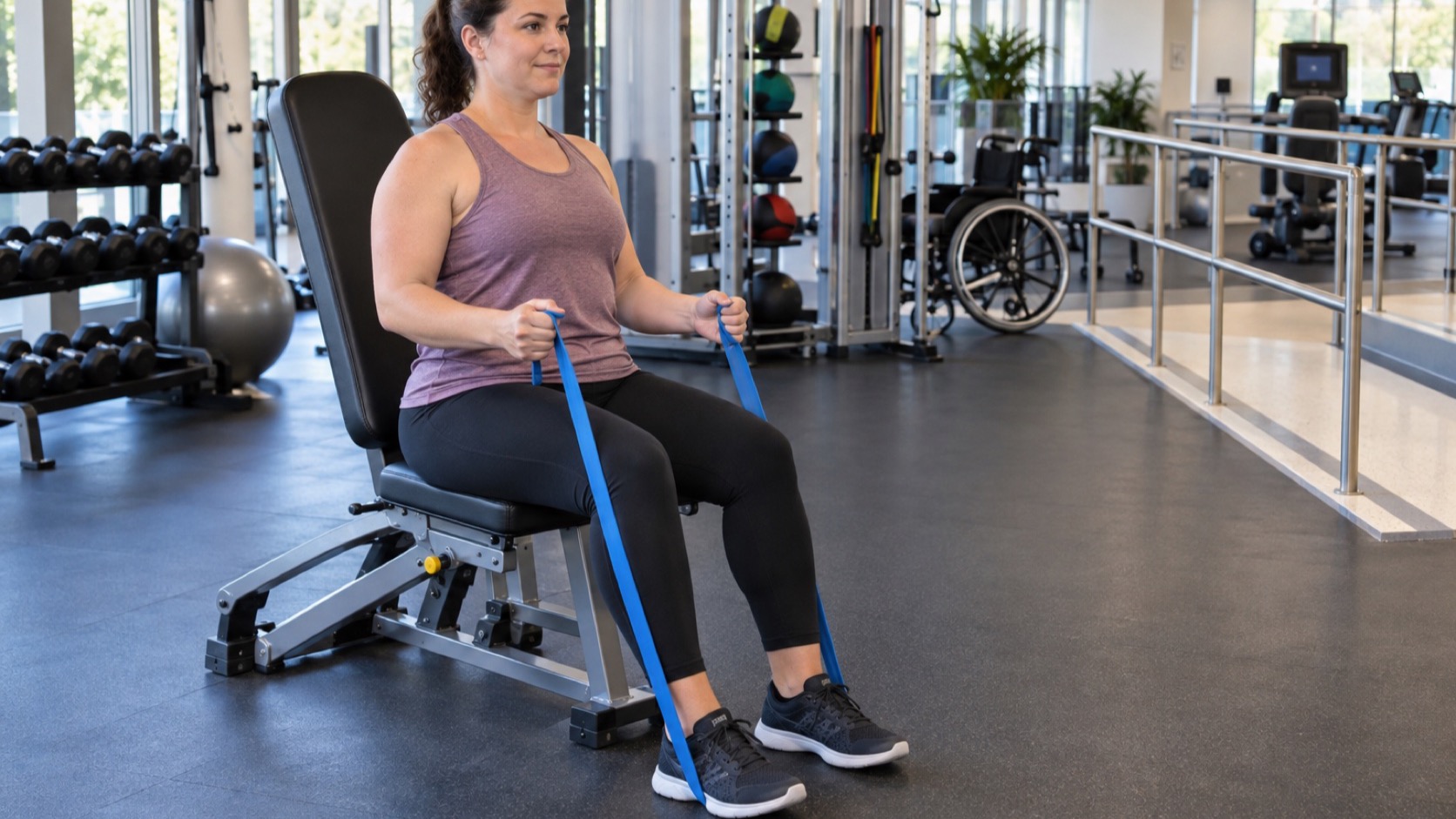
The Menu, in Four Families
Every bone-relevant activity can be sorted into one of four families, each with a distinct job. Resistance and impact are the two with the strongest direct evidence for bone density; weight-bearing is the high-frequency, low-dose foundation; balance is the fracture-avoidance layer. A complete program draws from all four — not because research proves the combination, but because each family covers something the others miss.
- 🏋️ Resistance — loaded exercises that strain the spine and hip through muscle pull and axial compression; the density workhorse.
- 🤸 Impact — jumps, hops, and stomps that deliver high-rate strain; the signal muscle work cannot replicate.
- 🚶 Weight-bearing — walking, stair climbing, hiking; low magnitude but nearly free, and it maintains what resistance builds.
- 🧘 Balance — single-leg stands, tai chi, heel-to-toe walking; does little for density directly but is the strongest lever against falls.
The strength training after 40 page makes the broader case for why this matters with age; here the focus is the bone signal itself.
Product picks are generic categories, not brands. We may earn a commission on Amazon or iHerb purchases at no cost to you — this never changes our evidence conclusions. Full disclosure
Adjustable weighted vest
May add loading to walking or simple strength movements for experienced users.
⚠️ Can aggravate joint, back, or balance problems; not appropriate for everyone and not needed for walking benefits.
Check price on Amazon →Resistance: The Muscle-Pull Family
Resistance training is the family with the deepest trial record, and the mechanism is straightforward: heavy exercises — squats, deadlifts, lunges, carries — compress the spine and pull on the hip through muscle attachments, producing the dynamic, high-magnitude strain the mechanostat reads as "build." The LIFTMOR protocol from the trial record was built entirely on this logic: five sets of five reps at over 85% of one-rep max, twice weekly, under supervision.
- 🏋️ The core lifts are the core menu — squat patterns, hinge patterns, and loaded carries pass load through the hip and spine; the five-pattern philosophy in the parent series covers the full set.
- 📈 Progressive overload is the engine — the same weight forever stops signaling the skeleton; the overload principle applies to bone exactly as it does to muscle.
- 🔄 Frequency and recovery — two to three sessions weekly with a rest day between is the pattern effective programs share; bone needs the recovery window between loading bouts.
- 🩺 Supervision when it matters — for anyone with low bone mass, the trials that showed gains were supervised; that point becomes the safety line.
Impact: The Landing Family
Impact loading is the fastest strain signal a bone can receive. The force of landing from a jump or the shock of a heel stomp arrives in milliseconds, and the mechanostat is wired to notice — high magnitude, high rate, dynamic. Studies in growing girls showed that a modest program of jumps and step aerobics improved bone mass at loaded sites (Heinonen 1996), and the ACSM position stand on bone health recommends impact exercise as a core element across the lifespan (Kohrt 2004).
- 🤸 The entry options — heel drops, marching stomps, low hops, then box step-ups and small jumps; every version is impact, and the height and force scale with ability.
- 🔢 Doses are short — the effective dose in many studies is surprisingly small: tens of impacts per session, several days a week, not hours of jumping.
- 🧊 Start soft, land soft — soft surfaces, low boxes, and controlled landings keep the rate of strain manageable while the skeleton acclimates.
- ⚠️ Impact is a progression, not a start — it belongs after basic strength and balance exist, and it is the first family to hand back to a clinician when bone disease is present.
Weight-Bearing: The Everyday Family
Weight-bearing exercise — anything done on your feet against gravity — is the background layer of the bone menu. Its forces are modest, near the maintenance range of the mechanostat, which is why it rarely produces the headline changes that heavy resistance does. But it is nearly free, safe for almost everyone, and it keeps the skeleton from drifting down between heavier sessions.
- 🚶 Brisk walking, stairs, hiking — the standard weight-bearing options; the walking page covers dose and pace.
- 🎒 Loading on top — a weighted vest or backpack converts the same walk into a higher-strain stimulus; vest weight should progress slowly.
- 🧭 Position in the menu — the baseline everyone can hold; resistance and impact are the progressive top layer.
Balance: The Fall-Insurance Family
Balance training earns its place on a bone menu for an indirect but decisive reason: fractures happen at the end of a fall. The best meta-analysis available found that exercise programs reduced the rate of falls in community-dwelling older people by about a fifth, and programs that challenged balance and ran more than three hours a week cut falls by nearly 40% (Sherrington 2017).
- 🧘 The exercises are simple — single-leg stands, heel-to-toe walking, tai chi, and dynamic balance work; the stability & mobility pillar page has the menu.
- 📊 The dose is what matters — the 39% reduction came from programs that challenged balance and totaled more than three hours weekly; thirty seconds of standing is not the same intervention.
- 🦴 The bone link is real — most hip fractures follow a fall; preventing the fall prevents the fracture.
Progression: From Entry to Load
The menu is only safe if it is ordered. Progression is the discipline that turns a list of exercises into a program — and where the safety considerations from the bone health topic get applied.
- 🪜 Step 1: establish the baseline — movement quality, basic strength, and balance before any impact; the movement quality screens are a reasonable gate.
- 🏋️ Step 2: build the resistance layer — two to three sessions weekly of progressive compound lifts; this is the spine and hip density work.
- 🤸 Step 3: add impact last — begin with low hops and stomps, then progress height and force; add vest weight only after impact feels stable.
- 🧘 Step 4: hold the balance layer — a little balance work most days, layered into warm-ups and daily life, is the fall-insurance habit.
- 🔁 Step 5: progress on a schedule — add load or impact every few weeks; plateaued programs stop signaling the skeleton, so the double progression rules apply here too.
| Family | Examples | Typical dose | Bone job | Verdict |
|---|---|---|---|---|
| 🏋️ Resistance | Squats, deadlifts, lunges, carries | 2–3 sessions/week, heavy progressive sets | Spine and hip density | Core |
| 🤸 Impact | Hops, stomps, box step-ups, small jumps | Tens of impacts, 3–5 days/week | High-rate strain signal | Strong |
| 🚶 Weight-bearing | Brisk walking, stairs, hiking, vest walks | Most days, 30+ minutes | Maintenance baseline | Support |
| 🧘 Balance | Single-leg stands, tai chi, heel-to-toe | Several minutes, most days | Fall prevention | Strong |
The dose column is deliberately approximate — trials vary, and the honest reading is "regular and progressive" rather than a precise weekly quota.
Building a Week From the Menu
Assembling the week is simple: the families layer onto the same sessions instead of demanding separate ones.
- 📅 Monday and Thursday — resistance sessions: compound lifts plus a short impact block (stomps, low hops) as a finisher.
- 📅 Wednesday and Saturday — weight-bearing days: brisk walking or stairs, with vest weight if appropriate, plus five minutes of balance work.
- 📅 Daily — balance sprinkled into life: single-leg stands while brushing teeth, heel-to-toe in the kitchen.
- 🔁 Monthly — progress one variable: more weight, higher box, heavier vest, or longer balance holds; never everything at once.
📋 The menu is a sequence, not a buffet
Order matters more than selection. Baseline strength and balance come first, resistance builds the density layer, impact is added last and slowly, and weight-bearing holds the floor between sessions. Skip the order and you trade the safety margin for a marginal dose increase — a bad trade at any age, and unacceptable with a bone diagnosis.
Questions, Answered Briefly
- ❓ Can I do impact if I have never jumped? — Yes, starting with heel drops and stomps on soft ground; impact is a progression with an entry level, not all-or-nothing.
- ❓ Is the weighted vest safe for my spine? — For most people without bone disease, gradually added vest weight is well tolerated; with a diagnosis or back issues, ask a clinician or physiotherapist first.
- ❓ Do I need all four families every week? — No — two resistance sessions plus daily walking and minutes of balance cover the essentials; impact is the optional accelerator when the baseline is solid.
- ❓ Where does the rest of the protocol fit? — The 2-day minimum frequency evidence, the 40 loading rules, and the recovery math all apply unchanged; the bone menu rides on top of a working resistance program.
The Bottom Line
- Four families cover the bone stimulus — resistance and impact carry the direct evidence; weight-bearing maintains; balance prevents the falls that cause fractures.
- Progression is the safety system — baseline, then resistance, then impact, then load; adding impact before strength and balance exist is how programs get risky.
- Small doses, done regularly, beat heroic sessions — tens of impacts a few days a week and two to three resistance sessions outproduce occasional marathons of either.
- Known bone disease changes the rules — with osteoporosis, fracture history, or related conditions, the menu gets planned with a clinician or physiotherapist, and impact may be deferred or replaced.
Related Topics
- Watson et al., "High-Intensity Resistance and Impact Training Improves Bone Mineral Density and Physical Function in Postmenopausal Women With Osteopenia and Osteoporosis: The LIFTMOR Randomized Controlled Trial," Journal of Bone and Mineral Research (2018)
- Heinonen et al., "High-impact exercise and bones of growing girls," Medicine & Science in Sports & Exercise (1996)
- Kohrt et al., "American College of Sports Medicine Position Stand: Physical activity and bone health," Medicine & Science in Sports & Exercise (2004)
- Sherrington et al., "Exercise to prevent falls in older adults: an updated systematic review and meta-analysis," British Journal of Sports Medicine (2017)
- Martyn-St James & Carroll, "Progressive high-intensity resistance training and bone mineral density changes among premenopausal women: evidence of discordant site-specific skeletal effects," Osteoporosis International (2006)