Osteoporosis, Fracture History & the Safety Line
Everything so far assumes a healthy skeleton with normal bone mass. That assumption is the line this page draws: once osteoporosis is diagnosed, or a fragility fracture has happened, the loading calculus changes. The guidance here is not optional — clinician or physiotherapist involvement is required before the menu gets programmed.
What the evidence supports
- A prior fragility fracture roughly doubles the risk of a subsequent fracture, independent of bone density (Kanis 2004).
- Supervised high-intensity resistance and impact training improved bone density and function in postmenopausal women with low bone mass, with one minor adverse event across the trial (Watson 2018).
- Vertebral fractures are strong predictors of new vertebral fractures within a year (Lindsay 2001).
What remains uncertain
- Whether high-intensity loading is appropriate for people with existing vertebral fractures is not settled by trials — most studies exclude them.
- Individual fracture risk depends on factors beyond density — fall history, medications, age — that only an assessment can integrate.
Evidence last reviewed: August 20, 2026. Conclusions may change as new research is published.
Why the Line Exists
The loading menu is built on the mechanostat's assumption: a skeleton that can tolerate strain and adapt to it. Osteoporosis breaks that assumption in two ways. The bone is less dense and structurally weakened, so the strain that would signal "build" in a healthy skeleton can instead exceed what fragile bone tolerates. And the consequence of a mistake is not a sore muscle — it is a fracture. That asymmetry is why the safety line exists, and why it sits before the program, not after it.
- 🦴 What osteoporosis is — bone mineral density at least 2.5 standard deviations below the young-adult average (a T-score of −2.5 or lower), defined by the World Health Organization; osteopenia sits between −1.0 and −2.5.
- 🩻 What a fragility fracture is — a fracture from a fall from standing height or less, the signature event that marks a skeleton as vulnerable.
- ⚠️ The line is a conversation starter — a diagnosis does not mean "no loading"; it means loading gets designed with a clinician or physiotherapist first.
The distinction matters because the rest of this page is not a prohibition — it is a redirection of how the menu gets planned.
Fracture History Changes the Arithmetic
The most important epidemiological fact on this page is simple: a prior fracture is one of the strongest predictors of another one. A landmark meta-analysis found that a history of any fragility fracture roughly doubles the risk of subsequent fracture, and the effect is independent of bone density (Kanis 2004). For vertebral fractures the pattern is sharper still — women with one vertebral fracture have about a five-fold higher risk of a new vertebral fracture within the following year (Lindsay 2001).
- 📈 The risk compounds with time — the doubling is on top of age-related decline; a history of fracture plus low density is not an addition but a multiplication of risk factors.
- 🩻 The first fracture is often the warning — for many people the first fragility fracture is the event that leads to a diagnosis; after it, the plan changes permanently.
- 🧭 Why this matters for exercise — the goal shifts from "build density" to "avoid the second fracture," and every loading decision gets weighed against that priority.
When the Guidance Is Required
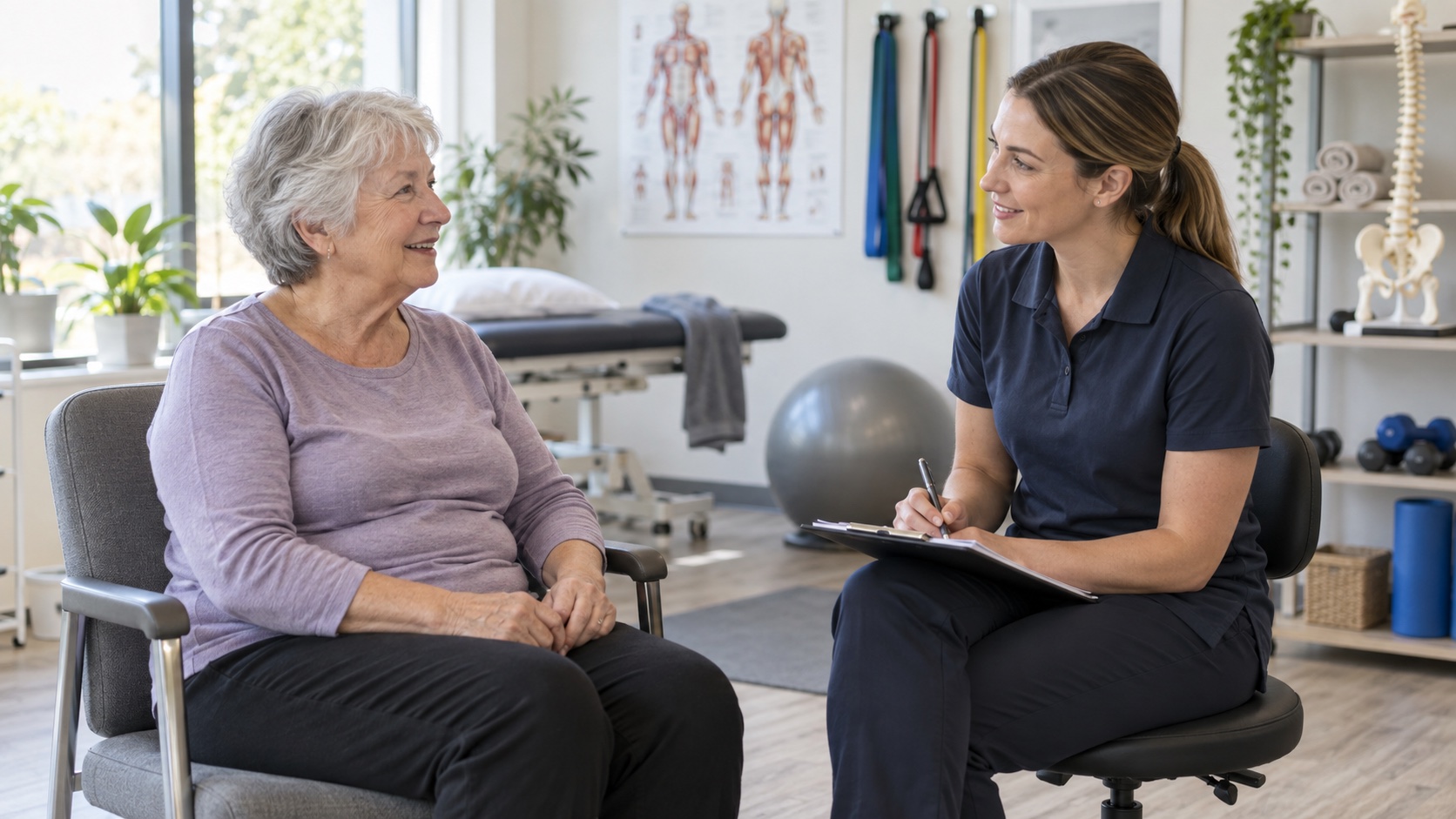
The brief is explicit, and this page repeats it because it is the safety line itself: known osteoporosis, fracture history, or bone-related conditions change the safety calculus — clinician or physiotherapist guidance is required. That is not a suggestion or a "talk to your doctor if concerned" nicety; it is the operating rule for anyone with these conditions who wants to train.
- 🩺 What a clinician brings — an assessment of fracture risk that density alone cannot capture: vertebral fracture status, fall risk, medications (glucocorticoids especially), and whether the skeleton is ready for loading.
- 🏋️ What a physiotherapist brings — the actual programming: which exercises, which loads, which progressions, and how to load without putting the spine in risky positions.
- 📋 What you bring — your history: prior fractures, recent height loss, new back pain, falls in the past year; these details change the plan more than a T-score alone.
- 🧠 The mindset shift — supervision is not a downgrade of the program; the LIFTMOR trial that produced the strongest evidence in low-bone-mass women was supervised, screened, and deliberately progressed (Watson 2018).
The Red Flags That Send You to the Line
A diagnosis is the obvious trigger, but the line is also crossed by symptoms and history that have not yet been diagnosed. These are the flags that should move loading off the menu and into an assessment:
| Situation | Why it matters | Action |
|---|---|---|
| 🦴 Diagnosed osteoporosis (T-score ≤ −2.5) | Structurally weakened bone changes what loading is safe | Clinician first |
| 🩻 Any prior fragility fracture | Roughly doubles subsequent fracture risk (Kanis 2004) | Clinician first |
| 📏 Height loss of 4+ cm or new kyphosis | May indicate silent vertebral fractures | Assessment first |
| 💊 Long-term glucocorticoid use | Medication-driven bone loss with its own risk profile | Clinician first |
| 🤕 New or unexplained back pain | Can signal a vertebral fracture that changes the plan | Assessment first |
| 🧍 Balance problems or recent falls | Fall risk is a fracture risk in a fragile skeleton | Physio first |
None of these rows means "never train." Every one of them means "get the plan built with guidance before loading," which is a different and more useful instruction.
What Supervised Loading Can Look Like
The evidence does not stop at a diagnosis — it redirects the program. The strongest trial in low-bone-mass women, LIFTMOR, deliberately loaded the spine and hip with high-intensity work and produced density gains with one minor adverse event in the training group (Watson 2018). The key words are the ones that made it safe: screened participants, supervised sessions, taught technique, and progression managed by professionals.
- 🏋️ Loading can include the spine — with rules — spine loading in osteoporosis is a professional decision about positions, loads, and progression; it is not a blanket ban and not a free-for-all.
- 🧘 Balance work stays on the menu — fall prevention is the highest-value intervention after a fracture history; the stability & mobility pillar has the safest entry points.
- 🔄 Progression is slower and more conservative — smaller increments, more checks, and impact deferred until the professional signs off; the 40 loading rules get tighter, not abandoned.
- 🩺 The plan includes more than exercise — medication review, calcium and vitamin D status, and fall-risk reduction are typically part of the same conversation; the long-term plan covers the full picture.
🩺 The safety line is a conversation, not a wall
Too often this page gets read as "don't train." The actual message is narrower and more useful: with osteoporosis, fracture history, or bone-related conditions, the loading menu is planned with a clinician or physiotherapist, not improvised. The trials show supervised loading can be safe and effective in low-bone-mass populations — that is the conversation the line exists to start.
Principles Are Not Promises
The final note on this page is a boundary. Everything in this series describes loading principles — the mechanostat, the menu, the trial averages. Principles are not guarantees. A supervised program may improve density, hold it steady, or simply keep you strong and stable; individual response varies, and no exercise plan promises a scan outcome. The truthful framing, for everyone and especially across the safety line, is that loading is one contributor to bone health among genetics, nutrition, medications, and fall risk — not a deterministic fix.
- 📉 Outcomes vary person to person — group averages in trials hide wide individual variation; the same program can produce a gain, a plateau, or a loss in different people.
- 🧬 Density is not destiny — bone strength also depends on structure and quality that DXA does not capture; a stable scan with strong function may be a good outcome.
- 🩺 The professional is the translator — a clinician or physiotherapist turns these principles into an individual plan and reads the results against your specific risk profile.
Questions, Answered Briefly
- ❓ Does osteoporosis mean I cannot lift weights? — It means the weights get chosen with a clinician or physiotherapist; supervised high-intensity programs have been tested in low-bone-mass women and produced gains (Watson 2018), but only under those conditions.
- ❓ I had a wrist fracture years ago — does that count? — A fragility fracture at any site raises subsequent fracture risk (Kanis 2004); a clinician can judge whether the original event was fragility-related and what it means for your plan.
- ❓ Can I start with walking while I wait for an assessment? — Gentle weight-bearing and balance work are reasonable interim steps for most people, but with a recent vertebral fracture or unexplained back pain, even those should wait for guidance.
- ❓ What questions should I bring to the clinician? — Whether loading is safe for your specific skeleton, which positions to avoid, what loads to start at, and how to progress — plus a request for a physiotherapist referral if one is not already involved.
The Bottom Line
- Osteoporosis, fracture history, or bone-related conditions change the safety calculus — clinician or physiotherapist guidance is required before loading, not recommended after the fact.
- A prior fragility fracture roughly doubles subsequent fracture risk (Kanis 2004), and vertebral fractures raise it further — the first fracture is a warning, not an isolated event.
- Supervised loading can be safe and effective in low-bone-mass populations — the LIFTMOR trial is the proof of concept, with screening and supervision as the conditions of that safety.
- Loading principles are not promises of outcomes — the menu, the progression, and the trial averages describe what tends to happen, not what will happen for you.
Related Topics
- Kanis et al., "A meta-analysis of previous fracture and subsequent fracture risk," Bone (2004)
- Lindsay et al., "Risk of new vertebral fracture in the year following a fracture," Journal of the American Medical Association (2001)
- Watson et al., "High-Intensity Resistance and Impact Training Improves Bone Mineral Density and Physical Function in Postmenopausal Women With Osteopenia and Osteoporosis: The LIFTMOR Randomized Controlled Trial," Journal of Bone and Mineral Research (2018)
- Cosman et al., "Clinician's Guide to Prevention and Treatment of Osteoporosis," Osteoporosis International (2014)
- World Health Organization, "Assessment of fracture risk and its application to screening for postmenopausal osteoporosis" (1994)