Bone Health & Resistance Training
The skeleton is the quietest tissue in the body — it does not ache as it weakens, and it changes on a scale of months, not weeks. This page is the loading case: what exercise can and cannot do for bone, and how to load the skeleton without loading it into danger.
What the evidence supports
- Loading is one of the few inputs the skeleton demonstrably responds to — strain magnitude, rate, and novelty all shape bone adaptation (Rubin & Lanyon 1985; Turner 1998).
- A landmark supervised trial of high-intensity resistance plus impact improved lumbar-spine density in postmenopausal women with low bone mass (Watson 2018, LIFTMOR).
- Exercise reduces fall rates by about a fifth overall, and balance-challenging programs by roughly 40% — the fall, not the bone, is often the event that breaks (Sherrington 2017).
What remains uncertain
- Effects at the hip are smaller and slower than at the spine, and some sites barely respond — no exercise reliably moves every bone.
- Trials rarely run long enough to show fracture reduction directly; density change is the proxy, and a noisy one.
- Whether any specific dose is meaningfully better than another — sets, reps, loading frequency — is still largely unresolved.
Evidence last reviewed: August 20, 2026. Conclusions may change as new research is published.
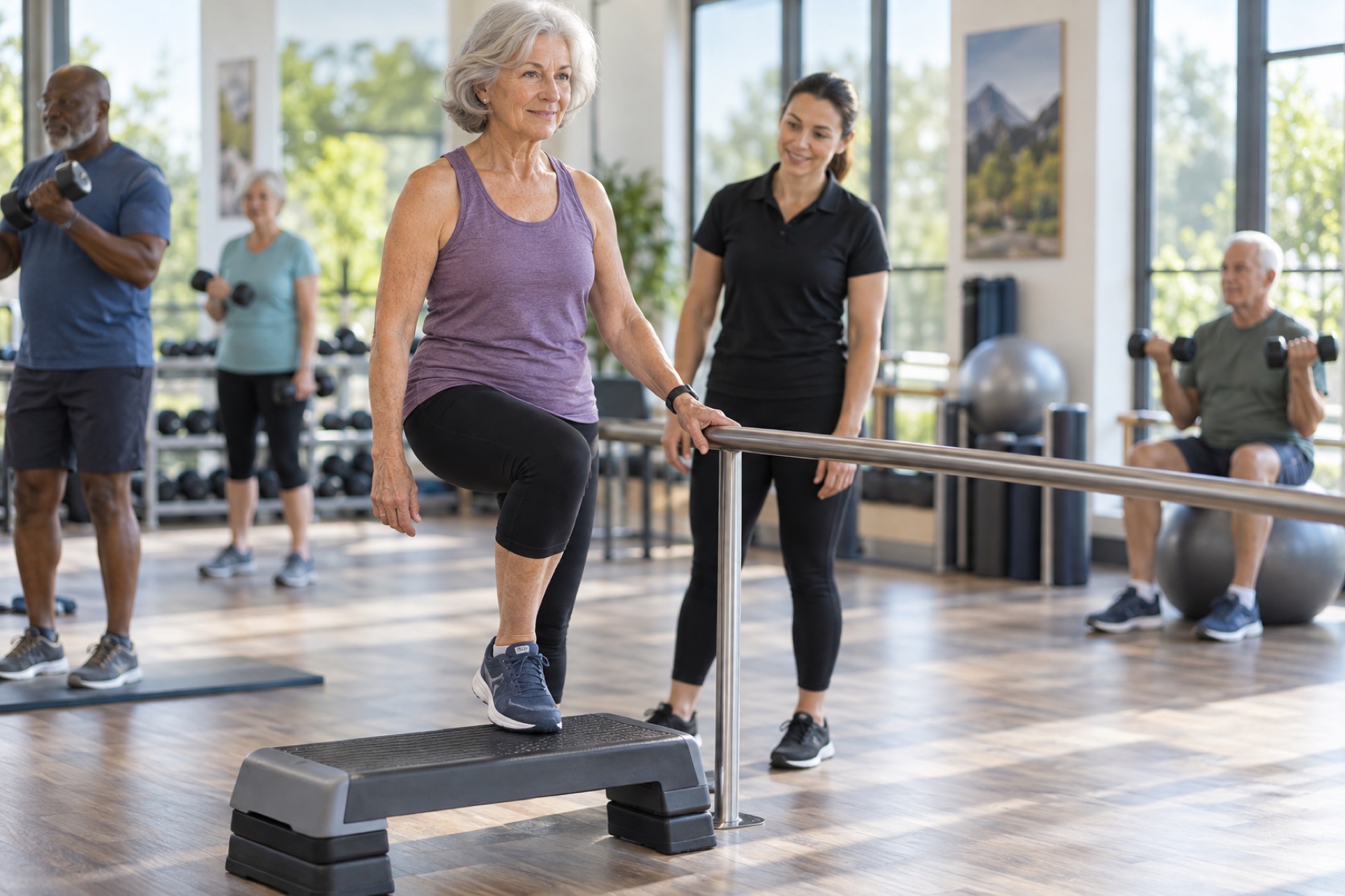
Why Bone Needs Loading
Bone is one of the few tissues in the body that gets stronger when it is physically demanded of, and weaker when it is not. The mechanostat — Harold Frost's 1987 framing — describes a thermostat-like system: strain above a set point nudges bone formation, strain below it nudges resorption (Frost 1987). Bed rest and spaceflight make the point brutally: unload the skeleton and it sheds mass on a measurable schedule.
- 🦴 The strain window — classic loading studies associated the adaptive response with roughly 1,000–3,000 microstrain; below that range, resorption dominates (Rubin & Lanyon 1985). Everyday walking sits under the adaptive threshold.
- ⏳ The slow clock — one bone remodeling cycle runs 3–6 months. The skeleton's answer to a new training stimulus arrives on that schedule, not next week's.
- 📉 The midlife math — bone mass peaks around age 30, then declines; loss accelerates after menopause and with age. Loading in midlife is a preservation-and-possibly-gain strategy, not a repair.
The practical consequence: the skeleton rewards the same habits that build muscle — progressive overload — but it judges them on a much slower ledger.
How Bone Decides to Adapt
Not all loading is equal in bone's eyes. Charles Turner's three rules, drawn from decades of animal loading studies, still organize the field (Turner 1998):
- ⚡ Dynamic beats static — bone responds to changing strain, not held strain. A squat's loading and unloading cycle signals far more than standing under a load would.
- 📏 Magnitude matters — within limits, bigger strains produce bigger responses. This is the case for heavy resistance and for impact, and the reason walking alone underwhelms.
- 🎲 Novelty counts — the same stimulus, repeated forever, stops registering. Rotating exercises and progressions keeps the skeleton paying attention.
- 🔁 Bout separation — loading split into shorter bouts with rest between them appears to signal more than one long session; animal work found this pattern enhanced bone formation (Robling 2001).
Product picks are generic categories, not brands. We may earn a commission on Amazon or iHerb purchases at no cost to you — this never changes our evidence conclusions. Full disclosure
Adjustable dumbbells
Allows progressive loading at home across common strength movements.
⚠️ Poor technique or rapid load increases raise injury risk; not required to begin moving more.
Check price on Amazon →What the Trials Actually Show
The strongest single study in the exercise-and-bone literature is LIFTMOR: 101 postmenopausal women with osteopenia or osteoporosis trained twice weekly for eight months, either supervised high-intensity resistance plus impact (five sets of five at over 85% of one-rep max) or a low-intensity home program (Watson 2018). The high-intensity group gained 2.9% at the lumbar spine while controls lost 1.2%; the femoral neck held nearly steady (+0.3%) while controls lost 1.9%. One minor adverse event — a back spasm — was reported.
- 📈 The spine moved — lumbar spine was the responsive site; a 2.9% gain reverses a year or more of expected postmenopausal loss, in women already below normal density.
- 🩺 Safety was tracked, not assumed — the program was supervised, screened, and deliberately progressed; that design is part of the result, not a footnote.
- 🧭 Site-specificity is the rule — reviews find spine responds to axial loading while hip effects are smaller and slower, and upper-extremity sites barely move (Martyn-St James & Carroll 2006; Howe 2011). Men show small but measurable benefits too (Kelley 2000).
The Loading Menu
The practical menu has four families, each loading bone differently — and they combine better than they compete. The dose framing comes from the ACSM position stand: impact on most days plus resistance on 2–3 days per week is the general pattern associated with bone health (Kohrt 2004).
| Exercise family | How it loads bone | Evidence note |
|---|---|---|
| 🏋️ Heavy resistance (squats, deadlifts, overhead press) | Axial compression of spine and hip, high strain magnitude | Strongest trial support |
| 🦘 Impact (jumps, hops, skipping, stair bounds) | High-rate ground-reaction force, novelty signal | Combined with resistance in LIFTMOR |
| 🏃 Jogging and brisk walking | Moderate ground-reaction force, roughly 1.6–3× body weight | Walking alone appears insufficient |
| 🧍 Balance and falls work (single-leg stands, tai chi) | Minimal direct loading — prevents the fall, not the loss | Falls evidence is strong (Sherrington 2017) |
| 🤲 Weight-bearing through hands (planks, carries) | Loads wrist and forearm sites | Plausible local mechanism, limited trials |
Ground-reaction forces are approximate multiples of body weight across the biomechanics literature: walking ≈1.2, brisk walking ≈1.6, jogging ≈2.5, running ≈3.0, jump landing ≈4.5. The jump is the biggest signal the skeleton can get without a barbell — and the one that demands the most careful progression. The loading menu subtopic turns this table into a buildable routine.
Loading Rules That Protect the Spine
The same strain that builds bone can injure it when the spine is asked to bend and bear at once. The rules are simple, and they are the difference between loading and overloading.
- 🪜 Progress like everything else on this site — start light, add load in the smallest steps, and follow the double-progression pattern; the skeleton wants the same graduated asking as the muscle.
- 🧍 Keep the spine neutral under load — avoid end-range spinal flexion while lifting; the exercise selection page owns the movement-quality layer.
- 🚩 Sharp pain is a stop sign — joint pain or new back pain means stop that movement today, not the program; swap in a pain-free pattern. Pain that persists is a clinician question.
- 😴 Let the remodeling happen — loading sessions need recovery like muscle does; 48 hours between hard sessions for the same region is a sensible default.
Osteoporosis, Fracture History & the Safety Line
Everything above assumes an uncomplicated skeleton. That assumption is the line: known osteoporosis, fracture history, or bone-related conditions change the safety calculus — clinician or physiotherapist guidance is required. The epidemiology explains why the line exists: a prior fragility fracture roughly doubles the risk of another, independent of density (Kanis 2004), and a first vertebral fracture raises the risk of a new one within the following year about five-fold (Lindsay 2001).
| Situation | Why it matters | Action |
|---|---|---|
| 🦴 Diagnosed osteoporosis (T-score ≤ −2.5) | Structurally weakened bone changes what loading is safe | Clinician first |
| 🩻 Any prior fragility fracture | Roughly doubles subsequent fracture risk (Kanis 2004) | Clinician first |
| 📏 Height loss of 4+ cm or new kyphosis | May indicate silent vertebral fractures | Assessment first |
| 💊 Long-term glucocorticoid use | Medication-driven bone loss with its own risk profile | Clinician first |
| 🤕 New or unexplained back pain | Can signal a vertebral fracture that changes the plan | Assessment first |
| 🧍 Balance problems or recent falls | Fall risk is a fracture risk in a fragile skeleton | Physio first |
None of these rows means "never train." Every one means "build the plan with guidance before loading" — the LIFTMOR trial's strongest evidence came from supervised, screened women with diagnosed low bone mass. The safety-line subtopic goes deeper into what that supervision looks like.
Falls: The Other Half of the Equation
Density gets the headlines, but most hip fractures follow a fall. A systematic review of 88 trials with nearly 20,000 community-dwelling older adults found exercise cut fall rates by about a fifth — and programs that challenged balance and ran more than three hours weekly cut them by nearly 40% (Sherrington 2017).
- 🧘 The exercises are cheap — single-leg stands, heel-to-toe walking, tai chi; the stability & mobility pillar page has the menu.
- 📊 The dose is the point — the 39% figure came from programs that challenged balance and totaled three-plus hours weekly; thirty seconds of standing is not the same intervention.
- 🦴 The bone link is direct — a skeleton you load, on legs that do not fall, is the whole program; each half protects the other.
The Decade-Long Plan
Bone work is measured in years, and the plan should be built to survive them. Density trends are read across scans, not snapshots — DXA re-test cadence is commonly about every two years, and screening typically begins at 65 for women unless risk factors push it earlier (Cosman 2014).
- 🏋️ Train the loading, keep it boring — two or three resistance sessions plus impact most weeks, progressed on the double-progression rules; novelty in exercise selection, consistency in the habit.
- 🥩 Feed the bricks — protein at the 1.2–1.6 g/kg working target, calcium 1,000–1,200 mg daily (the higher end for women 51+ and men 71+), vitamin D 600–800 IU; food first, and a D-status check via a clinician if unsure (Weaver 2016).
- 📅 Expect the schedule — first detectable spine changes around six months, hip changes on a 12–24-month horizon; a flat first-year scan is data, not failure.
- 🔄 Re-screen on the clinical rhythm — DXA every couple of years, with the results steering the plan; the long-term plan subtopic owns the full decade view.
⚠️ The safety line
Known osteoporosis, fracture history, or bone-related conditions change the safety calculus — clinician or physiotherapist guidance is required before loading. That sentence is not a disclaimer; it is the difference between a program that strengthens bone and one that risks it. Loading principles are not promises of outcomes.
Questions, Answered Briefly
- ❓ Can I build bone with bodyweight alone? — Partly. Bodyweight squats and push-ups load the skeleton, and jumps add impact, but the strain-magnitude rule favors progressive resistance for the spine and hip; the two combine better than either alone.
- ❓ Do I need to jump if I have knee problems? — No. Resistance work plus balance training covers most of the benefit without impact; joint limitations are clinician territory before any loading program.
- ❓ Will lifting make my bones denser? — The honest answer: loading is associated with gains at loaded sites in trials, and nobody can promise what your DXA will show. Density is judged on trends across scans, and the years between them are where the work happens.
- ❓ Is walking enough? — For density, likely not: walking's ground-reaction force sits near or below the adaptive range. Walking is excellent for everything else; bone wants the heavier and the faster ends of the menu.
This Page in One Workflow
- Screen — before the first loaded rep: any red flag from the table, any fracture history, any bone-related condition? That decides whether the plan starts with a clinician or with a barbell.
- Load — two or three resistance sessions weekly, spine neutral, progressed on double progression; add impact (jumps, hops) as the entry level allows.
- Balance — a few minutes of single-leg and dynamic balance work most days; the falls data earn their place in the plan.
- Feed — protein at the 1.2–1.6 g/kg target, calcium and vitamin D covered from food where possible.
- Re-measure — DXA on the clinical rhythm, roughly every two years; judge the trend, not the snapshot.
Run the loop for a year before judging it — the skeleton answers on a remodeling clock, and the first scan after you start is often the baseline that later scans beat.
The Bottom Line
- Loading shapes bone — strain magnitude, rate, and novelty are the levers the skeleton responds to; dynamic, novel, progressive efforts beat long steady sessions.
- The trial record is real but modest — supervised heavy resistance plus impact was associated with spine gains in low-bone-mass women; hip effects are smaller and slower.
- The safety line is absolute — osteoporosis, fracture history, or bone-related conditions require clinician or physiotherapist guidance before loading.
- Loading principles are not promises of outcomes — density changes are measured in single digits over months, and DXA reads trends across scans, not snapshots.
Go Deeper: Bone Health & Resistance Training
These five companion pages turn the topic into smaller, testable practices.
- 🔗 Bone Responds to Loading
- 🔗 What Trials Show for Bone Density
- 🔗 The Loading Menu
- 🔗 Osteoporosis, Fracture History & the Safety Line
- 🔗 The Long-Term Bone Plan
Related Topics
- Watson SL, et al. "High-Intensity Resistance and Impact Training Improves BMD and Physical Function in Postmenopausal Women With Osteopenia and Osteoporosis: The LIFTMOR Randomized Controlled Trial." Journal of Bone and Mineral Research (2018)
- Sherrington C, et al. "Exercise to prevent falls in older adults: an updated systematic review and meta-analysis." British Journal of Sports Medicine (2017)
- Kanis JA, et al. "A meta-analysis of previous fracture and subsequent fracture risk." Bone (2004)
- Lindsay R, et al. "Risk of new vertebral fracture in the year following a fracture." JAMA (2001)
- Rubin CT, Lanyon LE. "Regulation of bone mass by mechanical strain magnitude." Calcified Tissue International (1985)
- Turner CH. "Three rules for bone adaptation to mechanical stimuli." Bone (1998)
- Kohrt WM, et al. "Physical activity and bone health." Medicine & Science in Sports & Exercise (2004)
- Howe TE, et al. "Exercise for preventing and treating osteoporosis in postmenopausal women." Cochrane Database of Systematic Reviews (2011)
- Frost HM. "Bone mass and the mechanostat: a proposal." Anatomical Record (1987)