The Mediterranean Diet Decoded
Most diets rise and fall with the news cycle. The Mediterranean pattern is different — it's backed by the strongest evidence base in nutrition science, including a major randomized trial. But "Mediterranean" has become a marketing word, so let's decode what the actual pattern is, what it does, and how to eat it on a Tuesday night.
What the evidence supports
- PREDIMED, a large randomized trial, found ~30% lower risk of major cardiovascular events on a Mediterranean pattern (with olive oil or nuts) versus a low-fat control.
- Observational cohorts consistently link the pattern with lower all-cause mortality, CVD, and diabetes.
- Adherence correlates with better cognitive aging in multiple cohorts (MIND-style variants).
What remains uncertain
- Which components drive the benefit (olive oil? fish? total pattern?) is hard to isolate.
- Benefits are relative to the comparison diet — a typical Western diet in most studies.
- PREDIMED had documented randomization problems and was retracted and re-analyzed; conclusions survived but the episode is a useful caution.
Evidence last reviewed: August 13, 2026. Conclusions may change as new research is published.
What It Actually Is
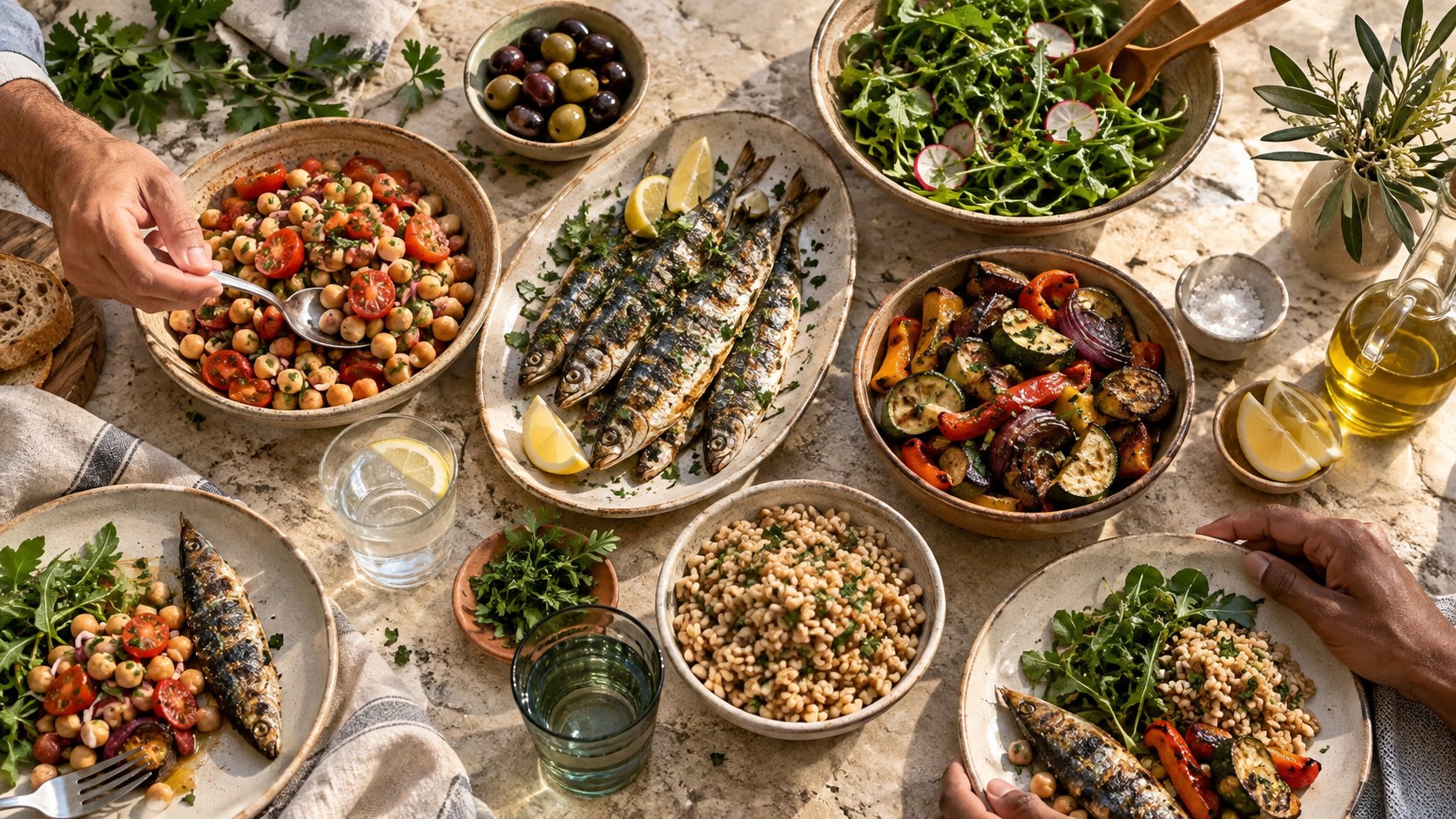
The Mediterranean diet is a dietary pattern, not a set of foods — which is exactly why it works in practice: there's no forbidden list, only proportions. The pyramid in one paragraph: daily and generous — vegetables, fruit, legumes, whole grains, nuts, seeds, and extra-virgin olive oil as the principal fat; weekly and regular — fish and seafood several times, poultry, eggs, and dairy in moderation; occasional — red meat and sweets as guests, not residents. Water as the default drink, wine optional and moderate (with a serious caveat we'll get to). The pattern descends from the traditional diets of Crete and southern Italy in the mid-20th century, before processed food arrived.
| Frequency | Foods |
|---|---|
| 🍽️ Every meal | Vegetables, fruit, legumes, whole grains, olive oil, herbs & spices |
| 🐟 Weekly, several times | Fish and seafood; nuts and seeds |
| 🥛 Weekly, moderate | Poultry, eggs, cheese and yogurt |
| 🎉 Occasionally | Red meat, processed meat, sweets, sugary drinks |
Product picks are generic categories, not brands. We may earn a commission on Amazon or iHerb purchases at no cost to you — this never changes our evidence conclusions. Full disclosure
Canned oily fish
A shelf-stable fish option where an article explicitly teaches sardines, mackerel, or similar fish as food-first pattern ingredients.
⚠️ Sodium, bones, allergy, and species-specific mercury guidance matter; vary seafood choices when advised, especially in pregnancy.
Check price on Amazon →The Evidence: More Than Association
Most diet claims rest on observation — but the Mediterranean pattern has something rarer: randomized trial data. PREDIMED enrolled ~7,400 Spanish adults at high cardiovascular risk and assigned them to a Mediterranean diet supplemented with extra-virgin olive oil, a Mediterranean diet supplemented with nuts, or a low-fat control diet. The result: ~30% lower risk of major cardiovascular events (heart attack, stroke, cardiovascular death) in both Mediterranean arms, with the effect emerging within about five years. The study later had to be retracted over randomization irregularities, then re-analyzed and republished with the conclusions essentially unchanged — a useful reminder that even landmark nutrition science deserves skepticism, and that the Mediterranean pattern's support doesn't rest on any single study anyway: dozens of cohorts, from the original Seven Countries Study onward, point the same direction.
Why It Works: Not One Magic Ingredient
The pattern's power comes from stacking multiple mechanisms — none of them dramatic alone:
Monounsaturated fat & polyphenols
Olive oil's MUFA profile improves lipid ratios while polyphenols (oleocanthal and friends) blunt inflammation and oxidation.
Fiber, everywhere
Legumes, vegetables, and whole grains push fiber well past the 25–30g threshold — feeding the gut microbiome (see the fiber topic).
Marine omega-3s
Weekly fish supplies EPA and DHA, associated with lower cardiovascular risk in this dietary context.
What it displaces
Half the benefit is subtraction: less red and processed meat, less added sugar, fewer ultra-processed calories.
The Wine Question, Answered Honestly
The traditional pattern includes wine with meals, and observational studies once suggested a J-shaped curve of benefit. The modern evidence has soured on this: more rigorous analyses (including mendelian randomization and large cohorts) find no level of alcohol is protective for overall mortality, and any cardiovascular benefit is outweighed by cancer and other risks. The current consensus: if you don't drink, don't start for your heart; if you do drink, the Mediterranean context (small amounts with food, not bingeing) is the least harmful pattern — and zero remains the health-maximizing dose. The diet works perfectly well without the wine; treat it as optional culture, not nutrition.
Eating It on a Tuesday: Practical Translation
- Make olive oil the default fat. Cooking, dressing, finishing — extra-virgin for everything but high-heat frying.
- Beans before beef. Two to three legume-based dinners weekly — lentils, chickpeas, white beans — displace red meat automatically.
- Fish twice a week. Canned sardines and mackerel count — they're cheap, shelf-stable, and exactly on-pattern.
- Vegetables are the main event. Half the plate, at least two meals a day, cooked simply with olive oil and garlic.
- Nuts as the default snack. A small handful daily — the PREDIMED nut arm used ~30g/day.
- Fruit for dessert. The traditional pattern ends meals with fruit — sweetness without the sugar spike (see the sugar topic).
🧾 The 80/20 reality
Adherence studies show the benefits track consistency over perfection. The pattern tolerated in real life — olive oil daily, legumes weekly, occasional restaurant steak — outperforms the perfect pattern abandoned in February. Score yourself on the week, not the meal.
Frozen vegetables and spinach
A practical frozen-produce option where an article specifically teaches it as a food-pattern convenience.
⚠️ Check for added sauces or sodium and maintain frozen-food handling; individual dietary needs vary.
Grocery item — availability varies by region.
Check price on Amazon →A Week on the Pattern: The Rotation
| Day | Protein anchor | Notes |
|---|---|---|
| 🫘 Monday | Lentil soup or stew | Legume day #1 — the workhorse of the pattern |
| 🐟 Tuesday | Oily fish (salmon, sardines) | Fish day #1 — omega-3s on schedule |
| 🍗 Wednesday | Chicken or turkey | Poultry in moderation, vegetables as the main event |
| 🫘 Thursday | Chickpeas (curry, salad, roast) | Legume day #2 |
| 🐠 Friday | White fish or shellfish | Fish day #2 |
| 🥚 Saturday | Eggs or dairy-forward meal | Weekend frittata — the traditional pattern's breakfast |
| 🥩 Sunday | Red meat, if at all | The "occasional" slot — quality cut, small portion |
The rotation does the adherence work for you: two legume days, two fish days, poultry and eggs in between, and red meat demoted from default to occasion. Once the weekly skeleton is in place, the daily decisions mostly make themselves.
Does It Work for Weight Loss?
The Mediterranean pattern wasn't designed as a weight-loss diet, and it isn't magic for it — but it outperforms most diets anyway for an unglamorous reason: it's sustainable. Trials like DIRECT find Mediterranean-style diets produce weight loss comparable to low-fat and low-carb approaches at 6–12 months, with an edge in staying adhered to, because nothing is forbidden and the food is genuinely good. Weight loss still requires a calorie deficit — the pattern just makes the deficit easier to hold, by replacing ultra-processed foods with high-volume, high-satiety whole foods. The honest framing: if weight loss is your primary goal, the Mediterranean pattern is an excellent vehicle for it, not a replacement for the deficit itself.
Cognitive Benefits: Enter the MIND Diet
A variant called the MIND diet — Mediterranean + DASH, with emphasis on berries, leafy greens, and nuts — was designed specifically for brain aging. Cohort studies have associated higher MIND adherence with slower cognitive decline and lower Alzheimer's risk, and a 2023 randomized trial found small but real cognitive benefits over three years, particularly in those who'd been eating poorly. The evidence is younger and less airtight than the cardiovascular data, but the mechanism case is coherent: vascular health, polyphenols, and omega-3s all support the brain. For longevity purposes, the MIND variant is a reasonable upgrade to the same pattern — add berries and leafy greens to the daily list and you're most of the way there.
The Budget Version
The Mediterranean diet has a reputation for expense that's mostly a branding problem. The actual pattern is built on historically poor-people food: dried beans and lentils (the cheapest protein per gram in the supermarket), canned sardines and mackerel (shelf-stable fish, no price premium), frozen vegetables and spinach (frozen is nutritionally equivalent to fresh and far cheaper), seasonal and root vegetables, and extra-virgin olive oil — the one genuine splurge, and even then a bottle stretches across weeks of cooking. Processed convenience food, by contrast, is almost always more expensive per meal. The budget constraint, it turns out, mostly filters out the foods the pattern excludes anyway.
Meal-prep containers
May lower the practical friction of preparing meals ahead.
⚠️ None expected; avoid treating meal-prep as an all-or-nothing dietary rule.
Check price on Amazon →The 30-Day Ramp
- 🫒 Week 1: Olive oil becomes the default fat; add one legume dinner.
- 🐟 Week 2: Add one fish dinner; swap white bread/rice for whole-grain versions.
- 🥦 Week 3: Vegetables move to half the plate at dinner; nuts become the default snack.
- 🥩 Week 4: Red meat drops to once weekly; fruit replaces dessert. The pattern is now the default, not the project.
The Bottom Line
- It's a pattern of proportions, not a food list — plants and olive oil daily, fish weekly, red meat occasionally.
- Evidence is unusually strong: a large randomized trial (~30% fewer cardiovascular events) plus consistent cohorts.
- No single magic ingredient — fiber, polyphenols, MUFA, omega-3s, and displacement stack together.
- Skip the wine guilt either way: zero alcohol is the health-maximizing dose; the diet works without it.
Go Deeper: Subtopics
- 🔎 The PREDIMED trial, read honestly — the famous 30% CVD reduction, its retraction-and-reanalysis story, and what survives. Read it →
- 🔎 The 7 components that matter — olive oil, nuts, fish, legumes, vegetables, whole grains, moderate wine: each component's evidence. Read it →
- 🔎 Mediterranean ≠ Mediterranean menu — how to apply the pattern in non-Mediterranean cuisines. Read it →
- 🔎 The fat quality core — monounsaturated substitution mechanics: what the diet replaces, not just what it adds. Read it →
- 🔎 Mediterranean for disease states — diabetes, depression (SMILES trial), and cognitive outcomes. Read it →
Related Topics
- Estruch et al., "Primary prevention of cardiovascular disease with a Mediterranean diet supplemented with extra-virgin olive oil or nuts," New England Journal of Medicine (2018, republished)
- de Lorgeril et al., "Mediterranean diet, traditional risk factors, and the rate of cardiovascular complications after myocardial infarction," Circulation (1999)
- Dinu et al., "Mediterranean diet and multiple health outcomes: an umbrella review of meta-analyses of observational studies and randomised trials," European Journal of Clinical Nutrition (2018)
- Martínez-González et al., "The Mediterranean diet and cardiovascular health," Circulation Research (2019)
- GBD 2016 Alcohol Collaborators, "Alcohol use and burden for 195 countries and territories," The Lancet (2018)
- Barnes et al., "Trial of the MIND diet for prevention of cognitive decline in older persons," New England Journal of Medicine (2023)