Mediterranean ≠ Mediterranean Menu
You do not need olive oil, and you do not need Greece. The Mediterranean diet is a set of proportions, not a shopping list — and every major cuisine on earth has a version of it hiding in plain sight. This page translates the pattern into the kitchens you might already cook in.
What the evidence supports
- Adherence to the Mediterranean pattern is scored on food-group proportions, and higher scores track lower mortality across many populations — not just Mediterranean ones.
- The pattern's components exist in every cuisine: legumes, vegetables, whole grains, fish, and mostly-unsaturated cooking fats are universal.
- The protective features are structural — plant volume, fiber, fat quality — and structure translates cleanly across food cultures.
What remains uncertain
- Whether local oils (mustard, peanut, avocado) carry olive oil's specific polyphenol benefits is largely untested.
- Adherence scores were developed in Mediterranean populations; how well they capture non-Mediterranean eating is an open question.
- Specific regional foods (fermented staples, spice-heavy dishes) have not been studied at the same resolution.
Evidence last reviewed: August 15, 2026. Conclusions may change as new research is published.
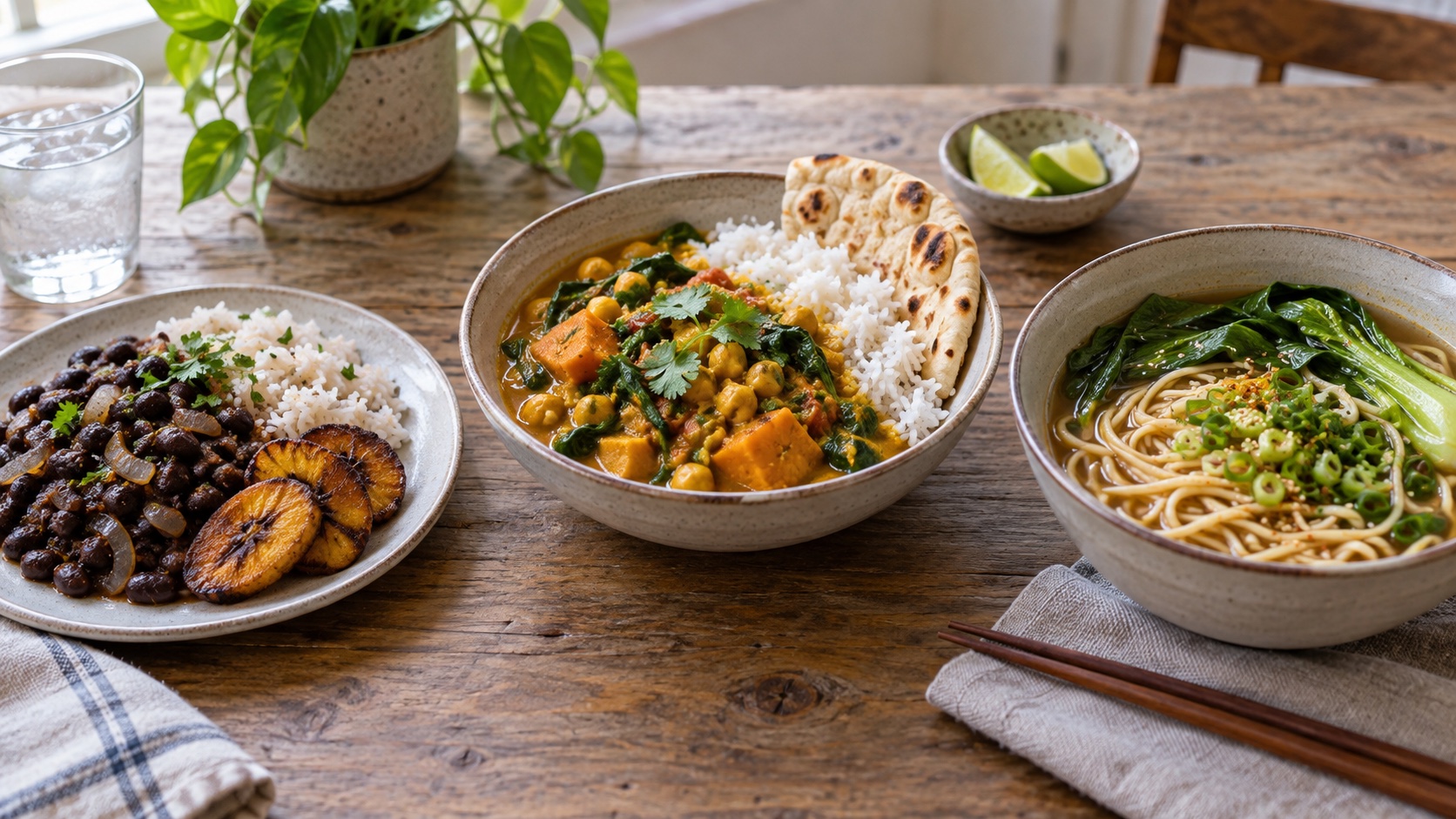
The Pattern Is a Grammar, Not a Menu
Here is the detail that makes translation legitimate: the Mediterranean diet was never defined by specific foods. The adherence score that anchors the evidence — the Mediterranean Diet Score — counts servings of food groups: vegetables, legumes, fruit and nuts, cereals, fish, the monounsaturated-to-saturated fat ratio, and modest dairy and alcohol (NEJM, 2003). When researchers applied that scoring logic, they found each two-point increase in adherence was associated with meaningfully lower mortality, in a meta-analysis of nearly 1.6 million people across many countries (BMJ, 2008). A score of proportions, not ingredients, is what the evidence is built on — so any cuisine that hits the proportions is, for scientific purposes, the Mediterranean diet. The official modern pyramid says the same thing in different words: it describes frequencies and food groups, not recipes (Public Health Nutrition, 2011). What actually matters is the skeleton: plants own the plate, legumes anchor most days, fat is mostly unsaturated, animal foods are accents, and whole grains carry the starch.
Product picks are generic categories, not brands. We may earn a commission on Amazon or iHerb purchases at no cost to you — this never changes our evidence conclusions. Full disclosure
Canned beans and lentils
A lower-friction way to use legumes where an article gives a concrete food-first practice.
⚠️ Increase gradually if gas is troublesome; people with IBS or a prescribed diet may need individualized guidance.
Check price on Amazon →The Four Transferable Rules
- 🥦 Rule 1 — plants own the plate. Vegetables, ideally cooked in the local fat with aromatics, are the main event at two meals a day, not a side dish. This is the single largest structural change for most Western eaters.
- 🫘 Rule 2 — a legume anchor most days. Beans, lentils, chickpeas, soy — every cuisine has one, and the evidence for legumes as a survival predictor is among the strongest in food epidemiology.
- 🛢️ Rule 3 — mostly-unsaturated fat, local edition. Olive oil where olive oil is local; elsewhere, the cuisine's own liquid plant oils — mustard, peanut, rapeseed, avocado, sesame. The fat quality core explains why the swap, not the brand, carries the benefit.
- 🍗 Rule 4 — animal foods as accents. Meat flavors the dish rather than filling the plate; fish appears weekly where it's available; dairy shows up fermented — yogurt, kefir, aged cheese.
- 🌾 Rule 5 — whole grains carry the starch. Brown rice, whole corn, millet, whole wheat — the grain is whole or the meal is missing its fiber payload. Fruit, fresh or dried, closes the meal.
Indian: The Closest Cousin
Indian home cooking may be the world's best-kept Mediterranean secret. Dal — spiced lentils — is a daily legume anchor, exactly the frequency the pattern asks for. Vegetables appear in nearly every meal, typically cooked in mustard or groundnut oil, both mostly unsaturated. The traditional fat profile is strong: ghee exists but was historically a finishing touch, not the cooking medium. Yogurt (dahi) supplies the fermented dairy slot, and coastal regions eat fish on schedule. The translation work is subtraction, not addition: dial down the restaurant-style cream sauces, the deep-fried snacks, and the refined white rice portion, and dial up whole grains — brown basmati, millet rotis — plus a second vegetable dish. A typical home thali — dal, two vegetables, yogurt, a roti — is, structurally, a Mediterranean plate with different spices. The gut topic would add that the spice mix itself (turmeric, cumin, coriander) is plausibly doing microbiome work, though that evidence is young.
Mexican & Central American
The Mesoamerican kitchen is built on the same bones: beans, corn, squash — the traditional "three sisters" — plus tomatoes, chiles, and avocado. Black beans and pinto beans are a daily legume anchor; corn tortillas, when made from whole-grain masa, are a whole-grain staple; avocado is an unsaturated fat source with a trial literature of its own on blood lipids. Fish is regional — abundant on both coasts, scarce inland — and the pattern accommodates that the same way it does in Spain. The translation points: keep lard out of the beans (or use it as the occasional accent, not the default), treat tortilla chips and fried antojitos as the "sweets" category — occasional guests, not residents — and watch the liquid calories: sugary sodas are the single largest off-pattern item in the region's modern diet. A pot of beans, a pile of vegetables, corn tortillas, and a little cheese is the pattern, wearing a different hat.
East Asian
Japanese, Chinese, and Korean cuisines offer the pattern's fish and vegetable volume in its most natural form — and one distinctive swap: soy replaces legumes with tofu, tempeh, and edamame, which are legumes in concentrated form. Miso soup at breakfast is a fermented legume product; that is squarely on-pattern. The gaps to close: refined white rice is the default starch in all three, and swapping even half of it for brown rice, barley, or buckwheat soba closes most of the fiber distance; and sodium runs high in soy sauce, pickles, and soups, which matters for blood pressure independently of the pattern (see the blood pressure topic). Cooking fats are mostly fine — rapeseed, sesame, and peanut oils are unsaturated — with the caveat that deep-frying converts a good oil into a delivery system for batter. Korean banchan — the spread of small seasoned vegetable dishes that accompanies every meal — is essentially the pattern's vegetable volume, pre-installed; a Chinese home stir-fry of greens, tofu, and a little meat over rice is a Mediterranean plate wearing soy sauce. The structure to keep: a small fish, a bowl of vegetables, fermented soy, and rice that is at least partly whole.
The Swap Engine: Six Kitchens, One Skeleton
| Cuisine | Legume anchor | Default fat | Whole-grain swap | Signature on-pattern dish |
|---|---|---|---|---|
| 🇮🇳 Indian | Dal (lentils) | Mustard / groundnut oil | Brown basmati, millet roti | Dal + two vegetables + yogurt |
| 🇲🇽 Mexican | Black / pinto beans | Avocado, corn oil | Whole-masa tortillas | Beans, squash, tortillas, salsa |
| 🇯🇵 Japanese | Tofu, edamame | Rapeseed, sesame | Brown rice, barley, soba | Miso soup, grilled fish, vegetables |
| 🇪🇹 Ethiopian | Lentils, split peas | Niter kibbeh — go easy | Teff injera (whole grain) | Misir wat + greens + injera |
| 🇸🇪 Nordic | Peas, brown beans | Rapeseed oil | Rye bread, oats | Herring, rye, root vegetables |
| 🇺🇸 Soul food | Black-eyed peas | Peanut / vegetable oil | Brown rice, corn | Peas, collard greens, okra |
The table is the point made visible: the same skeleton — legumes daily, vegetables in volume, mostly-unsaturated fat, whole grains — wearing six different sets of spices. The off-pattern items are equally universal: refined white starch, deep frying, sugary drinks, and salt-heavy processed foods appear in every cuisine's modern form. Translation is therefore two moves, not one: keep the traditional structure of your own kitchen, and subtract the industrial additions your grandmother's version never had. That is the entire method — and it is why the environment design protocol treats cuisine as an asset rather than an obstacle.
🗺️ Cuisine is the vehicle, not the cargo
The evidence scores food groups, not recipes. Keep your grandmother's dishes — the pattern is about the proportions inside them: plants default, legumes daily, fat mostly unsaturated, meat as flavor. If the structure is right, the labels don't matter.
Questions, Answered Briefly
- 🫒 Do I specifically need olive oil? No. The pattern-level evidence is about mostly-unsaturated fats. Olive oil has the most direct trial data and unique polyphenols, but mustard, rapeseed, and avocado oils cover the structural requirement — the fat quality page details the swap logic.
- 🥩 Is the pattern vegetarian? Plant-dominant, not plant-exclusive. Fish weekly and occasional poultry, eggs, and red meat all fit — the proportions do the work.
- 🍚 Is white rice off-pattern? White rice is a refined grain, and refined grains are the pattern's weakest slot. Making even half the rice whole — or pairing white rice with lentils, which is itself a whole-protein plus fiber move — closes most of the gap.
- 👵 What about my family's traditional cooking? Keep the dishes; adjust the ratios inside them — more vegetables, more legumes, less frying, whole grain where the dish allows. That is the whole translation.
The Bottom Line
- The Mediterranean diet is a grammar, not a menu — the evidence rests on adherence scores of food groups, and scores translate across cuisines.
- Four rules carry the pattern: plants own the plate, legumes anchor most days, fat is mostly unsaturated, and animal foods are accents.
- Indian dal, Mexican beans, Japanese tofu — every cuisine has a native version of the pattern already on the table.
- The real work is subtraction: less refined starch, less deep-frying, less sugar — whatever the local names for those are.
Related Topics
- Trichopoulou et al., "Adherence to a Mediterranean diet and survival in a Greek population," New England Journal of Medicine (2003)
- Sofi et al., "Adherence to Mediterranean diet and health status: meta-analysis," BMJ (2008)
- Bach-Faig et al., "Mediterranean diet pyramid today. Science and cultural updates," Public Health Nutrition (2011)
- Estruch et al., "Primary Prevention of Cardiovascular Disease with a Mediterranean Diet Supplemented with Extra-Virgin Olive Oil or Nuts," New England Journal of Medicine (2018, republication)
- U.S. Department of Agriculture, FoodData Central — food composition data for fiber values cited in the chart (2026)