The 7 Components That Matter
The Mediterranean diet is famous as a package deal — and the package is exactly what the trials tested. But when you try to live it, you live it component by component: a bottle of oil, a bag of nuts, a tin of sardines. Here is each of the seven pieces, what it plausibly does, how strong its own evidence is, and the dose that keeps showing up.
What the evidence supports
- Olive oil and nuts carry the strongest direct evidence, because PREDIMED supplemented exactly those two foods and both arms benefited.
- Whole grains, vegetables, and legumes rest on large, consistent cohort meta-analyses with dose-response patterns.
- Fish has solid observational support, though supplement trials suggest the benefit may be about displacement more than omega-3 pills.
What remains uncertain
- How much credit each component deserves is a modeling exercise — the basket was tested, not the individual items.
- The "active ingredient" in olive oil (fat type or polyphenols) is still being disentangled.
- Wine's place in the pattern is cultural, not nutritional — pooled analyses find no protective dose of alcohol.
Evidence last reviewed: August 15, 2026. Conclusions may change as new research is published.
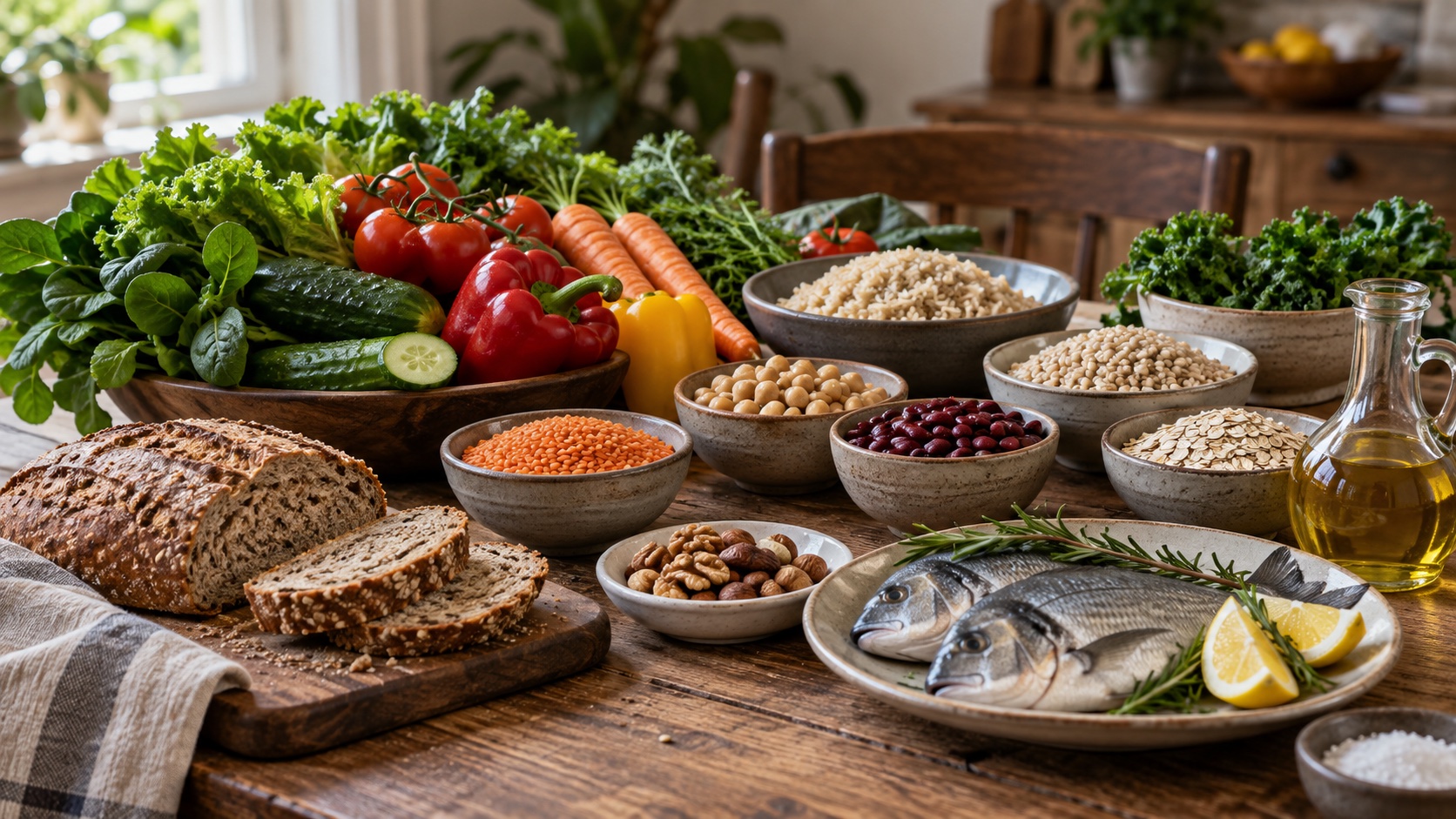
Why Components, Not Superfoods
PREDIMED's arms were defined by supplementation — a liter of extra-virgin olive oil a week, or 30 grams of mixed nuts a day — layered on top of shared dietary counseling. That design lets us say something real about those two foods, and almost nothing causal about the other five. The rest of the components earn their place through cohorts: large populations, long follow-up, dose-response curves, and statistical adjustment for everything measurable. The honest hierarchy is therefore uneven, and pretending otherwise — treating all seven as equally "proven" — is where Mediterranean diet reporting goes wrong. The pattern is a basket, and baskets have a property individual foods lack: the components cover for each other. The fiber topic and the fats and carbs topic own the underlying physiology; this page scores the seven.
Product picks are generic categories, not brands. We may earn a commission on Amazon or iHerb purchases at no cost to you — this never changes our evidence conclusions. Full disclosure
Extra-virgin olive oil
A culinary fat option where an article specifically teaches an extra-virgin olive-oil dietary pattern.
⚠️ Calorie-dense; storage and freshness matter. It is an ingredient, not a disease treatment.
Check price on Amazon →Olive Oil: The Principal Fat
Extra-virgin olive oil is the pattern's signature fat, and it has the strongest component-level evidence. The PREDIMED olive oil arm showed the largest risk reduction of the three groups, with adherence verified by urinary hydroxytyrosol — so we know people actually consumed it. Mechanistically it does two things at once: its monounsaturated fat improves blood lipid profiles when it displaces saturated fat, and its polyphenols (oleocanthal, hydroxytyrosol) appear to dampen inflammation and LDL oxidation. The polyphenol angle has regulatory weight: the European Food Safety Authority approved a health claim that 5 mg of hydroxytyrosol and derivatives per day — about 20 grams of a polyphenol-rich extra-virgin oil — protects blood lipids from oxidative damage (EFSA, 2011). Practical translation: use extra-virgin as the default for dressing, finishing, and low-heat cooking. Polyphenol content varies by harvest and storage, and "light" or refined oils lose most of it — but even standard olive oil still delivers the fat swap, which the fat quality page argues is the deeper mechanism.
Nuts: The 30-Gram Habit
The PREDIMED nuts arm — 15 grams of walnuts plus 7.5 grams each of almonds and hazelnuts daily — matched the olive oil arm's risk reduction, which makes nuts the second component with arm-level trial evidence. The cohort literature agrees: a dose-response meta-analysis found that each 28-gram daily serving of nuts was associated with roughly a fifth lower all-cause mortality and a similar reduction in cardiovascular events across 20 prospective studies (BMC Medicine, 2016). Nuts plausibly work through several channels at once: unsaturated fat, fiber, magnesium, and a satiety profile that makes them a snack you don't overeat the way you overeat chips. The dose that keeps appearing is a small handful — about 30 grams — which is also the amount at which weight gain fails to materialize in trials, despite the calories. Watch the one failure mode: salted, candied, or honey-roasted versions quietly convert a longevity food into a snack food.
Fish: Real Food, Modest Evidence
Fish sits in an awkward evidence spot. Observational data are consistent — a classic review of the risks and benefits concluded that one to two servings a week, especially of oily fish, is associated with lower coronary mortality (JAMA, 2006). But the randomized evidence for the presumed active ingredient is weak: the Cochrane review of omega-3 supplementation for cardiovascular prevention found small or no effects on most outcomes (2018), and trial results for fish oil pills have been underwhelming across the board. The reconciliation is probably displacement plus context: people who eat fish twice a week are, by arithmetic, eating less of something else, and fish in a plant-rich dietary pattern may behave differently than fish oil in a Western one. The pattern's own standard — fish or seafood several times weekly, oily fish included — remains reasonable, and canned sardines and mackerel deliver it for the price of a sandwich. Just don't expect the benefit of the pill aisle.
The Fiber Trio: Legumes, Vegetables, Whole Grains
These three are the volume of the diet — the foods that fill the plate — and their evidence is the deepest in nutrition. Whole grains: a dose-response meta-analysis found that each 90 grams a day was associated with roughly 17% lower all-cause mortality and similar reductions in cardiovascular disease across 45 cohorts (BMJ, 2016). Vegetables and fruit: a meta-analysis of 95 cohorts found mortality benefits that plateaued around 7–8 servings a day (International Journal of Epidemiology, 2017). Legumes are the sleeper: the famous finding from an older multi-ethnic study of elderly people was that legume intake was the strongest dietary predictor of survival (Asia Pacific Journal of Clinical Nutrition, 2004), and legumes anchor the pattern's protein without the saturated fat of red meat — see the protein topic for the plant-versus-animal arithmetic. The unifying mechanism is fiber: the Lancet meta-analyses found that 25–29 grams a day is associated with 15–30% lower all-cause and cardiovascular mortality (2019). Most people eat half of that; the trio is how you close the gap.
Mixed tree nuts
A whole-food snack or ingredient option where an article specifies nuts as part of a dietary pattern.
⚠️ Allergy, choking risk, portion size, and caloric density matter.
Check price on Amazon →Wine: The Honest Seventh
The traditional pattern includes wine with meals, and for decades observational studies suggested a J-shaped curve. The modern pooled analyses have dismantled that curve: an individual-participant analysis of nearly 600,000 drinkers found no level of alcohol protective for overall mortality once confounders were handled (Lancet, 2018), and the Global Burden of Disease collaborators concluded the same across 195 countries (Lancet, 2018). Resveratrol — the molecule in red wine that once made headlines — is present in amounts far too small to matter, and supplement trials with it have not panned out. So wine earns its seat in the pattern on cultural grounds only: small amounts, with food, among people who already drink. If you don't drink, nothing in the evidence says to start — the diet works fine without it, and the alcohol and cognition page covers the brain side of the same math.
| Component | Typical dose in studies | What it plausibly does | Evidence |
|---|---|---|---|
| 🫒 Olive oil | ~4 tbsp/day (PREDIMED arm) | MUFA swap + polyphenols; lipid and oxidation effects | Good |
| 🥜 Nuts | ~30 g/day | Unsaturated fat, fiber, magnesium, satiety | Good |
| 🐟 Fish | 2+ servings/week | Omega-3s and displacement of red meat | Moderate |
| 🫘 Legumes | 3+ servings/week | Fiber and plant protein anchor | Moderate |
| 🥦 Vegetables | Half the plate, 2+ meals/day | Fiber, polyphenols, nitrate, potassium | Good |
| 🌾 Whole grains | 3+ servings/day | Fiber and slow carbohydrate | Good |
| 🍷 Wine (optional) | Small amounts, with meals | Cultural ritual; no demonstrated protective dose | Limited |
🧺 The basket beats the best item
No single component explains the Mediterranean pattern's results — including the two with trial data. The seven pieces work through different mechanisms (fat quality, fiber, omega-3s, polyphenols, displacement), which is exactly why the package is more robust than any ingredient claim. Buy the basket, not the superfood.
Meal-prep containers
May lower the practical friction of preparing meals ahead.
⚠️ None expected; avoid treating meal-prep as an all-or-nothing dietary rule.
Check price on Amazon →Questions, Answered Briefly
- 🏆 Which component matters most? Nobody can isolate that from the trials. The fat swap and the fiber trio carry most of the mechanistic weight, but the honest answer is: the combination is the intervention.
- 💰 Do I need expensive olive oil? No. Any genuine extra-virgin oil delivers the fat swap; the polyphenol content — higher in early-harvest, freshly bottled oils — is a bonus tier, not the entry fee. Standard olive oil is fine for cooking.
- 🐟 Can I skip fish? The direct evidence for fish itself is modest, and plant omega-3s plus algae oil are reasonable substitutes. But fish is also displacement — it replaces red meat on the plate, and that part you'd want to replicate somehow.
- 🍷 Is the wine mandatory? No. Zero alcohol is the health-maximizing dose; wine's seat in the pattern is cultural. Skip it without losing anything measurable.
The Bottom Line
- Olive oil and nuts have the strongest component evidence — PREDIMED supplemented exactly those foods, in both of its successful arms.
- The fiber trio is the volume play: whole grains, vegetables, and legumes carry cohort evidence as deep as any in nutrition, mostly through fiber.
- Fish is real food with modest evidence — eat it for the pattern and the displacement, not because fish oil pills delivered in trials.
- Wine is optional culture, not nutrition. No protective dose of alcohol survives pooled analysis; the diet works without it.
Related Topics
- Estruch et al., "Primary Prevention of Cardiovascular Disease with a Mediterranean Diet Supplemented with Extra-Virgin Olive Oil or Nuts," New England Journal of Medicine (2018, republication)
- Aune et al., "Whole grain consumption and risk of cardiovascular disease, cancer, and all cause and cause specific mortality: systematic review and dose-response meta-analysis of prospective studies," BMJ (2016)
- Aune et al., "Fruit and vegetable intake and the risk of cardiovascular disease, total cancer and all-cause mortality — a systematic review and dose-response meta-analysis of prospective studies," International Journal of Epidemiology (2017)
- Aune et al., "Nut consumption and risk of cardiovascular disease, total cancer, all-cause and cause-specific mortality: a systematic review and dose-response meta-analysis of prospective studies," BMC Medicine (2016)
- Darmadi-Blackberry et al., "Legumes: the most important dietary predictor of survival in older people of different ethnicities," Asia Pacific Journal of Clinical Nutrition (2004)
- Mozaffarian & Rimm, "Fish intake, contaminants, and human health: evaluating the risks and the benefits," JAMA (2006)
- Abdelhamid et al., "Omega-3 fatty acids for the primary and secondary prevention of cardiovascular disease," Cochrane Database of Systematic Reviews (2018)
- Reynolds et al., "Carbohydrate quality and human health: a series of systematic reviews and meta-analyses," The Lancet (2019)
- Wood et al., "Risk thresholds for alcohol consumption: combined analysis of individual-participant data for 599,912 current drinkers in 83 prospective studies," The Lancet (2018)
- EFSA Panel on Dietetic Products, "Scientific Opinion on the substantiation of health claims related to polyphenols in olive oil," EFSA Journal (2011)