Blood Pressure: The Silent Killer
High blood pressure is the leading modifiable risk factor for death worldwide, and it produces almost no symptoms until it produces a catastrophe. Two numbers, measured correctly, tell you more about your cardiovascular future than almost anything else — and both respond to levers you already own.
What the evidence supports
- Blood pressure is causally, dose-responsively linked to stroke, heart attack, and kidney disease.
- The SPRINT trial: treating to a systolic target below 120 mmHg cut cardiovascular events and death by ~25% in high-risk adults.
- Lifestyle interventions — exercise, sodium reduction, weight loss — lower blood pressure meaningfully in trials.
What remains uncertain
- How aggressively to treat older, frailer adults remains debated — benefits and risks balance differently.
- Home vs clinic measurements disagree often; which one best predicts outcomes is still being refined.
- Individual sodium sensitivity varies — population advice doesn't fit everyone equally.
Evidence last reviewed: August 13, 2026. Conclusions may change as new research is published.
The Categories, Memorized
Blood pressure is two numbers: systolic (pressure while the heart squeezes) over diastolic (pressure while it relaxes). The current AHA/ACC categories:
| Category | Systolic | Diastolic | What it means |
|---|---|---|---|
| Normal | < 120 | < 80 | Keep doing what you're doing |
| Elevated | 120–129 | < 80 | The warning track — lifestyle time |
| Stage 1 hypertension | 130–139 | 80–89 | Lifestyle, plus medication conversation for higher-risk adults |
| Stage 2 hypertension | ≥ 140 | ≥ 90 | Medical treatment generally recommended |
The shift from the old 140/90 threshold to 130/80 in 2017 was controversial and remains so — but it was driven by the trial data that follow, and it means roughly half of American adults now meet the definition of hypertension, most not knowing it.
Product picks are generic categories, not brands. We may earn a commission on Amazon or iHerb purchases at no cost to you — this never changes our evidence conclusions. Full disclosure
Smart scale with body-composition estimates
Can make body-weight trends easier to observe; body-composition estimates may be used as a rough personal trend only.
⚠️ Bioimpedance estimates vary with hydration and device assumptions; frequent weighing can be unhelpful for people with eating-disorder risk or body-image distress.
Check price on Amazon →SPRINT: Why the Number Matters So Much
The trial that changed practice: SPRINT randomized ~9,400 high-risk adults to standard treatment (systolic target < 140) versus intensive treatment (target < 120). The intensive arm showed a ~25% reduction in major cardiovascular events and a ~27% reduction in all-cause mortality — results strong enough that the trial was stopped early. The nuance worth stating: SPRINT used careful, standardized measurement (rested, automated cuffs) that reads lower than typical rushed clinic readings, and intensively treated patients saw more medication-related side effects. The honest synthesis: for people at elevated risk, lower is genuinely better — but the measurement has to be real, not white-coat noise.
Blood Pressure's History, In Brief
A number we now take for granted was, for most of history, unmeasurable — the physician's toolkit stopped at the pulse and the patient's story. The cuff (a century-old invention, refined into the modern sphygmomanometer) changed the arithmetic of prevention: it turned a symptomless process into a number, and made the single most cost-effective act in medicine possible — the measurement that catches the killer before it strikes. The Framingham Heart Study in the 1960s cemented the finding that changed public health: high blood pressure predicts heart attack and stroke years in advance, and treating it changes those outcomes. Every time you sit still for a reading, you're using the cheapest longevity technology ever invented.
Salt, More Precisely
Sodium is the most argued-about lever in blood-pressure science, so precision matters. What's settled: populations eating little sodium have little hypertension, and sodium-reduction trials (the DASH-sodium design) show consistent, meaningful pressure reductions. What's genuinely debated: individual sensitivity varies enormously — some people drop 10 mmHg on a low-sodium diet while others barely move — and the extreme low-sodium tails of the J-curve debate remain contested. The practical position: most of your sodium isn't in the shaker — it's in processed food, where roughly three-quarters of Western intake hides — which makes the intervention an ingredient-list habit, not a cooking sacrifice. Cook from base ingredients, and the sodium question largely answers itself.
Measure It Like the Trial Did
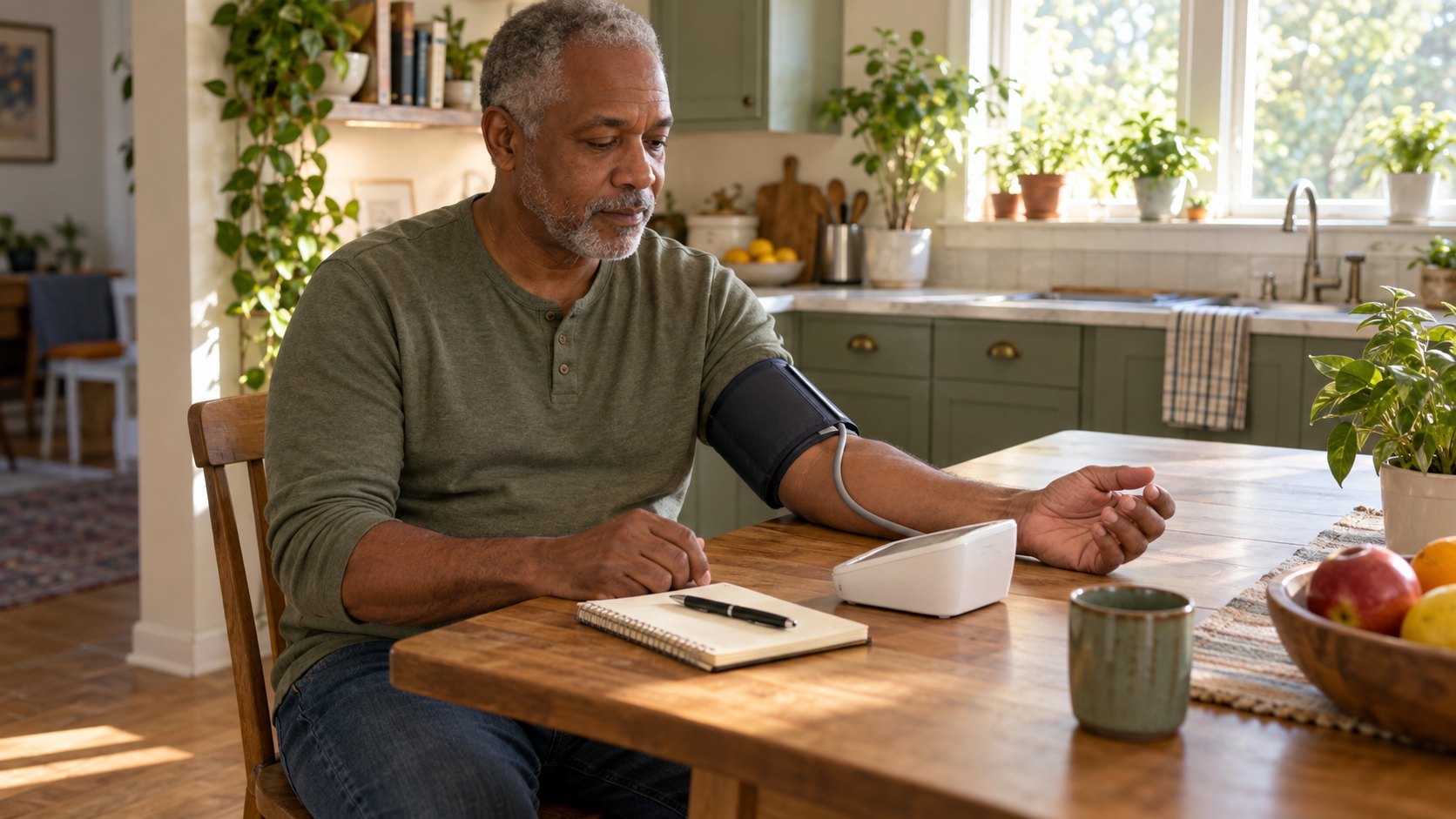
Blood pressure is one of the most commonly botched measurements in medicine — and at home. The rules that separate signal from noise: sit quietly for five minutes (the difference between a rushed and rested reading can be 10+ mmHg), feet flat, back supported, arm at heart level, no caffeine or exercise in the 30 minutes prior, empty bladder, and take two readings one minute apart and average them. The cuff must fit — an undersized cuff systematically over-reads. Home monitoring matters because of two phenomena: white-coat hypertension (high in clinic, normal at home — treatable with reassurance, not always drugs) and masked hypertension (normal in clinic, high at home — the dangerous one that gets missed). A $40 home cuff and a week of morning-and-evening readings answer both.
😴 The sleep connection
A frequently missed cause of resistant hypertension is sleeping badly. Obstructive sleep apnea — covered in the Sleep pillar — is present in a large share of people whose pressure won't budge, and treating it measurably lowers blood pressure in trials. Before accepting a lifetime of escalating medication, the honest question to ask is: how's the sleep?
What High Pressure Actually Does
Blood pressure is the force your blood vessels feel with every heartbeat — and vessels are not indifferent to being hammered. Sustained pressure: damages the endothelial lining (the single-cell layer that keeps vessels slick and supple), accelerates atherosclerosis (where the lipid topic's ApoB particles find their entry), thickens the heart muscle (the left ventricle works against a stiffer load — the "hypertensive heart" that eventually fails), punches holes in the brain's small vessels (the silent strokes and white-matter damage behind vascular dementia), and grinds down the kidneys' filtration units (a top cause of dialysis). The organ list — heart, brain, kidneys, eyes — is why hypertension earns the "silent killer" title: by the time any of them complains, the pressure has been at work for decades.
The 30-Day Pressure Reset
- Week 1: Baseline week — two readings morning and evening with correct technique; no changes yet. Note caffeine and sleep alongside each reading.
- Week 2: Daily 30-minute brisk walk (the most strongly evidenced lever), and sodium audit — most sodium hides in processed food, not the salt shaker.
- Week 3: Add potassium foods daily (greens, beans, potatoes, bananas) and keep alcohol to a minimum; add a second short walk after dinner.
- Week 4: Re-measure the same way and compare weekly averages. If sleep quality is poor or snoring is present, raise the apnea question — and if pressure remains ≥ 130/80, that's a physician conversation, not a defeat: lifestyle and medication are partners, not rivals.
Blood Pressure Questions, Answered Briefly
- Why does my reading vary so much? Because blood pressure is a dynamic signal — stress, caffeine, posture, even conversation move it. That's exactly why protocol and averaging matter more than any single number.
- Which number matters more? Systolic dominates risk prediction after ~50; diastolic matters relatively more in younger adults. The categories above handle both.
- Can meditation really lower it? Breathing and meditation produce modest, real reductions in trials (a few mmHg) — useful as part of the stack, not a substitute for the big levers.
Buying the Right Cuff
The most valuable home-health purchase on this entire site, measured by information per dollar, is a validated upper-arm blood-pressure cuff — not a wrist device, which is position-sensitive and less reliable. What to look for: upper-arm cuff, automatic inflation, memory for readings, and — ideally — a listing on a validation registry (the US and EU maintain independent validation lists; the manual almost always names them). Fit matters more than brand: the cuff's width should cover about 40% of your upper-arm circumference, and too-small cuffs systematically inflate readings. Expect to spend roughly $40–70 once, and expect it to outlast several phones. It's the instrument that turns the "silent" killer into a number you check with your coffee.
The Lifestyle Levers, Ranked by Evidence
| Lever | Typical effect | Evidence |
|---|---|---|
| 🏃 Regular aerobic exercise | −5 to −8 mmHg systolic | Strong — among the best-documented lifestyle effects in medicine |
| ⚖️ Weight loss | ~ −1 mmHg per kg lost | Strong |
| 🧂 Sodium reduction | −2 to −6 mmHg (more in salt-sensitive people) | Strong — the DASH-sodium trials |
| 🍌 Potassium-rich foods | −2 to −4 mmHg | Moderate–strong — food sources, not megadose pills |
| 🍺 Alcohol reduction | −2 to −4 mmHg | Moderate–strong |
| 😴 Sleep and stress work | Variable but real | Moderate |
The DASH dietary pattern — vegetables, fruit, whole grains, lean protein, modest sodium — is the eating style the trials used, and it's the same architecture as the Mediterranean topic's pattern viewed through a blood-pressure lens. Notice the convergence: the same levers that fix glucose, insulin, and visceral fat are the ones that fix blood pressure. Metabolic health is one system with many dials, not many systems with one dial each.
The Bottom Line
- Know the categories: normal < 120/80; elevated 120–129; stage 1 ≥ 130/80; stage 2 ≥ 140/90.
- SPRINT settled the direction: lower is better for high-risk adults — but only with accurate measurement.
- Measure like the trial: rested, cuffed correctly, averaged — and check at home to unmask white-coat and masked hypertension.
- The levers are the same old friends: exercise, weight, sodium, potassium, sleep — including treating sleep apnea.
Go Deeper: Subtopics
- 🔎 The 130/80 vs 140/90 question — the guideline history and what the SPRINT trial changed. Read it →
- 🔎 Home monitoring, done right — cuff fit, timing, and the 7-day average protocol (links BP Protocol's home-measurement). Read it →
- 🔎 The non-drug levers ranked — sodium, potassium, exercise, alcohol, weight: effect sizes in mmHg. Read it →
- 🔎 White-coat & masked hypertension — the two measurement traps and what they mean. Read it →
- 🔎 When medication is the answer — the handoff criteria and the honest case for antihypertensives (links BP Protocol). Read it →
Related Topics
- SPRINT Research Group, "A randomized trial of intensive versus standard blood-pressure control," New England Journal of Medicine (2015)
- Whelton et al., "2017 ACC/AHA guideline for the prevention, detection, evaluation, and management of high blood pressure in adults," Hypertension (2018)
- Sacks et al., "Effects on blood pressure of reduced dietary sodium and the DASH diet," New England Journal of Medicine (2001)
- Cornelissen & Smart, "Exercise training for blood pressure: a systematic review and meta-analysis," Journal of the American Heart Association (2013)
- GBD 2019 Risk Factors Collaborators, "Global burden of 87 risk factors," The Lancet (2020)