Home Monitoring, Done Right
A blood pressure measured once a year in a rushed clinic is weather; a week of careful home readings is climate. The evidence says the home average predicts your cardiovascular future better than the clinic number does — but only if the device is validated, the cuff fits, and the ritual is consistent. This page covers the science behind why home monitoring works and where it quietly fails; the step-by-step ritual itself lives on the protocol page.
What the evidence supports
- Home blood pressure averages predict cardiovascular outcomes better than clinic readings (Niiranen, Hypertension, 2010).
- A validated upper-arm cuff with a correctly sized band produces readings comparable to ambulatory reference measurements.
- Self-monitoring that actually guides medication titration lowers pressure more than usual care (TASMINH4, Lancet, 2018).
What remains uncertain
- The exact protocol — two readings, seven days, discard day one — is expert consensus, not a randomized trial comparing schedules.
- Home cuffs cannot measure sleep-time pressure; that requires 24-hour ambulatory monitoring.
- Oscillometric devices misread irregular heart rhythms, so some people simply need another method.
Evidence last reviewed: August 15, 2026. Conclusions may change as new research is published.
Why Home Beats the Clinic
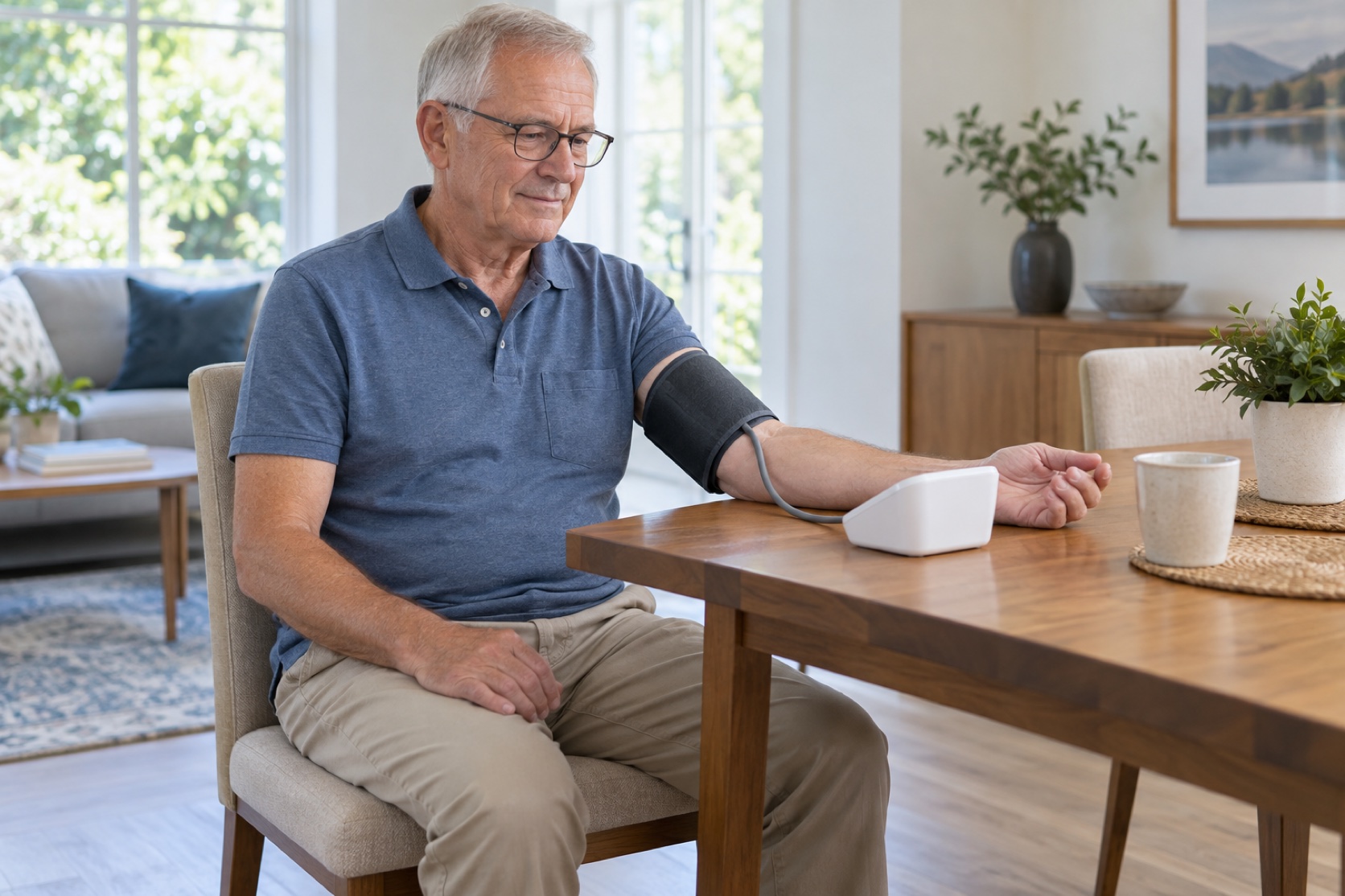
The clinic reading has three problems: it is one snapshot instead of many, it is taken in a setting that raises pressure in a meaningful share of people (the white-coat effect the next page in this series dissects), and it is frequently botched — rushed, wrong cuff, unsupported arm. Home monitoring fixes all three at once: dozens of readings, taken in the conditions where you actually live, averaged into a number that reflects your usual pressure rather than your appointment pressure. The outcome data back this up: in a Finnish cohort, home averages predicted cardiovascular events better than clinic readings did (Niiranen et al., Hypertension, 2010), and a systematic review found home measurements much closer to the 24-hour ambulatory reference standard than clinic measurements are (Hodgkinson et al., BMJ, 2011). The practical translation: a home average of 135/85 carries roughly the weight of a clinic 140/90 — the American Heart Association and American Medical Association's 2020 joint statement treats home readings at or above 130/80 as hypertensive.
Validated, or Just Sold?
The market for blood pressure devices is full of products that have never been through independent accuracy testing. "Clinically validated" on a box should mean the device passed a standardized protocol — a pass/fail comparison against a reference measurement across a range of pressures and arm sizes — but validation lists exist precisely because the label cannot be trusted at face value.
- 🏆 The lists are the shortcut. STRIDE BP (the US Blood Pressure Validated Device Listing) and Medaval maintain registries of devices that passed independent testing. If the model you are considering is not on a list, assume nothing.
- 💪 Upper-arm over wrist. Wrist devices can be accurate, but only when held exactly at heart level — a positioning demand that fails in real use far more often than it succeeds. The upper-arm cuff removes the variable most likely to go wrong.
- 📐 Validation covers the cuff too. A device is validated with the band it ships with; swapping in a different size from another brand breaks the assumption the test made.
- 💲 Cost is not quality. Validated devices with memory and averaging run roughly $40–100 — among the highest-information-per-dollar purchases in metabolic health, and the price of a premium app-connected model buys convenience, not accuracy.
- 🔋 Features that matter are boring. Memory with averaging, a large display, and a cuff that fits. Everything else is decoration.
The Cuff-Size Science
The most common hardware error is the least glamorous: the cuff is the wrong size. A randomized crossover trial put people through readings with correctly sized, one-size-too-small, one-size-too-large, and two-sizes-too-small cuffs (Ishigami et al., JAMA Internal Medicine, 2023). The mismatches moved systolic readings by several mmHg — in the direction you would fear, since an oversized cuff reads low and hides pressure, while an undersized cuff reads high and manufactures it. The takeaway is not subtle: measure your bare mid-arm, buy the band that matches, and remember that most monitors ship with a standard cuff that may not be yours.
What Skews a Reading, Systematically
Beyond the cuff, a short list of conditions predictably bends the number — and the ritual on the protocol page exists to remove all of them. Knowing the direction of each bias matters, because an underestimate is the more dangerous failure: it produces false reassurance.
| Condition | Direction | Why it happens |
|---|---|---|
| Arm dangling or below heart level | ⬆ Overreads | Gravity adds hydrostatic pressure the cuff then measures |
| Crossed legs or no back support | ⬆ Overreads | Muscle tension and posture raise sympathetic tone |
| Talking during the reading | ⬆ Overreads | Speech itself raises pressure; readings taken mid-conversation are contaminated |
| Full bladder | ⬆ Overreads | Bladder distension reflexively increases pressure |
| Caffeine or exercise in the prior 30 minutes | ⬆ Overreads | Transient pressor effects that describe your coffee, not your vessels |
| Oversized cuff | ⬇ Underreads | The bladder can't occlude the artery at the right pressure |
| First reading of a session, no rest | ⬆ Overreads | The alerting response to the cuff itself; the second reading runs lower |
The cure for all seven rows is the same: sit quietly for five minutes, feet flat, back supported, arm at heart level, no talking, two readings a minute apart — and never judge a single number. The average is the measurement.
What Home Cannot See
- 🌙 The nighttime record. Whether your pressure dips during sleep — and whether it surges before waking — needs a 24-hour ambulatory monitor, not a home cuff. People whose pressure fails to dip carry extra risk that daytime readings alone cannot reveal; the Sleep pillar covers the nightly BP dip's biology.
- 💓 Irregular rhythms. Oscillometric devices assume a regular pulse. Atrial fibrillation can make home readings unreliable in both directions, which is why people with irregular rhythms need clinic auscultation or other methods — a clinician question, not a gadget question.
- 📉 The clinic–home gap itself. Home numbers run about 5–10 mmHg below clinic numbers on average. That gap is not error; it is information — but only if you know which number you are comparing against which threshold. The white-coat and masked hypertension page turns this gap into a diagnostic tool.
- 🩺 The diagnosis and the prescription. A log never diagnoses or treats on its own. Its job is to make the clinician conversation precise — and in trials, self-monitoring only helped when it changed treatment (the TASMINH4 trial's lesson, Lancet, 2018).
⚠️ The log is evidence, not treatment
In TASMINH4, self-monitoring with feedback lowered systolic pressure about 3.5 mmHg more than usual care, and self-monitoring plus telemonitoring about 4.7 mmHg — the benefit came from acting on the numbers, not from owning a cuff. And a reading at or above 180/120 that holds after five quiet minutes, or any reading with chest pain, breathlessness, or vision changes, is urgent care — not a protocol entry. Interpreting repeated abnormal readings belongs with a qualified clinician.
Questions, Answered Briefly
- ❓ Why is my first reading always the highest? The alerting response — the body's startle at the cuff. That is why the ritual takes two readings a minute apart and why day one of a baseline gets discarded as practice.
- ❓ Is a wrist cuff acceptable? A few wrist models have passed validation, but they demand exact wrist-at-heart positioning that fails in daily use. The validated upper-arm cuff is the default because it removes that judgment call.
- ❓ My home numbers look great but the clinic scares me. Which wins? For most decisions, the home average — bring the log. Persistent disagreement is itself diagnostic; the white-coat page explains both directions of the gap.
- ❓ How often do I need to do this? A full seven-day baseline to start, a mini-baseline weekly while changing anything, and a seven-day run every three to six months once stable — roughly two weeks of measuring per year.
- ❓ Can I measure too much? Yes — and the failure mode is anxiety, not accuracy. Repeated checking outside the protocol turns a health tool into a worry ritual; the schedule exists as much to limit measuring as to structure it.
The Bottom Line
- Home averages predict better than clinic snapshots — many readings in real conditions beat one reading in an artificial one.
- Validation and cuff size decide data quality — a validated upper-arm device with a correctly sized band, or the numbers mean nothing.
- The ritual removes systematic bias — rest, posture, silence, and averaging exist to delete known error directions.
- Monitoring only helps when it changes something — the log is the evidence that powers clinician conversations, not a treatment in itself.
Related Topics
- Niiranen et al., "Home-measured blood pressure is a stronger predictor of cardiovascular risk than office blood pressure: the Finn-Home study," Hypertension (2010)
- Hodgkinson et al., "Relative effectiveness of clinic and home blood pressure monitoring compared with ambulatory blood pressure monitoring in diagnosis of hypertension: systematic review," BMJ (2011)
- Ishigami et al., "Effects of cuff size on the accuracy of blood pressure readings: the Cuff(SZ) randomized crossover trial," JAMA Internal Medicine (2023)
- McManus et al., "Efficacy of self-monitored blood pressure, with or without telemonitoring, for titration of antihypertensive medication (TASMINH4)," The Lancet (2018)
- Shimbo & Artinian, "Self-measured blood pressure monitoring at home: a joint policy statement from the American Heart Association and American Medical Association," Circulation (2020)
- Stergiou et al., "European Society of Hypertension practice guidelines for office and out-of-office blood pressure measurement," Journal of Hypertension (2021)