Fats & Carbs: Quality Over Quantity
Three decades of diet wars asked the wrong question. Low-fat versus low-carb was a marketing rivalry dressed as science — the evidence, then and now, points somewhere calmer: the type of fat and the type of carb matter more than the total, and what you replace something with matters most of all. This page is the grown-up version of both macronutrients in one place.
What the evidence supports
- Replacing saturated fat with unsaturated fat is associated with lower cardiovascular risk — the "replacement matters" finding.
- Industrial trans fats are harmful at any dose; most jurisdictions have restricted them.
- Whole grains and low-glycemic whole-food carbs associate with better metabolic health than refined carbs.
What remains uncertain
- Whether saturated fat is harmful per se or only relative to what replaces it remains genuinely contested.
- Optimal macro ratios for individuals likely vary with genetics and metabolic status — no universal split exists.
- Low-carb diets' long-term outcomes depend heavily on protein and fat quality, which studies rarely control well.
Evidence last reviewed: August 13, 2026. Conclusions may change as new research is published.
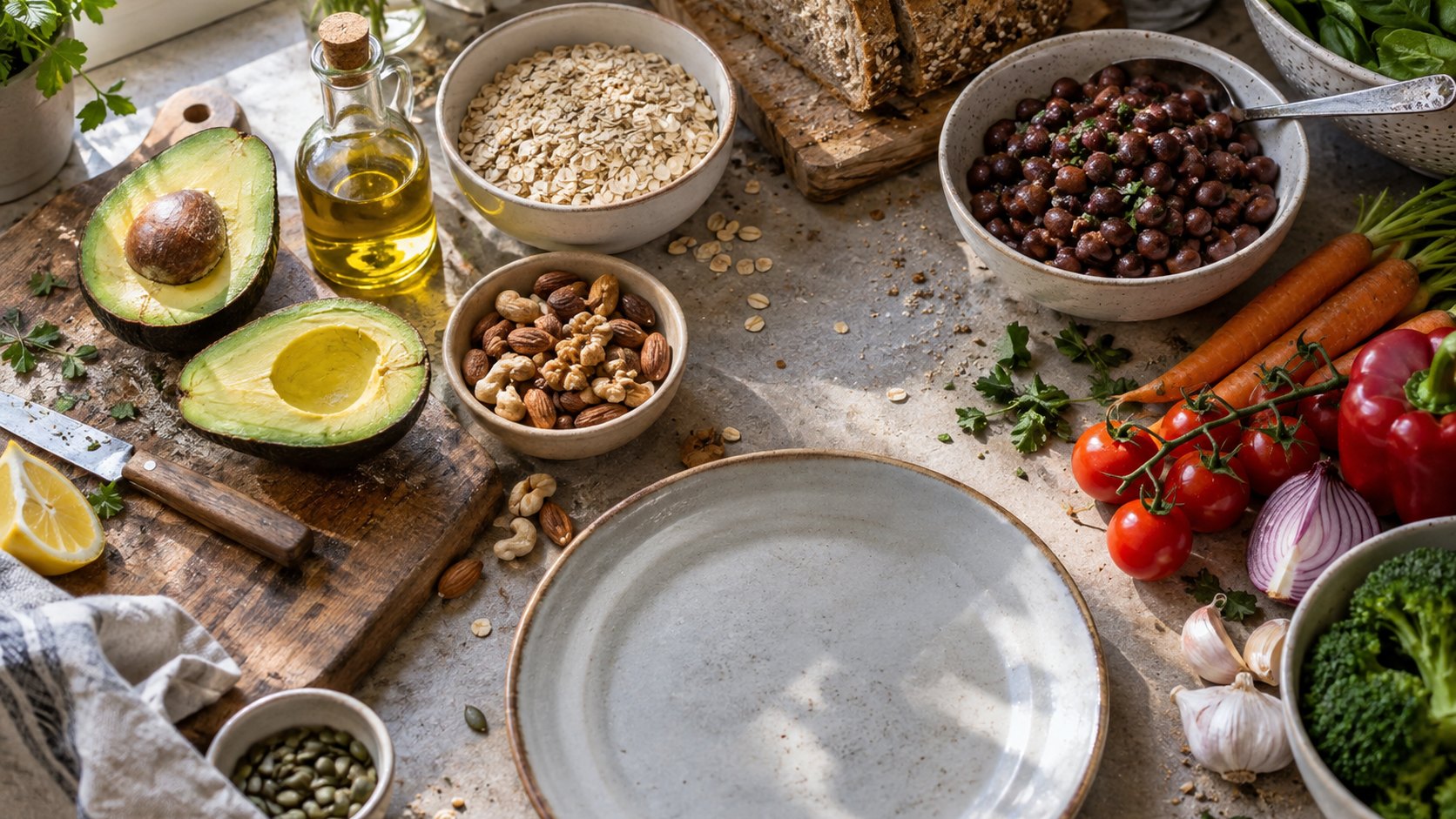
The Wars That Taught the Wrong Lesson
From the 1980s, the public was told fat was the enemy — so food manufacturers removed fat and added sugar and refined starch, and obesity rates climbed anyway. The low-carb counter-revolution then declared carbohydrates the enemy. Both movements had a kernel of truth wrapped in an oversimplification. What the last two decades of substitution research — mostly large prospective cohorts — actually shows is a subtler picture: it's not "less fat" or "less carbs," it's which fats and which carbs, and what they replace. The classic finding: replacing 5% of calories from saturated fat with polyunsaturated fat is associated with meaningful reductions in coronary risk, while replacing saturated fat with refined carbohydrate is associated with no benefit — or worse. The replacement, not the subtraction, is the story.
Product picks are generic categories, not brands. We may earn a commission on Amazon or iHerb purchases at no cost to you — this never changes our evidence conclusions. Full disclosure
Extra-virgin olive oil
A culinary fat option where an article specifically teaches an extra-virgin olive-oil dietary pattern.
⚠️ Calorie-dense; storage and freshness matter. It is an ingredient, not a disease treatment.
Check price on Amazon →Fats: A Four-Aisle Taxonomy
| Fat type | Sources | The honest read |
|---|---|---|
| 🫒 Unsaturated (MUFA & PUFA) | Olive oil, nuts, seeds, avocado, fatty fish | Beneficial — the fats with the best evidence for cardiovascular and metabolic health |
| 🐟 Omega-3s (EPA/DHA) | Oily fish, algae | Beneficial — marine fats with specific anti-inflammatory roles (see the supplements topic) |
| 🧈 Saturated fat | Butter, red meat, coconut, full-fat dairy | Context-dependent — risk depends heavily on what it displaces; dairy behaves differently from red meat |
| ⛔ Trans fats (industrial) | Partially hydrogenated oils, some fried foods | Avoid — harmful at any realistic dose; widely restricted but still present in some products |
The saturated-fat nuance deserves honesty: the "saturated fat is harmless" counter-movement cherry-picked studies that replaced saturated fat with refined carbs (where, of course, nothing improved) and ignored the substitution studies where replacing it with unsaturated fat did reduce risk. The mainstream position — saturated fat is fine in moderation, better replaced with unsaturated fat when possible, and far less harmful than trans fat or refined carbs — is the one that survives the evidence.
Carbs: The Quality Spectrum
| Carb type | Sources | The honest read |
|---|---|---|
| 🌾 Whole grains | Oats, quinoa, brown rice, whole-grain bread | Beneficial — fiber, minerals, and gentler glucose curves |
| 🫘 Legumes & vegetables | Beans, lentils, leafy greens, crucifers | Beneficial — the backbone of every longevity-associated pattern |
| 🍎 Whole fruit | Apples, berries, citrus | Beneficial — the fiber matrix changes the glucose story |
| 🍩 Refined carbs & added sugar | White bread, pastries, sugary drinks, most snacks | Minimize — the carbs behind the metabolic associations (see the sugar topic) |
Carbohydrate quantity matters chiefly for people with metabolic disease — for whom low-carb approaches can be genuinely useful tools under medical guidance. For healthy adults, the evidence favors carb quality over carb counting: the same grams of carbohydrate from lentils and from white bread have opposite metabolic profiles. If you remember one carb rule, remember this: whole foods, mostly plants, fiber attached.
The Swaps That Do the Work
| Instead of… | Try… | Why |
|---|---|---|
| 🧈 Butter on toast | Extra-virgin olive oil | Unsaturated fat swap with direct evidence |
| 🍚 White rice | Quinoa, brown rice, or lentils | Whole grain + fiber + protein |
| 🥤 Soda / juice | Water, sparkling water, whole fruit | Liquid sugar is the highest-leverage removal |
| 🥪 Mayonnaise | Yogurt, hummus, or olive-oil mayo | Shifts fat quality without losing texture |
| 🥩 Red meat, 3rd time this week | Fish or a lentil dish | The Mediterranean substitution, in practice |
| 🍰 Pastry dessert | Fruit + plain yogurt + nuts | Sugar down, fiber and protein up |
None of these swaps requires willpower at every meal — they're environment changes: what's in the kitchen, what's on the menu rotation, what gets ordered by by default. The diets that last aren't the ones that forbid the most; they're the ones that make the better option the easy option.
⚖️ Ratios? Don't obsess
The evidence does not support one magical macro split — 40/30/30, ketogenic, or otherwise — for healthy adults. What's consistently supported: protein adequacy (the protein topic), fiber (the fiber topic), unsaturated over saturated fats, whole over refined carbs, and a pattern you can sustain. Get those five right and the ratio takes care of itself.
Meal-prep containers
May lower the practical friction of preparing meals ahead.
⚠️ None expected; avoid treating meal-prep as an all-or-nothing dietary rule.
Check price on Amazon →Cooking Fats: Heat Changes the Story
A fat that's excellent on salad can degrade under high heat, so the practical rule is to match the fat to the temperature. Low-to-medium heat: extra-virgin olive oil is fine — the "never cook with EVOO" warning is mostly myth; its smoke point (~190–210°C) covers everyday sautéing. High heat (searing, wok): refined oils with higher smoke points — avocado oil, refined olive oil, or neutral vegetable oils — are the practical choice. The real hazards are different from the smoke-point trivia: reused frying oil (the trans-fat source in some food service) and burned food, not the choice between olive and avocado. Keep it boring: EVOO for most cooking, a high-smoke-point neutral oil for searing, and no deep-frying as a habit.
The Cholesterol Question: Eggs and Dairy
Two decades ago, eggs were feared for their cholesterol; the current evidence has largely retired that fear. Dietary cholesterol has a modest effect on blood cholesterol in most people (the liver adjusts production), and cohort studies find egg intake in the context of an otherwise good diet is not associated with increased cardiovascular risk — with the caveat that eggs in the context of bacon-and-white-toast breakfasts are a different meal than eggs in a Mediterranean context. Dairy splits similarly: fermented dairy (yogurt, kefir, some cheeses) associates with neutral-to- favorable metabolic outcomes despite saturated fat, while butter's reputation is weaker. The honest synthesis: don't fear eggs; prefer fermented dairy; and judge the meal, not the ingredient in isolation.
Low-Carb, Done Right vs. Wrong
Low-carbohydrate diets are legitimate tools — especially for type 2 diabetes and metabolic syndrome, where trials show real glucose and weight benefits. But the outcomes depend heavily on what the carbs are replaced with. The "wrong" version: carbs out, butter, bacon, and processed meat in — which can raise LDL and leave cardiovascular risk unchanged or worse. The "right" version: carbs out, olive oil, nuts, avocado, fish, and vegetables in — a plant-forward low-carb pattern that cohorts associate with favorable outcomes. The same logic applies in reverse to low-fat diets: fat out, sugar in, was the 1990s mistake. Whatever macro you restrict, the replacement determines the result — the theme of this entire topic.
Snack Architecture
Snacks are where most macro-quality failures happen, because the default snack supply chain is refined carbs plus seed oils. The fix is architectural: make the good snack easier than the bad one. Nuts in a bowl on the counter, fruit at eye level in the fridge, yogurt front and center, and the chips nowhere — or in an inconvenient cupboard. Research on "choice architecture" shows position and convenience beat willpower reliably. Three anchor snacks cover most needs: nuts + fruit (fat, fiber, carbs in balance), Greek yogurt + berries (protein + polyphenols), and hummus + vegetables (fiber + unsaturated fat). Stock those, position those, and the snack problem mostly solves itself.
The Plate Method: One Visual Rule
If you remember nothing else from this topic, remember the plate: half the plate vegetables, a quarter protein, a quarter whole grains or starchy vegetables, and a thumb of fat — olive oil, nuts, or avocado. That single image encodes nearly everything this topic argues: fiber and plants dominate, protein is protected, refined carbs are crowded out by volume, and the fats are the right ones by default. It works in any cuisine, needs no tracking, and survives restaurant menus: order the protein, ask for extra vegetables, and treat the starch as a side rather than the stage. The diet wars spent thirty years arguing about macros; the plate ends the argument visually.
The Bottom Line
- Quality beats quantity for both macros: unsaturated fats and whole-food carbs are the foundations.
- Replacements matter most: what you swap in determines whether a change helps — saturated fat → unsaturated fat helps; saturated fat → refined carbs doesn't.
- Trans fats: avoid entirely. Added sugar and refined carbs: minimize.
- Skip the ratio wars. Protein, fiber, and quality swaps do 90% of the work.
Go Deeper: Subtopics
- 🔎 Saturated fat, re-examined — the substitution question: saturated fat replacing what? (the food-matrix answer). Read it →
- 🔎 Omega-6 & seed oils — the inflammatory-oil debate: what the actual trials show. Read it →
- 🔎 Carb quality taxonomy — glycemic load, whole vs refined, and the fiber-coating principle. Read it →
- 🔎 Low-carb vs low-fat, finally — the DIETFITS-style evidence: adherence beats macronutrient identity. Read it →
- 🔎 Cooking oils, ranked — smoke points, oxidation, and what to cook with at high heat. Read it →
Related Topics
- Sacks et al., "Dietary fats and cardiovascular disease: a presidential advisory from the American Heart Association," Circulation (2017)
- Li et al., "Saturated fats compared with unsaturated fats and sources of carbohydrates in relation to risk of coronary heart disease," Journal of the American College of Cardiology (2015)
- Reynolds et al., "Carbohydrate quality and human health: a series of systematic reviews and meta-analyses," The Lancet (2019)
- Mozaffarian, D., "Dietary and policy priorities for cardiovascular disease, diabetes, and obesity," Circulation (2016)
- de Souza et al., "Intake of saturated and trans unsaturated fatty acids and risk of all cause mortality, cardiovascular disease, and type 2 diabetes," BMJ (2015)