Environment Design: Friction & Defaults
You don't rise to the level of your goals; you settle at the level of your environment. The habits that stick are the ones your rooms, screens, and cupboards make easy — and the ones you quit are the ones they make hard. This page is the architecture layer: one step, one default, one shelf at a time, so the habit runs without hourly heroics.
What the evidence supports
- When food is visible and within reach, people eat measurably more of it — proximity and visibility beat stated intentions.
- Defaults shape most choices: opt-out systems reliably outperform opt-in across organ donation, savings, and health settings.
- Removing steps toward a behavior — and adding steps away from it — changes behavior more reliably than motivation does.
What remains uncertain
- Most environment studies are short, small, and single-setting (offices, labs, cafeterias) — the size of the effect in your home is genuinely individual.
- Whether one-off phone tweaks like grayscale hold up for months is far less studied than food-placement effects.
Evidence last reviewed: August 13, 2026. Conclusions may change as new research is published.
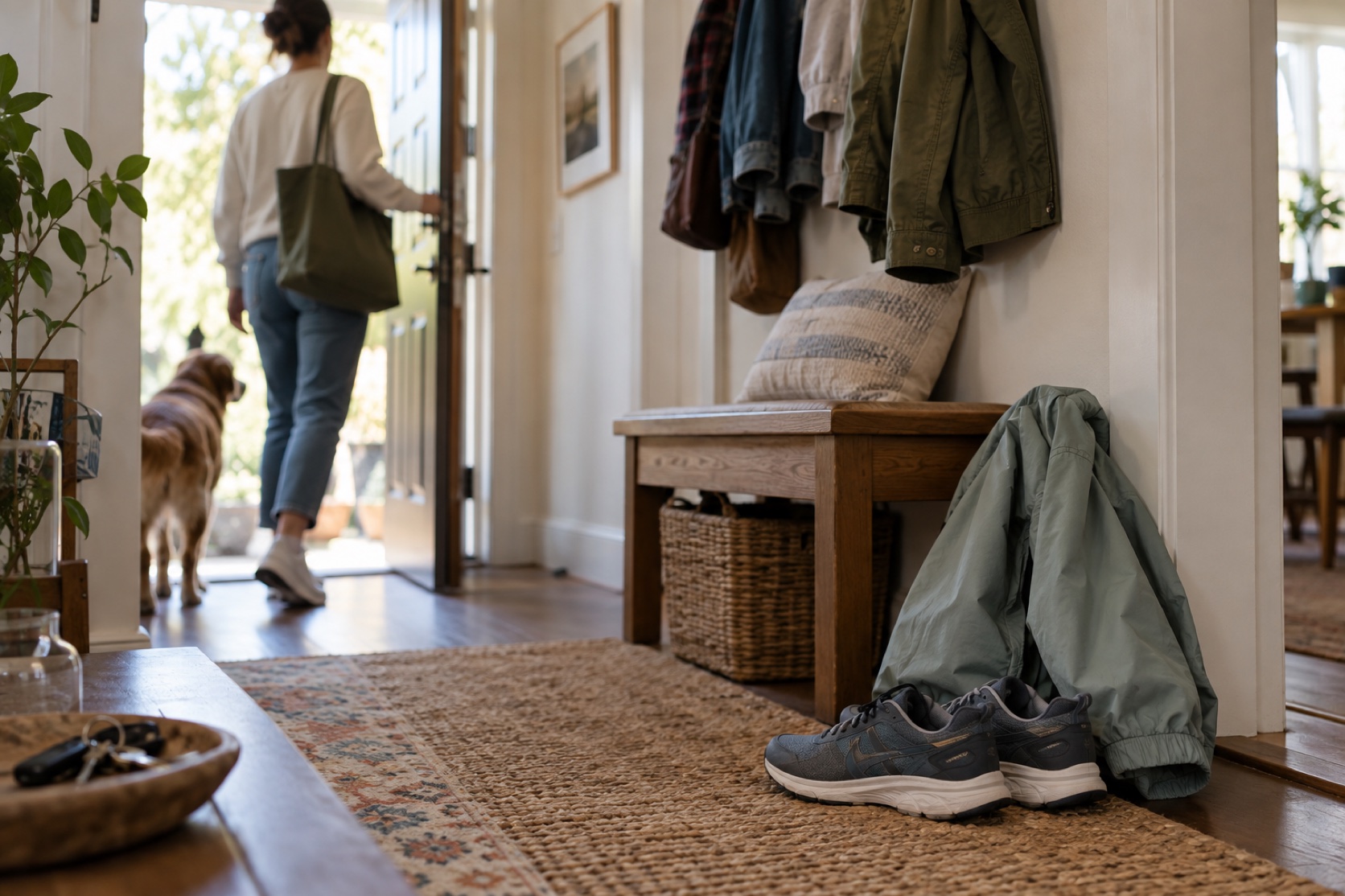
Habits Live in Contexts, Not Intentions
Wendy Wood's research describes habit as a context–response association: the cue is the situation, not the goal. Change the situation and the behavior follows it.
- 🍿 The stale popcorn study — moviegoers with strong movie-theater popcorn habits ate stale popcorn at nearly the same rate as fresh in the theater. The context pulled the behavior; the taste barely registered.
- 🎛️ The unit of change — you cannot reliably override the cue in the moment it fires, but you can change what the cue meets: the counter, the screen, the door hook.
- ⚡ The willpower ceiling — motivation is a wave: high at 7am, low at 10pm. Environment is architecture: it works the same at both hours.
Friction: The Real Lever
Friction is the number of steps between you and an action — the most underrated variable in behavior change, because it is boring, and it works.
- ➖ Subtracting friction — one removed step (kit laid out, bottle filled) converts intention into action more reliably than a reminder does.
- ➕ Adding friction — one added step (cookies in a lidded bin on a high shelf, feed apps behind a search) converts impulse into effort — and effort into "not tonight."
- 🧮 The exchange rate — one step off the good path and one onto the bad beats a doubled dose of motivation — willpower is finite; friction never gets tired.
Defaults: The Option That Runs by Not Running
A default is what happens when you do nothing — and doing nothing is what tired people do most.
- 🫀 The organ-donation finding — countries where donation is the default (opt-out) have consent rates above 85%; opt-in countries sit near or below 20%. The gap is not character; it is the form.
- 🏦 The retirement echo — automatic enrollment in savings plans sharply raises participation versus asking people to sign up — people keep what they are given.
- 📦 Your defaults to set — subscriptions and autoplay, the first app on the home screen, the food at eye level, the plate in the cupboard. Each is a choice you make once and live with for months.
Product picks are generic categories, not brands. We may earn a commission on Amazon or iHerb purchases at no cost to you — this never changes our evidence conclusions. Full disclosure
Blackout shades or curtains
May reduce unwanted bedroom light and make a dark sleep setting easier to maintain.
⚠️ None expected from the product itself; install securely and preserve a safe route to exits.
Check price on Amazon →The 10pm Problem
Every environment has an evening version: at 10pm the decision-maker is slower, hungrier for reward, and indifferent to the morning plan — and takes the path of least resistance, whatever that path currently is.
- 🍪 The kitchen at 10pm — the default is whatever is visible and ready in one motion — a design decision made at 3pm, knowingly or not.
- 📱 The phone at 10pm — the default is the first icon, the endless feed, the autoplay — the tired brain does not search for better, it accepts what loads first.
- 🧠 The wrong fix — a stricter 10pm rule is another demand on the least motivated version of you — it fails repeatedly and reads as weakness.
- 🌅 The right fix — a 7pm environment change: snack out of sight, charger moved, book on the pillow. The 10pm you inherits the 7pm you's choices — that is the whole trick.
The Food Environment: Visible = Eaten
The food studies are the cleanest demonstration of this page: placement moves intake while intention barely nudges it.
- 🍬 The candy-dish studies — office workers ate several more pieces a day when candy sat in a clear dish on the desk than when the same candy sat in an opaque dish two meters away — same candy, same people, only the arrangement changed.
- 👀 The rule — visible food gets eaten; convenient food gets eaten first. You cannot out-intend your own countertop, so stock it deliberately.
- 🔁 The inversion — the same law serves your goals: vegetables visible, snacks invisible — and the default snack quietly changes identity.
| Placement | The swap | Why it works |
|---|---|---|
| 🍎 Counter | Fruit bowl where the snack jar lived | Visible food gets eaten — make the visible thing the good thing |
| 🍪 Pantry | Snacks in opaque bins, top shelf, lids on | Invisibility plus two steps of friction |
| 🍽️ Dinnerware | Smaller plates and bowls | Portions track the plate size, not appetite alone |
| 🥬 Fridge | Prepped vegetables at eye level, drinks at the back | The first thing seen becomes the first thing eaten |
The food environment in four swaps — restraint not required.
The Phone Environment
The phone is the most engineered environment you live in. You can re-engineer it in one ten-minute pass.
- 🌈 Grayscale — in a small 2020 study, participants with grayscale phones cut daily screen time and social-media use over about seven weeks. Color is part of the engagement engineering — removing it makes the feed taste like the stale popcorn.
- 🗂️ App placement — one home screen, no feed apps. The feed moves behind a search or into a folder named by intent ("Read", "Move") — the default scroll now requires a deliberate trip.
- 🔕 Notifications — off for everything except humans; badges off. Every ping is an invitation you did not send — uninvited invitations should require effort to find.
- 🔌 The charger — the phone charges outside the bedroom — one move that solves the 10pm phone default and pays the sleep pillar at the same time.
| Setting | Change | Why |
|---|---|---|
| 🌈 Grayscale | On | Removes the color engineering that keeps feeds sticky |
| 🗂️ Home screen | Feed apps off; one screen of tools | The default scroll has to search first |
| 🔕 Notifications | Off except humans; badges off | Each ping is an invitation you didn't send |
| 🔌 Charger | Out of the bedroom | Kills the 10pm scroll at the source |
The phone reset, one pass — ten minutes, rechecked weekly.
One-Time Setups: Five Minutes That Pay All Week
A one-time setup is friction removed in advance — performed once at high motivation, so the low-motivation moment never has to solve anything.
- 👟 Clothes laid out — running kit on the chair the night before deletes the 5:30am "where is everything" negotiation — the decision was made at 9pm.
- 🎒 Bag by the door — gym bag or work bag packed and parked at the exit removes the door's last excuse.
- 💧 Bottle filled on the desk — hydration that requires standing up and remembering loses to hydration already there.
- 📚 Book on the pillow — the evening default is whatever is closest to the bed: make it the book, and move the phone.
- 🛠️ The principle — every setup is the same sentence: "I did the thinking yesterday; today only needs motion."
Reusable water bottle
Can make regular access to water more convenient.
⚠️ Excessive water intake can be harmful in unusual circumstances; individual fluid needs vary.
Check price on Amazon →The Two-Minute Environment Audit
The audit turns this page into a routine: walk the apartment, log the friction, fix the biggest step — two minutes, one habit at a time.
- Pick one habit to audit — the one you most want running, or the one currently failing.
- Walk the path — log every step between you and the habit, then every step between you and its competitor.
- Name the default — if you do nothing, what happens? That is what the environment currently votes for.
- Make two changes — one step off the good path, one step onto the bad path.
- Re-audit — weekly for a month on this habit, then monthly on the whole apartment.
| Habit | What stands in the way | One change | Cost |
|---|---|---|---|
| 🏃 Morning run | Kit in a drawer upstairs | Kit laid out the night before | 3 minutes nightly |
| 🥗 Lunch salad | Greens buried in the crisper | Prepped vegetables at eye level | 10 minutes weekly |
| 📖 Evening reading | Phone on the nightstand | Book on the pillow, phone charging in the kitchen | 2 minutes nightly |
| 💤 Earlier bedtime | TV autoplay | Autoplay off | One-time |
A completed two-minute audit — minutes paid once, dividends all week.
Designing Rooms for the Habits You Want
Each room votes. The point is not austerity — it is making every room cast the vote you actually want.
- 🍳 Kitchen — the room of the food defaults: produce forward, snacks sealed and high, plates sized for the portions you want.
- 🛏️ Bedroom — the room of sleep: dark, cool, phone elsewhere — one room, one job, so the wind-down stops competing with the feed.
- 🛋️ Living room — the room of connection and movement: a mat spot that needs no clearing, a book within arm's reach of the usual seat.
- 🚿 Bathroom — the room of pairing: floss next to the toothbrush, the habit stacked on one that already runs.
🏠 Move the room, not the mountain
When a habit keeps failing, the cheapest fix is rarely more discipline. It is one fewer step on the good path, one more on the bad. Audit the room before you blame the person — the room is usually where the vote was lost.
Where the Evidence Lives
This page is the architecture layer — the science behind each claim has a home in the pillars; this series references rather than repeats it:
- 🎯 Why habits matter for longevity at all — the Hobbies & Habits topic owns the case that repeated, meaningful activity is a longevity behavior; this page makes repetition automatic.
- 🧘 The daily downshift — the Downshift Habit topic owns the recovery-side ritual and its evidence; these environment rules apply directly — put the breathwork cue in the room where stress happens.
- 👥 The social environment — the Building Your Tribe topic owns the fact that other people are part of your environment; scheduling the tribe into the physical space is a default too.
- 😴 The bedroom's job — the sleep pillar's Bedroom Engineering page owns the room-by-room sleep specifics; the charger rule is its shortest version.
What to Do When It Goes Wrong
Environments get reverted by life — guests, travel, new apps. Five real scenarios, with the response that works:
- 🚩 Guests or travel wrecked the environment — of course they did; environments get rebuilt by other hands all the time. Treat it as routine maintenance: a ten-minute rebuild pass on return. Not a failure — a weather event.
- 🚩 Someone you live with keeps buying the junk — default-setting in a shared home is diplomacy, not moral combat. Negotiate one shelf or drawer that is yours and one counter zone that stays clear; win the zones you can, let the rest go.
- 🚩 The grayscale keeps getting switched off — find out why before fighting it. If photos or maps genuinely need color, keep grayscale everywhere else or evenings-only. The point is friction, not suffering.
- 🚩 The audit found ten problems and you feel overwhelmed — pick one: the biggest lever with the lowest cost. Environment design compounds — a single countertop swap outperforms ten half-installed systems.
- 🚩 The environment is right but the habit still doesn't happen — environment lowers a habit's cost; it does not trigger it. The trigger is the Implementation Intentions page's if–then plan: cue, place, time — architecture plus a cue is the full machine.
Questions, Answered Briefly
- ❓ Do I need to spend money on this? — Almost never. The highest-yield changes are arrangement, not purchase: what sits where, what is visible, what loads first — a fruit bowl and a shelf do most of the work.
- ❓ Won't I just get used to the fruit bowl and drift back? — Habituation cuts both ways, which is why the audit repeats: weekly for a month, then monthly. The environment drifts; the audit is the counter-drift.
- ❓ Is grayscale backed by evidence or just a trick? — One small published study (reduced screen time and social-media use over about seven weeks) and a plausible mechanism: color is part of the engagement design. Treat it as cheap and testable, not proven law.
- ❓ What if I share my home? — Own one zone completely and leave the rest alone: a drawer, a shelf, and a counter that follow your rules change your evening defaults — zero conflict beats a pantry war.
The Bottom Line
- Habits are context–response pairs — the environment, not the intention, runs them hour to hour.
- Friction is the lever — one step removed from the good path and one added to the bad beats doubled motivation.
- The default wins — set defaults while motivated; the 10pm you inherits the 7pm you's choices.
- Two minutes of audit beats an hour of willpower — weekly at first, monthly after.
This Page in One Workflow
- Pick one habit — and its main competitor (training vs. couch, salad vs. snack).
- Audit for two minutes — walk both paths and log every step; name the current default.
- Set the default — visible = good, hidden = hard; one step off the good path, one onto the bad.
- Reset the phone in one pass — grayscale, home screen, notifications, charger.
- Re-audit on schedule — weekly for a month, then monthly for the whole apartment.
The Daily Checklist
- Counters show the food you want to eat more of
- Phone on grayscale; feed apps off the home screen
- Clothes or bag laid out for tomorrow's first move
- Water bottle filled and on the desk
- Book on the pillow, phone charging outside the bedroom
- Thirty seconds spent removing one step from a good habit's path
The Weekly Checklist
- Two-minute environment audit on the habit of the week
- Phone reset check: grayscale on, notifications still trimmed
- Kitchen reset: snacks sealed and high, produce forward
- Charger still living outside the bedroom
- One room re-designed for one habit you want more of
Go Deeper: Environment Design: Friction & Defaults
These five companion pages turn the topic into smaller, testable practices.
Related Topics
- Wood, W., & Rünger, D., "Psychology of habit," Annual Review of Psychology (2016)
- Neal, D. T., Wood, W., & Quinn, J. M., "Habits — a repeat performance," Current Directions in Psychological Science (2006)
- Painter, J. E., Wansink, B., & Hieggelke, J. B., "How visibility and convenience influence candy consumption," Appetite (2002)
- Wansink, B., Painter, J. E., & Lee, Y. K., "The office candy dish: proximity's influence on estimated and actual consumption," International Journal of Obesity (2006)
- Johnson, E. J., & Goldstein, D., "Do defaults save lives?" Science (2003)
- Holte, A. J., & Ferraro, F. R., "True colors: grayscale setting reduces screen time and time on social media," Computers in Human Behavior Reports (2020)