The Default Effect
Every environment has a do-nothing option — the thing that happens when you are too tired to choose. In hospitals and pension plans, changing that option changed what millions of people did without asking them to change anything at all. This page takes the same machinery and installs it in the three places you live most: the kitchen, the gym bag, and the phone.
What the evidence supports
- Switching a default from opt-in to opt-out changed behavior at population scale: organ-donation consent, retirement saving, and advance-care preferences all moved dramatically with the form alone (Johnson & Goldstein, 2003; Madrian & Shea, 2001).
- The default effect works partly through status quo bias — people keep what they are given — and partly through what the default implies about the sensible choice.
- The same logic transfers to personal settings: the first option visible, loaded, or already prepared reliably wins the low-effort moment.
What remains uncertain
- Default studies in institutions involve thousands of people and official forms; whether a home equivalent — a shelf, a charger location — holds its strength for months has not been studied at the same scale.
- Some people actively override defaults, especially when they notice them; a lazily set default can also point you the wrong way, so the default must be chosen, not just inherited.
Evidence last reviewed: August 15, 2026. Conclusions may change as new research is published.
Doing Nothing Is a Choice
A default is what happens when you do nothing — and doing nothing is what tired people do most. The phrase sounds technical, but the experience is universal: the snack that is already on the counter, the app that loads first, the alarm already set for the wrong time. None of these required a decision in the moment; each was chosen once, somewhere, and then ran on autopilot for months. The behavioral finding is that this autopilot is not a trivial detail of decision-making. It is usually the whole decision.
Two forces carry the default. The first is status quo bias: people disproportionately keep whatever option is already in place, partly from inertia and partly because changing feels like an endorsement of effort. The second is implied endorsement: a default reads as a recommendation, as in \"if this were a bad idea, it would not be set up this way.\" Together they mean the person who arranges the default — you, at 7 p.m. — quietly votes on behalf of the person who will encounter it at 10 p.m. That is precisely the arrangement the parent protocol page calls architecture: a choice made once, then inherited for free.
The Big Default Studies
The strongest demonstrations come from systems with paperwork, because paperwork makes the default visible to researchers. In organ donation, countries where donation is the default consent ran effective consent rates above 99 percent — Austria and Sweden are the often-cited examples — while opt-in countries such as the United States and the United Kingdom ran in the teens or twenties (Johnson & Goldstein, Science, 2003). The gap is not explained by national character; it is the form. People who support donation on surveys do not opt in; people who feel vaguely uneasy do not opt out.
Retirement saving tells the same story with numbers most people can feel. In a large company studied by Madrian and Shea, 401(k) participation jumped from about a third of new hires to above 85 percent when enrollment flipped from opt-in to automatic, with the optional exit left in place (Quarterly Journal of Economics, 2001). Nobody was compelled; the default simply stopped asking people to raise their hands. The principle generalizes to health settings as well — patients given default options on advance-care forms made systematically different end-of-life choices depending on the box that was already checked (Halpern et al., Annals of Internal Medicine, 2013). In every case, the honest summary is the same: when the effortful option is the default, most people take it; when the healthy option is the default, most people keep it.
The chart's moral is not that everyone should behave like Sweden. It is that these are enormous differences produced by a piece of paper, which means your own defaults — the ones with no paperwork attached — are doing comparably shaped work. The rest of this page is about noticing them.
Your Three Private Defaults
Institutions set defaults with forms; you set them with shelves, bags, and screens. Three environments carry most of the daily votes in a normal household.
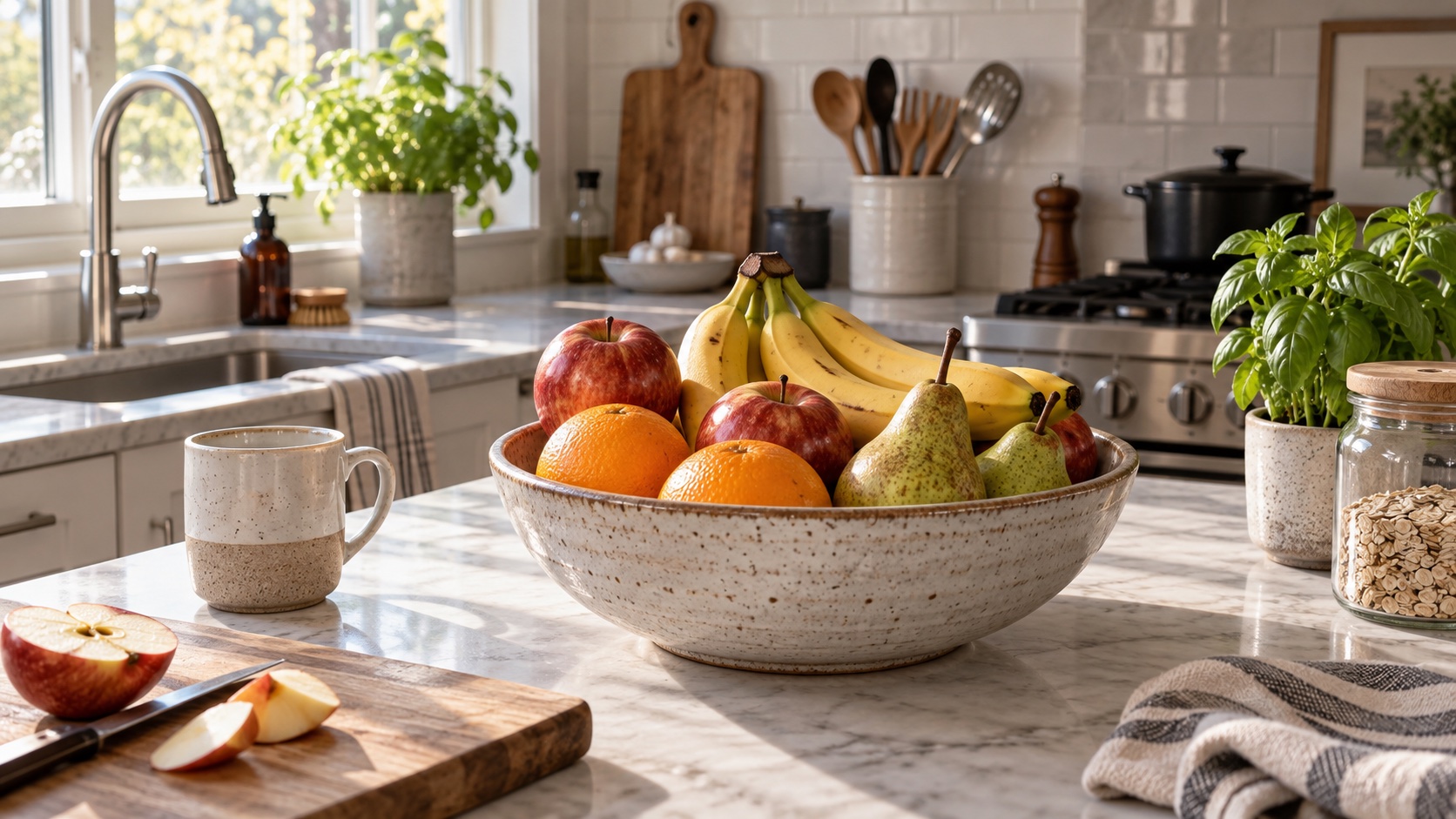
- 🍽️ The kitchen default is whatever is visible at eye level and ready in one motion. If that is the fruit bowl, the default light meal is fruit; if it is the snack cupboard, the default is the snack. The kitchen audit page in this series does the full walk-through; the short version is: eye level is the ballot box, and you are the electoral commission.
- 🎒 The gym-bag default is whatever the door presents on the way out. A bag packed and parked at the exit makes the default trip to the gym; an empty bag in the closet makes the default trip nowhere. Same person, same schedule, different default.
- 📱 The phone default is the first icon, the last app, the autoplaying episode. It is the most engineered environment you own, and it resets in ten minutes: one home screen of tools, feed apps behind a search, notifications off except for humans, and the charger outside the bedroom.
🏠 The default is a door, not a destiny
A good default does not lock you in; it makes the good path the path of least resistance and leaves the exit unlocked. That is what separates this approach from rigidity: you are not banning the snack, downloading no apps is not forbidden — the snack is merely no longer the default. You can still walk to the store at 10 p.m.; you simply have to mean it. The freedom survives; the autopilot is what changed.
The Audit: Name the Do-Nothing
Setting defaults well starts with a plain question, asked of one environment at a time: if I do nothing, what happens? The table runs the question over the three environments and records both the current default and the swap that redirects it.
| Spot | The current default | The swap | How the default flips | Read |
|---|---|---|---|---|
| 🍽️ | Snack jar on the counter | Fruit bowl on the counter, snacks in the pantry | The visible default becomes the healthy one | Good |
| 🎒 | Empty bag in the closet | Packed bag by the door | The leaving-the-house default includes the gym | Good |
| 📱 | Feed app first on the home screen | Feed app deleted from the home screen | The unlock-and-see default is a tool, not a feed | Moderate |
| 🌙 | Phone on the nightstand | Charger in the kitchen, book on the pillow | The bedtime default is reading, not scrolling | Good |
The audit in four rows — each swap is a choice made once, then inherited nightly.
Set Defaults While Motivated
The timing rule for all of this is as important as the swaps themselves. Defaults are set at your best, for your worst. The person who arranges the kitchen at 7 p.m., high-energy and clear-headed, is doing a favor for the person who will wander in at 10 p.m., depleted and not looking for a debate. The practical sequence is short and repeatable:
- Pick the lowest-energy moment. Find the habit that routinely collapses at night, first thing, or mid-afternoon — not the one that fails when everyone is watching.
- Name the do-nothing. Write one sentence: when I do nothing, what happens? That sentence is the current default, and it is usually embarrassing in exactly the instructive way.
- Change the option, not the rule. Do not add a rule about snacks; relocate the snack. Rules need enforcement, which is you; defaults need only arrangement, which is done once.
- Re-check in a week. Defaults get reverted by guests, shopping trips, and updates. The friction page in this series gives the weekly re-audit rhythm; this page just adds the question to ask when you do it.
The Limits of Defaults
Defaults are powerful, and power needs a cautious hand. Three failure modes are worth naming. First, a lazy default points the wrong way: a life stacked with subscriptions, autoplay, and \"accept all\" consent screens is a set of defaults someone else chose for you — probably in their favor. Audit defaults, don't worship them. Second, defaults can go stale: the charger in the kitchen works until you start reading on the couch, at which point the couch becomes the new default, and the book must follow you there. Third, over-engineering is itself a failure: a household with eleven optimized systems and no slack becomes a museum of good intentions. The rule that prevents all three is the same one: choose the default for the moment that matters, re-check it weekly, and keep the changes boring enough that they survive a bad week.
The Bottom Line
- The do-nothing option is a choice. It was set by someone — you or a company — and it can be reset by you.
- The evidence is population-scale. Opt-in versus opt-out changed organ donation and retirement saving by tens of percentage points; the form, not the person, did the work.
- Set defaults for the tired version of you. Kitchen, gym bag, and phone, arranged at high energy so the low-energy moment inherits a good option.
- Audit defaults, don't worship them. They drift, they stale, and someone else's defaults are running your subscriptions — re-check weekly and keep the changes boring.
Related Topics
- Johnson, E. J., & Goldstein, D., "Do defaults save lives?," Science (2003)
- Madrian, B. C., & Shea, D. F., "The power of suggestion: inertia in 401(k) participation and savings behavior," Quarterly Journal of Economics (2001)
- Halpern, S. D., et al., "Default options in advance directives influence how patients set their advance directives," Annals of Internal Medicine (2013)
- Thaler, R. H., & Sunstein, C. R., Nudge: Improving Decisions About Health, Wealth, and Happiness (Yale University Press, 2008)