Omega-6 & Seed Oils
Seed oils may be the most argued-about ingredient in the modern pantry. One camp calls them inflammatory sludge; the other calls them heart-protective staples. The actual evidence — cohort data, blood biomarkers, and a pair of infamous recovered-data trials — is more interesting, and more boring, than either camp.
What the evidence supports
- Higher linoleic acid intake is associated with lower coronary risk — about 9% fewer CHD events per 5% of energy (Circulation, 2014).
- Blood levels of linoleic acid, which reflect intake, are associated with lower cardiovascular and total mortality across 30 pooled cohorts (Circulation, 2019).
- Randomized trials find linoleic acid does not raise inflammatory markers — the inflammatory-oil claim lacks direct human support (J Acad Nutr Diet, 2012).
What remains uncertain
- The recovered-data trials (Sydney Diet Heart, Minnesota Coronary Experiment) suggest population, replacement food, and dose can flip the result — why remains debated.
- Whether very high linoleic acid intakes, well beyond typical diets, behave like moderate intakes is genuinely untested.
- The health relevance of omega-6-to-omega-3 ratios is contested; absolute intakes may matter more than the ratio.
Evidence last reviewed: August 15, 2026. Conclusions may change as new research is published.
Product picks are generic categories, not brands. We may earn a commission on Amazon or iHerb purchases at no cost to you — this never changes our evidence conclusions. Full disclosure
Extra-virgin olive oil
A culinary fat option where an article specifically teaches an extra-virgin olive-oil dietary pattern.
⚠️ Calorie-dense; storage and freshness matter. It is an ingredient, not a disease treatment.
Check price on Amazon →What Seed Oils Actually Are
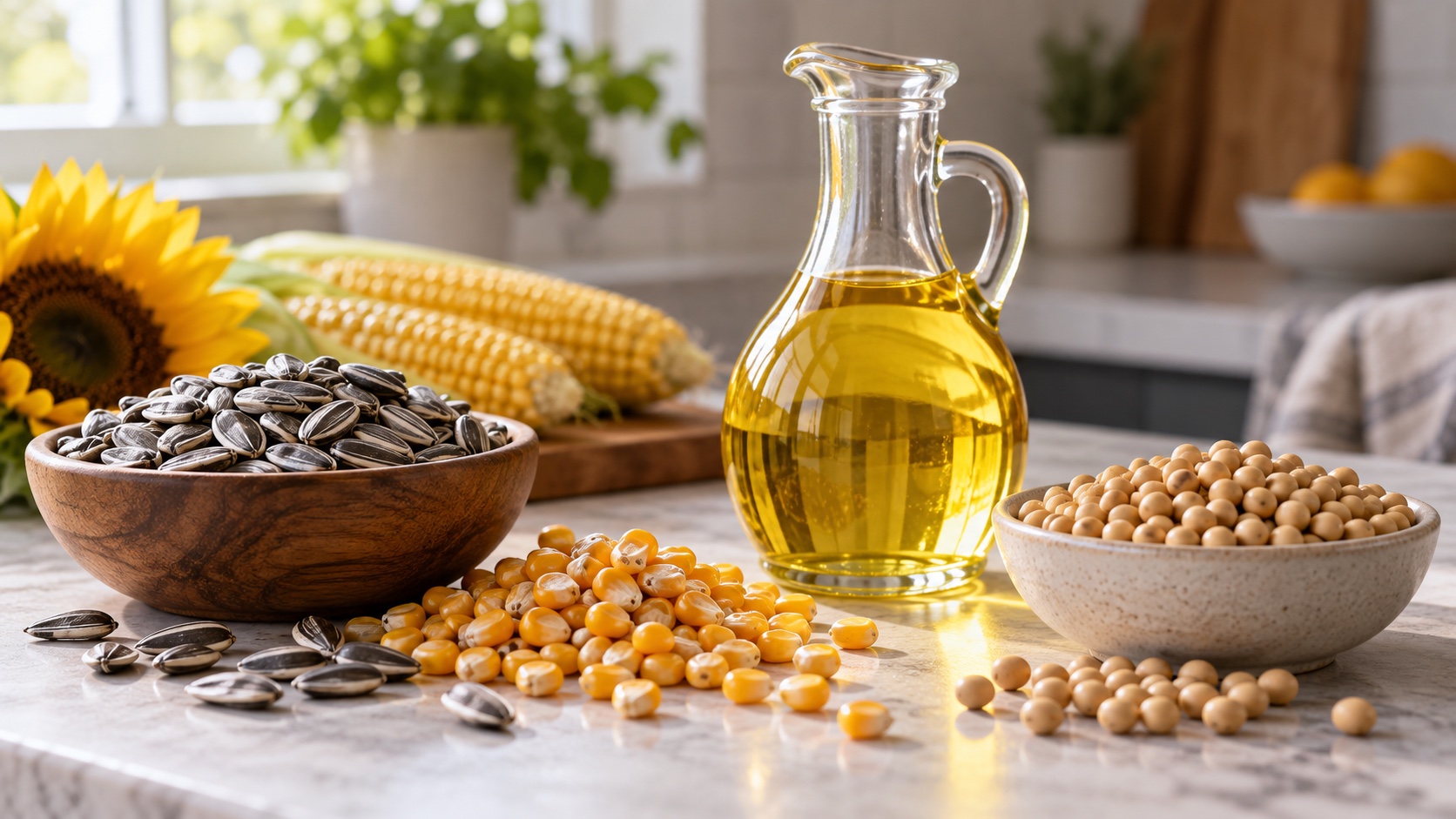
"Seed oil" is not a chemistry term; it is a marketing one, applied to oils pressed from soybean, canola (rapeseed), sunflower, safflower, corn, and cottonseed. What they share is linoleic acid — the essential omega-6 polyunsaturated fat humans cannot synthesize and must eat — plus industrial refinement: solvent extraction, bleaching, and deodorizing. They entered the food supply mostly after 1950, which is the honest kernel behind the alarm: humans now eat more linoleic acid than at any point in history, and no long-running randomized trial has tested that experiment from start to finish. Where the two camps part ways is on what the available evidence says about that change. The parent topic covers the four-aisle fat taxonomy; this page audits the omega-6 controversy specifically.
The Case Against, Stated Fairly
- 🧪 Oxidation in the bottle and the fryer. Polyunsaturated fats are the most prone to oxidation, and heavily reused frying oil accumulates degradation products — a genuine issue, covered in the cooking oils subtopic.
- ⚗️ Refinement. Hexane extraction and high-heat deodorizing are unappetizing processes; whether the finished refined oil differs meaningfully from cold-pressed oil in human outcomes is not well tested.
- 📐 The ratio argument. Linoleic acid competes with omega-3s for the same enzymes, so a very high omega-6 intake could, in principle, blunt omega-3 conversion — plausible in theory, weak in human data.
- 🕰️ The substitution history. Linoleic acid's rise tracked the rise of ultra-processed food, so in the wild it often travels with refined carbs and salt — guilt by association, but real association.
The Case For, Stated Fairly
The strongest evidence in the debate is not the marketing but the biomarkers. Pooled data from 30 prospective cohorts found that higher blood levels of linoleic acid were associated with lower risks of total cardiovascular disease, cardiovascular mortality, and ischemic stroke (Circulation, 2019) — and blood levels are a better measure of true intake than food questionnaires, because they cannot be misremembered. The same pattern appears in the Cardiovascular Health Study, where higher circulating linoleic acid was associated with lower total mortality in older adults (Circulation, 2014). The dietary-epidemiology layer agrees: each 5% of energy from linoleic acid was associated with 9% fewer coronary events and 13% fewer coronary deaths in meta-analysis (Circulation, 2014), and the American Heart Association's presidential advisory reviewed the same literature and concluded the omega-6 concern is unsupported (Circulation, 2017). Observational data can always be fooled by confounders — but confounders that perfectly track a blood molecule across thirty cohorts would be remarkable.
The Trials That Fuel the Debate
The counter-narrative leans on two reanalyses of mid-century trials. The Sydney Diet Heart Study (1966–73) gave men with recent coronary events safflower-oil margarine, raising linoleic acid to about 15% of energy; recovered data showed the intervention group had higher mortality than the control group (BMJ, 2013). The Minnesota Coronary Experiment (1968–73) fed one group a diet replacing saturated fat with linoleic-acid-rich corn oil margarine; recovered data showed lower cholesterol but no mortality benefit, and a possible increase in risk among older participants (BMJ, 2016). Both deserve a fair hearing, and both come with caveats: margarine was the vehicle (with trans fat content unknown by modern standards), doses of linoleic acid were far above typical intakes, both were secondary-prevention or institutional populations, and the follow-up windows were short. The honest synthesis: these trials show that an aggressive linoleic-acid intervention in high-risk populations did not deliver the hoped-for benefit — they do not show that the linoleic acid in your pantry is harmful, and they sit against a much larger body of data pointing the other way.
The Inflammation Claim, Audited
The most common seed-oil claim — that linoleic acid causes systemic inflammation — comes mostly from cell-culture and rodent work, where doses and pathways do not translate directly to humans. The human trial evidence points the other way: a systematic review of randomized controlled trials found no consistent effect of raising linoleic acid intake on markers like C-reactive protein, IL-6, or TNF-alpha, and in some trials markers moved slightly in the anti-inflammatory direction (Journal of the Academy of Nutrition and Dietetics, 2012). The mechanisms invoked — arachidonic acid downstream of linoleic acid — are real but heavily regulated in the body, and the strongest inflammation signal in the modern diet is not which oil is in the dressing but how much ultra-processed food is on the plate. The gut–brain axis and microbiome topics cover where dietary inflammation actually shows up.
| Claim | Verdict |
|---|---|
| Linoleic acid raises systemic inflammation | Not supported — RCTs show no rise in inflammatory markers |
| Seed oils raise heart-disease risk | Contradicted — cohort and biomarker data point the other way |
| Omega-6 crowds out omega-3 | Only at extremes — mostly relevant at very high intakes; absolute intakes matter more than the ratio |
| Reused frying oil is harmful | Supported — degradation products accumulate with each reuse |
| Linoleic acid lowers LDL versus saturated fat | Strong — consistent across controlled feeding trials |
| Cold-pressed oils are meaningfully healthier | Unclear — minor differences; not a health verdict |
⚖️ The dose makes the story
The alarmist case against seed oils is mostly a case against reused industrial fryer oil and the ultra-processed foods it rides in — exposures that look nothing like a tablespoon of canola oil in a home pan. When the two are conflated, a real food-safety point about frying becomes a false verdict about an entire fat class.
A Practical Stance
- 🫒 Keep olive oil as the default. Extra-virgin olive oil has the strongest trial evidence of any culinary fat and sits outside this whole debate.
- 🛢️ Don't fear the canola in your kitchen. At normal home-use doses, the cohort and biomarker data do not support avoiding it.
- 🐟 Spend attention on omega-3s instead. Fatty fish twice a week moves the balance more than micro-managing omega-6 (see the supplements topic).
- 🍟 Watch the real exposures. Deep-fried restaurant food and heavily processed snacks are where oxidized and degraded oil actually concentrates — see cooking oils, ranked.
- 🥜 Nuts count as good omega-6. Walnuts and almonds deliver linoleic acid in a food matrix with fiber and polyphenols, which is exactly how the favorable cohort data look in practice.
Questions, Answered Briefly
- 🌻 Are seed oils "industrial poison"? No. The phrase describes solvent-extraction aesthetics, not human evidence. The RCTs find no inflammation signal; the cohorts find the opposite of harm.
- 🧈 Should I cook with butter instead? Swapping seed oil for butter trades linoleic acid for saturated fat — the substitution evidence says that is the wrong direction (see saturated fat, re-examined).
- 📊 What about the 6:1 ratio? The omega-6-to-omega-3 ratio has weak support as a health metric; most expert reviews now emphasize absolute omega-3 intake. Eating fish and walnuts beats ratio arithmetic.
- 🛒 Are cold-pressed oils worth the price? For flavor and cooking pleasure, sometimes. For measurable health outcomes, the difference between cold-pressed and refined oils is not established.
The Bottom Line
- The inflammatory-oil claim fails the human trials: raising linoleic acid does not raise inflammatory markers.
- The cohort and biomarker data favor linoleic acid, with about 9% fewer coronary events per 5% of energy.
- The recovered-data trials teach context, not condemnation: high-dose margarine interventions in high-risk populations are not your pantry.
- Worry about the fryer, not the dressing: reused frying oil and ultra-processed food are the exposures that matter.
Related Topics
- Farvid et al., "Dietary linoleic acid and risk of coronary heart disease: a systematic review and meta-analysis of prospective cohort studies," Circulation (2014)
- Marklund et al., "Biomarkers of dietary omega-6 fatty acids and incident cardiovascular disease and mortality: an individual-level pooled analysis of 30 prospective cohort studies," Circulation (2019)
- Wu et al., "Circulating omega-6 polyunsaturated fatty acids and total and cause-specific mortality: the Cardiovascular Health Study," Circulation (2014)
- Ramsden et al., "Use of dietary linoleic acid for secondary prevention of coronary heart disease and death: evaluation of recovered data from the Sydney Diet Heart Study," BMJ (2013)
- Ramsden et al., "Re-evaluation of the traditional diet-heart hypothesis: analysis of recovered data from Minnesota Coronary Experiment (1968–73)," BMJ (2016)
- Johnson & Fritsche, "Effect of dietary linoleic acid on markers of inflammation in healthy persons: a systematic review of randomized controlled trials," Journal of the Academy of Nutrition and Dietetics (2012)
- Sacks et al., "Dietary fats and cardiovascular disease: a presidential advisory from the American Heart Association," Circulation (2017)
- Mozaffarian, Micha & Wallace, "Effects on coronary heart disease of increasing polyunsaturated fat in place of saturated fat: a systematic review and meta-analysis of randomized controlled trials," PLOS Medicine (2010)